How Severe Storm Flight Delays Disrupt Sleep
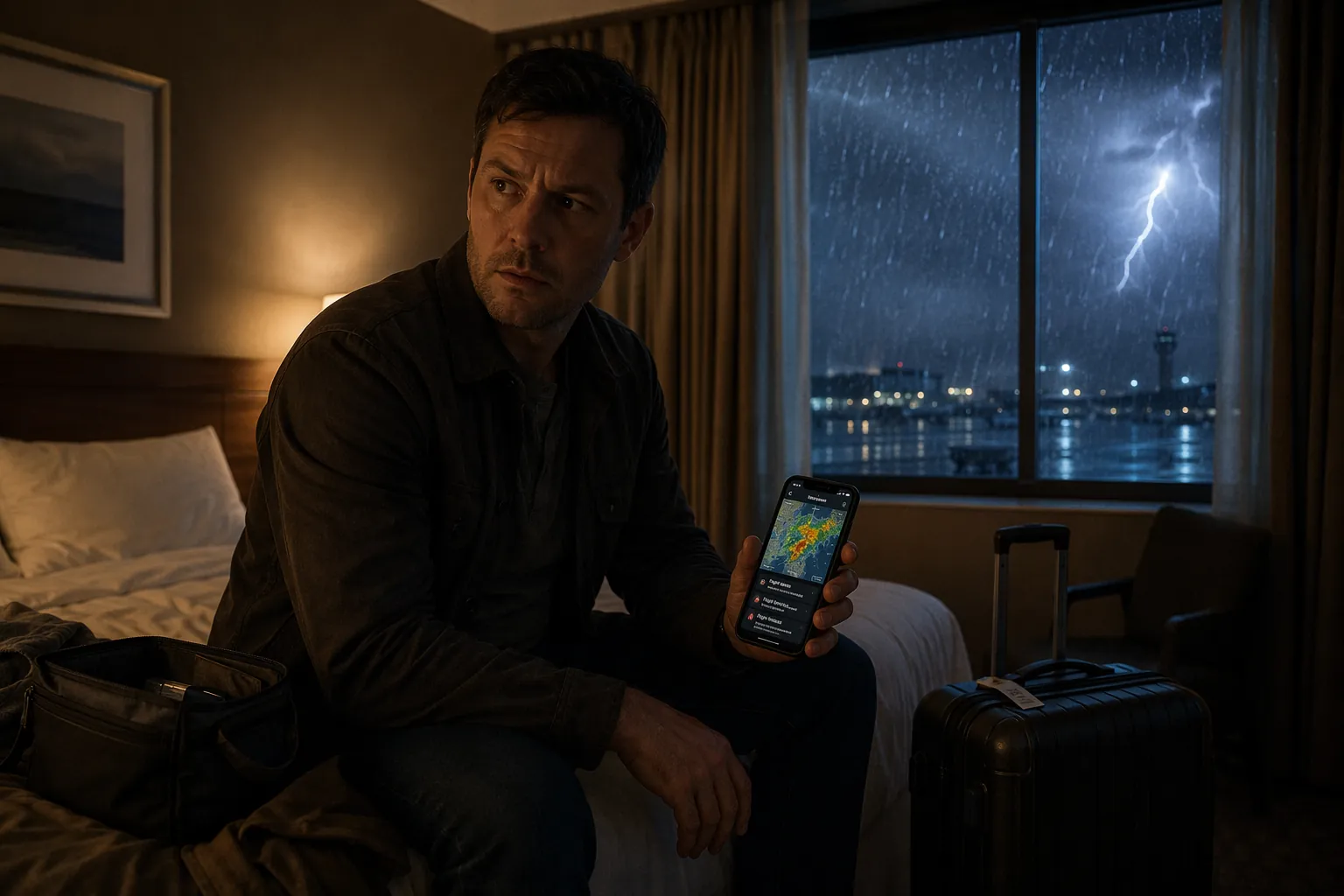
The storm is over by the time the hotel room goes quiet. The airport alerts have slowed. The gate crowd has scattered. You finally have a bed, a locked door, and a few hours before whatever version of tomorrow still exists.
And still, your body will not stand down. You keep checking the phone. You listen for hallway noise. Your clothes are still half on. The room is safe enough, but it does not feel trusted. That is the part ordinary “travel fatigue” explanations tend to miss.
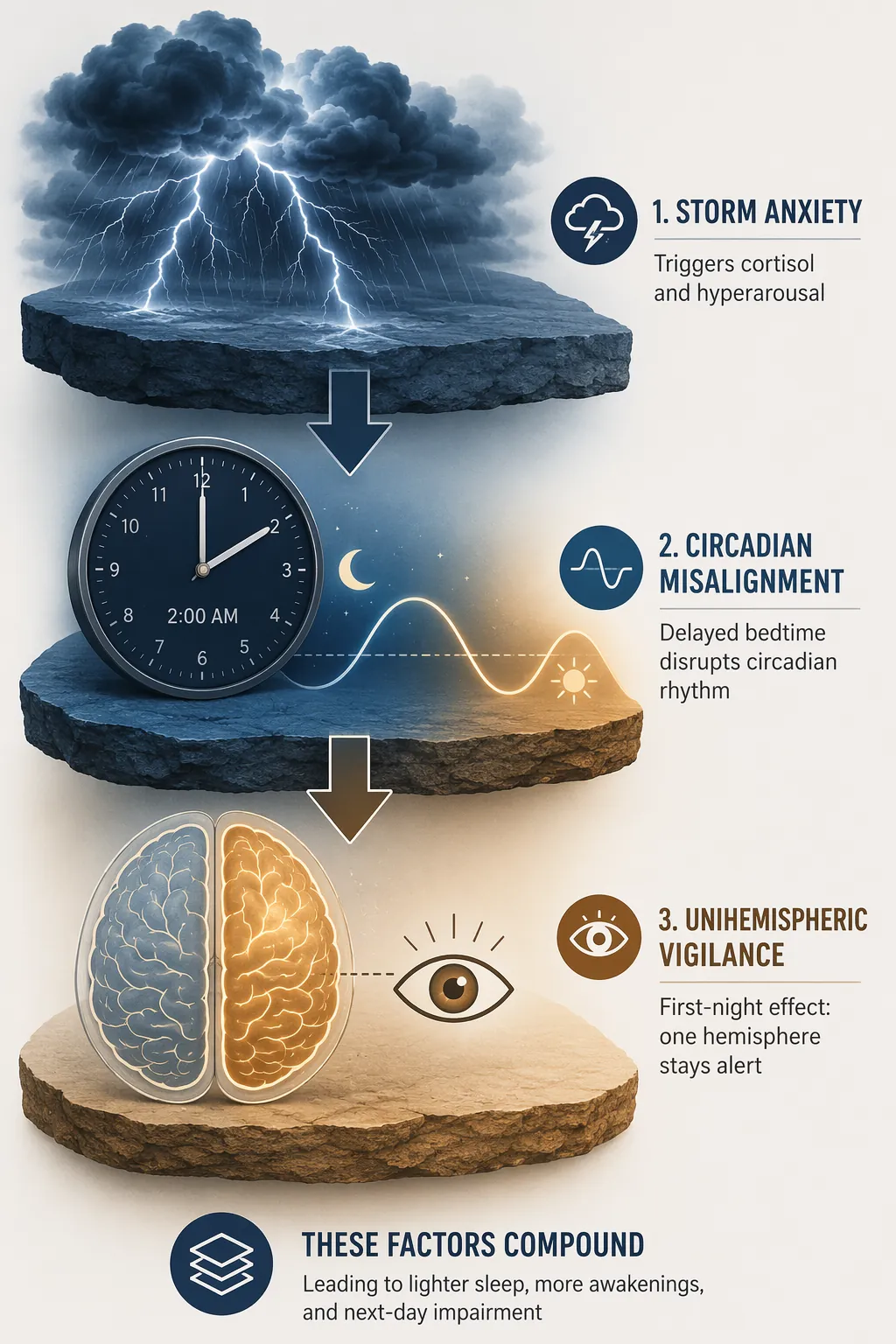
Severe storm flight delays disrupt sleep because they stack three problems at once: storm-specific anxiety, a forced circadian delay, and the first-night vigilance that comes with sleeping somewhere unfamiliar. Each one can disturb sleep on its own. Together, they can leave a traveler exhausted and alert at the same time.
The delay ends before your nervous system believes it
A mechanical delay is annoying. A storm delay can feel charged. Thunder, wind alerts, runway holds, missed connections, crowded terminals, and the possibility of another update keep the brain in a monitoring state. The body is not only waiting for transportation; it is scanning for threat, uncertainty, and loss of control.
That matters because sleep initiation depends on downshifting. The CDC Yellow Book discusses cortisol as one biological marker involved in travel-related circadian disruption, and cortisol is part of the broader stress system that helps keep the body alert when it thinks vigilance is useful.[1] Anxiety and sleep then begin feeding each other: anxiety can make it harder to fall asleep, and poor sleep can intensify anxiety the next day, according to the Sleep Foundation’s review of the bidirectional relationship.[2]
Storm anxiety is not a character flaw, and it is not always irrational. The National Weather Service gives public guidance for people who experience anxiety around severe weather, including preparing in advance and limiting repeated alert-checking once safety steps are in place.[3] In an airport, though, the situation is uniquely bad for that advice: travelers often cannot leave, cannot choose the timing, and may need to keep checking the same device that is also keeping them activated.
This is why a person can reach a hotel at 1:40 a.m. and still feel as if they are sitting under the departure board. The gate announcement has ended, but the body has rehearsed hours of “maybe” and “not yet.” By bedtime, the traveler is not simply late. They are late with a stress system that has had too much practice staying ready.
A late bedtime can act like travel across time zones
The second layer is more mechanical but just as punishing: the delay moves sleep into the wrong biological window. You do not have to cross an ocean for circadian timing to be disrupted. If a storm pushes a normal 10:30 p.m. bedtime to 2:00 a.m., the body has still been forced to operate against its expected rhythm.
The Sleep Foundation notes that going to bed three or more hours later than usual can produce sleep disruption similar to jet lag.[4] The CDC Yellow Book also describes circadian adaptation as gradual; for eastward travel, it gives the practical rule that adjustment often occurs at roughly one hour per day.[1] Those figures are useful because they keep the problem grounded. The traveler may not be “dramatic” for feeling off after one bad night. A several-hour shift is enough to matter.
Storm delays also tend to scramble the cues that normally tell the body what time it is. Bright airport lighting extends the evening. Dinner may become a snack at midnight. A passenger may nap upright at the gate, wake during boarding, sit under cabin lighting, and then try to sleep in a hotel room with a brain that has received a messy set of signals. The clock on the phone says bedtime. The body may not agree.
This helps separate storm-delay sleep from plain short sleep. If you voluntarily stay up late for a familiar event, the body is still usually in a known place, with a known ending. A severe weather delay adds uncertainty and pushes bedtime later. The sleep window narrows, but the activation window expands.
The unfamiliar room adds one more kind of alertness
Then comes the room you did not choose. It may be clean, quiet, and perfectly adequate. It is still unfamiliar. The thermostat clicks differently. The hallway has a different rhythm. The door latch is not the one your body knows. For some travelers, especially anxious flyers, older adults, solo travelers, and parents responsible for children, that unfamiliarity keeps sleep shallow.
The name for this is the first-night effect. In a 2016 Current Biology study from Brown University, Tamaki and colleagues found that during first-night sleep in an unfamiliar environment, the left default mode network showed a more vigilant pattern, with one hemisphere more responsive to external sounds.[5] That does not mean half the brain literally stays awake in the way a person does while standing at a counter. It does help explain the “one eye open” feeling people report in a strange hotel after a disrupted trip.
This layer is easy to dismiss because it sounds subtle. But after a storm delay, subtle is enough. If anxiety has already raised alertness and the circadian clock has already been pushed late, even mild environmental vigilance can keep sleep fragmented. The person may fall asleep in patches, wake to small noises, check the phone again, and wake in the morning unsure whether they slept at all.
Cancellation counts show scale, not the sleep mechanism
Large storm systems can affect many travelers at once. In March 2026, the New York Post reported more than 3,600 flight cancellations and more than 6,800 delays during a severe storm disruption.[6] KCRA reported more than 8,000 delayed flights during a June 2023 disruption.[7] Those numbers are useful for scale. They do not prove how any individual slept afterward.
That distinction matters. A cancellation database can tell us how many itineraries were disrupted. It cannot tell us whether a traveler’s cortisol stayed elevated, whether their bedtime moved by three hours, whether they slept in an airport hotel, or whether they had to drive children home the next morning on broken sleep.
The closest practical recovery signal in the available material comes from an Airport Dimensions/Sleepover survey of 1,500 travelers, which found that 8 in 10 reported accumulating sleep debt while traveling, with an average of 4 hours and 42 minutes per journey, and that 62% said they needed at least one full day to recover.[8] It is useful trend data, but it should be read with its source context: it was commissioned industry research from an airport sleep-station brand, not an independent clinical sleep study.
Treat the layer that is actually keeping you awake
The practical mistake after a storm delay is treating all sleep disruption as if it has one cause. An eye mask may help a bright room. It will not, by itself, tell a threat-monitoring brain that the storm is no longer your job. Melatonin may shift timing for some people, but it will not fix a hallway that feels unsafe or a phone that keeps delivering alerts.
| Layer | What it feels like | What helps most |
|---|---|---|
| Storm anxiety | Wired, scanning, repeatedly checking alerts | Downshift the stress response and set a clear alert boundary |
| Circadian delay | Sleepy at the wrong time, awake when you expected to crash | Use light, wake time, and meals to anchor the next day |
| First-night vigilance | Light sleep, waking to small sounds, not trusting the room | Make the sleep environment more predictable and familiar |
If storm anxiety is leading, reduce monitoring before you chase sleep
Start with safety, not sleep. Confirm the next flight status, weather alert settings, transportation plan, door lock, and wake-up alarm. Then create a stopping rule: one final check, alerts left on only for essential updates, phone placed away from the pillow. The goal is not to pretend the storm did not happen. It is to stop giving the brain new reasons to stay on duty.
A simple breathing or “traffic-light” framework fits this layer because it addresses hyperarousal directly. ABC News described Vanderbilt’s Stephanie Brinen using a traffic-light model for storm anxiety: green for normal readiness, yellow for rising activation, and red for acute distress, with calming actions matched to the level.[9] In a hotel room, that can mean noticing the level first, then choosing a proportionate action instead of refreshing alerts until the nervous system is even more convinced something is wrong.
Travelers who recognize this pattern from other event-specific anxiety may find the same principles useful in Restful Ground’s guide to sleeping when earthquake anxiety keeps you awake. The trigger is different, but the sleep problem is similar: the body keeps treating the night as a surveillance period.
If timing is the problem, use the morning more carefully than the night
After a severely delayed bedtime, the next morning becomes a reset opportunity. Light is the strongest everyday timing cue most travelers can control. The CDC Yellow Book’s phase-response guidance explains that light exposure can shift circadian timing depending on when it occurs, which is why travel advice often focuses on strategically timed light rather than simply “getting outside” at random.[1]
For a domestic storm delay with no time-zone change, the simplest version is usually this: keep the wake time reasonably anchored, seek bright morning light if you need to pull the rhythm earlier again, eat breakfast at a normal local time, and avoid turning the recovery day into a second extremely late night. A short nap can protect safety, especially before driving, but a long late-day nap may push the next bedtime later again.
The same logic appears in other event-related sleep disruptions, including late sports broadcasts and other schedule-shifting occasions. Restful Ground’s piece on why you are still tired after a late World Cup final covers the parallel problem: a body can pay for one shifted night longer than the calendar suggests.
If the room feels wrong, make it less new
First-night vigilance responds best to predictability. This is where a sleep kit earns its space, not as a cure-all, but as a way to give the brain familiar sensory cues. Clayton Sleep Institute recommends practical travel sleep items such as an eye mask, earplugs, comfortable sleepwear, and familiar bedtime supports.[10]
- Use the same sleep shirt, scent-free lotion, or small pillowcase you associate with home.
- Block unpredictable light before you try to fall asleep, not after the first awakening.
- Choose steady background sound if hallway noise keeps pulling attention.
- Do one room check, then stop rechecking unless something materially changes.
For older travelers, this layer deserves extra respect. Light sleep in an unfamiliar room is not only unpleasant; it can mean waking groggy in a layout the body does not know. Put shoes, glasses, medication, water, and a clear path to the bathroom where they can be found without searching in the dark.
Recovery may take longer than one night
A storm-delay night can leave two debts: lost sleep time and a nervous system that had to work too hard. That is why the next day often feels stranger than ordinary tiredness. The traveler may be irritable, hungry at odd times, clumsy, emotionally thin, or sleepy at inconvenient moments. The Airport Dimensions/Sleepover survey’s finding that 62% of travelers said they needed at least one full day to recover fits that lived pattern without diagnosing individual sleep injury.[8]
The recovery plan should be modest: protect the next bedtime, get morning light, keep caffeine earlier in the day, avoid a second late night if possible, and do not make the first recovery day more demanding than it has to be. If you need a fuller timeline, Restful Ground’s guide to how many nights it takes to recover sleep debt is the better place to go deeper.
Basic routines still help once the trigger has been addressed. A consistent wind-down, a cooler room, limited late caffeine, and a phone boundary are not glamorous, but they reduce the number of signals competing with sleep. Restful Ground’s sleep hygiene fundamentals are most useful after you have named which part of the storm-delay cascade is still active.
If sleep remains disrupted beyond about a week, or if the delay seems to have tipped occasional travel sleeplessness into a repeating pattern, it may be time to look beyond self-management. Cognitive behavioral therapy for insomnia is the best-established non-drug treatment path for chronic insomnia symptoms, and Restful Ground’s CBT-I explainer explains what that support actually involves.
Storm-delay sleep is not just travel tiredness. It is a stacked physiological problem: the stress system stays activated, the body clock gets pushed, and the unfamiliar room keeps part of the brain listening. The fix is rarely one perfect travel hack. It is treating the layer that is still keeping watch.
References
- CDC Yellow Book 2026: Jet Lag Disorder, Centers for Disease Control and Prevention, 2026
- Anxiety and Sleep, Sleep Foundation
- Storm Anxiety Guidelines, National Weather Service
- Jet Lag, Sleep Foundation
- Night Watch in One Brain Hemisphere during Sleep Associated with the First-Night Effect in Humans, Current Biology, 2016
- Severe Storm Flight Cancellation and Delay Report, New York Post, March 2026
- June 2023 Flight Delay Report, KCRA, June 2023
- Airport Dimensions/Sleepover Traveler Sleep Survey, Airport Dimensions/Sleepover
- Traffic-Light Framework for Storm Anxiety, ABC News/Vanderbilt
- Travel Sleep Kit Recommendations, Clayton Sleep Institute
Read the full guide: How travel weather delays affect sleep and stress