How Many Hours of Sleep Do Adults Need?

The Short Answer: How Much Sleep Do Adults Need?
The leading sleep health organizations — the American Academy of Sleep Medicine (AASM), the Sleep Research Society (SRS), the National Sleep Foundation (NSF), and the CDC — all converge on the same core range, with minor differences in how they define adult age subgroups. The table below shows the current recommendations side by side.
| Organization | Adults 18–60 | Adults 61–64 | Adults 65+ |
|---|---|---|---|
| AASM / SRS (2015 consensus) | 7 or more hours | 7 or more hours | 7 or more hours (no separate upper limit set) |
| CDC | 7 or more hours | 7–9 hours | 7–8 hours |
| National Sleep Foundation | 7–9 hours | 7–9 hours | 7–8 hours |
| Mayo Clinic (updated Feb 2025) | 7 or more hours | 7 or more hours | 7 or more hours |
The minor cross-body differences are worth noting accurately rather than collapsing into a single figure. The AASM and SRS set a floor of 7 hours for all adults without specifying a separate 65+ upper limit. The CDC and NSF both recommend a narrower 7–8 hour window for adults 65 and older, reflecting the sleep architecture changes that make longer sleep harder to achieve in that group. For practical purposes, 7–9 hours is the working target for most adults under 65, and 7–8 hours for most adults 65 and older.
Where These Numbers Come From: The Evidence Behind the Consensus
The AASM and SRS published their joint consensus statement following a process that most sleep content on the internet does not bother to describe. A panel of 15 subject-matter experts used a modified RAND Appropriateness Method — a structured technique for generating consensus from expert judgment informed by evidence — to evaluate 5,314 scientific articles.
Those papers were assessed across nine health outcome domains: cardiovascular health, metabolic function, mental health, immune function, human performance, cancer risk, pain, all-cause mortality, and general health. The panel reviewed what each domain's evidence showed about sleep duration and reached a consensus that 7 or more hours per night was the threshold below which health risks consistently increased.
| Health Domain | Finding at < 7 Hours |
|---|---|
| Cardiovascular health | Increased risk of hypertension, heart disease, stroke |
| Metabolic function | Increased risk of obesity and type 2 diabetes |
| Mental health | Elevated risk of depression and mood disturbance |
| Immune function | Impaired immune response, increased susceptibility to illness |
| Human performance | Cognitive impairment, reduced reaction time, impaired judgment |
| Pain | Increased pain sensitivity |
| Mortality | Elevated all-cause mortality risk |
| Cancer | Associations with increased cancer risk in some analyses |
| General health | Self-reported poor health, reduced quality of life |
The panel also concluded that sleeping more than nine hours may be appropriate for young adults, people recovering from sleep debt, and those with illness — and that long sleep duration more likely reflects underlying health problems than causes them. This distinction matters for interpreting the research correctly.
What Happens When Adults Sleep Fewer Than 7 Hours
The health consequences of chronic short sleep are not subtle. The AASM/SRS consensus and the National Heart, Lung, and Blood Institute (NHLBI) document a consistent pattern across multiple systems: the body and brain both deteriorate when regularly deprived of adequate sleep.
- Cardiovascular: elevated risk of hypertension, heart disease, and stroke
- Metabolic: increased likelihood of obesity and type 2 diabetes
- Mental health: higher rates of depression and emotional dysregulation
- Immune function: reduced ability to fight infection and slower recovery
- Cognitive performance: impaired concentration, memory, and reaction time
- Accident risk: increased likelihood of workplace errors, driving accidents, and microsleep episodes
- Pain sensitivity: lower pain threshold with chronic sleep restriction
The mortality data adds a useful quantitative frame. A large prospective study using NHANES data from 25,481 US adults found a U-shaped relationship between sleep duration and all-cause mortality, with 7 hours associated with the lowest risk. Adults sleeping 5 hours or fewer had a hazard ratio of 1.40 compared to the 7-hour reference group. Adults sleeping 9 or more hours had a hazard ratio of 1.74 — though, consistent with the AASM consensus, this elevated risk at long durations likely reflects underlying illness rather than sleep itself causing harm.
Why the Recommendation Is a Range, Not a Single Number
The 7–9 hour range exists because sleep need genuinely varies between individuals. The AASM/SRS consensus explicitly acknowledges that genetic, behavioral, medical, and environmental factors all influence how much sleep any given adult requires. Two people with identical schedules and health profiles may function optimally at 7.5 hours and 8.5 hours respectively, and both are within the normal range.
Harvard Sleep Medicine characterizes the functional optimum for most adults as 7.5 to 8.5 hours, with variation driven primarily by genetics and chronotype — the internal clock timing that makes some people naturally earlier or later sleepers. Age also plays a role: sleep architecture shifts across adulthood, and the distribution of deep and REM sleep changes with age even when total duration stays constant.
This adaptation effect is why the self-report question "do you feel fine?" is an unreliable measure of sleep adequacy. The more useful question is whether you can sustain genuine cognitive performance and alertness across a full day without artificial support — a distinction covered in the self-assessment section below.
True Natural Short Sleepers: Rare Genetics vs. Chronic Deprivation
A genuine exception exists: a small number of people are natural short sleepers, meaning they are genetically wired to need only 4–6 hours and wake fully refreshed without an alarm, experience no daytime drowsiness, and show no cognitive performance deficits. This is not a learned adaptation or a matter of willpower — it reflects specific inherited gene variants.
According to Cleveland Clinic's documentation of short sleeper syndrome, researchers have identified approximately 50 families worldwide carrying genetic mutations associated with this trait, including variants in the DEC2 and ADRB1 genes. Research in this area is ongoing, with additional gene mutations being identified in recent years, but the condition remains extremely rare by any measure.
The practical implication: if you are relying on caffeine to get through the afternoon, experiencing mood swings, or noticing that your memory and concentration are inconsistent, you are almost certainly not a natural short sleeper. You are experiencing the adapted state that chronic deprivation produces.
Sleep Quality Matters as Much as Duration
Total hours in bed and restorative sleep are not the same thing. Sleep is not a uniform state — it cycles through distinct stages across the night, and each stage serves different physiological functions. Spending 8 hours in bed does not guarantee 8 hours of restorative sleep if those hours are fragmented or if the architecture of the sleep is disrupted.
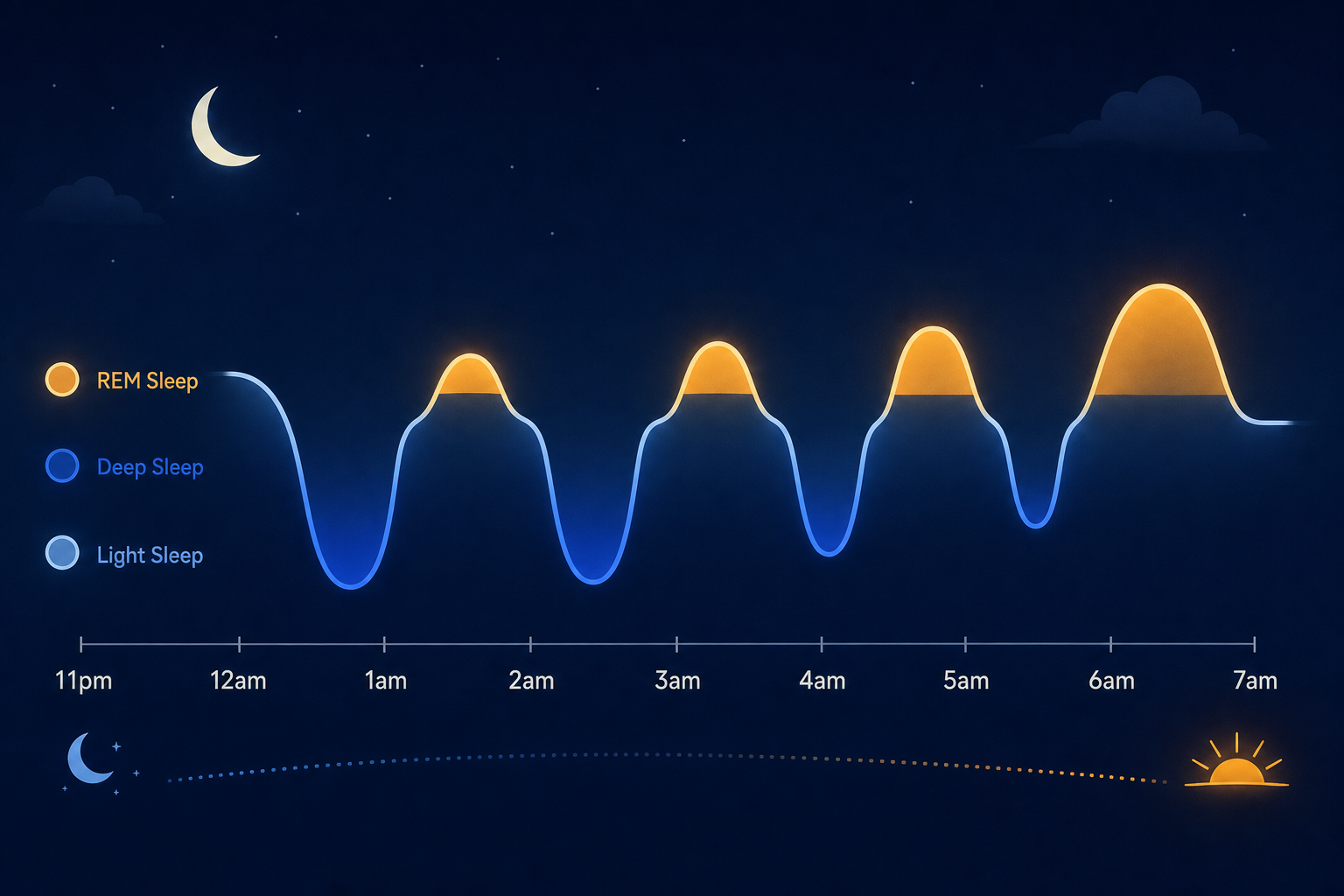
Two stages carry the most restorative weight. Slow-wave sleep (deep sleep, stage 3 NREM) makes up roughly 10–20% of total sleep time — approximately 90 minutes in a 7–8 hour night — and supports physical recovery, immune function, and tissue repair. REM sleep accounts for approximately 20–25% of total sleep time — about 2 hours in a 7–8 hour night — and is critical for memory consolidation, emotional processing, and mood regulation. REM periods lengthen progressively across the night, which is one reason cutting sleep short by even an hour or two disproportionately reduces REM.
A 2021 review examining sleep quality versus sleep quantity concluded that sleep quality is a superior index to quantity for assessing health outcomes, and that the most practical quality indicator is how rested you feel upon waking. Fragmented sleep — even when the total hours look adequate — prevents the body from completing full sleep cycles and reduces the proportion of deep and REM sleep actually achieved.
How to Find Your Personal Sleep Need
Rather than aiming for a fixed number, the most reliable approach is to identify the amount of sleep your body naturally seeks when given the opportunity. Harvard Sleep Medicine describes a practical method for doing this: the sleep vacation test.
- Set aside two weeks without an early alarm — a vacation, a long weekend, or any period when you can go to bed and wake naturally.
- Go to bed at a consistent time each night, ideally aligned with when you naturally feel sleepy.
- For the first several days, you will likely sleep longer than usual as accumulated sleep debt repays. Do not interpret this extended sleep as your baseline.
- After roughly three to five days, your sleep duration will stabilize. The amount you are sleeping at that point — typically somewhere in the 7–9 hour range — reflects your actual individual sleep need.
- Note the time you naturally wake and the time you went to bed. That gap is your personal target.
If a two-week window is not available, the Sleep Foundation's functional self-check provides a simpler daily test: do you wake feeling genuinely refreshed? Can you sustain mental sharpness and alertness throughout the day without needing caffeine to function? If the answer to both is yes, you are likely meeting your personal sleep need. If not, the gap between your current sleep and your actual need is worth taking seriously.
Signs You May Be Chronically Sleep-Deprived
Chronic sleep deprivation produces a recognizable pattern of symptoms. Because deprivation adaptation can reduce the subjective feeling of sleepiness over time, many people experience these signs without connecting them to their sleep. The list below draws from NSF guidance and NHLBI research on the behavioral and physical markers of insufficient sleep.
- Difficulty concentrating or sustaining attention on tasks that previously felt easy
- Memory lapses — forgetting words, appointments, or recent conversations
- Irritability or emotional reactivity disproportionate to the situation
- Persistent low mood or symptoms consistent with depression
- Unexplained weight gain or increased appetite, particularly for high-calorie foods
- Getting sick more frequently or taking longer to recover from illness
- Puffy eyes or persistent dark circles under the eyes
- Reliance on caffeine to reach a baseline functional state, rather than using it selectively
- Microsleep episodes — brief, involuntary moments of sleep during waking activities, including driving
Sleep Needs Across Adult Life: Older Adults and Special Circumstances
The underlying sleep need does not substantially decrease with normal aging, but the ability to achieve it often does. Mayo Clinic's updated guidance notes that aging tends to produce lighter sleep, longer time to fall asleep, shorter sleep spans, and more frequent nighttime waking — changes in sleep architecture rather than a reduced need for rest.
CDC data shows that 27.2% of adults aged 65 and older currently sleep fewer than 7 hours per night. Short sleep in this group peaks at ages 50–64 (34.5%), suggesting that the transition years are particularly challenging. Contributing factors include increased prevalence of sleep disorders, chronic pain, medication effects, and the circadian rhythm changes that accompany aging.
When to Stop Self-Assessing and Talk to a Doctor
Self-assessment is a useful starting point, but it has limits. If you have made genuine efforts to get adequate sleep — maintaining consistent sleep and wake times, allowing sufficient time in bed, addressing obvious behavioral factors — and you are still experiencing the signs of deprivation, that pattern warrants a clinical conversation.
- You consistently struggle to fall asleep despite being tired and having adequate time in bed
- You wake repeatedly during the night and cannot return to sleep
- You experience excessive daytime sleepiness even after what appears to be a full night's sleep
- A bed partner reports that you snore loudly, gasp, or stop breathing during sleep
- Deprivation symptoms persist for more than a few weeks despite behavioral changes
For readers who want to understand specific sleep disorders in more depth — including their diagnostic criteria and first-line treatments — the Sleep Conditions section of this site covers each condition with the clinical structure that a general FAQ entry cannot provide.
Read the full guide: How to Sleep Safely During Tornado Season