
How to Sleep Safely When Heat Index Hits 115°F
If you are trying to figure out how to sleep when the heat index is 115°F, start with the uncomfortable rule: do not assume a fan is helping. The CDC warns that electric fans should not be used when the indoor temperature is above 90°F because they can increase body temperature by blowing hot air across the skin.[1] At a 115°F heat index, the National Weather Service puts conditions in the “Danger” range, where heat stroke is possible with prolonged exposure.[2]
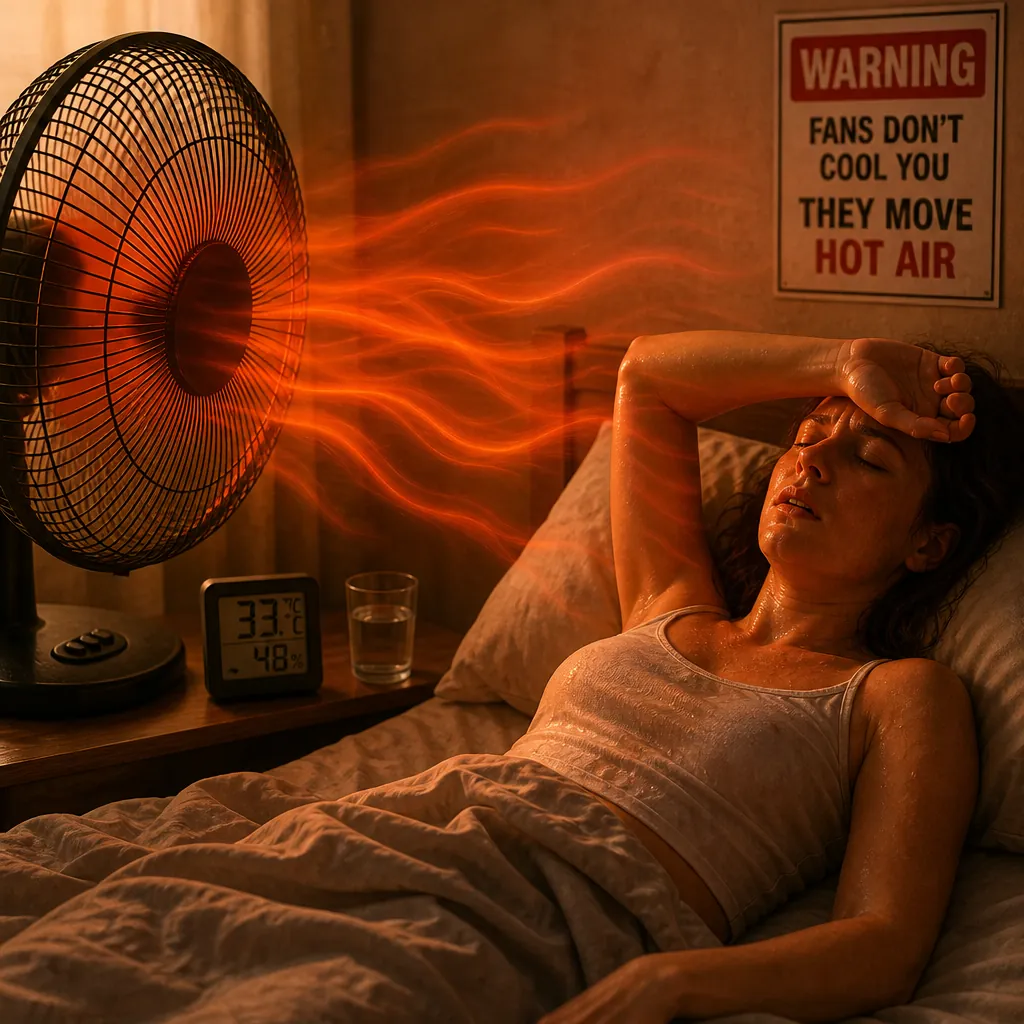
That changes the goal. This is not a night for perfect sleep hygiene. The first goal is to get your body into cooled air. If that is not possible immediately, use short-term body-cooling steps while you keep watching for heat illness. If symptoms cross into confusion, hot dry skin, or a temperature that stays high after cooling attempts, stop trying to sleep and treat it as an emergency.
Do I Need Air Conditioning Tonight?
Yes, if you can get to it. At this heat index, air conditioning is not a comfort upgrade; it is the safest sleep intervention. A bedroom that feels merely miserable at 10 p.m. can still keep your body from cooling enough to sleep, and it can keep heat stress building while you are lying still.
Sleep depends on a drop in core body temperature. Dr. Janet Kennedy, cited in The Guardian, describes a needed core-temperature drop of about 2°F to 3°F to help trigger melatonin release and initiate sleep.[3] That does not mean a hot room only causes insomnia. It means your body is fighting the room at the same time you are asking it to power down.
If your home has no AC, or the AC cannot keep up, look for cooled air outside the bedroom before you improvise in the bedroom. Call 2-1-1 for local cooling-center information. If it is open and safe to reach, a library, mall, community center, or the home of a friend or relative may be safer than staying in a room that remains above 90°F.
- If you can leave: go to an air-conditioned place before bedtime, not after symptoms start.
- If you care for an older adult, pregnant person, infant, or medically fragile person: move earlier and with less debate.
- If your AC is running but the room still feels hot: sleep in the coolest room, close off hotter spaces, and move to a lower floor if you have one.
- If transportation is the barrier: call 2-1-1 and ask specifically about cooling centers and local heat-emergency resources.
Who Should Not Try to Tough This Out?
Pregnant people should treat a 115°F heat index as a safety problem, not a willpower test. Public-health guidance notes that pregnancy makes the body work harder to cool both the pregnant person and the fetus, and extreme heat exposure is linked with risks including preterm birth and low birth weight.[4]
Older adults also deserve a lower threshold for leaving a hot room. The CDC identifies adults 65 and older among the groups at higher risk in heat, in part because the body’s cooling response becomes less efficient with age.[1] Caregivers should not wait for an older person to describe the room as dangerous; heat illness can impair judgment before a person recognizes how unwell they are.
The same caution applies to infants, people with heart or kidney disease, people taking medications that affect sweating or fluid balance, and anyone who has already had heat exhaustion symptoms earlier in the day. If you are responsible for someone in one of these groups, the safest plan is cooled air first.
What If I Truly Cannot Get to AC?
Use body cooling as a bridge, not as proof that the room is safe. The order matters: cool the body, reduce heat coming in, sleep in the coolest possible spot, and keep checking symptoms. If the indoor temperature is above 90°F, skip the fan unless it is part of an arrangement that actually cools the air rather than pushing hot air over your skin.[1]
| Action | Why It Helps Tonight |
|---|---|
| Take a lukewarm shower 60 to 90 minutes before bed | The shower warms the skin slightly, then the post-shower cooling response can help lower core temperature afterward. |
| Put cold towels or wrapped ice packs on pulse points | Use the neck, wrists, inner elbows, and behind the knees to cool blood near the skin. |
| Sleep on the lowest floor or lowest safe surface | Heat rises, so upper rooms often stay hotter overnight. |
| Use a damp, thin cotton sheet | Evaporation can help if the room is not dangerously hot and humid. |
| Chill a pillowcase or light cloth briefly | A cold surface near the head and neck can make the first stretch of rest safer and more tolerable. |
The shower should be lukewarm, not hot. SleepApnea.org describes a warm or lukewarm shower 60 to 90 minutes before bed as a way to support the body’s later cooling process.[5] A hot shower can push core temperature in the wrong direction, especially when the room is already trapping heat.
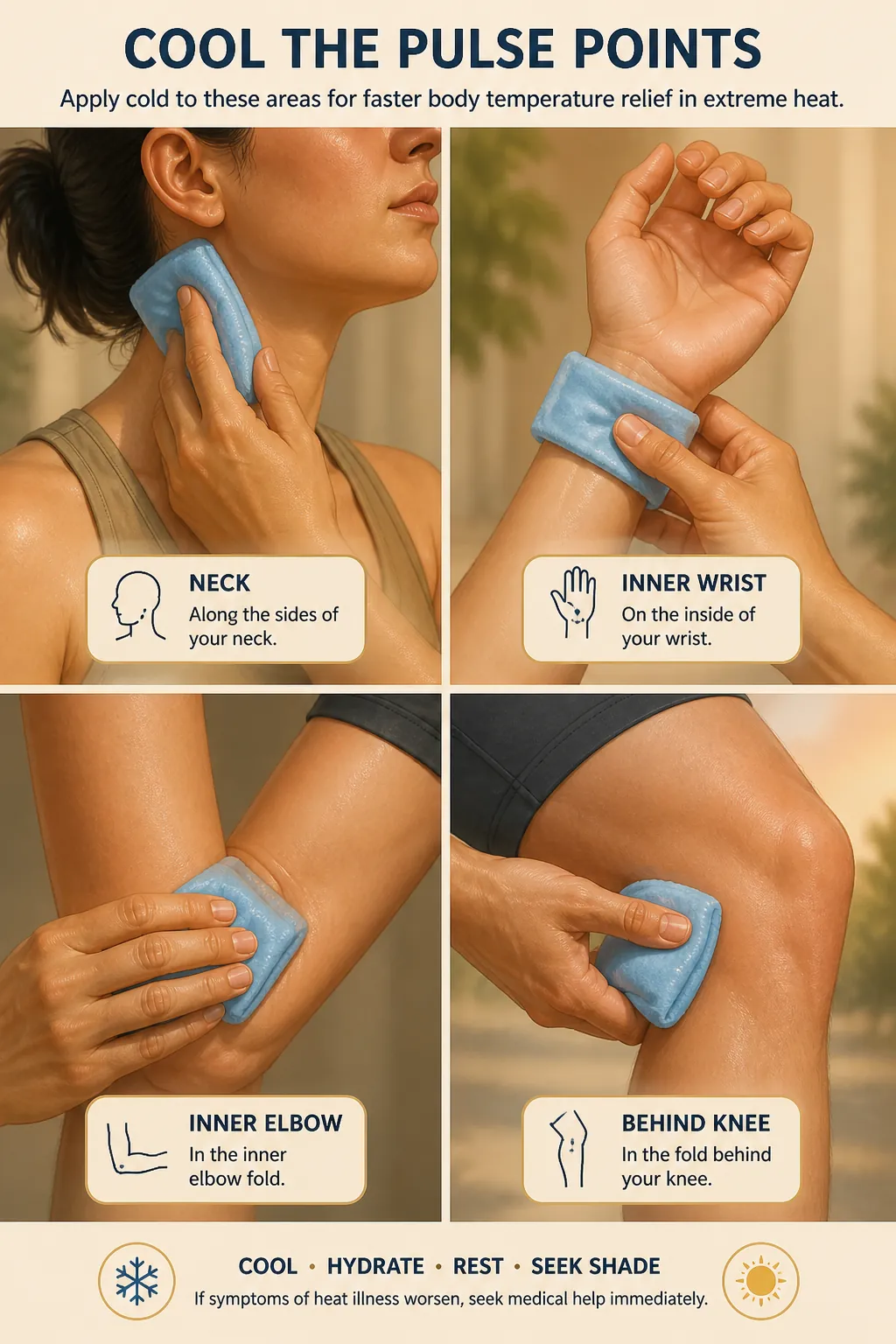
Cold on the neck is especially practical because it covers a useful cooling area quickly. The Guardian reported heat research used by Tennis Australia and the University of Sydney that supports cooling the neck during extreme heat; wrists, inner elbows, and behind the knees are also useful pulse-point targets.[3] Wrap ice packs or frozen items in cloth so you do not injure the skin.
Should I Sleep Alone or Share a Bed?
If you have a cooler option alone, use it. Another person adds body heat, and in a room already failing to cool, that can matter. SleepApnea.org notes that a second person in bed contributes additional heat, sometimes described as roughly comparable to a 100-watt source.[5]
For caregivers, this does not mean leaving a vulnerable person unchecked. It means separating heat sources while staying close enough to monitor. A chair beside a cooler sleeping spot may be safer than sharing a mattress in a stifling room.
What Should I Avoid Before Bed?
Avoid anything that adds heat load, interferes with cooling, or makes symptoms harder to notice. On a normal warm night, some of these might sound like ordinary sleep tips. At a 115°F heat index, they are safety rules.
- Do not use a fan in a room above 90°F unless the air is being cooled; the CDC warning is explicit that fans can raise body temperature in those conditions.[1]
- Do not drink alcohol before bed; it can interfere with thermoregulation and sleep quality.
- Do not eat a heavy late meal; digestion adds metabolic heat and can make sleep harder.
- Do not do vigorous evening exercise; save exertion for a cooler time or skip it during the heat emergency.
- Do not rely on toughness or acclimation; a 2024 systematic review found higher ambient temperatures degrade sleep quality and quantity, with limited evidence of rapid adaptation.[6]
Why Can’t I Just Sleep Badly for One Night?
Poor sleep is part of the problem, but it is not the whole problem. Research cited by the American Heart Association reported that sleep efficiency dropped 5% to 10% when nighttime temperature rose from 77°F to 86°F.[7] A 115°F heat index is far outside that ordinary warm-bedroom range.
That matters because a person who is exhausted may keep making the same failing plan: lie still, wait, sweat, drink water, turn the fan higher. If the room is still dangerously hot, waiting can become exposure. Sleep is not a shield against heat illness.
When Is This a Medical Emergency?
Do not measure danger only by whether you feel sleepy. At this heat index, confusion is not just grogginess. Hot, dry skin or a sudden stop in sweating is not a sign that you are “past the sweaty part.” A body temperature that stays elevated after cooling attempts means the plan is not working.
- Seek emergency help for confusion, disorientation, fainting, or behavior that seems unlike the person.
- Seek emergency help if skin is hot and dry, or sweating stops while the person still feels overheated.
- Seek emergency help if body temperature remains high after moving to a cooler place and using cooling measures.
- While waiting for help, move the person to the coolest available place and apply cool cloths or wrapped ice packs to the neck, wrists, inner elbows, and behind the knees.
The hierarchy is simple because it has to be: cooled air first, temporary body cooling second, emergency recognition the whole time.
References
- About Heat and Your Health, CDC.
- NWS Heat Safety, National Weather Service.
- Tips for sleeping in hot weather, The Guardian, 2026-07-28.
- Safe Pregnancies in Extreme Heat, California Department of Public Health.
- Sleeping in Hot Weather, SleepApnea.org.
- Sleep Medicine Reviews, Chevance et al., Sleep Medicine Reviews, 2024.
- Keep your cool, American Heart Association, 2025-08-19.
Read the full guide: How to Sleep When the Heat Index Reaches 100