How to Rest When Hurricane Anxiety Keeps You Awake
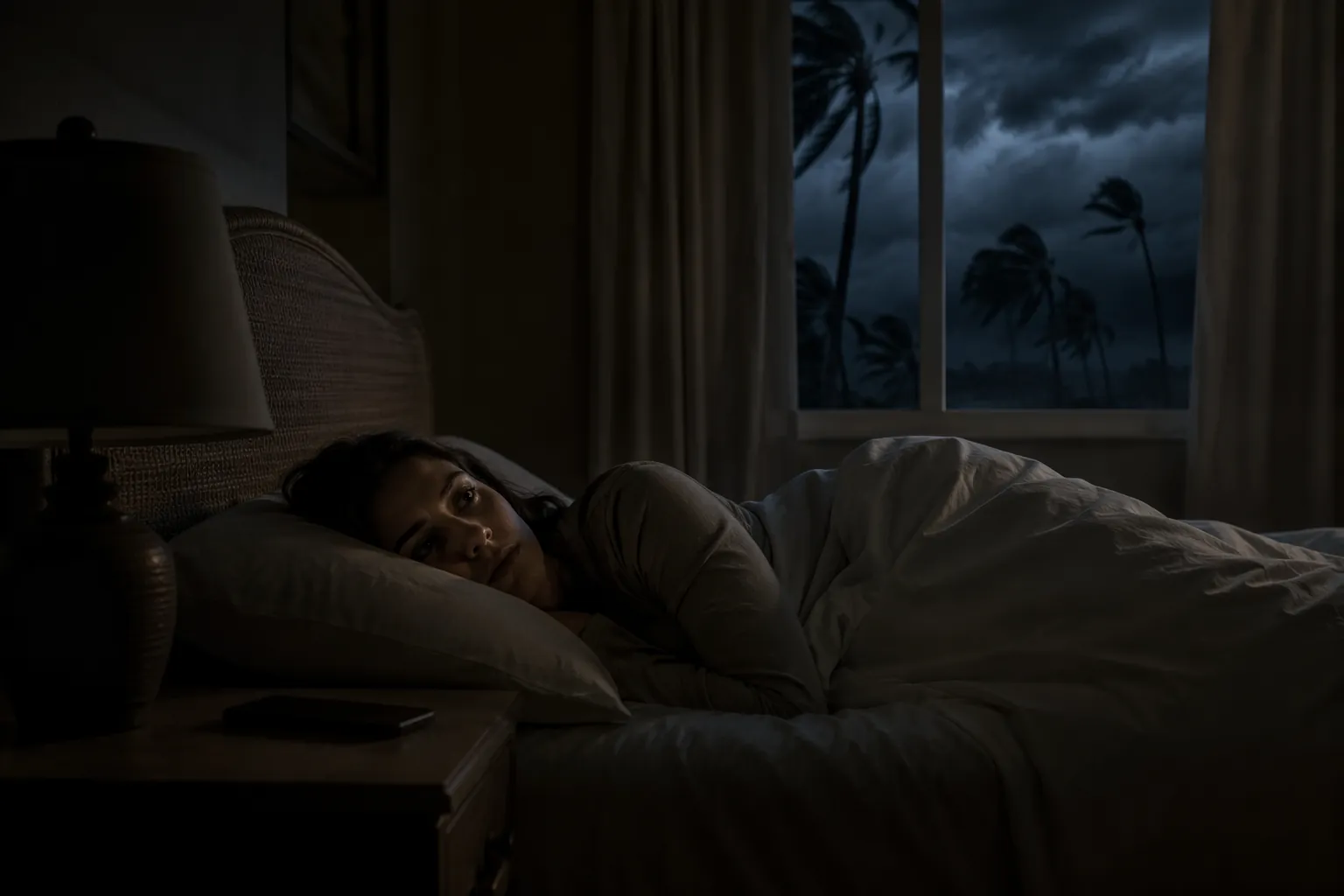
The hard part of trying to sleep before a hurricane is that your brain is not making a ridiculous argument. It is saying: stay awake, keep checking, do not miss the thing that changes the plan. In the 24 to 72 hours before landfall, that alertness can feel protective because sometimes it is. The problem is what happens when protection turns into a loop: one more radar refresh, one more video clip, one more imagined failure, until the person who has to make tomorrow morning’s decisions is running on fumes.
So the goal is not a perfect night. It is not proving you can sleep through uncertainty. The goal is strategic rest: enough quiet, stillness, and reduced stimulation to preserve judgment if you need to evacuate, move to an interior room, check on a relative, soothe a child, handle a pet, or respond when the power changes the whole rhythm of the house.
Anxiety before severe weather is a normal threat response, especially when the forecast is still moving and the stakes are personal. The Anxiety and Depression Association of America describes severe storms as a common anxiety trigger and emphasizes practical coping steps rather than pretending the fear is baseless.[1] That matters because advice for sleeping during hurricane anxiety has to keep two truths in the same room: you need information, and you also need to stop feeding your nervous system the most arousing version of that information.
Use three levers before the night gets away from you
Before you try to calm your body, make the night smaller. There are three levers that are actually movable before landfall: how you take in updates, where you put the worry, and whether the sleep space is ready before fatigue starts making choices for you.
| Lever | What to do | Why it matters before landfall |
|---|---|---|
| News intake | Check official or trusted text updates at planned times; avoid looping video coverage when you are trying to wind down. | You stay informed without repeatedly exposing yourself to alarming images. |
| Worry log | Write worries and next actions for 10 to 15 minutes at least two hours before bed. | You give your brain a place to put unfinished threats before lights-out. |
| Sleep environment | Move the rest area away from windows, charge devices, and gather a small sleep kit early. | You reduce late-night decisions when judgment is already tired. |
This is not a substitute for hurricane preparedness guidance, evacuation orders, emergency alerts, or medical care. If an alert tells you to act, act. If you have an anxiety disorder, panic disorder, PTSD, chronic insomnia, or a treatment plan already in place, keep following that plan and contact your clinician if symptoms escalate. Sleep tactics come after safety tasks, not before them.
Contain updates without cutting yourself off
The instruction to “stop checking the news” usually fails because it asks anxious people to give up the one behavior that feels responsible. A more usable rule is: keep the information, reduce the intensity.
Dr. Asim Shah of Baylor College of Medicine recommends reading weather updates rather than watching repeated video coverage, because video can heighten emotional arousal through alarming imagery while text provides the information with less sensory charge.[2] That difference is the practical compromise. You do not have to choose between ignorance and a livestream that keeps your body braced for impact.
For the pre-sleep window, make the rule specific enough that you do not have to renegotiate it every ten minutes. For example: check the latest official forecast or local emergency update in text form, confirm whether anything changes your next action, then close it until the next planned check. If you need alerts overnight, set the alerts; do not keep the screen open as if staring at it will make the storm more predictable.
Video is not morally wrong. There may be times when a live briefing matters, especially if officials are issuing instructions. But when the update does not change what you will do tonight, replaying wind footage, flood clips, and projected paths can keep your body in a state that is built for action, not rest. Read what you need. Watch only what changes a decision.
- Use text from official emergency management, the National Weather Service, local government, or a trusted local meteorologist.
- Decide what kind of update would change your plan: evacuation timing, shelter instructions, flood risk, tornado warnings, or power and road information.
- Put the phone across the room after the check if you keep reopening apps automatically.
- If someone else in the household is less activated, ask them to monitor non-urgent updates for a set stretch while you rest.
Move the worry out of the bed before you get into it
Catastrophic thoughts get louder at night partly because the room finally goes quiet. During the day, there are tasks: fill containers, charge devices, bring in loose items, text family, check supplies. At bedtime, the mind often tries to finish every unfinished scenario at once.
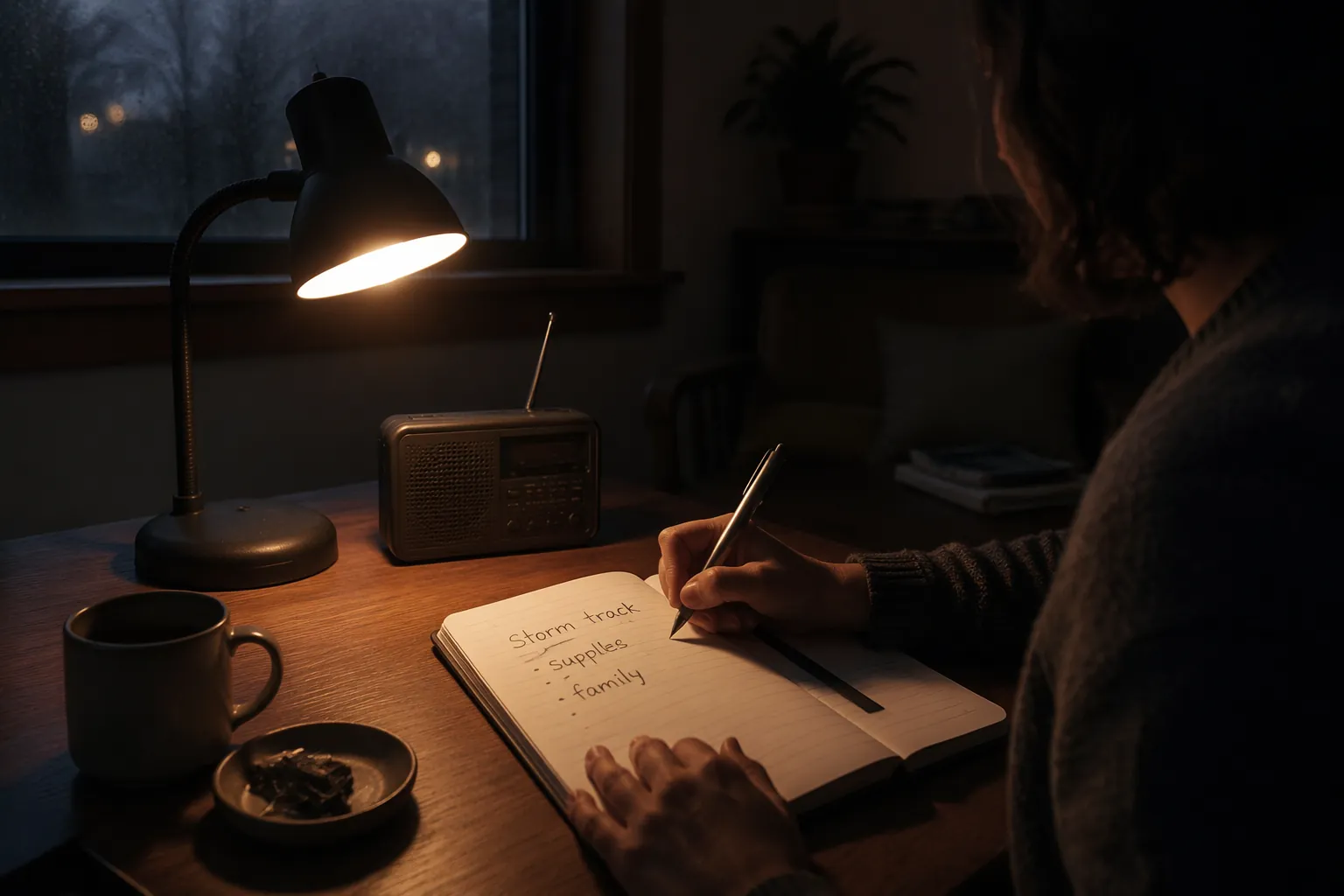
Courtney Bancroft, PsyD, writing for Northwell Health, recommends a 10- to 15-minute worry log at least two hours before bed so anxious thoughts are externalized before the bedroom becomes the place where they are processed.[3] The timing is important. If you do it in bed, the bed becomes the conference room. If you do it earlier, the page can hold the meeting and close it.
A useful hurricane worry log is not a gratitude journal and not a command to look on the bright side. It is a place to separate fears from actions. Draw two columns if that helps: “What I’m worried about” and “What I can do or have already done.” The first column gets the fear out of your head. The second column protects you from circling the same fear without deciding whether it requires action.
| Worry on the page | Next action or reality check |
|---|---|
| What if the power goes out overnight? | Charge phone and battery pack now; put flashlight and shoes by the bed; keep alerts on. |
| What if I sleep through an important warning? | Turn on emergency alerts; ask another adult to keep their alerts on too if available. |
| What if a window breaks? | Move sleeping area away from windows; identify the interior room before bed. |
| What if I panic at 3 a.m.? | Write one grounding step and one person or service to contact if safety is at risk. |
Keep the log short on purpose. Ten to 15 minutes is enough to capture the main loops without turning the exercise into another form of storm monitoring. When the timer ends, mark the actions that must happen tonight, do those, and leave the rest on the page. If a new worry appears in bed, you can tell yourself, “That goes on tomorrow’s list unless it changes tonight’s safety plan.”
Prepare the sleep space while you still have bandwidth
The sleep environment before a hurricane is not about creating a perfect sanctuary. It is about reducing preventable decisions after midnight. Amerisleep’s hurricane sleep guidance recommends moving mattresses away from windows, charging devices, and preparing a practical sleep kit with items such as an eye mask, earplugs, a battery fan, and a red-filter flashlight.[4]
Do the unglamorous setup early: plug in phones and battery packs, put medications and glasses where you can reach them, place shoes near the bed, and decide where you will move if conditions worsen. If you have children, older relatives, pets, or anyone who needs help relocating, talk through the first step before everyone is exhausted. “If we need to move, we go to this hallway” is better than trying to invent a plan while wind noise is doing its own work on the nervous system.
A prepared rest space also makes it easier to accept broken sleep. You may sleep in pieces. You may wake often. You may only doze. That is still different from spending the entire night upright, scrolling, and rehearsing disasters.
Use body-based calming as support, not proof that you are safe
Once the essential checks are done, the worry log is closed, and the room is prepared, body-based tools can help bring arousal down. They are not magic switches, and they should not be used to talk yourself out of responding to a real alert. They are for the stretch when nothing else needs to be done right now and your body has not caught up with that fact.
Amerisleep describes 4-7-8 breathing as inhaling for 4 counts, holding for 7, and exhaling for 8, with the goal of activating the parasympathetic nervous system and lowering heart rate within minutes.[4] Treat it as a low-risk calming practice, not as a hurricane-specific clinical intervention. If breath holds make you uncomfortable, skip the hold and lengthen the exhale instead.
- Put both feet on the floor or lie on your side in the prepared sleep area.
- Inhale gently through the nose for 4 counts.
- Hold for 7 counts only if that feels tolerable.
- Exhale slowly for 8 counts.
- Repeat a few rounds, then stop trying to measure whether you are calm enough.
Progressive muscle relaxation can serve the same purpose: tense and release one muscle group at a time, starting with the feet or hands. If your mind wanders back to the forecast, that is not failure. Bring it back to the next muscle group. The point is to give the body a task that is quieter than the storm loop.
If sleep comes in fragments, rest still counts
Sleep loss can make the brain’s fear response more reactive, which can turn anticipatory anxiety into a self-reinforcing loop; Amerisleep summarizes this relationship in its hurricane sleep guidance while citing NIH-related sleep and anxiety context.[4] That does not mean you have to achieve a full night for the effort to matter. It means every period of reduced stimulation is worth protecting.
If you are lying still in a safer prepared space, eyes closed, phone down, alerts set, and no immediate safety task waiting, you are no longer doing nothing. You are lowering the load on a system that may need to work hard later. Amerisleep also notes that lying still with eyes closed can provide physiological recovery even when sleep is incomplete.[4]
That is the realistic standard for the pre-landfall night. Stay reachable to real warnings. Remove the avoidable alarms. Put the fears somewhere outside your head before bed. Prepare the room before you are too tired to think clearly. Rest is not surrendering vigilance; in this situation, it is part of staying capable.
References
- Severe Storms: How to Reduce Your Anxiety, ADAA
- Navigating pre-storm anxiety, Baylor College of Medicine
- 5 ways to sleep better when anxiety takes hold, Northwell Health
- Hurricane Preparedness and Sleep, Amerisleep
Read the full guide: Why Hurricane Anxiety Keeps Women Awake and How to Sleep