Why Hurricane Anxiety Keeps Women Awake and How to Sleep
If you are lying awake before landfall with your phone nearby, your body may be doing something more specific than “being bad at sleep.” Hurricane anxiety insomnia is not a formal diagnosis. It is better understood as situational insomnia: a real storm threat, filtered through an already vulnerable sleep-and-anxiety system, keeps the brain scanning when it would normally downshift.
That distinction matters because generic bedtime advice often misses the point. A hurricane is not a vague worry you can simply reframe. It can change evacuation plans, power, medication access, caregiving, pets, income, and whether a roof holds through the night. The goal is not to convince yourself nothing is wrong. The goal is to prepare enough, reduce arousal enough, and protect the bed enough that sleep has a chance.
Why hurricane anxiety can hit women’s sleep so hard
Women start hurricane season with a higher baseline sleep burden. WomensHealth.gov reports that 1 in 4 women experiences insomnia symptoms, compared with fewer than 1 in 5 men, and notes that people with insomnia are much more likely to also have anxiety symptoms.[1] A large epidemiological review found lifetime anxiety disorder prevalence of 30.5% in women and 19.2% in men.[2]
Those numbers do not mean women are fragile in storms. They mean the alarm system may already be easier to trigger, especially for someone who has previously evacuated, lost power for days, cared for children through a warning, or watched floodwater rise close to the door. When the National Hurricane Center cone shifts at 10 p.m., the brain may treat bedtime as the wrong time to stand down.
Weather anxiety itself is common, though the exact prevalence is not as settled as insomnia and anxiety disorder data. A 2025 Thriveworks pulse study reported that 32% of the general population experiences anxiety related to extreme weather, but the publicly available summary does not provide the same depth of sampling detail a clinical paper would.[3] An older Ball State University report estimated that about 1 in 10 Americans may have severe weather phobia that can interfere with sleep, but that finding came from a modest survey of about 300 people across 43 states.[4] These figures are useful context, not a reason to label every storm-season sleepless night as a disorder.
This is not ordinary bedtime worry with a storm soundtrack
Ordinary sleep anxiety often turns inward: “What if I do not sleep?” Hurricane anxiety points outward: “What if the track changes, the evacuation order comes, the power fails, or my mother’s oxygen machine needs backup?” That difference changes the sleep strategy. You cannot treat a real external threat as if it were only a thought distortion.
Pre-storm anxiety guidance from Baylor College of Medicine describes how anticipating severe weather can keep people in a heightened state of alert, especially when they are consuming emotionally intense coverage.[5] The National Weather Service also recognizes storm anxiety as a real barrier for some people and recommends practical planning, reliable information sources, and support rather than avoidance alone.[6]
At night, that alert state becomes a sleep problem. The body listens for wind changes. The mind rehearses the route out. The hand reaches for the phone before a conscious decision has even formed. None of that is irrational in hurricane country. But once the necessary decisions are made, repeated checking can stop being preparation and start becoming fuel.
The plan for tonight: close the loop, lower arousal, protect the bed
A useful hurricane sleep plan has three layers. They do not replace official safety guidance, evacuation orders, or medical advice. They sit beside those decisions so your nervous system is not forced to keep auditing the same unfinished tasks all night.
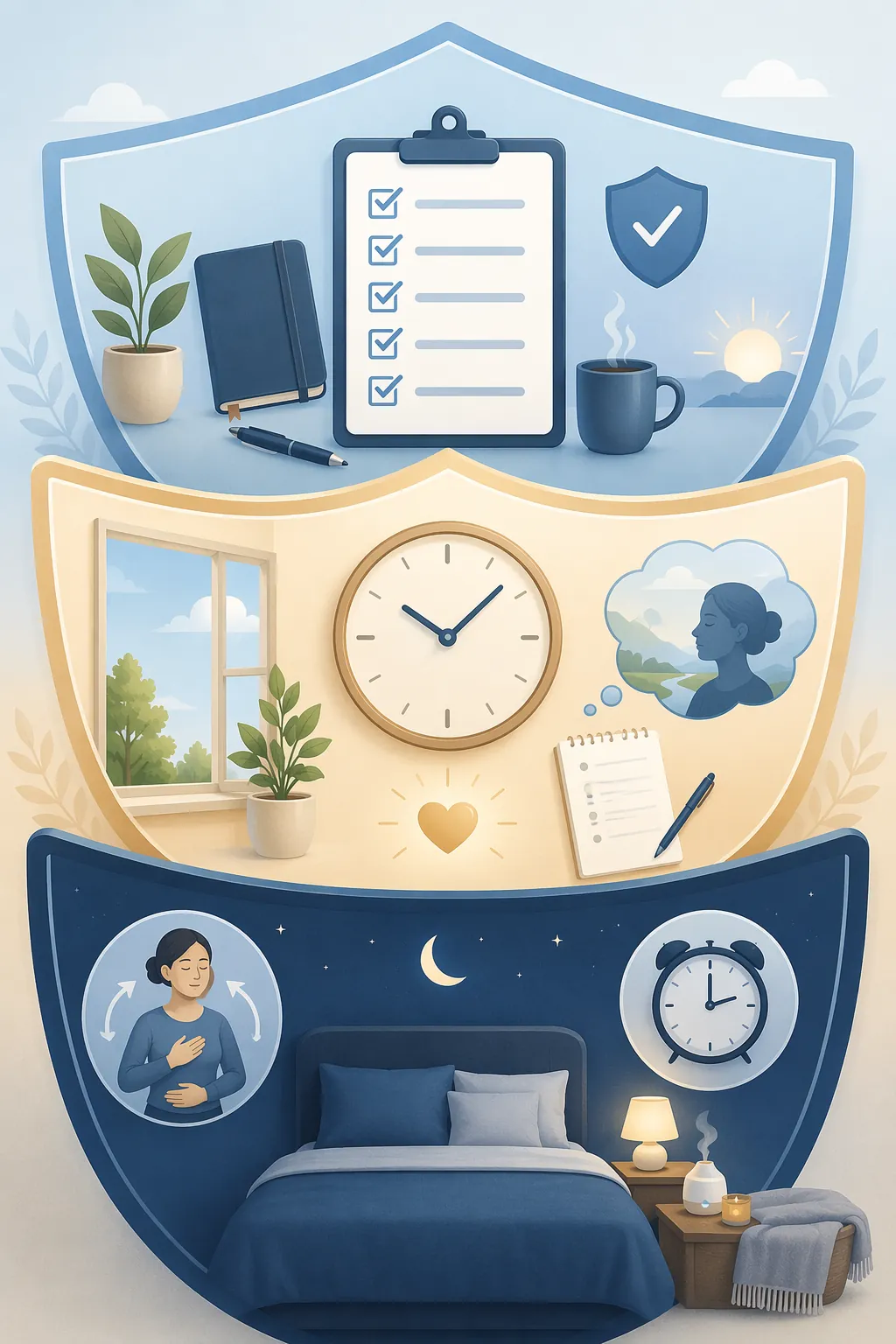
| Layer | What it does | What it looks like tonight |
|---|---|---|
| Preparation | Reduces unfinished threat-monitoring | Written checklist, device charging, medication and documents ready, one update schedule |
| Cognitive de-arousal | Contains rumination before bed | 10- to 15-minute daylight worry window, written updates instead of live video, clear checking rules |
| Sleep-protective behavior | Keeps the bed from becoming a storm command center | Breathing, muscle relaxation, grounding, comfort items, 20-minute rule, steady wake time |
Preparation: finish enough decisions that your brain can stand down
Preparedness helps sleep when it closes a threat loop. It does not help when it becomes an all-night search for certainty. Before evening, make a short written list of decisions that actually affect safety: evacuation threshold, shelter location, medication, water, pets, chargers, cash, documents, fuel, mobility needs, and the person responsible for checking official alerts.
- Write the evacuation trigger in plain language: “If our county issues a mandatory order,” “If water reaches the driveway,” or “If the forecast puts us in the surge zone.”
- Put medications, glasses, chargers, IDs, insurance information, and essential baby, elder, or pet supplies in one visible place.
- Choose two reliable update sources, preferably official written alerts and local emergency management, rather than several live feeds.
- Assign one update check before bed and one overnight check only if conditions require it.
- If another adult is present, divide the watch rather than having everyone half-awake all night.
This is where the line matters. Checking whether an evacuation order changed is useful. Watching the same radar loop until your chest tightens is usually not. If the next action would be the same no matter what you see, the check is probably feeding hypervigilance rather than improving safety.
Cognitive de-arousal: move worry into daylight and make updates less emotional
A worry window is not forced optimism. It is a container. CBT-I researcher Aric Prather described using a scheduled 10- to 15-minute worry period earlier in the day so the brain has a designated time to list concerns and next actions before bedtime.[7] For hurricane anxiety, that window works best before dark, when you can still make calls, move supplies, or change plans.
Set a timer. Write the worry in one column and the next action in another. “What if the power goes out?” becomes “Charge battery packs; freeze water bottles; set cooler plan.” “What if my father panics?” becomes “Call him at 7 p.m.; review where his flashlight and medications are.” If there is no action available tonight, write “no action until next official update” and name the update time.
The format matters because rumination likes open tabs. A written worry window turns vague dread into either an action, a scheduled check, or a temporarily unanswerable question. That last category is uncomfortable, but it is cleaner than pretending one more scroll will create certainty.
News format also matters. Baylor psychiatrist Dr. Asim Shah advises that watching news on television or a smartphone can intensify anxiety more than reading it, because video and phone feeds deliver more emotional stimulation; written updates often provide the facts with less arousal.[5] For sleep, that means switching from live coverage to scheduled written alerts when you are past the main decision-making window.
- Better: “I will read the county emergency update at 9:30 p.m. and again at 2 a.m. only if we remain under a warning.”
- Riskier: “I will keep the livestream open beside the bed in case something changes.”
- Better: “Emergency alerts stay on; social apps and video autoplay stay off.”
- Riskier: “I will keep checking comments to see what other people nearby are saying.”
If you live with children, older relatives, or someone who depends on you medically, the worry window may need to include them. That does not make it less therapeutic. It makes it honest. The point is to remove the mental load from the pillow and put it somewhere visible before the house goes quiet.
Sleep-protective behavior: do not turn the bed into the storm desk
Once safety tasks are handled for the moment, the sleep task is narrower: teach the body that the bed is not where you monitor, argue with forecasts, or rehearse disaster scenes. Sleep Foundation guidance on anxiety at night includes calming techniques such as breathing, relaxation, and grounding; Harvard Health also recommends relaxation practices and getting out of bed when wakefulness persists rather than lying there in a tense fight for sleep.[8][9]
Use a short wind-down sequence that can survive storm conditions. It does not need candles, silence, or a perfect bedroom. It needs repetition.
- Do one final practical scan: alerts on, phone charged, shoes and flashlight placed where you can reach them, written check time set.
- Try 4-7-8 breathing for several rounds: inhale for 4, hold for 7, exhale for 8. If holding your breath feels uncomfortable, lengthen only the exhale.
- Use progressive muscle relaxation: tense and release feet, calves, thighs, hands, shoulders, and jaw, noticing the release more than the effort.
- Ground through the room: name five things you can see, four you can feel, three you can hear, two you can smell, and one you can taste.
- Add comfort without apology: a weighted blanket if safe and not too hot, a familiar sweatshirt, a pet nearby, a low lamp, or a family text that says the plan is set.
The 20-minute rule needs storm-season translation. If you are awake for what feels like about 20 minutes and you are not under an immediate alert requiring action, get out of bed and sit somewhere dim. Read something neutral. Fold towels. Breathe. Do not open the radar unless it is the scheduled check time or an official alert has sounded. Return to bed when sleepy.
If the storm is close enough that someone truly needs to stay awake, make that explicit. “I am on watch until 2 a.m.; then my partner takes over” is different from everyone pretending to sleep while refreshing the forecast. If you are alone, decide whether the risk level calls for sleeping in clothes, setting multiple alert pathways, or resting in a safer interior room. Those adaptations protect sleep by reducing the feeling that you must remain half-awake to stay safe.
The morning after a bad night still matters
After a hurricane-anxiety night, the temptation is to sleep late, nap hard, and hope the body catches up. Sometimes a short recovery nap is unavoidable, especially after evacuation, caregiving, or cleanup. But if your goal is to stabilize insomnia, keep your wake time as steady as conditions allow. A consistent wake time is one of the anchors used in insomnia care because it helps reset sleep pressure for the following night.[1]
That does not mean punishing yourself after a frightening night. It means giving the next night a better starting point: daylight exposure when possible, caffeine earlier rather than later, food and hydration, and a return to the written update schedule if the storm threat continues. Generic “avoid screens” advice is too blunt here. Emergency information may be necessary. The better target is avoiding emotionally charged, repetitive, non-actionable checking when you are trying to rebuild sleep.
When storm sleeplessness becomes something more
Many people sleep poorly before landfall and then gradually recover once the threat passes, power returns, and the house feels ordinary again. Watch more closely if the storm involved direct exposure: injury, evacuation under threat, severe damage, flooding, entrapment, death of someone close, or weeks of displacement. Reviews of disaster mental health research have found substantial PTSD burden among direct disaster victims, with estimates often discussed in the 30% to 40% range depending on exposure and study context.[10]
Persistent nightmares, panic when it rains, avoiding rooms or roads tied to the storm, feeling constantly on guard, emotional numbness, or insomnia that does not ease after the immediate danger has passed are reasons to seek trauma-informed care. The VA National Center for PTSD notes that prolonged exposure, cognitive processing therapy, and EMDR have stronger empirical support for PTSD treatment after disasters than general supportive counseling alone.[11]
If your sleep is also being disrupted by other environmental threats, the same hypervigilance pattern may show up in different weather. Related guides on wildfire anxiety and sleep, earthquake anxiety at night, flash flood anxiety sleep, and thunderstorm sleep disruption in perimenopause can help you adapt the same basic idea: respect the real threat, reduce unnecessary monitoring, and keep the bed from becoming the place where your nervous system runs the whole emergency.
Hurricane anxiety insomnia does not need a dramatic label to deserve care. If the storm passes and sleep gradually returns, the layered plan did what it was supposed to do. If fear keeps living in your body after the sky clears, that is not a character flaw or a failure to relax. It is a sign to get more support.
References
- Insomnia in women — womenshealth.gov
- Gender differences in anxiety disorders: prevalence, course of illness, comorbidity and burden of illness — PMC, 2011
- New studies show extreme weather conditions common cause of anxiety — WHSV, January 27, 2026
- One in 10 suffer severe weather phobia — Ball State University, 2014
- Navigating pre-storm anxiety — Baylor College of Medicine
- Storm Anxiety — National Weather Service
- How to beat anxiety and insomnia and get back to sleep — NPR, January 15, 2026
- Anxiety at Night — Sleep Foundation
- Tips for beating anxiety to get a better night’s sleep — Harvard Health
- Natural disasters mental health impact — PMC
- Long-Term Interventions Following Disaster Events — VA National Center for PTSD
Read the full guide: How to Sleep When Storm Anxiety Hits in Hawaii