
Why You're Still Tired After 8 Hours of Sleep With Hypothyroidism
You slept eight, nine, maybe ten hours, and your body is acting as if the night never happened. With hypothyroidism, that is not a cue to blame your discipline or buy a better pillow. The most useful next steps usually start with four checks, in this order: whether your thyroid medication is working as intended, whether obstructive sleep apnea is fragmenting your sleep, whether restless legs syndrome is keeping your nervous system active at night, and whether nutrient problems such as low ferritin, iron, B12, or magnesium are adding another layer.

The British Thyroid Foundation makes a distinction that many exhausted patients need to hear plainly: tiredness is usually relieved by sleep; hypothyroid fatigue can persist even when sleep duration is adequate [1]. That difference matters because “I sleep enough and still wake unrefreshed” is not the same clinical problem as “I stay up too late.”
| Check | What it can do to sleep and energy | Clue to bring to the appointment |
|---|---|---|
| Thyroid medication adequacy or absorption | Leaves you functionally undertreated even if you take the pill every day | Coffee, breakfast, calcium, iron, missed doses, or inconsistent timing near levothyroxine |
| Obstructive sleep apnea | Breaks sleep with repeated breathing disruptions, often without full awakenings you remember | Snoring, dry mouth on waking, observed pauses, morning grogginess, high STOP-BANG risk |
| Restless legs syndrome | Creates an urge to move the legs at rest, especially in the evening or at night | Crawling, pulling, or uncomfortable leg sensations relieved by movement |
| Nutrient deficiencies | Can worsen fatigue, restless legs, and sleep quality independently of sleep duration | Ferritin, iron studies, B12, or magnesium have never been checked or were borderline |
First, separate “sleepy” from “fatigued”
Patients often use one word — tired — for several different states. Clinicians cannot sort that out unless you translate it. Sleepiness means you are likely to doze off if given the chance. Fatigue means your body feels heavy, slow, or drained even if you are not actually falling asleep. Unrefreshing sleep means the night was long enough on paper but did not restore you.
That distinction changes the next question. If you are falling asleep at work, while reading, or as a passenger in a car, your clinician may think about hypersomnia or sleep-disordered breathing. Sleep Foundation notes that hypothyroidism is considered a leading endocrine cause of hypersomnia, which is excessive sleepiness despite apparently adequate sleep opportunity [2]. If you are not dozing but feel flattened, weak, and slow, the thyroid treatment and nutrient review may move higher.
Before the appointment, write down three ordinary days: bedtime, wake time, naps, caffeine timing, medication timing, and whether you felt sleepy enough to doze or fatigued but wired awake. This is more useful than arriving with the single sentence, “I’m tired all the time.” That sentence is true. It is also too broad to act on.
Check 1: Is your thyroid medication actually being absorbed?
Medication comes first because it is the easiest place to find a fixable problem. A person can take levothyroxine faithfully and still absorb it poorly. That can leave them feeling as if the dose is too low, even when the prescription bottle says the right thing.
The practical rules are not decorative. Levothyroxine is generally taken on an empty stomach, 30 to 60 minutes before food, at a consistent time each day, and separated from calcium or iron supplements by at least 4 hours [3]. Coffee is also worth naming out loud. “I take it every morning” is not enough detail if the pill goes down with coffee and breakfast five minutes later.
This is the part to make boringly specific. Tell your clinician: “I take levothyroxine at 6:30 a.m. with water, coffee at 7:15, breakfast at 7:30,” or “I take it with my multivitamin,” or “I take iron at night but calcium at breakfast.” Those details can change whether your clinician interprets your symptoms as undertreatment, inconsistent absorption, or a separate sleep problem.
What to gather before asking for a medication review
- The exact time you take thyroid medication on weekdays and weekends.
- Whether you take it with water only, coffee, food, fiber, antacids, calcium, iron, or a multivitamin.
- Any missed doses, doubled doses, brand or generic changes, pharmacy substitutions, or changes in schedule.
- Your recent thyroid labs, if available, and whether symptoms changed after any dose adjustment.
Do not adjust thyroid medication on your own to test a theory. Bring the timing record to the clinician who manages your thyroid treatment, often a primary care clinician or endocrinologist. If the story points toward poor absorption or undertreatment, they can decide whether labs, timing changes, formulation changes, or dose changes are appropriate.
One useful sentence is: “Before we call this lifestyle fatigue, can we review whether my levothyroxine timing, absorption, and current labs fit my symptoms?” That is not demanding special treatment. It is giving the appointment a cleaner starting point.
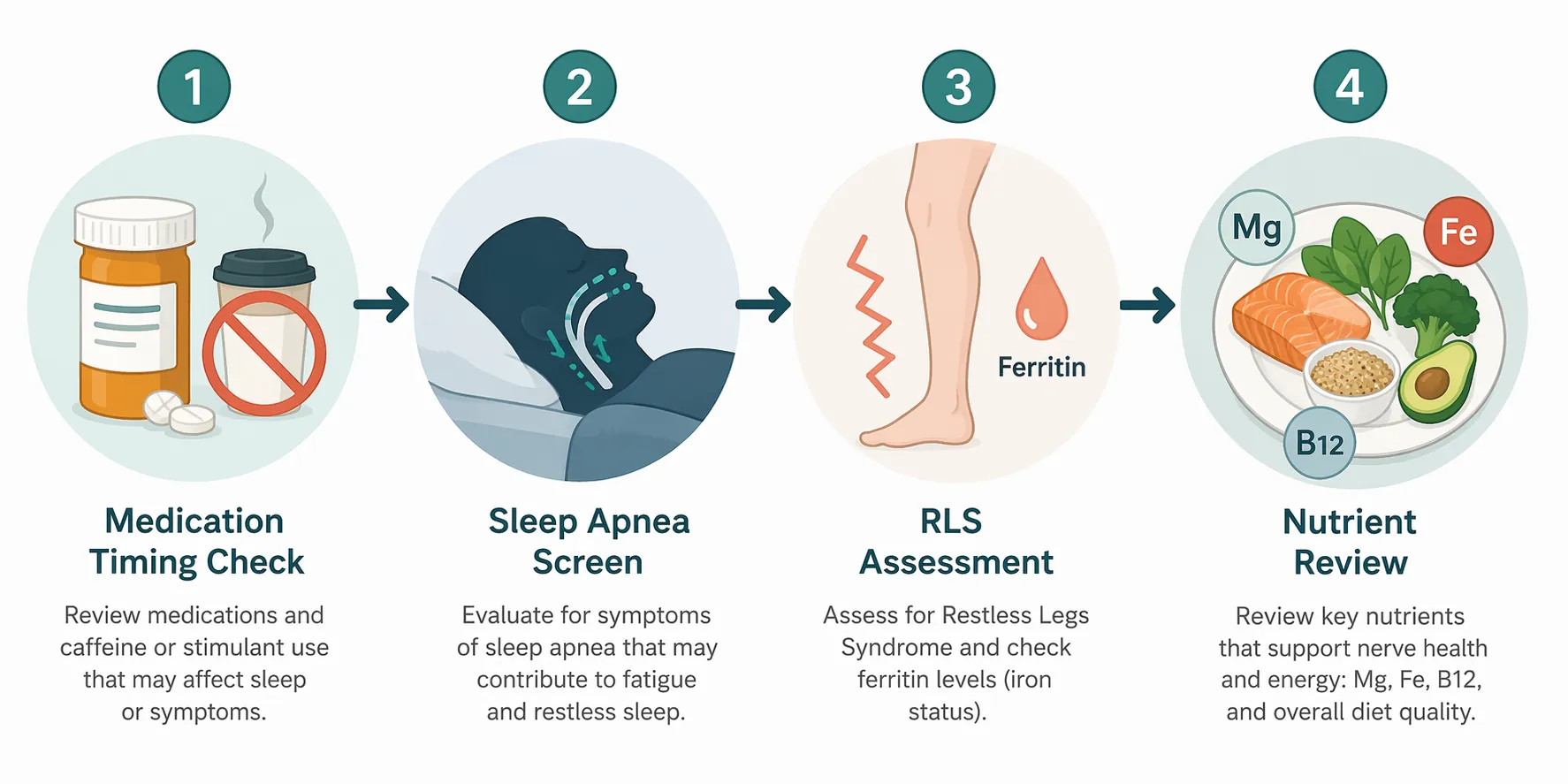
Check 2: Could obstructive sleep apnea be making eight hours look better than it is?
Obstructive sleep apnea is easy to miss when you already have a thyroid diagnosis. The patient says, “I have fatigue.” The clinician hears, “Hypothyroidism.” Meanwhile, the airway may be repeatedly narrowing or closing during sleep, causing brief arousals, oxygen changes, and a morning that feels like no sleep happened.
This deserves a high place in the triage sequence because the overlap is not rare in the research. A 2016 systematic review reported that approximately 30% of adults newly diagnosed with hypothyroidism met criteria for obstructive sleep apnea; a later review also described a strong link between hypothyroidism and obstructive sleep apnea [4]. Treat that 30% as a major signal, not a personal diagnosis. It does not mean every treated hypothyroid patient has sleep apnea, and it does not replace testing.
The clue pattern is different from “I need more sleep.” Snoring matters. Waking with a dry mouth matters. A bed partner saying you pause, choke, gasp, or breathe strangely matters. So does waking after a long night with a heavy head, foggy concentration, or the need to nap despite enough time in bed.
STOP-BANG is a common screening framework clinicians use to organize risk: snoring, tiredness, observed breathing pauses, blood pressure, body size, age, neck size, and sex assigned at birth. You do not need to self-diagnose from it. You do need to stop editing out snoring because it feels unrelated to thyroid fatigue.
What to bring up
- “I sleep eight or more hours but wake unrefreshed.”
- “I snore,” or “Someone has noticed pauses, gasping, or choking.”
- “I wake with dry mouth,” especially if it happens repeatedly.
- “Can we screen my sleep apnea risk and decide whether I need a sleep study?”
If the risk is meaningful, the appropriate next step is usually a sleep medicine evaluation and a sleep study, not another month of generic sleep hygiene. Treatment decisions such as CPAP belong with a sleep specialist or a clinician trained in sleep-disordered breathing. Thyroid management still matters, but a well-timed thyroid pill cannot hold an airway open all night.
Check 3: Are restless legs disrupting sleep before you even notice?
Restless legs syndrome is not just “my legs feel tired.” The more useful description is an uncomfortable urge to move the legs, often with crawling, pulling, buzzing, aching, or electrical sensations. It tends to show up at rest, often in the evening or at night, and movement gives at least temporary relief.
There is a thyroid connection worth taking seriously. In a 2021 study in the Journal of Sleep Research, restless legs syndrome was found in 14.3% of people with hypothyroidism compared with 8.1% of controls [5]. That does not prove every leg sensation is thyroid-related, but it makes the symptom too relevant to dismiss.
Medication optimization may help some patients, but this is where caution matters. One study found that about one-third of hypothyroid patients with restless legs syndrome had complete resolution after thyroid medication was optimized [6]. That is promising; it is not a guarantee. It does mean that restless legs symptoms should be mentioned during the thyroid medication review instead of being treated as a separate annoyance you forgot to bring up.
Ferritin belongs in this conversation because low iron stores are a well-known driver of restless legs symptoms. Ferritin is not the same as hemoglobin. You can be told you are “not anemic” and still have iron stores that deserve review in the context of restless legs, heavy periods, dietary restriction, gastrointestinal issues, or frequent blood donation.
The specific wording to use
Try this: “At night, when I lie still, my legs feel like they crawl or pull, and I have to move them. Can we check ferritin and iron studies and also review whether my thyroid medication is optimized?” That sentence is much more actionable than “I sleep badly.”
Do not start iron casually. Too much iron can be harmful, and the right response depends on labs, medical history, and why iron stores might be low. The useful move is to ask for ferritin and iron studies, then let your clinician interpret them.
Check 4: Review ferritin, iron, B12, and magnesium without turning this into supplement roulette
Nutrient problems can sit underneath the main thyroid story. They can worsen fatigue, restless legs, sleep quality, and the sense that your body is not recovering. They are also where the internet gets sloppy very quickly, so keep the frame medical: test, interpret, treat the cause, and avoid piling on supplements just because you are desperate.
Ferritin is the most appointment-ready item if you have restless legs, heavy menstrual bleeding, a history of low iron, vegetarian or low-iron eating patterns, or persistent fatigue with no recent iron review. Some thyroid-focused clinicians discuss ferritin targets around 90 to 110 ng/mL for symptom improvement, but that range should be treated as a clinical discussion point rather than a self-treatment rule [7].
B12 is worth asking about if you have numbness, tingling, balance changes, a restricted diet, gastrointestinal conditions, acid-suppressing medication use, or a history of autoimmune disease overlap. The point is not that B12 explains every hypothyroid fatigue case. The point is that an unmeasured deficiency can keep you exhausted even while everyone keeps staring only at the thyroid panel.
Magnesium is more complicated. Low magnesium has been discussed in Hashimoto’s and sleep-quality contexts, and some thyroid resources describe bedtime magnesium doses in the 150 to 300 mg range [7]. That still does not make magnesium a harmless universal fix. Kidney disease, medication interactions, diarrhea, and the form and dose all matter. If you want to try it, make it part of a clinician-reviewed plan, especially if you take other medications.
A clean nutrient request sounds like this: “Because I still wake exhausted despite adequate sleep, can we review ferritin and iron studies, B12, and magnesium, especially given my restless legs symptoms and fatigue?” That gives your clinician a reasoned question, not a shopping list.
Where sleep hygiene fits — and where it does not
A regular wake time, morning light, less alcohol, and a cooler bedroom can help many sleep problems. Fine. But if you are already giving yourself eight or more hours and still waking as if you were never restored, sleep hygiene is not a full explanation. It may help separate insomnia from unrefreshing sleep, but it will not diagnose poor levothyroxine absorption, sleep apnea, restless legs syndrome, or low ferritin.
Perimenopause can also layer hot flashes, night sweats, and lighter sleep on top of thyroid fatigue for many people in midlife. If that is your situation, say so. Just do not let the word “hormones” become a junk drawer that prevents the four checks above from being done.
Bring this version of the problem to your clinician
The appointment-ready version is not “I’m tired.” It is this:
- “I have hypothyroidism and sleep eight or more hours, but I wake unrefreshed.”
- “Here is exactly how I take my thyroid medication, including coffee, food, calcium, iron, and missed doses.”
- “I snore, wake with dry mouth, or have possible breathing pauses — can we screen for obstructive sleep apnea?”
- “My legs crawl or feel unbearable at rest in the evening — can we discuss restless legs syndrome and check ferritin?”
- “Can we review ferritin, iron studies, B12, and magnesium rather than assuming sleep duration is the whole story?”
If eight or more hours of sleep still leaves you exhausted with hypothyroidism, the next useful move is not more vague advice to go to bed earlier. It is a structured review of thyroid medication timing and adequacy, obstructive sleep apnea risk, restless legs symptoms with ferritin, and nutrient status with the clinician who can test and treat the right problem.
References
- Coping with fatigue — British Thyroid Foundation
- Thyroid Issues and Sleep — Sleep Foundation
- Does Hypothyroidism Cause Chronic Fatigue? — Healthline
- Obstructive Sleep Apnea in Hypothyroidism — PMC/NIH, 2022
- Hypothyroidism in restless legs syndrome — PubMed, 2021
- Restless Leg Syndrome and Hypothyroidism — Paloma Health
- Sleep Solutions for Hashimoto's — Thyroid Pharmacist
Read the full guide: Still Exhausted After Cyclospora? How Sleep Supports Your Recovery