
CBT-I, Sleep Medication, or Both? What the 2026 AASM Guideline Says About Treating Chronic Insomnia
Why Most People with Chronic Insomnia End Up on Medication — and Why That Matters
Roughly 10 to 15 percent of adults meet criteria for chronic insomnia disorder, yet the majority never receive the treatment that clinical guidelines consistently rank first. Instead, most end up managing their sleep with prescription sedatives or over-the-counter antihistamines — not because those options are more effective, but because they are more available.
The gap between what guidelines recommend and what primary care delivers has real consequences. Sleep medications suppress symptoms while you take them. They do not remove the behavioral and cognitive patterns that keep insomnia alive. The moment you stop, those patterns are still there.
For adults who are currently only using sleep aids — OTC or prescription — or who are trying to decide whether to start therapy, take a medication, or do both, the treatment-choice question matters enormously for long-term outcomes. Until April 2026, there was no evidence-based clinical guideline specifically addressing how to combine these approaches. Now there is.
Why Insomnia Becomes Chronic: The Perpetuating Factors CBT-I Targets
Most people's insomnia starts with an identifiable stressor — a job change, a health scare, a period of anxiety. What makes it chronic is not the original stressor. It is what happens afterward.
Once poor sleep repeats for several weeks, the brain begins associating the bed with wakefulness and arousal rather than sleep. Behaviors that seem helpful — spending extra time in bed, napping to compensate, monitoring the clock — actually reinforce the pattern. Cognitive habits compound this: catastrophizing about tomorrow's performance after a bad night, monitoring bodily sensations for signs of sleepiness, putting effort into falling asleep. Effort is the enemy of sleep onset.
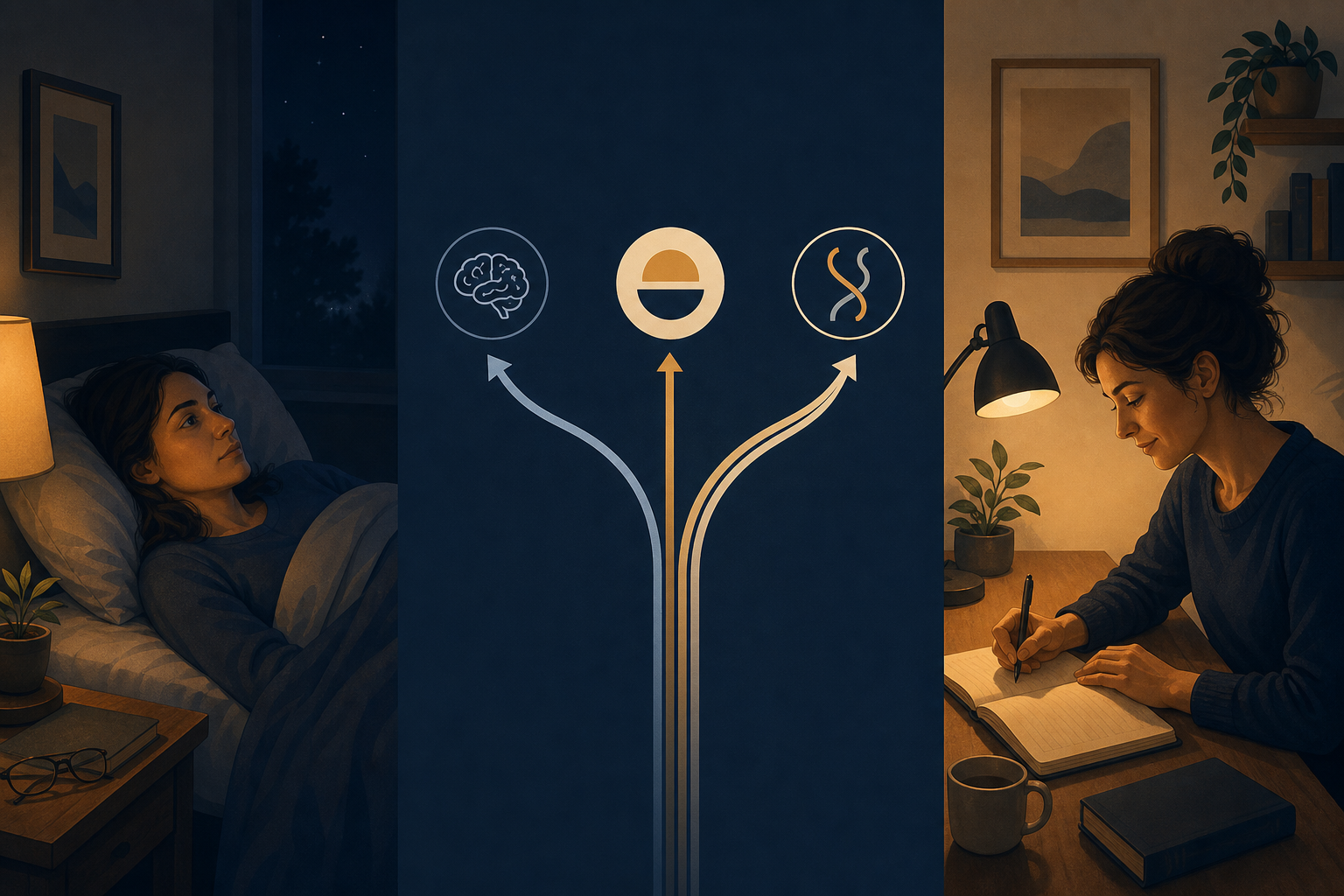
These perpetuating factors — conditioned arousal, hyperarousal, and maladaptive sleep effort — are what CBT-I is designed to dismantle. They are also why medication alone cannot produce lasting improvement: it quiets the symptom without touching the mechanism.
The Three Treatment Pathways: What Each One Actually Does
Understanding the treatment comparison requires understanding what each approach does mechanistically — not just what it is called.
Cognitive behavioral therapy for insomnia (CBT-I) directly targets the perpetuating factors described above. Sleep restriction rebuilds homeostatic sleep pressure. Stimulus control reconsolidates the association between the bed and sleep. Cognitive restructuring reduces the amplifying effect of catastrophic thinking. The result is a dismantling of the maintenance cycle — and because the mechanism is addressed rather than suppressed, the effects persist after treatment ends. CBT-I typically involves six to eight sessions. For a full breakdown of its components, see our CBT-I for insomnia FAQ.
Pharmacotherapy suppresses insomnia symptoms acutely. Sedative-hypnotics reduce sleep latency and nighttime waking while the drug is active. They do not modify conditioned arousal, hyperarousal, or dysfunctional beliefs about sleep. When the medication stops, the underlying maintenance mechanisms remain intact. Additionally, some medication classes carry risks of tolerance, dependence, and rebound insomnia with discontinuation.
Combination therapy pairs both approaches, starting them concurrently. The logic is additive: medication provides faster short-term symptom relief — particularly for total sleep time in the early weeks — while CBT-I works on the underlying mechanisms. The question is whether that early symptom boost justifies the tradeoffs, and for whom.
| Approach | Mechanism | Durability | Typical timeline |
|---|---|---|---|
| CBT-I alone | Dismantles perpetuating factors (conditioned arousal, hyperarousal, sleep effort) | Effects persist after treatment ends | 6–8 sessions over 6–8 weeks |
| Pharmacotherapy alone | Suppresses symptoms while medication is active; does not modify maintenance mechanisms | Effects end when drug stops; rebound risk on discontinuation | Acute relief within days; guidelines suggest short-term use only |
| Combination (CBT-I + medication, concurrent) | CBT-I addresses mechanisms; medication adds early total sleep time gains | Durable if CBT-I component is maintained; medication typically tapered | Concurrent initiation; medication often short-term within CBT-I course |
The 2026 AASM Guideline Decoded: Two Recommendations in Plain Language
In April 2026, the American Academy of Sleep Medicine published its first clinical practice guideline specifically addressing combination treatment for chronic insomnia. The guideline was endorsed by seven professional societies, including the American Academy of Family Physicians, the American Geriatrics Society, and the Society of Behavioral Sleep Medicine. It contains two conditional recommendations, both rated at low certainty of evidence by the AASM's own GRADE assessment.
Recommendation 1 addresses the comparison between combination therapy and medication alone: the AASM suggests using CBT-I plus insomnia medication over medication alone. In plain terms: if you are going to use medication for chronic insomnia, adding CBT-I makes it a better choice. Medication without any behavioral component is the weakest-supported option.
Recommendation 2 addresses the comparison between combination therapy and CBT-I alone: the AASM suggests against using combination treatment over CBT-I alone. In plain terms: adding medication to CBT-I does not improve outcomes enough to justify it as a default approach. For most adults, CBT-I by itself is the preferred first-line treatment.
The guideline includes an important exception remark. Patients who place higher value on increasing total sleep time early in treatment, or who place lower value on reducing daytime symptoms, may reasonably choose combination over CBT-I alone. This exception is not a loophole — it reflects a genuine tradeoff. Medication does produce about 20 more minutes of total sleep per night in the short term compared to CBT-I, largely because sleep restriction temporarily reduces time in bed. For some patients, that early gain matters.
"Our analysis suggests that CBT-I by itself is the most efficacious first-line treatment for insomnia. However, using medication with CBT-I may provide modest benefit for some specific outcomes, such as total sleep time. These recommendations are meant to support thoughtful, patient-centered decision-making rather than a one-size-fits-all approach." — Dr. Daniel J. Buysse, lead author, AASM 2026 combination therapy guideline
When Combination Therapy Makes Clinical Sense: Five Specific Scenarios
The guideline's exception remark and supporting discussion identify specific circumstances where combining CBT-I with medication is a reasonable, patient-centered choice — not evidence of combination superiority, but a recognition that individual values and contexts matter.
- You place high value on early total sleep time gains. If the number of hours you sleep in the first few weeks of treatment matters significantly to you — for functional, occupational, or quality-of-life reasons — combination therapy offers a modest but real short-term advantage over CBT-I alone.
- You work in a safety-sensitive occupation. For people whose jobs involve operating heavy machinery, driving, or other high-stakes tasks, rapid symptom relief during the early weeks of CBT-I may reduce risk. The initial phase of sleep restriction can temporarily worsen daytime fatigue before improving sleep.
- CBT-I access is delayed. If you cannot start CBT-I immediately — due to waitlists, cost, or availability — short-term medication use while arranging access is a reasonable bridge. This is not combination therapy in the guideline's formal sense, but it reflects the guideline's acknowledgment that access barriers are a real constraint.
- Rapid symptom relief is a clinical priority. For patients experiencing severe acute distress from sleep deprivation — for example, during a mental health crisis or after a significant life disruption — the speed of medication's effect may outweigh the tradeoffs in the short term.
- Daytime symptom reduction is a lower priority. CBT-I produces strong improvements in daytime functioning, not just nighttime sleep. If your primary concern is total sleep time rather than daytime alertness, energy, or mood, the combination tradeoff may align with your values.
Medication Types and Their Roles in Insomnia Treatment
Not all sleep medications work the same way, carry the same risks, or fit the same patient profile. Understanding the main classes helps clarify what the guideline's evidence base does and does not cover.
| Class | Examples | Mechanism | Key considerations |
|---|---|---|---|
| Benzodiazepines | Temazepam, triazolam | Enhance GABA-A receptor activity, producing sedation | Risk of tolerance, dependence, rebound insomnia; Beers Criteria advises avoiding in adults 65+ |
| Z-drugs (BzRAs) | Zolpidem, eszopiclone, zaleplon | Selective GABA-A modulation; shorter-acting than benzodiazepines | Cognitive and motor impairment, next-day sedation, anterograde amnesia; Beers Criteria concern for older adults; guidelines suggest short-term use |
| DORAs | Suvorexant, lemborexant, daridorexant | Block orexin A and B from binding to OX1/OX2 receptors, reducing wake-promoting signaling | FDA-approved; newer class; not included in any combination trials reviewed by the 2026 guideline — their role in combination is extrapolation, not guideline-supported |
| Trazodone (off-label) | Trazodone | Antihistaminic and serotonergic effects produce sedation | Among the most widely prescribed insomnia medications in the US despite no FDA insomnia indication; used in one combination trial in the 2026 guideline review |
| OTC antihistamines | Diphenhydramine | H1 receptor blockade produces sedation | Not recommended for chronic insomnia disorder; tolerance develops rapidly; not appropriate as a long-term management strategy |
Melatonin deserves a brief note: the AASM guideline explicitly advises against prescribing melatonin for chronic insomnia disorder. It is not an appropriate pharmacological component of combination therapy. For questions about melatonin specifically — including dosage and timing for other uses — see our melatonin dosage FAQ.
Getting Access to CBT-I: In-Person, Telehealth, and Digital Options
The 2026 AASM guideline explicitly frames access to CBT-I as a health equity issue. Over-reliance on pharmacotherapy in underserved populations — where CBT-I is unavailable or unaffordable — perpetuates long-term disparities in insomnia management. Understanding the access landscape is therefore not just practical; it is clinically relevant to which treatment path is realistic for you.
In-person CBT-I with a trained behavioral sleep medicine specialist remains the gold standard. Availability varies significantly by geography, and waitlists can be long. Telehealth has expanded access substantially — the PSYPACT interstate compact allows licensed psychologists to provide CBT-I across state lines, and VA telemedicine programs have extended access to veterans in rural areas.
Digital CBT-I programs represent the largest access expansion, but the landscape is uneven. The distinction that matters most is whether a platform is FDA-cleared.
- Somryst and SleepioRx are the two FDA-cleared digital CBT-I platforms confirmed in the 2026 AASM guideline. Both are categorized as evidence-based, reimbursable digital mental health treatments by CMS. If cost or coverage is a concern, these are the platforms to ask your insurer about.
- Other sleep apps — including many well-marketed consumer products — are not FDA-cleared and are not categorized as evidence-based treatments. They may contain useful sleep hygiene information, but they are not equivalent to a validated CBT-I program.
A Decision Framework: Choosing Your Starting Point Based on the Evidence
The evidence hierarchy from the 2026 guideline and the Furukawa et al. 2024 network meta-analysis provides a clear framework for most adults. Long-term remission data from the network meta-analysis — which followed 823 participants across 13 RCTs to approximately 24 weeks — found 41% remission with CBT-I alone, 40% with combination therapy, and 28% with pharmacotherapy alone. The difference between CBT-I alone and combination at 24 weeks is negligible. The difference between either of those and medication alone is substantial.

| Your situation | Evidence-supported starting point | Rationale |
|---|---|---|
| CBT-I is accessible now | CBT-I alone | Preferred by AASM Rec 2; 41% long-term remission; effects persist after treatment ends; lowest dropout rate |
| Early total sleep time is a high priority | Combination (CBT-I + medication, concurrent) | Guideline exception remark; medication adds ~20 min/night TST in short term; discuss medication class and duration with clinician |
| CBT-I access is delayed (waitlist, cost, geography) | Short-term medication while arranging CBT-I access; transition to CBT-I as soon as available | Guideline acknowledges access barriers; sequential evidence supports adding CBT-I to existing pharmacotherapy |
| Currently using medication only | Add CBT-I; taper medication with clinician guidance | Medication alone has 28% long-term remission; guideline authors note findings may be extrapolated to support adding CBT-I to existing pharmacotherapy |
| Currently using medication + concerned about dependence | CBT-I with medication taper support | CBT-I supports successful tapering; withdrawal and rebound insomnia risk should be managed with clinician guidance |
When to Escalate to a Sleep Specialist
Most adults with chronic insomnia can begin CBT-I — whether through a digital platform, telehealth, or primary care referral — without first seeing a sleep specialist. But there are specific circumstances where specialist involvement changes the treatment picture.
- An adequate trial of CBT-I (six to eight sessions, completed as directed) has not produced meaningful improvement. A sleep medicine specialist can assess whether a comorbid condition — sleep apnea, restless legs syndrome, a circadian rhythm disorder — is maintaining the insomnia despite behavioral treatment.
- Comorbid conditions complicate treatment selection. Anxiety disorders, depression, chronic pain, and neurodegenerative conditions each interact with insomnia treatment in ways that may require coordinated management beyond primary care.
- Medication dependence or withdrawal is a concern. Long-term benzodiazepine or Z-drug use creates physiological dependence that requires a structured, medically supervised taper. This is not a self-managed process.
- You want a formal evaluation for a DORA or other newer pharmacological option. DORAs require a prescription and are most appropriately evaluated in the context of a full insomnia history, comorbidity review, and discussion of the evidence base.