
How to Use a Japa Mala for Better Sleep at Night
If you searched for “jaap mala for better sleep at night,” the usual spelling is Japa Mala. The bedtime use is simple: hold the beads, move one bead at a time with each breath or repeated phrase, and stop when sleepiness takes over. You do not have to finish all 108 beads. If you fall asleep halfway through, the practice did its job.
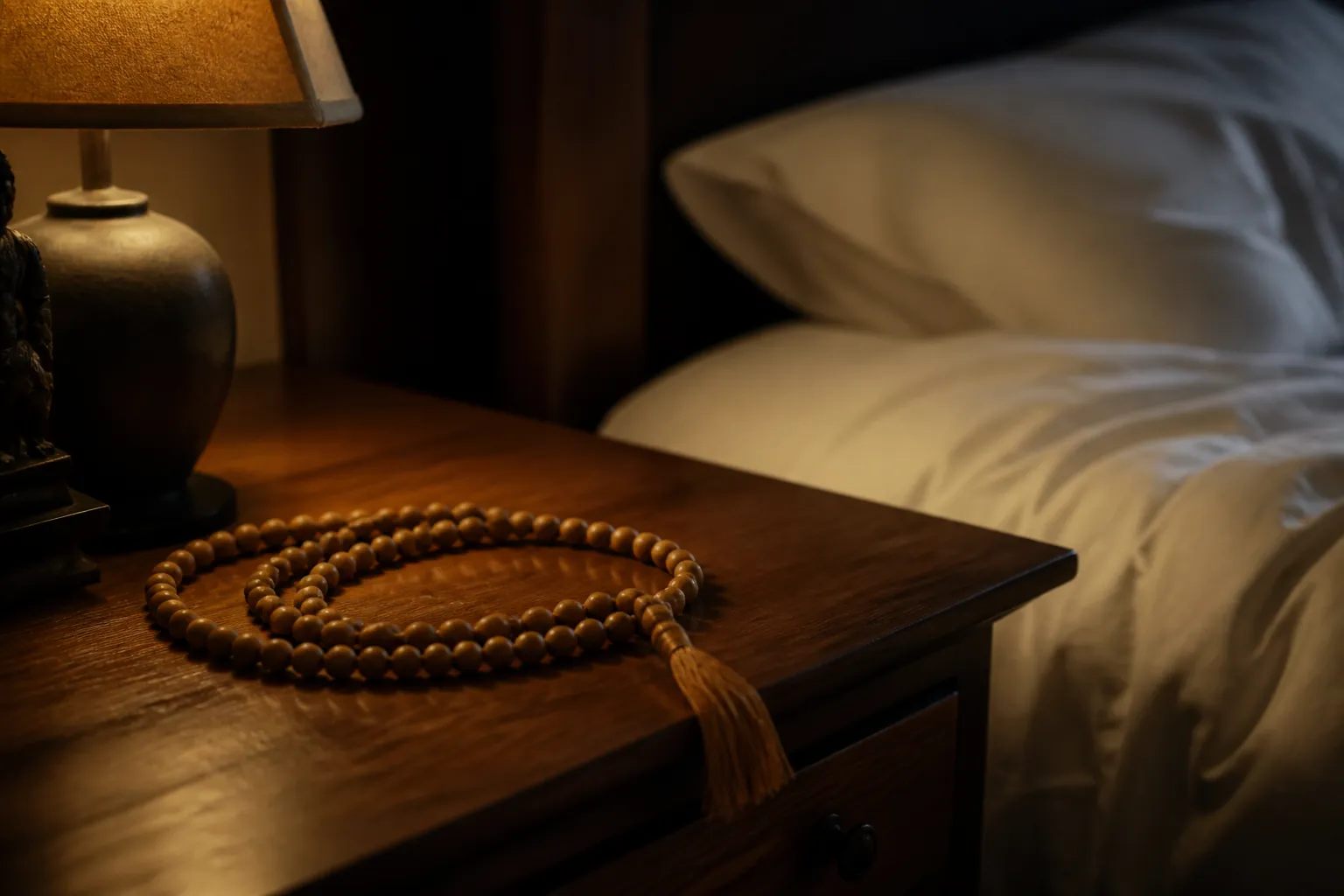
A Bedside Japa Mala Protocol for Tonight
This is the version to use when your body is tired but your mind is still negotiating, reviewing, rehearsing, or quietly panicking.
- Sit up in bed or lie on your side or back. Choose the position that makes sleep possible, not the one that looks most meditative.
- Hold the mala in your right hand, with the beads draped over the middle finger. Traditionally, the index finger does not handle the beads.
- Find the guru bead, usually the larger or ornamented bead, and begin with the bead next to it.
- Use your thumb to draw one bead toward you for each breath cycle or each mantra repetition.
- Keep the phrase quiet, slow, and boring in the best possible way. The point is not intensity; it is return.
- If you reach the guru bead again, do not cross over it. Turn the mala around and continue in the opposite direction.
- When drowsiness arrives, place the mala on the nightstand rather than wearing it while you sleep.
Those handling details follow common mala-use instructions: begin near the guru bead, move bead by bead, use the thumb to count, and reverse direction rather than crossing the guru bead.[1]
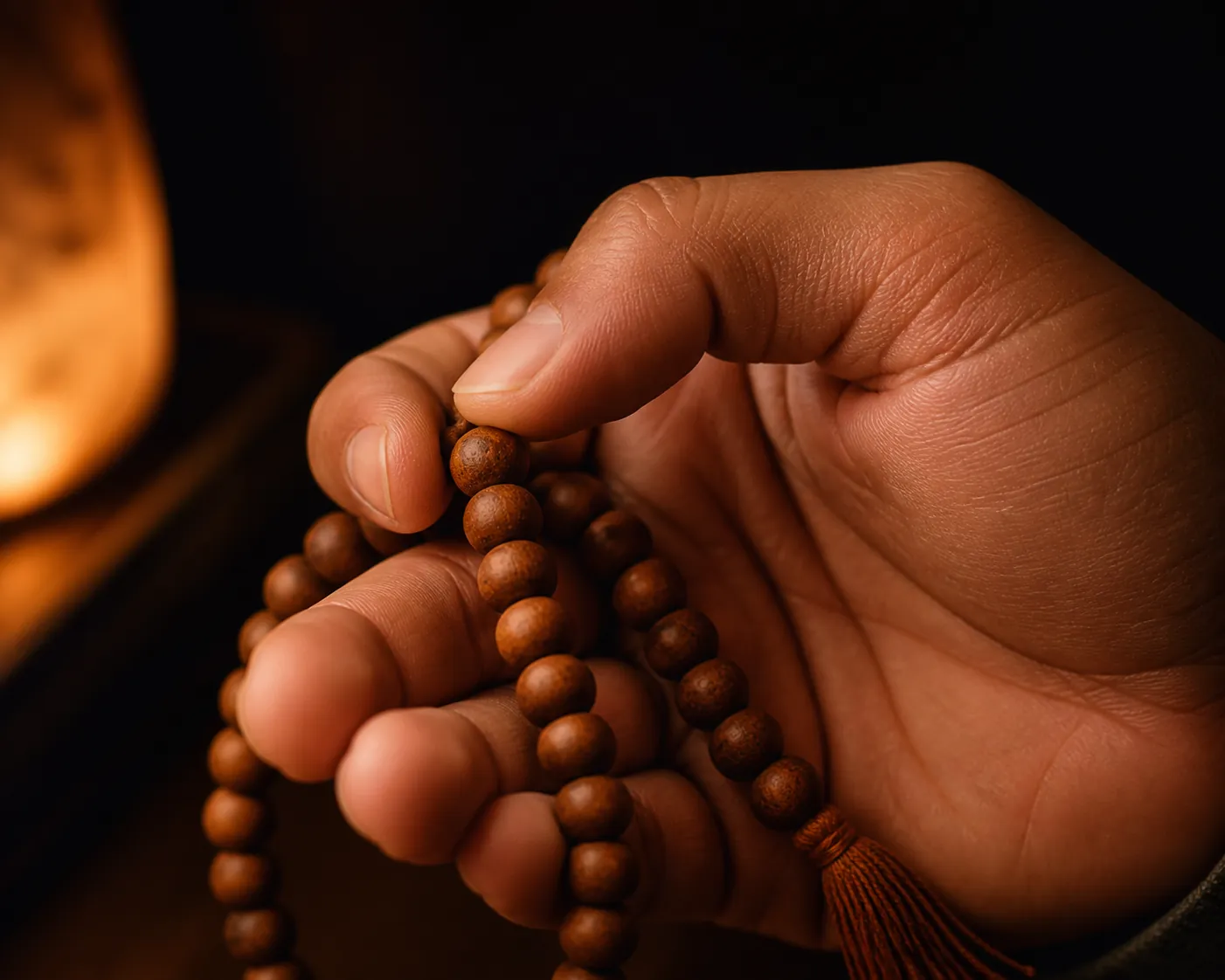
For sleep, make the practice smaller than a formal seated meditation. One bead can equal one full breath: inhale, exhale, move the bead. Or one bead can equal one quiet repetition of a phrase. Either way, the bead gives the hand a job, the phrase gives the mind a place to return, and the breath gives the body a rhythm.
Choose the Mantra by the Sleep Problem
A bedtime mantra does not need to be profound. In fact, if a phrase makes you think too much, argue with it, or evaluate whether you believe it, it is probably too complicated for 2 a.m. Pick words that reduce friction.
| If the sleep barrier is... | Try... | Why this may fit |
|---|---|---|
| Anxiety or a racing mind | “Om” or “I am calm” | Short phrases leave less room for rehearsal and problem-solving. |
| Restless sleep or body tension | Breath-as-mantra, such as counting the inhale and exhale | The breath becomes the repeated object instead of another mental task. |
| Waking from nightmares | “I am safe, I am protected” | The phrase answers threat without requiring analysis. |
| Self-judgment or rumination | “I welcome a new day with endless possibilities” | A softer phrase can interrupt the loop of reviewing what went wrong. |
If a traditional Sanskrit mantra is part of your practice, use it. If it is not, a plain English phrase is fine. The sleep-relevant feature is repetition with low cognitive load. The phrase should be easy enough to repeat when you are irritated, wired, or half-awake.
People who are anxious often do better with very short phrases because long ones can turn into performance. People who wake from bad dreams may prefer a phrase that names safety. People in perimenopause, ADHD adults, and older adults with learned dread around bedtime may need permission to keep the ritual almost childishly simple. That simplicity is part of what makes the ritual usable.
What the Evidence Can Actually Support
There is no randomized controlled trial showing that Japa Mala practice itself makes people fall asleep faster. That matters. The honest case is indirect: repetitive speech appears to quiet brain regions associated with self-referential mental activity, meditation has evidence for improving sleep quality, and beads may make repetition easier to sustain when attention is frayed.
The strongest neuroscience clue comes from a 2015 fMRI study of 23 non-meditators. Participants silently repeated a single word with eyes closed. During repetition, researchers found widespread BOLD signal reduction across default mode network regions, including the posterior and anterior cingulate, precuneus, right inferior parietal lobule, insula, and medial frontal gyrus, with no corresponding positive activation elsewhere.[2]
That does not prove that a full Japa Mala ritual treats insomnia. The study used silent single-word repetition, not a traditional 108-bead devotional practice, and it did not measure sleep. But it does support a plausible experience many people recognize: repeated words can reduce the sense of mental noise instead of giving the mind another topic to chew on.
The sleep evidence is broader. A 2018 systematic review of 18 randomized controlled trials with 1,654 participants found moderate-strength evidence that mindfulness meditation significantly improved sleep quality compared with active controls, with an effect size of 0.33 after intervention and 0.54 at 5 to 12 months of follow-up.[3]
A separate trial summarized by Harvard Health reported that mindfulness meditation reduced insomnia, fatigue, and depression in middle-aged and older adults with moderate sleep disturbance compared with sleep hygiene education alone.[4]
The bead part is less directly studied. Still, tactile counting has a practical advantage at bedtime: it gives attention somewhere physical to land. For a person who keeps checking the clock, replaying a conversation, or trying to force sleep through willpower, the bead is a quiet replacement behavior. Move bead, breathe, repeat. Nothing needs to be solved before the next bead.
Which Beads Are Best for Sleep?
Choose beads you will actually want to touch in the dark. Texture, weight, and emotional association matter more here than a promised medical effect.
- Sandalwood is traditionally associated with calm and has a warm, soft feel in the hand.
- Amethyst is traditionally associated with anxiety reduction and sleep.
- Howlite is often linked in lapidary traditions with sleep quality and midnight waking.
- Black onyx is traditionally treated as protective, which may appeal to nightmare-prone sleepers.
- Rose quartz is commonly associated with self-compassion, which may suit bedtime rumination.
- Clear quartz is often described as supporting intention or amplification.
Those are traditional and personal-symbolic associations, not clinical findings. If amethyst makes the ritual feel soothing to you, that is useful. It does not mean amethyst has been shown in sleep trials to treat insomnia.
Should You Wear a Japa Mala While Sleeping?
For bedtime practice, use the mala until you are sleepy, then put it beside the bed. Some traditions discourage wearing or sleeping with a mala out of respect for the object. There is also a plain practical reason: strings can break, beads can scatter, and jewelry can become uncomfortable or unsafe during sleep.
A nightstand practice keeps the ritual intact without turning the mala into sleepwear. If you wake during the night, you can reach for it again and restart with one bead, one breath, one phrase.
When a Mala Is Not Enough
A Japa Mala can be a reasonable low-risk bedtime ritual for racing thoughts, especially if you need a tactile alternative to rumination. It is not a substitute for insomnia care. If poor sleep is persistent, worsening, tied to safety risks, or interfering with daytime functioning, the next step is evidence-based treatment such as CBT-I and a conversation with a qualified clinician.
The cleanest way to use the mala is as a bridge: away from clock-checking, away from mental argument, and toward a repeatable rhythm your tired brain can follow. Set it down when sleep comes.
References
- How To Use Mala Beads, Kati Kaia
- Repetitive speech elicits widespread deactivation in the human cortex: the “Mantra” effect?, Brain and Behavior, 2015
- The effect of mindfulness meditation on sleep quality: a systematic review and meta-analysis of randomized controlled trials, Annals of the New York Academy of Sciences, 2018
- Mindfulness meditation helps fight insomnia, improves sleep, Harvard Health, 2015
Read the full guide: What to Do Tonight During a Full Moon for Better Sleep