How to Watch the July 2026 Meteor Shower Without Ruining Your Sleep
If you are trying to figure out how to watch the July 2026 meteor shower without ruining your sleep, the answer is not an all-night vigil. It is a partial-night plan: sleep first, wake for the useful pre-dawn window, keep the viewing field genuinely dark, use red light only, leave the phone out of it, and go straight back to bed.
That sounds less romantic than “stay up and see what happens,” but it is kinder to the person who has to drive, work, parent, manage hot-flash wakeups, or keep an ADHD routine from sliding into a two-day recovery project. The meteor shower is not the main sleep threat. The threat is turning a short outdoor viewing into a bright, screen-lit second evening.
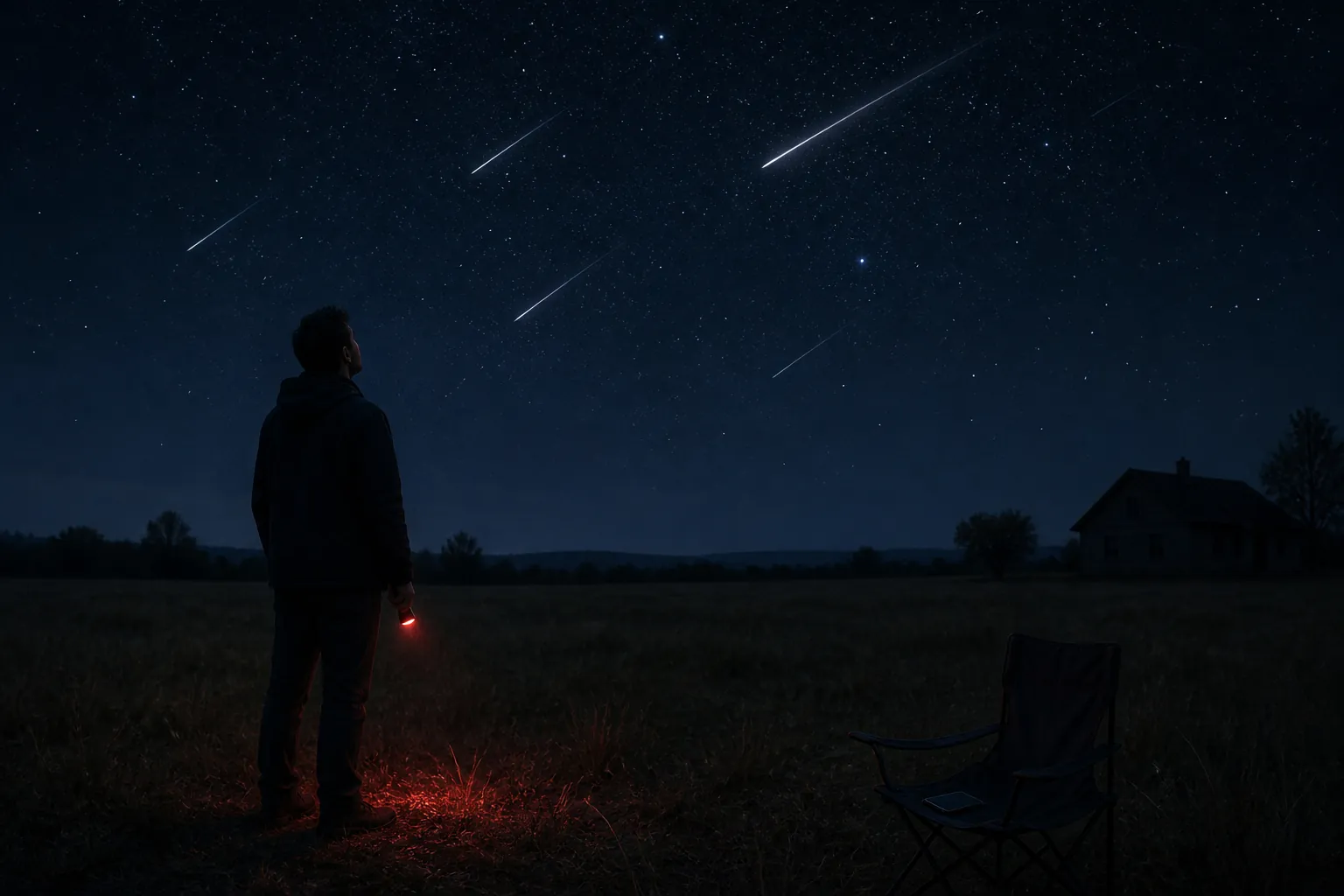
The short version: protect the night at the edges
For a 2–4 AM kind of sky event, the safest sleep strategy is to narrow the disruption. Do not “wait up.” Go to bed early, wake for a bounded viewing block, and return to bed before your brain gets the message that the day has restarted.
| Phase | What to do | What to avoid |
|---|---|---|
| Before | Bank sleep with an early bedtime, consider an early-afternoon nap, and decide your viewing window before you are tired. | Do not push caffeine later than your normal cutoff to force yourself through the night. |
| During | Stand or sit in a dark outdoor spot, use only a dim red light pointed down, and block the moon or nearby lights when possible. | Do not check apps, brighten a screen, text photos, or walk through lit rooms. |
| After | Come inside by the route you prepared, keep lights off or very dim, and get directly back into bed. | Do not scroll, snack under kitchen lights, review photos, or “just stay up now.” |
The point is not perfection. You do not need professional skywatching discipline. You need fewer wake minutes, less artificial light in the eyes, and no phone ambush at the exact moment your body should be sliding back toward sleep.
Before: set up the night so willpower is not the plan
The sleep-protective part of meteor watching starts before sunset. If you wait until 1:45 AM to decide where your flashlight is, whether the back door squeaks, or whether you need an app to find the viewing direction, you have already made the outing more stimulating than it needs to be.
Choose the simplest version of the night while you are still fully awake. Decide where you will stand, what you will wear, which door you will use, and when you will come back in. Put the red flashlight where you can reach it without turning on a lamp. If you need warm clothing, shoes, keys, a chair, or a blanket, stage them before bed.
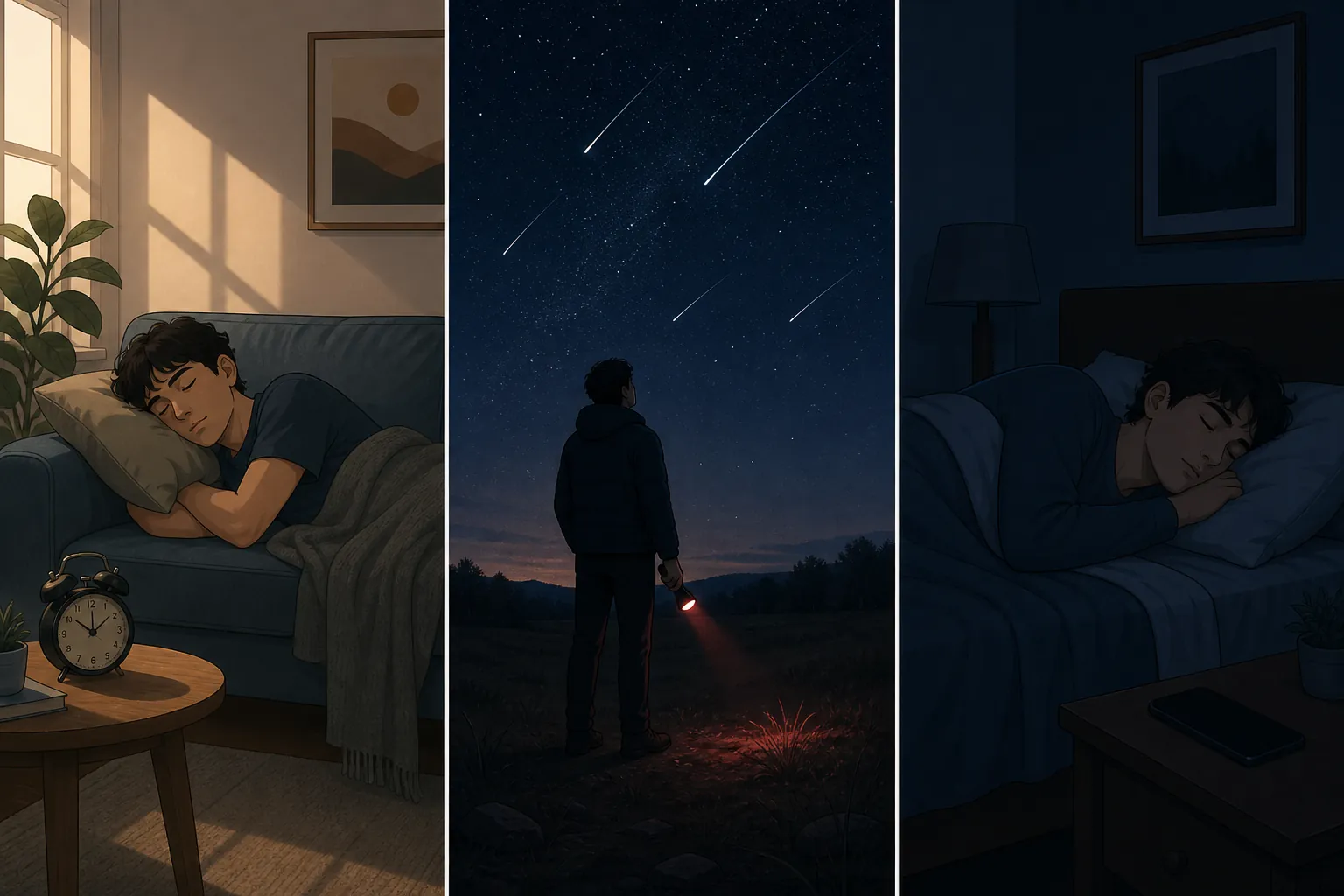
Bank sleep without turning the day into a sleep project
The cleanest preparation is an earlier bedtime on the night of the shower or, better, one or two slightly earlier nights beforehand. This is especially useful if your sleep is already fragmented. A perimenopausal reader who often wakes hot at 3 AM does not need a plan that assumes one perfect first sleep block. An ADHD adult who knows one late night can loosen the next three routines does not need a heroic version of skywatching. Both need a smaller disruption.
An early-afternoon nap can also help, as long as it does not steal from bedtime. Keep it early enough that you still feel ready to sleep that evening. The goal is not to become nocturnal for one night. The goal is to make the pre-dawn wakeup less costly.
Cut off caffeine as if you still intend to sleep
Do not use late caffeine to make the meteor shower possible. If you already have a caffeine cutoff that protects your sleep, keep it. If you are sensitive to caffeine, be more conservative, not less. A late coffee may help you get outside, but it can also keep the outing alive long after the sky has stopped being the issue.
This is where a lot of “special occasion” plans quietly fail. The person does not lose sleep only because they woke at 2 AM. They lose sleep because they caffeinated for it, checked the phone, got hungry, turned on the kitchen light, and then wondered why bed felt unconvincing at 4:30.
During: make the viewing field dark, simple, and phone-free
A dark outdoor field is not the same sleep problem as a lit bedroom, a glowing kitchen, or a phone held near your face. That distinction matters. You are trying to see faint meteors, so the skywatching advice and the sleep advice line up nicely for once: darker is better.
Keep the hierarchy simple:
- Best: no artificial light in your eyes while you watch.
- Acceptable tool: a dim red light pointed down, used only when needed for safety.
- Worth avoiding: porch lights, car interior lights, bright headlamps, kitchen lights, bathroom lights, and white flashlights.
- Worst offender: the phone screen, because it is bright, close to your eyes, and designed to keep your attention.
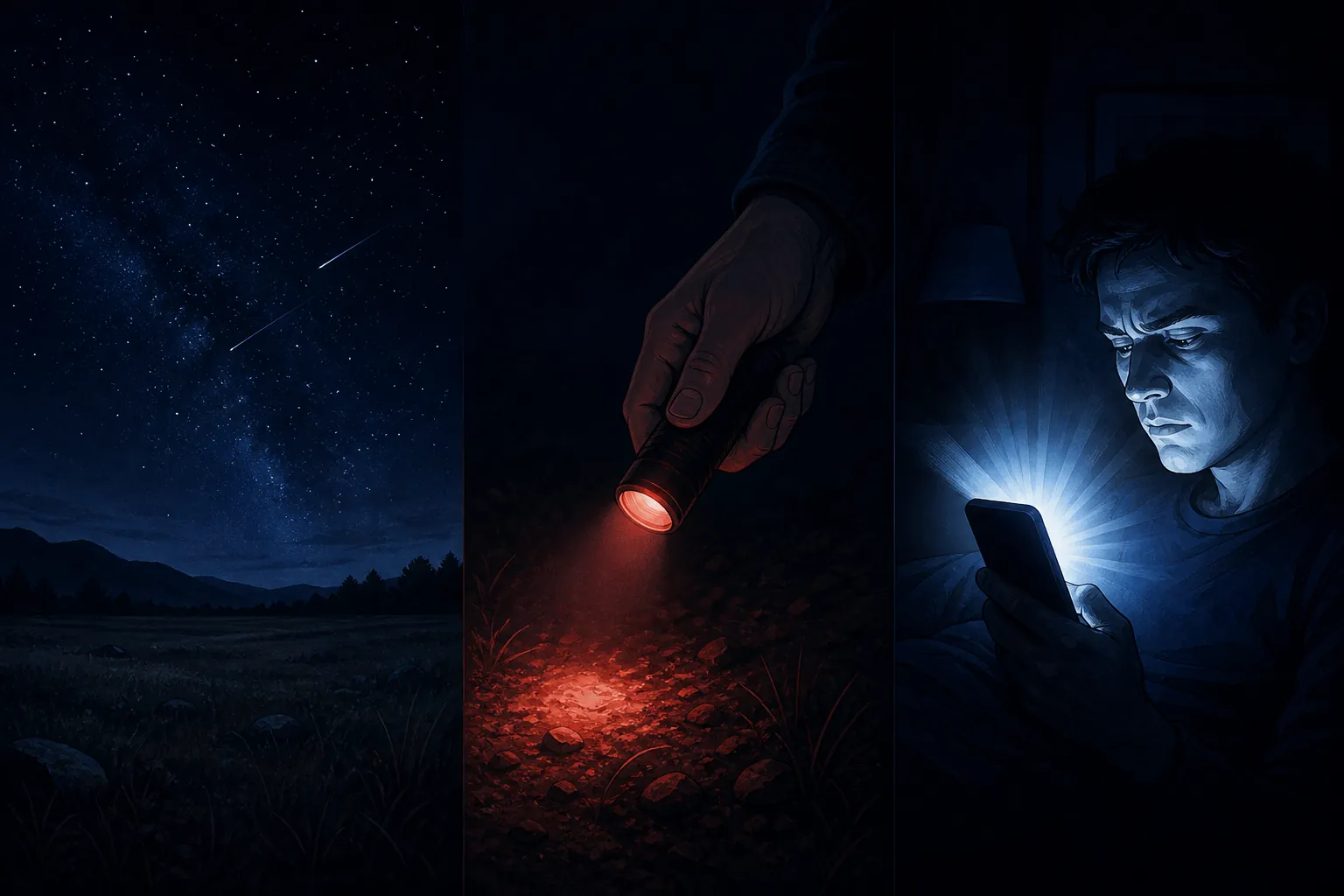
Use red light correctly
Red light is not a magic permission slip to wander around fully illuminated. Use the dimmest setting that lets you move safely. Point it at the ground, not at your face, your companion’s face, or the sky. Turn it off as soon as you are settled.
If you are watching with someone else, agree on this before you go outside. One person’s bright headlamp can undo everyone’s dark adaptation and make the whole outing longer because people then wait to see faint meteors again. Sleep-wise, that is exactly the kind of preventable extension you are trying to avoid.
Block the moon and local lights instead of troubleshooting the sky
If the moon or a nearby light is in your line of sight, move so a building, tree, hill, fence, or parked car blocks it. This is more useful than repeatedly checking an app or adjusting settings on a screen. You are not trying to optimize every variable. You are trying to give your eyes a dark view and keep the night bounded.
This is also why the better moonless windows around the event may be the wiser choice for some people. If a nearby night gives you a darker, shorter, less frustrating viewing block, that may protect sleep better than insisting on the nominal peak and then spending extra time fighting glare.
Do not bring the phone into the decision loop
The phone is where a reasonable pre-dawn outing becomes a second evening. First it is one sky app check. Then it is a weather refresh. Then a text. Then a photo that looks disappointing, so you try again. Then your brain is no longer in a quiet, dark, temporary wakeup. It is awake in the modern way.
If you need orientation, learn it before bed. If you need a timer, use a non-glowing alarm or set the phone across the room before you sleep, then do not take it outside. If you need emergency access, keep the phone face-down, dimmed, and untouched unless there is an actual need. The default should be no screen.
Photography is the easiest sacrifice. Night-sky photography usually asks for setup, review, adjustment, and patience. Those are fine on a planned sleepless night. They are not fine if your stated goal is to watch the July 2026 meteor shower without wrecking the next day.
After: the return to bed is the whole game
When the viewing window ends, end it. Do not review what you saw. Do not check whether other people saw more. Do not stand in the kitchen under bright lights deciding whether you are hungry. Do not reward yourself with a scroll because you were disciplined outside.
Use the boring route back: red light or very dim light only if safety requires it, bathroom only if needed, no conversation that becomes a recap, no phone, bed. If you wake a partner, child, or pet, resist turning that into a household reset. The fewer systems you activate, the easier it is to return to sleep.
This is especially important for people whose sleep is already easy to fragment. A hot-flash wakeup, a child calling out, or an ADHD “while I’m up…” chain can convert a planned short wake into a long one. The rule is not punitive. It is protective: the meteor shower gets a window, not the rest of the night.
Why partial sleep is worth protecting
The reason this plan is worth the fuss is that sleep loss is not all-or-nothing. Preserving part of the night is meaningfully better than giving up the whole thing. In a controlled sleep-restriction and recovery study, Banks and colleagues found that neurobehavioral recovery after sleep loss was not equivalent across sleep opportunities; the amount of recovery sleep mattered, and one night of recovery did not fully erase the effects of prior restriction [1].
For meteor watching, the practical lesson is modest but important: a planned wakeup after real sleep is a different risk from staying awake until dawn. If you get a solid first sleep block, watch briefly in darkness, and return to bed, you have preserved far more than someone who treats the shower as an overnight endurance event.
The other physiological distinction is light. A genuinely dark viewing field asks your eyes to adapt to the night. A lit room or phone screen asks your brain to process bright artificial light at the wrong time. Those are not equivalent experiences, even if both happen at 3 AM. The transition moments—walking through the house, unlocking the phone, turning on the bathroom light—often do more damage than the quiet minutes spent looking up.
A practical plan for the night itself
Here is the version that keeps the sleep cost bounded:
- Earlier that day, keep caffeine within your normal sleep-safe window. If you nap, make it early afternoon rather than late day.
- Before bed, stage clothes, shoes, keys, chair, blanket, and a dim red light. Decide your viewing location and return time.
- Go to bed early enough that the outing interrupts sleep instead of replacing it.
- When the alarm goes off, do not check your phone. Get up, stay quiet, and go outside by the darkest safe route.
- Watch from a dark spot. Use red light only when you need to move. Block the moon or local lights with landscape or structures when possible.
- End on time, even if the sky is tempting. Come inside without turning the night into a review session.
- Return directly to bed. No scrolling, no snacks under bright lights, no photo editing, no “I’m already awake” chores.
If you have to drive early, be stricter. If you are caring for small children, be stricter. If your sleep has been poor all week, consider choosing a shorter moonless viewing window or skipping the wakeup entirely. There is no meteor bright enough to make drowsy driving a good trade.
What not to optimize
You do not need a long gear list. You do not need to identify every radiant detail in the moment. You do not need a perfect reclining setup if assembling it means turning on the garage light and waking the house. You do not need to capture proof.
The useful optimizations are the unglamorous ones: fewer bright lights, fewer decisions after waking, fewer minutes awake, and fewer reasons to touch the phone. A dark field, a red light pointed down, and a pre-decided return time will do more for next-day alertness than another app check.
The best version of this night is planned, short, dark, and boring on purpose. The July 2026 meteor shower does not have to ruin your sleep. An unstructured all-night vigil can. A middle-of-the-night phone check can. Keep the outing contained, and the sleep debt stays much more recoverable.
References
- Neurobehavioral Dynamics Following Chronic Sleep Restriction: Dose-Response Effects of One Night for Recovery — Sleep, 2010 — https://academic.oup.com/sleep/article/33/8/1013/2454620
Read the full guide: How to Watch the Perseid Meteor Shower Without Losing Sleep