
How to Help Kids Sleep in a Screen-Filled AI World
Short answer
Yes: screens and AI tools can cost kids sleep. The most useful answer is also the least dramatic one. The problem is usually not blue light alone. The bigger problems are lost time, bedtime mental arousal, and interactive content that keeps asking for one more tap, message, request, game turn, story ending, or reply. A 2024 National Sleep Foundation consensus panel agreed that screen use and presleep content impair sleep in children and adolescents, and that behavioral strategies can reduce those effects. The same panel did not reach consensus that presleep screen light by itself impairs sleep, which matters because “turn on night mode” is not the same as protecting bedtime. [1]
The practical answer for tonight is: protect the final hour before bed from screens when you can, keep devices out of bedrooms overnight, replace the screen with a predictable wind-down activity, and have adults follow the same bedroom rule. If a full hour would turn bedtime into a household war, start smaller—15 to 30 minutes is still a real boundary—and build from there.
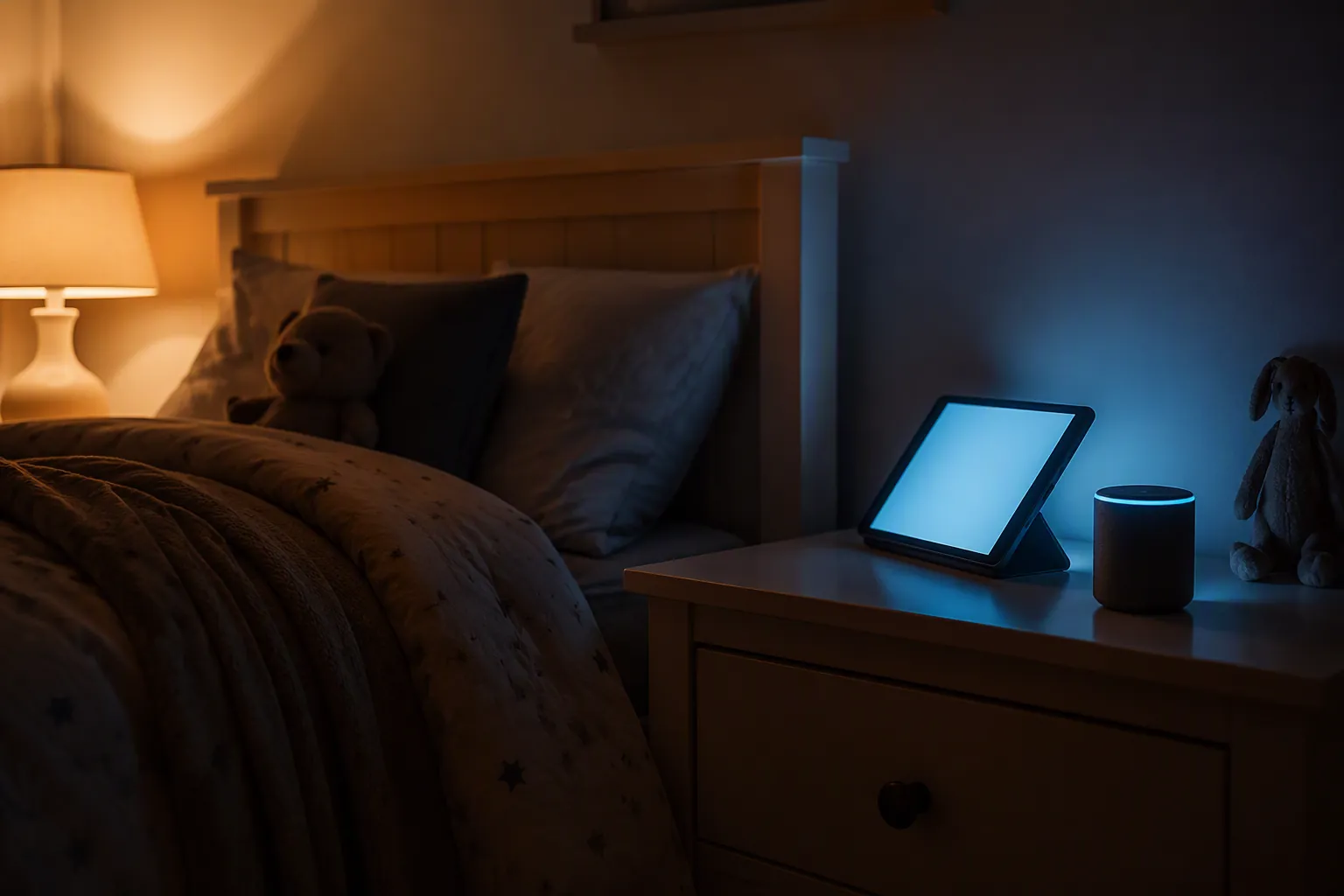
Why screens cost sleep: the evidence stack
Parents often get handed one explanation—blue light—and one product-shaped solution. The evidence points to a broader bedtime problem. Screens can delay sleep because they take up time that would otherwise be used for winding down, because some content keeps the brain socially and emotionally “on,” and because light exposure can affect the body clock. Those mechanisms are not equal in practical importance.
Strongest practical evidence: time displacement
The first mechanism is simple and stubborn: bedtime screens take minutes from bedtime. A child who is watching, texting, gaming, chatting with a chatbot, or asking a story app for one more ending is not brushing teeth, getting into pajamas, reading with a parent, lying in the dark, or falling asleep.
This is where the toddler evidence is especially useful because it tests a household action rather than only measuring an association. In the Bedtime Boost randomized trial, 105 families with toddlers aged 16 to 30 months were followed over 7 weeks. Removing screens in the hour before bed improved toddler sleep quality and reduced night awakenings, according to the University of Bath summary of the published JAMA Pediatrics study. [2]
The broader child literature points in the same direction, though much of it is observational. A 2024 Canadian Family Physician review summarized dose-response findings including about 10 minutes less sleep per additional screen hour in a Finnish preschool cohort of 736 children, 6 to 11 minutes less sleep in a Hong Kong cohort of 2,903 children, and adverse sleep associations in roughly 90% of studies in a 67-study review. [3]
Those numbers do not mean every extra screen hour causes exactly the same sleep loss in every child. They do mean bedtime screen use is not a harmless background habit when a child is already short on sleep.
Strong evidence for some uses: content and cognitive arousal
The second mechanism is the one many families recognize fastest: not all screen use behaves the same at bedtime. A quiet rerun, a multiplayer game, a group chat, and a chatbot that answers instantly do not ask the same thing from a child’s brain.
In a Penn State study of 475 15-year-olds using accelerometer-measured sleep, interactive screen use mattered. Texting and gaming in the hour before bed delayed sleep onset by about 30 minutes, while passive viewing did not show a significant association. [4]
That distinction is important for real bedrooms. A teen who is waiting to see whether a friend replies is in a different state from a teen watching a low-stakes show. A child asking a story generator for another version of the ending is not just consuming a story; the child is negotiating with the device. A younger child talking to a voice assistant may not experience it as “screen time” at all, even though it can still keep the bedtime relationship active and unfinished.
Narrower evidence: light still matters, but it is not the whole problem
Light exposure at night can affect circadian timing and sleepiness, and blue-enriched light is a reasonable part of the bedtime conversation. Children may be especially sensitive to evening light, and dimming devices is better than staring into a bright screen in a dark room. [5]
But the National Sleep Foundation consensus is a useful guardrail here: the expert panel did not reach consensus that presleep screen light by itself impairs sleep, even while it did agree that screen use and presleep content impair children’s and adolescents’ sleep. [1]
So yes, use night mode, dim the screen, and keep bright devices away from a dark bedroom. Just do not confuse that with solving the bedtime problem. A dimmed phone can still deliver a stressful message. A blue-light filter does not make a game less interactive. Blue-light glasses do not end the “one more response” loop.
What the AI world changes
AI does not create a completely new sleep mechanism. It intensifies the mechanisms families already struggle with: interactivity, emotional pull, time loss, and limit-setting friction.
Chatbots, companion apps, story generators, smart speakers, and AI toys can feel less like “watching a thing” and more like being in a conversation. That matters at bedtime because conversation is relational. When a parent says, “That’s enough,” the child may not feel interrupted from a device; the child may feel interrupted from a relationship, a story thread, or a character that was just about to answer.
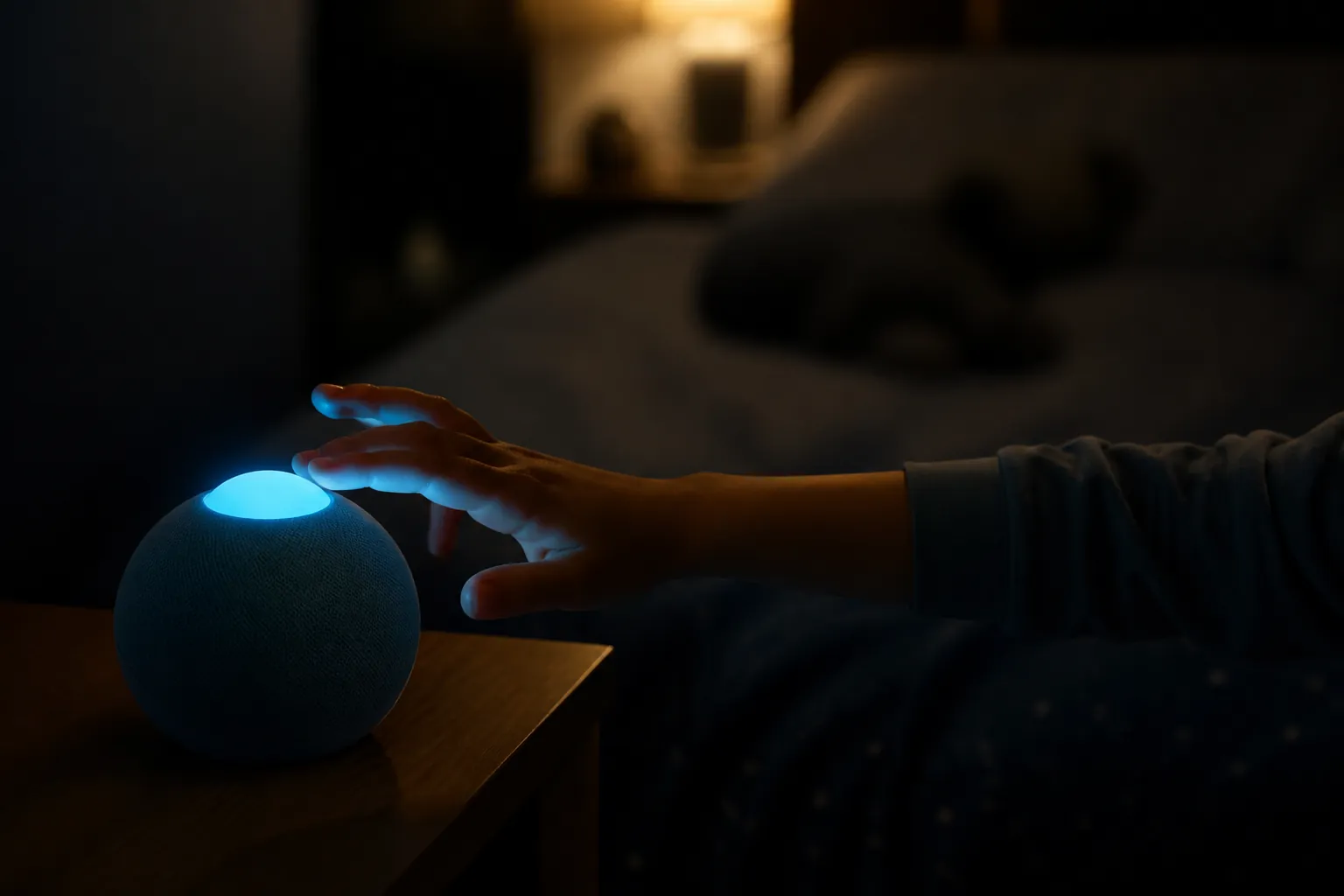
AACAP lists sleep disturbances related to device use among warning signs of unhealthy AI use, notes that children can become attached to chatbots, and warns that some children may react strongly when parents set limits. Its guidance is not to pretend AI is not there, but to explore tools together and set clear boundaries. [6]
The AAP’s HealthyChildren.org guidance makes a related point about companion chatbots: they can play on children’s magical thinking and parasocial attachment, and AI cannot replace the stable relationships children need. Bedtime is one of the places that truth becomes practical, not abstract. [7]
That does not mean every AI story app is dangerous or every voice assistant must disappear from family life. It does mean AI belongs in the same bedtime category as texting and gaming: interactive enough to deserve firmer limits than passive, low-stakes media.
The household rules that matter most
A clean rule on paper can become a nightly fight if it removes the child’s coping tool and offers nothing in its place. The goal is not a perfectly screen-free household. The goal is to make the last part of the evening boring, predictable, and relational enough for sleep.
| Rule | What it looks like tonight | Why it matters |
|---|---|---|
| Protect the final wind-down period | Aim for a screen-free final hour. If that is unrealistic, begin with 15–30 minutes. | This reduces time displacement and gives the body a repeated cue that sleep is next. |
| Keep devices out of bedrooms overnight | Phones, tablets, gaming devices, smart speakers used for play, and AI toys charge outside the bedroom. | A child cannot answer one more message or request if the device is not beside the bed. |
| Treat AI as interactive media | No solo chatbot, story-generator, voice-assistant play, or companion-style tools in the final wind-down period. | The issue is the back-and-forth loop, not whether the tool has a traditional screen. |
| Replace the screen | Use a picture book, audiobook with no interactive choices, drawing, bath, quiet music, stretching, or a repeated parent-child routine. | A bare ban leaves the child with a gap; a replacement gives the nervous system somewhere to land. |
| Model the bedroom rule | Adults charge phones outside the bedroom when possible, or at least keep them off the bed and out of the bedtime routine. | The rule is more believable when the adult is not scrolling while enforcing it. |
This family-level approach is also where pediatric media guidance has been moving. The AAP’s 2026 digital media guidance emphasizes a family media plan, device-free bedrooms, parent modeling, and replacing screens rather than relying only on time limits. [8]
The bedroom rule deserves special attention for older children and teens. Common Sense Media reports that over half of preteens and teens use phones overnight, which turns the device from an evening habit into a sleep-interruption machine. [9]

If the one-hour rule is too much
Start where your family can actually succeed. Pediatric sleep expert Maida Lynn Chen has suggested that when a full hour is not possible, families can begin with 15 to 30 minutes of screen avoidance, prefer passive over interactive content, and move in increments. She also notes the mixed messages children receive when parents are on their own devices while trying to limit children’s use. [10]
A realistic first move might be: no games, messaging, chatbots, or AI story requests after pajamas. If your child still watches something, make it passive, short, and outside the bedroom. Then move the cutoff earlier once the routine has stopped feeling like a nightly emergency.
How to handle AI tools without making them mysterious
Children need clear language for AI boundaries. “The chatbot sleeps in the kitchen.” “The story app can help us choose one idea before bath, but it does not come into bed.” “The smart speaker can play the same sleep sound, but it cannot answer questions after lights-out.” Those rules work better than arguing at 9:40 p.m. about whether the device is technically a screen.
Co-use also changes the tone. If an AI story tool is part of the evening, use it earlier and together: choose one request, read the result, then close it. The parent, not the app, decides when the story is finished. That preserves the relationship at bedtime instead of handing the final emotional exchange to software.
Where melatonin fits
Melatonin is not the behavioral plan. It may be appropriate for some children under clinician guidance, including some children with neurodevelopmental conditions or circadian rhythm problems, but it should not become the household workaround for a device-driven bedtime.
The American Academy of Sleep Medicine reports that 45% of U.S. parents have given melatonin to a child under 18. It also cautions that melatonin supplements are not regulated by the FDA in the same way as medications and recommends behavioral changes and clinician guidance first. [11]
That regulation point is not a small footnote. If a child is taking a sleep supplement while still sleeping next to a phone, gaming late, or bargaining with a chatbot from bed, the most fixable problem has been skipped.
When the problem is bigger than screens
Screens can be the visible part of a deeper bedtime problem. If your child has ADHD, autism, anxiety, sensory needs, delayed sleep timing, or intense bedtime resistance, use the Neurodivergent Sleep cluster rather than treating this as a simple media-limit issue. The screen may be regulation, stimulation, avoidance, social connection, or all of those at once.
Parents’ sleep matters too. If you are the adult enforcing device limits while also dealing with insomnia, postpartum sleep loss, perimenopausal night waking, shift work, or chronic sleep deprivation, the family plan has to include your sleep reality. A parent who is exhausted is not failing; they are enforcing boundaries with a much smaller margin.
A workable tonight-and-tomorrow plan
- Tonight, move charging out of the bedroom. If that is too hard for a teen, start with the device across the room and notifications off, then move it out once the rule is established.
- Choose the first cutoff: final hour if possible, 15–30 minutes if not.
- Ban the most activating categories first: messaging, games, short-video feeds, chatbot conversations, AI companions, and interactive story requests.
- Put a replacement in the same slot: book, bath, music, drawing, stretching, low-light conversation, or the same noninteractive audio every night.
- Make the adult rule visible: no parent phone in the child’s bed, and no scrolling during the part of bedtime where the child is expected to disconnect.
- If sleep still does not improve, look beyond screens before reaching for supplements: timing, anxiety, ADHD, medication effects, snoring, restless sleep, and the caregiver’s own sleep load all deserve attention.
The point is not to raise a child untouched by modern technology. It is to keep the last stretch of the night from becoming another interactive space that someone has to negotiate when everyone is already tired.
References
- The impact of screen use on sleep health across the lifespan, Sleep Health, 2024
- Screen-free bedtimes boost toddler sleep, University of Bath
- Screen time and sleep in children, Canadian Family Physician, 2024
- Interactive screen use reduces sleep time in kids, researchers find, Penn State
- How Does Blue Light Affect Children's Sleep?, Sleep Foundation
- Is AI Dangerous for Children?, AACAP
- How AI Chatbots Affect Kids, HealthyChildren.org
- Understanding the New AAP Digital Media Guidelines, AAP Center of Excellence on Social Media and Youth Mental Health, 2026
- How to Help Kids Balance Phones and Screens with Sleep, Common Sense Media
- Screen time is contributing to chronic sleep deprivation in tweens and teens, The Conversation
- Rethinking the use of melatonin as a sleep aid for kids, American Academy of Sleep Medicine
Read the full guide: How to Sleep During a Tornado Warning When Pregnant