
How to Sleep During a Tornado Warning When Pregnant
If you are pregnant and lying in bed while storms move through, the safest answer depends on one word: watch or warning. A tornado watch means conditions are favorable for tornadoes; you may be able to sleep if your alerts are working, your shelter route is clear, and your supplies are already packed. A tornado warning means a tornado has been sighted or indicated by weather radar; you do not stay in bed, try to finish a sleep cycle, or wait to see what happens. You move to shelter immediately.[1]
That distinction matters more at 2 a.m. than it does in a calm daytime planning conversation. Pregnancy already makes sleep lighter and more interrupted for many people. You may be waking to urinate, changing positions because your hips ache, dealing with reflux, or needing more pillows just to breathe comfortably. A tornado plan that assumes you can spring out of bed, curl tightly on the floor, and think clearly in the dark is not a pregnancy-safe plan. It is an ordinary plan with a large missing piece.
During a Watch, Prepare So Sleep Is Possible
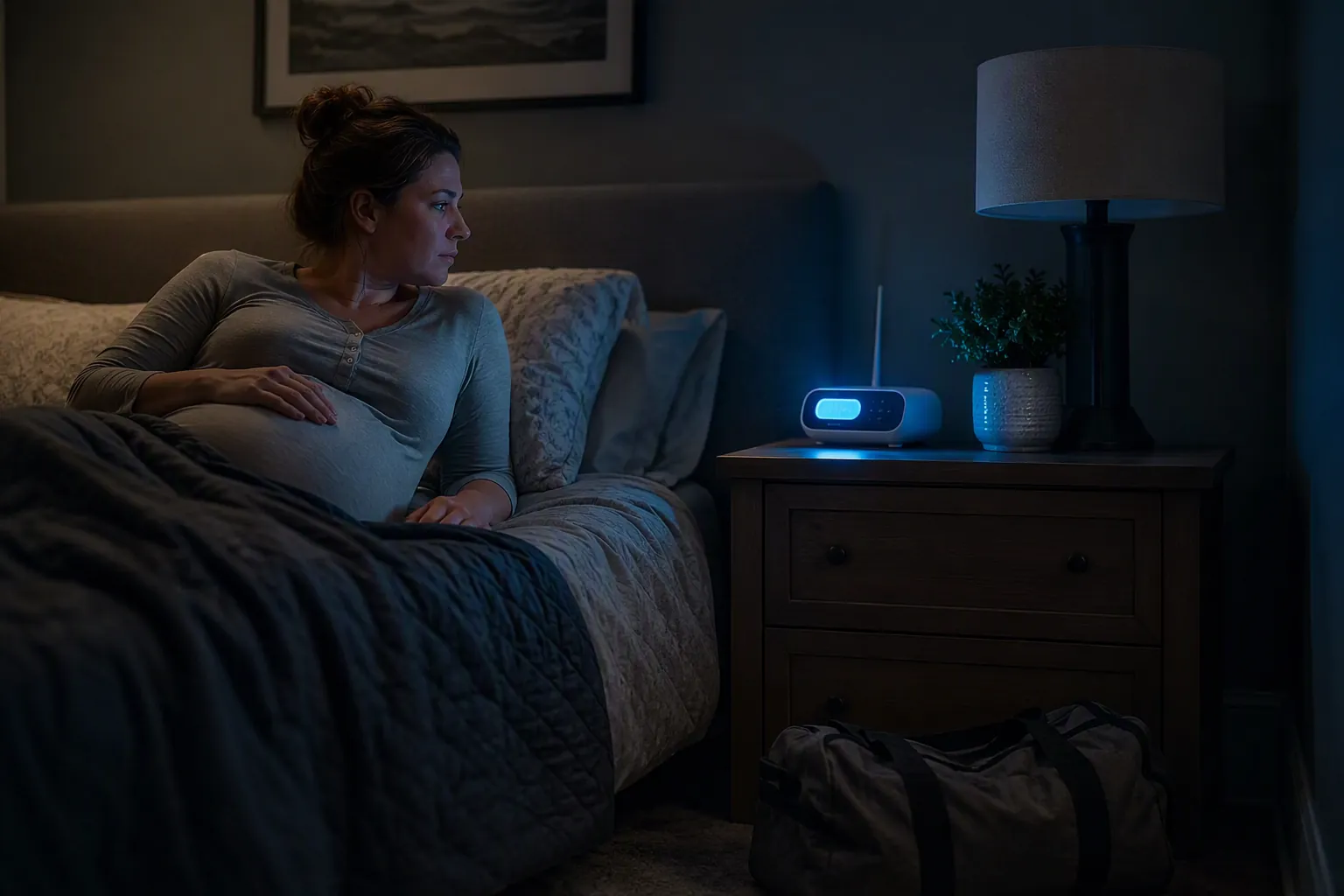
During a tornado watch, the goal is not to stay awake all night staring at radar unless local conditions truly demand it. The goal is to remove the decisions you would otherwise have to make half-asleep. Before you get into bed, choose the shelter location, place shoes and a flashlight where your feet will find them, put your phone and weather radio within hearing range, and move the go-bag to the path between your bed and shelter.
The shelter location still starts with standard tornado guidance: go to a basement if you have one, or to an interior room on the lowest floor, away from windows. The CDC also advises covering your body with a blanket, sleeping bag, or mattress and protecting your head and neck.[2] Pregnancy changes how you carry out that advice; it does not make the lowest-floor, interior-room rule optional.
| If the alert says | What it means for sleep | What to do |
|---|---|---|
| Tornado watch | Sleep may be reasonable only if alerts and shelter access are ready. | Set redundant alerts, clear the route, pack the go-bag, and lie down in clothes you can move in. |
| Tornado warning | Sleep is no longer the task. | Go to shelter immediately and protect your head, neck, and abdomen as well as possible. |
| Warning canceled or threat passes | Rest may resume if local officials and alerts show the immediate threat has ended. | Reset alerts, check for new watches or warnings, then use a short settling routine. |
Why the Alert Beside the Bed Carries So Much Weight
Nighttime tornadoes are dangerous partly because people are asleep and partly because they cannot see the storm coming. Ashley and colleagues found that 27% of tornadoes occurred between 6 p.m. and 6 a.m., and that nocturnal tornadoes were about 2.5 times as likely to be deadly as daytime tornadoes.[3] Those numbers are not a reason to panic through every stormy night. They are a reason to treat the device that wakes you as part of the shelter plan, not as an accessory.
Warnings do often arrive before the worst tornadoes. NOAA’s nighttime tornado preparation materials state that 97% of significant tornadoes rated EF3 or higher had a warning in effect before they developed, with an average lead time of 16 minutes.[4] Sixteen minutes can be enough time to get from bed to an interior shelter area, put on shoes, grab the go-bag, and protect your body. It is not enough time to search for the flashlight, argue with a dead phone, or decide which bathroom is safest.
Use more than one alert path. The National Weather Service recommends having multiple ways to receive warnings, including a NOAA Weather Radio, and not relying only on outdoor sirens.[1] For pregnancy sleep, that redundancy is not fussy. Phones can be silenced, drained, or out of range. Sirens may not wake you indoors. A NOAA Weather Radio with battery backup belongs close enough to the bed that it can wake the person who actually has to move.
- Keep the NOAA Weather Radio plugged in with battery backup installed.
- Enable Wireless Emergency Alerts on your phone and keep the phone charged overnight.
- Set your weather radio for your county or local warning area so it wakes you for relevant warnings.
- Place one flashlight by the bed and one in the shelter area.
- If you sleep with earplugs, white noise, or a fan, test whether the warning alarm still wakes you.
Modify the Tornado Protective Position for Pregnancy
The standard tornado instruction to get low, cover your head, and protect the back of your neck remains the backbone of the plan.[2] The problem is the usual mental picture: a body curled tightly on the floor, knees tucked in, torso compressed, mattress or blanket pulled over everything. In later pregnancy, that may be impossible, painful, or unwise if it restricts your abdomen or breathing.
There is no pregnancy-specific tornado-position trial showing one tested posture for every trimester. The safest practical approach is a reasoned adaptation of CDC sheltering guidance: keep yourself as low and protected as possible, preserve head and neck coverage, and create enough space for your belly and lungs.
Earlier Pregnancy: Low, Covered, Not Compressed
In the first trimester or early second trimester, you may still be able to use a more standard crouched or kneeling position. Even then, do not force a tight curl if nausea, dizziness, pelvic pain, or breathing discomfort makes it harder to stay stable. Get low in the shelter area, face away from windows or potential flying debris, and use your hands, a pillow, helmet, folded blanket, or mattress edge to protect your head and the back of your neck.
Later Pregnancy: Side-Lying or Knees-Spread
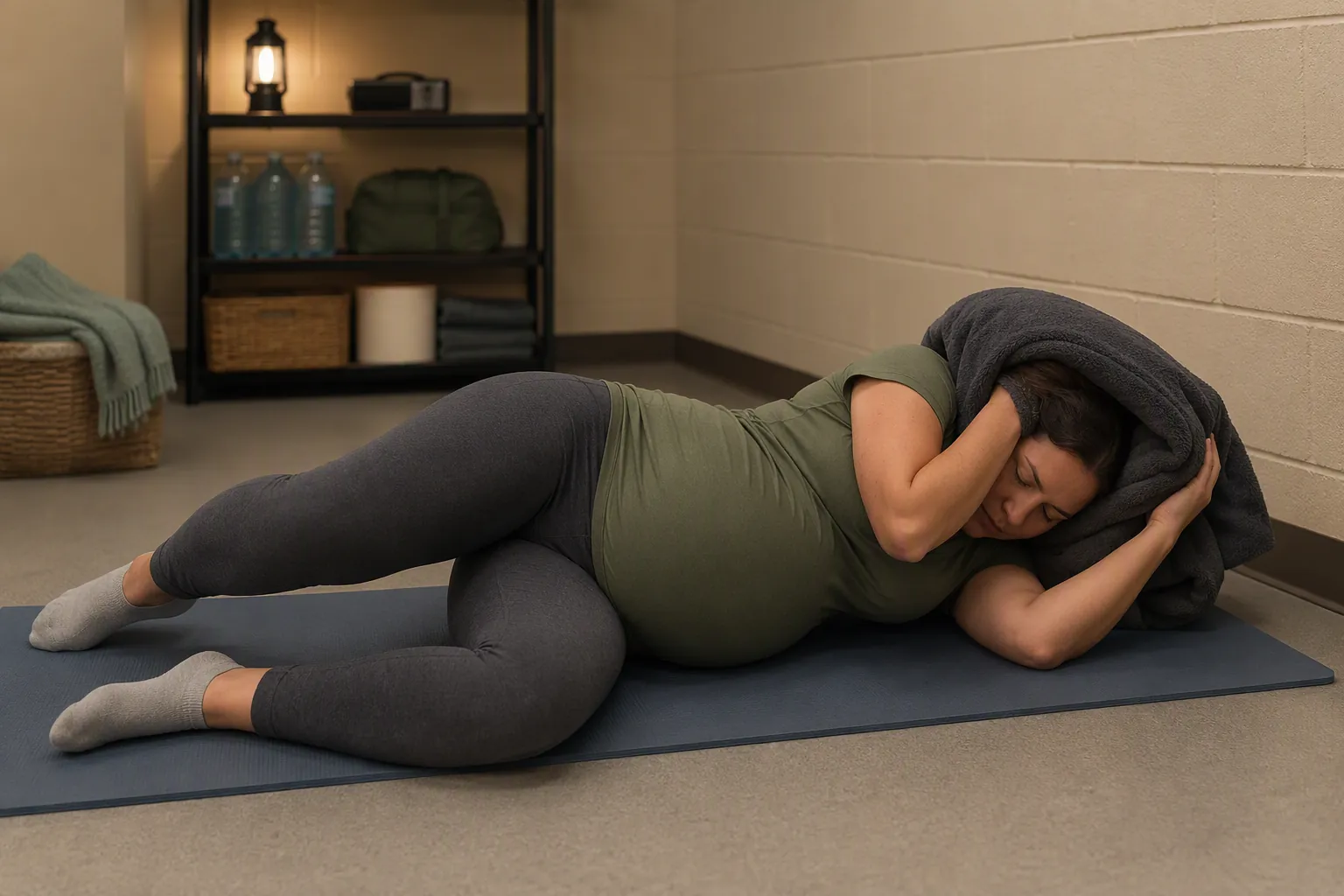
In the second half of pregnancy, a side-lying position often makes more sense than trying to fold yourself into a ball. Lie on your side on the shelter floor if you can get down safely, bend your knees enough for stability, and keep your knees apart so your abdomen is not squeezed. Pull a blanket, pillow, coat, or padded item over your head and neck while leaving your face clear enough to breathe.
If side-lying is not possible because the space is too small or you cannot get back up easily, use a wide-kneed kneeling posture, sit low against an interior wall, or lean forward over pillows while another padded item shields your head and neck. The exact shape matters less than the priorities: lowest safe position, no windows, head and neck protected, abdomen not compressed, breathing not restricted.
A mattress can be useful protection, but it should not become a weight pinning your belly or chest. If someone else is sheltering with you, decide before bedtime who helps position the mattress, who holds the flashlight, and who grabs the bag. Pregnant people are often told to “just get under something sturdy,” but in the dark, with a larger abdomen and a shifting center of gravity, that instruction needs choreography.
Build the Bed-to-Shelter Route Before You Need It
A good nighttime tornado plan is boring on purpose. It turns a frightening chain of decisions into a short route your body has already practiced: sit up, put on shoes, grab the bag, take the flashlight, move to the shelter, get low, cover head and neck. Practice it once in daylight and once at night. You are not rehearsing panic; you are finding the laundry basket in the hallway, the rug that slips, the door that sticks, and the position that does not work with your belly.
Keep shoes by the bed because tornado debris can include glass, nails, and splintered wood. Keep the path clear because pregnancy changes balance and makes falls more consequential. If you are alone overnight, write the route down and put it where you can see it from bed. If you live with a partner, child, roommate, or older relative, assign jobs before storms arrive rather than while the warning alarm is sounding.
- Before bed during a watch: charge your phone, turn on the NOAA Weather Radio, place shoes and flashlight by the bed, and move the go-bag into reach.
- When a warning sounds: get up immediately, put on shoes, grab the flashlight and go-bag, and move to the chosen shelter.
- In shelter: use the lowest, most protected position your pregnant body can maintain while protecting your head and neck.
- After the warning passes: check for updated alerts before leaving shelter or returning to bed.
Pack a Pregnancy-Specific Tornado Go-Bag
Ready.gov recommends emergency supplies such as water, food, a flashlight, batteries, a first-aid kit, medications, a radio, and phone-charging options.[5] For pregnancy, the bag should be small enough to grab quickly and specific enough that you are not trying to remember medical details while sirens are sounding.
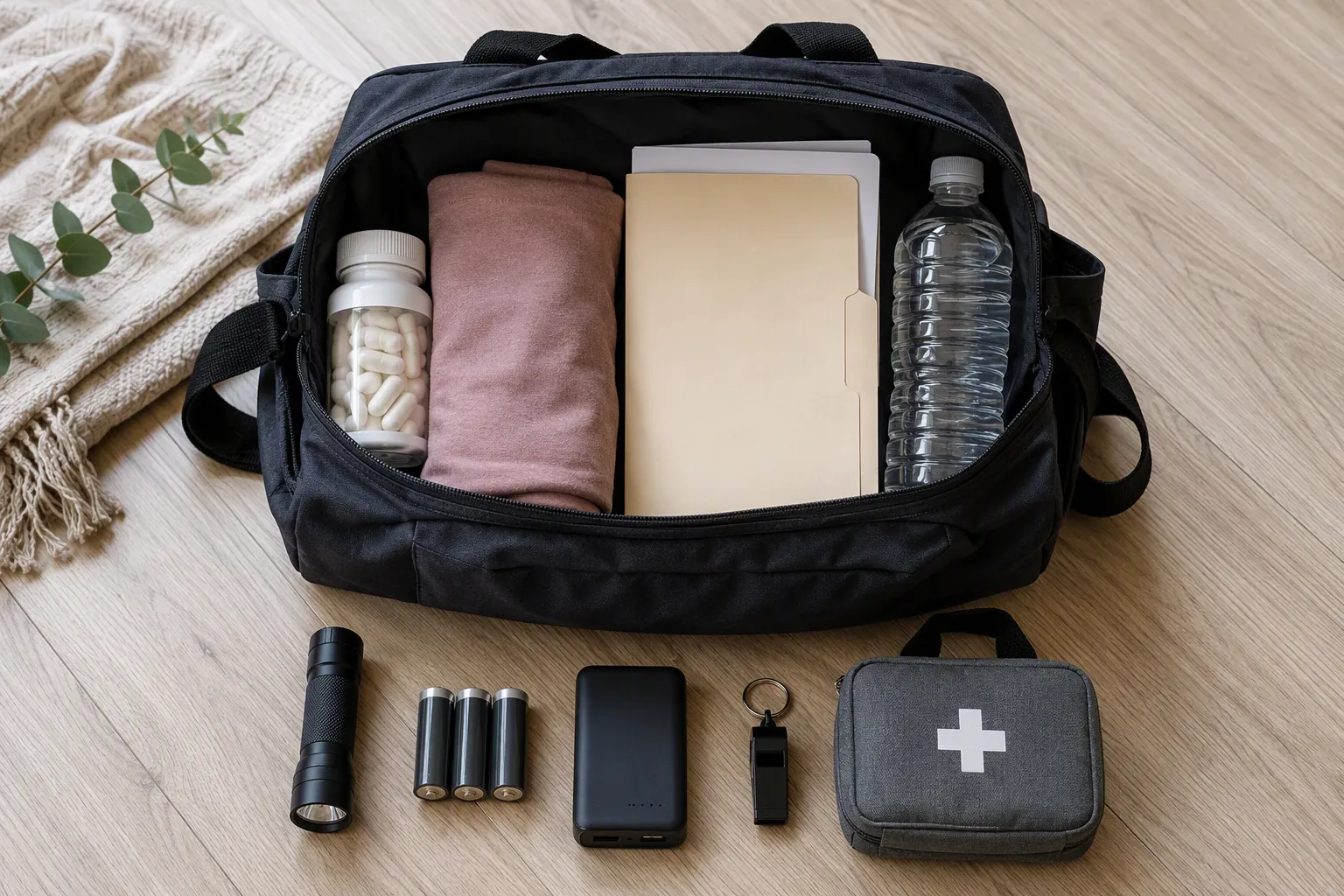
- Prenatal records: include a printed summary or copies of key records, especially if you have complications, medications, allergies, blood type information, or a high-risk pregnancy.
- Prenatal vitamins and necessary medications: pack a small supply and rotate it so it does not expire.
- Water bottle and easy snack: choose something you can tolerate if nausea, reflux, or blood-sugar swings are part of your pregnancy.
- Flashlight, spare batteries, and portable charger: assume the power may fail and the phone battery may not last.
- First-aid basics, whistle, and ID: keep the kit practical rather than so large that you hesitate to grab it.
- Small comfort item: a clean mask, hair tie, extra pair of glasses, or light layer can matter more at 2 a.m. than it sounds in daylight.
The prenatal records are not dramatic, but they are one of the few items that can travel with you if the night gets worse than expected. If you need medical care after a storm, a clinician should not have to reconstruct your pregnancy history from memory while you are shaken, separated from your usual clinic, or unable to access your phone.
What to Do With Storm Anxiety Once the Plan Is Real
Storm anxiety is not a character flaw, and pregnancy can make the body less forgiving of vigilance. General pregnancy sleep disruption can come from hormonal changes, urinary frequency, physical discomfort, and restless legs symptoms, among other causes; tornado season adds another layer of listening and checking.[6] If you were already sleeping in fragments, a watch that lasts until dawn can feel like proof that rest is irresponsible.
Anxiety advice works better after the practical chain is handled. The National Weather Service’s storm anxiety guidance emphasizes having a plan, knowing where to get information, and using preparation to reduce fear.[7] For a pregnant sleeper, that means the calming routine begins only after the alert system is active, the shelter route is ready, and the bag is packed. Deep breathing cannot substitute for a working warning source.
Once those pieces are in place during a watch, give your brain a narrower job. Check the forecast at planned intervals instead of refreshing endlessly. Put the phone face down but audible. Keep one lamp or night-light positioned so the route to shelter is visible without fully waking the room. If you need background sound, use a low volume that does not mask alerts.
After a warning expires, do not pressure yourself to fall asleep immediately. Check for additional warnings or watches, reset the radio if needed, drink water, use the bathroom, and return to the sleep position that is already working for your pregnancy. If storm nights are repeatedly turning into insomnia, the broader pattern belongs in a pregnancy sleep plan, not just a tornado plan; Restful Ground’s guide to pregnancy insomnia by trimester goes deeper into that part.
If Power, Heat, or After-Storm Noise Keeps You Awake
A tornado warning is the urgent piece, but the night may not become restful just because the warning expires. Power outages, heat, alarms, road noise, and checking on relatives can all keep sleep broken. If the storm leaves you without air conditioning, pregnancy can make heat feel harder to tolerate; the practical cooling steps in Restful Ground’s guide to sleeping without AC during a power outage are a better place for that next problem.
For storm-season sleep planning that is not limited to tornado warnings, especially if tropical systems, power outages, or neurodivergent sleep patterns are part of your household, see Restful Ground’s related piece on storm sleep for pregnancy, perimenopause, and ADHD. Keep that separate from the warning rule itself: you cannot make sleeping through an active tornado warning safe. You can make tornado-season sleep less fragile by preparing for the warning before you lie down.
References
- Tornado Safety, National Weather Service.
- Safety Guidelines: During a Tornado, Centers for Disease Control and Prevention.
- Nocturnal Tornadoes in the United States, Weather and Forecasting, 2008.
- Nighttime Tornado Preparation Toolkit, NOAA/National Weather Service.
- Tornadoes, Ready.gov/FEMA.
- Can I Sleep During a Tornado Watch?, Amerisleep.
- Storm Stress and Anxiety, National Weather Service.
Read the full guide: How to Sleep Well During Extreme Heat Alert When Pregnant