
Which Wines Hurt Your Sleep Least on Hot Summer Nights?
If you want the best wines for hot weather and sleep quality, the honest answer is narrower than most summer wine lists make it sound: no wine is sleep-friendly on a hot night. The least damaging choice is a low-alcohol wine, ideally under 10% ABV, finished at least 3 to 4 hours before bed. That does not make it a sleep aid. It only lowers the ethanol load compared with a heavier pour.
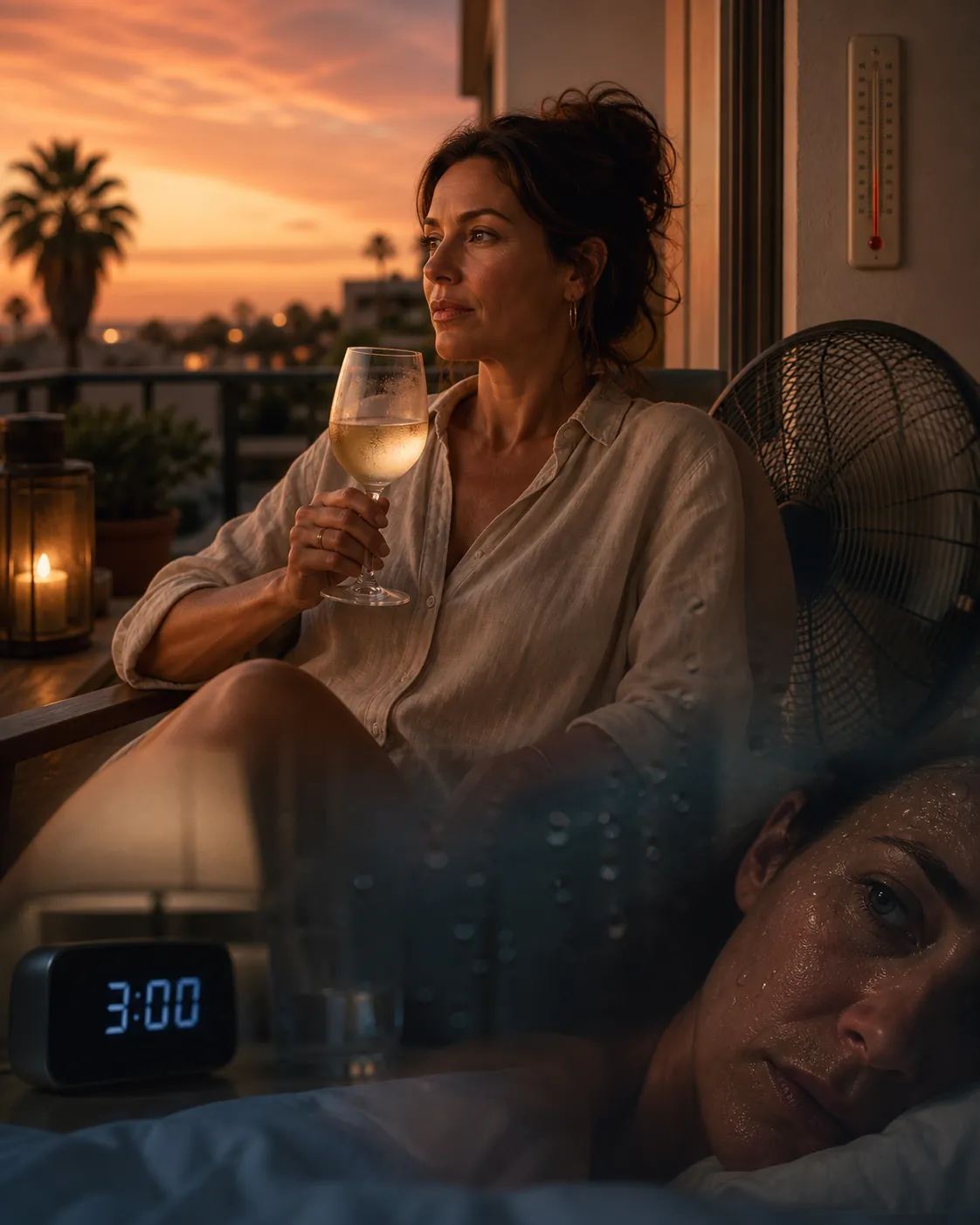
That distinction matters because the first effect of wine can feel convincing. You get drowsy faster. The evening softens. Then, around 2 or 3 a.m., the bargain comes due: lighter sleep, more awakenings, thirst, heat, and the particular irritation of realizing the “relaxing” drink helped you fall asleep but did not help you stay asleep.
Why wine can make you sleepy first and restless later
The sleep pattern is not imaginary. A 2025 systematic review and meta-analysis in Sleep Medicine Reviews found that alcohol tends to reduce sleep onset latency, meaning people fall asleep faster, while increasing wake after sleep onset and reducing sleep efficiency later in the night.[1] In plain English: alcohol can improve the doorway into sleep while making the house less stable once you are inside.
That is why “I sleep better after a glass” can be true for the first part of the night and false for the night as a whole. The sedating effect is front-loaded. As alcohol is metabolized, sleep becomes more fragmented. REM sleep can be suppressed earlier and rebound later, and the second half of the night becomes easier to disturb.
Hot weather makes that tradeoff less forgiving. Sleep depends on the body’s ability to shed heat. A cool bedroom, light bedding, and a falling core temperature all support the transition into stable sleep. Alcohol pushes in the other direction.
Hot nights make the alcohol problem bigger
In a controlled thermoregulation study, Danel and colleagues found that alcohol raised core body temperature by 0.36°C and reduced circadian temperature amplitude by 43%.[2] The study used heavy alcohol exposure over 26 hours, so those numbers should not be treated as a one-glass prediction. Still, the direction of the effect is the part that matters for a July bedroom: alcohol interferes with the normal temperature rhythm that sleep is trying to use.
On a mild night, your body may have more room to compensate. During a heat wave, in a warm apartment, or after a late patio dinner, there is less margin. Alcohol can also make you urinate more and wake thirstier, which is not the same as dehydration from a medical emergency, but is very much the kind of dry-mouthed 3 a.m. discomfort that keeps people awake.
This is also where wine color stops being the useful category. Red, white, and rosé all contain ethanol. A chilled white may feel more refreshing than a room-temperature red, and a sparkling low-ABV wine may fit a summer meal better, but the sleep-relevant question is not whether the wine feels summery. It is how much alcohol reaches your system, how close to bedtime it lands, and whether your body is already fighting heat.
For more on the heat side of the equation, the deeper cooling strategies belong in Restful Ground’s guide to sleeping during a heat dome. The wine decision sits on top of those basics, not instead of them.
The least-bad wine choice is about ABV, not wellness claims
If wine is going to happen anyway, look at the label before the varietal romance takes over. Alcohol by volume tells you more about sleep risk than whether the bottle has notes of citrus, stone fruit, or forest floor.
At the same serving size, a low-alcohol wine can deliver far less ethanol than a high-alcohol wine. Wine Folly’s comparison puts Moscato d’Asti around 5.5% ABV, about 6.6 grams of ethanol per 5-ounce glass, while a 15% ABV Zinfandel delivers about 18 grams in the same pour.[3] That is not a subtle difference. It is close to a threefold ethanol gap before the evening’s food, heat, timing, and second glass enter the picture.
| Wine style | Typical ABV | Sleep-relevant read |
|---|---|---|
| Moscato d’Asti | About 5.5% | One of the lowest-ABV wine choices; sweet, lightly sparkling, and still alcohol-containing |
| Brachetto d’Acqui | About 6.5% | Low-ABV red sparkling option; better than high-alcohol reds for ethanol load |
| Kabinett Riesling | About 8% | Often a useful low-ABV white choice; check the bottle because styles vary |
| Spätlese Riesling | About 8.5% | Can stay under 10% ABV, though producer and sweetness level matter |
| Vinho Verde | About 9% | Light summer style that often fits the lower-ABV target |
| Muscadet | About 9.5% | Dry, lighter white style that may stay under 10% ABV |
The practical cutoff is simple: under 10% ABV is the better target; under 11% is still preferable to the 13.5% to 15% bottles that can quietly turn one glass into a much larger alcohol exposure. This does not require turning dinner into a spreadsheet. It does require resisting the idea that a “light-bodied” wine is automatically low alcohol. Some wines taste fresh and still carry a higher ABV than expected.
There is also no good reason to choose wine for its melatonin content. Some wines have been discussed in that context, but the amounts are tiny compared with therapeutic supplement doses. If the goal is sleep, wine is an alcohol delivery system with trace compounds attached, not a meaningful melatonin strategy.
Timing is the second lever
The least-bad wine is not only lower in alcohol; it is earlier. Cleveland Clinic’s sleep guidance recommends finishing alcohol at least 3 to 4 hours before bed to reduce its effect on sleep.[4] That timing window is not a magic shield. It is a way to avoid sending your body into the first sleep cycle while it is still actively processing alcohol.
For a 10:30 p.m. bedtime, that means the glass belongs with an early dinner, not with the last episode, the late-night dessert plate, or the “just one more outside while it cools down” part of the evening. On hot nights, the late glass is the one most likely to collide with both alcohol metabolism and poor cooling.
- Choose the lower-ABV bottle first, ideally under 10% ABV.
- Keep the serving modest; ABV only helps if the pour does not expand.
- Finish 3 to 4 hours before bedtime.
- Pair the drink with food and water, but do not treat water as a way to cancel alcohol’s sleep effects.
- Cool the room first; wine should not be competing with a hot bedroom.
When the right wine is no wine
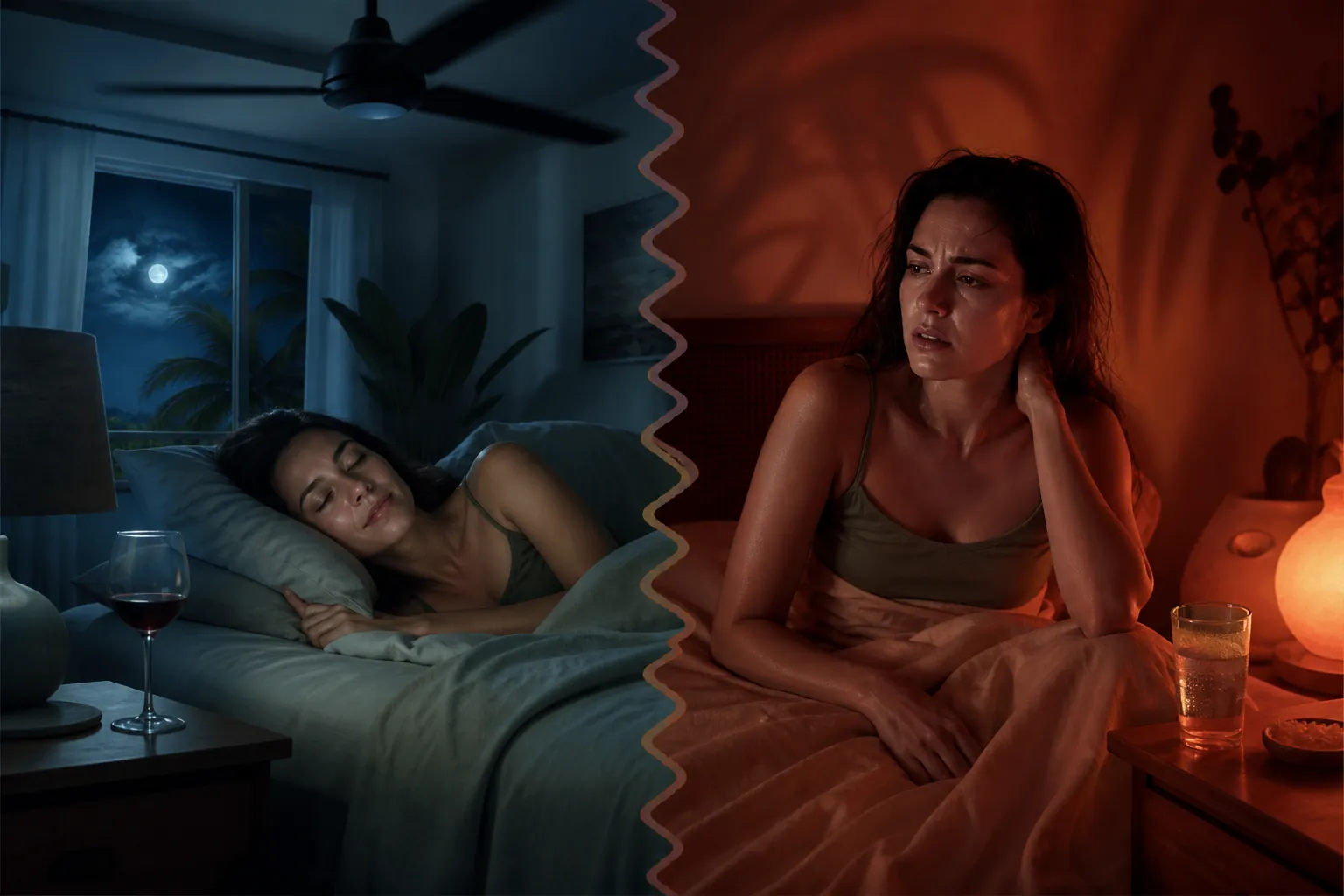
There are nights and bodies where optimization is the wrong frame. If you have sleep apnea, alcohol should not be treated as a varietal-selection problem. Alcohol can relax the upper airway and worsen breathing disruptions during sleep, and Cleveland Clinic specifically warns that alcohol can worsen sleep apnea.[4] In that situation, a 6.5% sparkling red is not the same risk as a 15% red, but the safer sleep choice is still to skip alcohol.
The same hard stop applies when perimenopause-related night sweats are already active. Hot weather, alcohol, and vasomotor symptoms are a miserable stack. If you are waking soaked, flushed, or unable to cool down, the question is no longer which wine is least disruptive. The question is why add another heat and fragmentation trigger to a night that is already physiologically loaded.
This is not purity advice. It is triage. A person sleeping well in a cool room after an early, low-ABV glass is making a different bargain from a person with untreated apnea, a heat-stressed bedroom, or repeated 3 a.m. sweats.
What to drink when sleep matters more than wine
The only genuinely sleep-neutral wine choice is the one without alcohol. Non-alcoholic wine, a spritz with no alcohol, tart cherry juice, or a chamomile-based mocktail will not create the same ethanol-driven sleep fragmentation. Sleep Foundation lists tart cherry and chamomile among bedtime mocktail ingredients commonly used for sleep-oriented drinks.[5] That does not mean a mocktail sedates you like medication. It means it avoids the alcohol problem.
For readers considering a longer break, Restful Ground’s explainer on what happens to your sleep when you quit alcohol goes deeper into the abstinence side of the tradeoff.
So the practical boundary is this: if sleep quality matters tonight, especially during heat, night sweats, or sleep apnea risk, the best wine is no wine. If you still choose to drink, make it lower ABV, check the label, keep it early, and do not ask a chilled glass to do the work of a cool bedroom and an alcohol-free nervous system.
References
- The effect of alcohol on subsequent sleep in healthy adults: a systematic review and meta-analysis, Sleep Medicine Reviews, 2025.
- Alcohol consumption and the body’s biological clock, American Journal of Physiology-Regulatory, Integrative and Comparative Physiology, 2001.
- The Lightest to the Strongest Wine, Wine Folly.
- Why You Should Limit Alcohol Before Bed for Better Sleep, Cleveland Clinic.
- Bedtime Mocktails for Sleep, Sleep Foundation.
Read the full guide: Which cooling sleep deals suit your life stage?