
How the 2026 Levothyroxine Recall Affects Your Sleep
If you are wondering whether the 2026 levothyroxine recall is why you are sleeping badly, the safest short answer is: possibly, but usually indirectly. The recall itself is not known to have a special “insomnia side effect.” Sleep can be affected because subpotent tablets may leave you under-replaced, because switching from a weak supply to a fully potent refill can make the same prescribed dose feel temporarily too strong, or because the word “recall” can put your nervous system on alert when you are trying to sleep.
Do not stop levothyroxine on your own. Thyroid hormone is a necessary daily medication for many people, and abrupt interruption can create its own risks. The practical first step is to call the pharmacy and ask them to verify the manufacturer and lot number on your bottle. Then contact the prescriber if your symptoms changed after a refill, after learning about the recall, or after switching to a replacement supply—especially if you are older, pregnant, have heart disease, or take levothyroxine for thyroid cancer suppression.

What was recalled, and why it matters for sleep
The July 2026 recall involved Major Pharmaceuticals levothyroxine tablets. The voluntary recall was initiated on July 13, 2026, covered seven dosage strengths from 25 mcg through 150 mcg, and was classified as a Class II recall because affected tablets were subpotent—meaning they may have contained less active ingredient than the label stated. Patients were directed to check pharmacy, manufacturer, and lot information rather than guessing by pill appearance alone.[1]
That subpotency detail is the hinge. A weaker tablet does not usually create a sudden stimulant-like insomnia picture by itself. More often, it can let hypothyroid symptoms creep back in. Then, when a person changes to a fully potent refill at the same prescribed dose, the body may experience that dose as a jump upward compared with what it had been receiving. Those are different situations, and they feel different at night.
There is not a peer-reviewed trial that directly studies “levothyroxine recall sleep side effects” as its own outcome. The best-supported explanation comes from putting three evidence streams together: the recall’s subpotency finding, known levothyroxine under- and over-replacement symptom patterns, and current clinical guidance on what patients should do after a potency-related recall.
Two sleep patterns to separate before you panic
The useful question is not simply “Can levothyroxine affect sleep?” It can. The better question is what kind of sleep problem you are having and when it started. Poor, heavy, unrefreshing sleep points in a different direction than wired wakefulness with a racing heart.
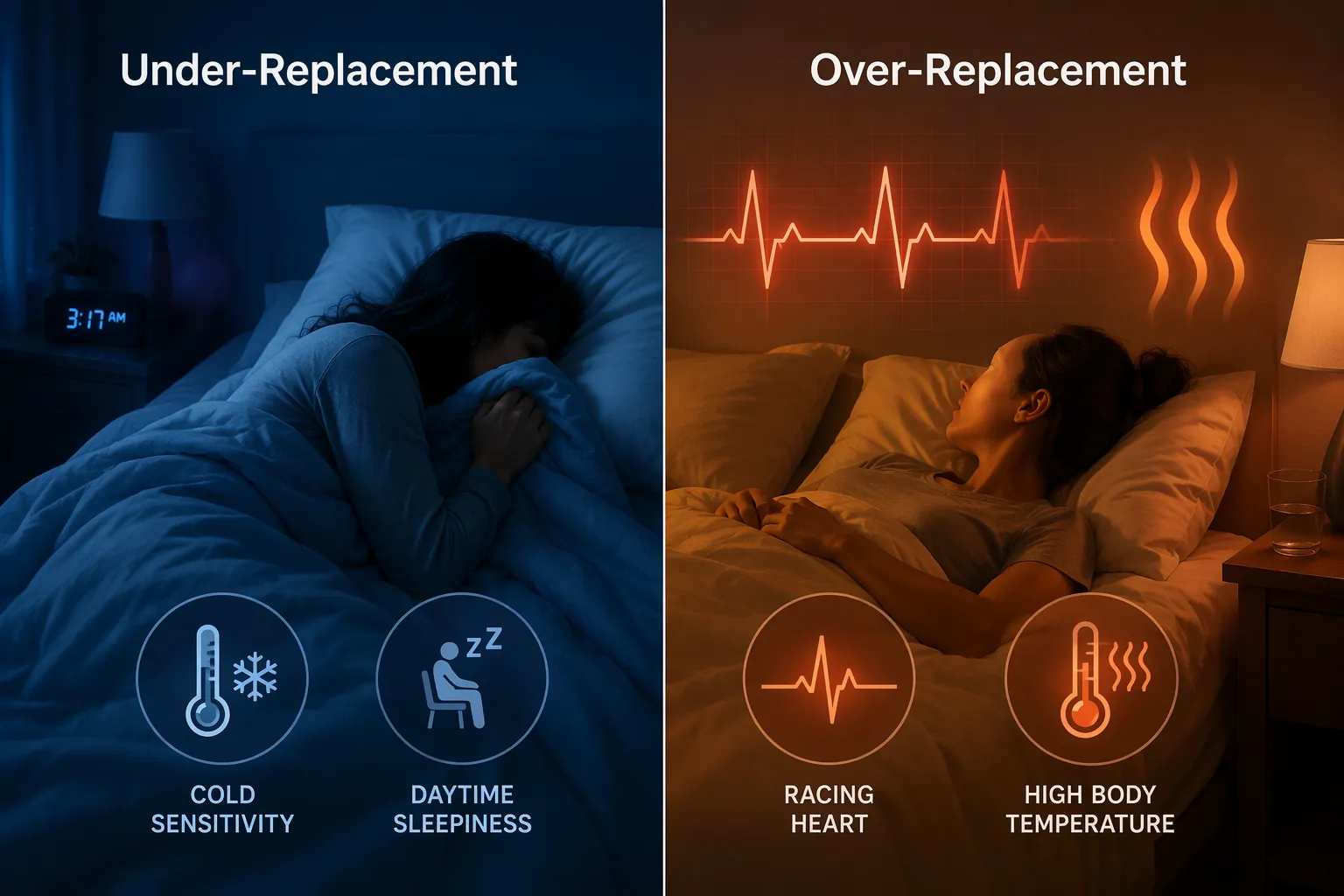
If sleep feels heavy, unrestorative, and daytime fatigue is worse
This is the under-replacement pathway. If an affected tablet delivered less levothyroxine than expected, your body may have been getting less thyroid hormone than your prescription intended. That can allow hypothyroid symptoms to return or worsen: fatigue, cold sensitivity, constipation, weight gain, daytime sleepiness, and a general sense that sleep is not restoring you.
This may not feel like classic insomnia. You may fall asleep but wake feeling as if you never reached useful rest. You may sleep longer and still drag through the day. Some people describe this as “bad sleep” when the more precise problem is that low thyroid hormone is making both daytime energy and nighttime sleep quality worse.
A prescriber will usually want the timeline: when the recalled bottle was dispensed, when symptoms changed, whether the pharmacy has confirmed the manufacturer and lot, and whether thyroid labs such as TSH should be checked or repeated after the medication supply is corrected. Clinical guidance on the 2026 recall specifically advises patients not to stop medication, to contact the pharmacy and prescriber, and to ask whether dose re-evaluation is needed after switching from a subpotent supply.[2]
If you are wired, hot, anxious, shaky, or your heart is racing
This is the over-replacement pathway, and it is the one that more closely resembles insomnia. Levothyroxine over-replacement is associated with symptoms such as insomnia, fast or pounding heartbeat, anxiety, tremor, and heat intolerance.[3][4]
The recall can lead to this pattern in a roundabout way. Imagine a person who has been taking a subpotent supply for several weeks. Their prescribed dose says one thing, but their body has effectively been receiving less. When the pharmacy replaces that supply with fully potent levothyroxine at the same labeled dose, the dose on paper has not changed—but the amount their body actually experiences may rise. For a while, that can feel like too much thyroid hormone.
This matters most when the nighttime complaint is specific: lying awake despite feeling tired, waking with a pounding heart, feeling unusually warm, sweating, trembling, or feeling internally revved up. Those symptoms deserve a prompt call to the prescriber, not a week of experimenting alone with skipped doses.
Older adults deserve extra caution here. Clinical guidance on the recall prioritizes follow-up for adults 65 and older, pregnant patients, people with heart disease, and patients using levothyroxine for thyroid cancer suppression, because the consequences of being under- or over-replaced can be more serious in those groups.[2]
| What you notice | More consistent with | What to do next |
|---|---|---|
| Sleeping more but not feeling restored; worse daytime sleepiness; cold sensitivity; constipation; weight gain | Possible under-replacement after subpotent tablets | Verify lot/manufacturer with the pharmacy and ask the prescriber whether thyroid labs or dose reassessment are appropriate. |
| Trouble falling asleep; waking wired; racing heart; anxiety; tremor; heat intolerance | Possible relative over-replacement after switching to fully potent supply | Contact the prescriber promptly, especially if you are older, pregnant, have heart disease, or have palpitations. |
| Sleep worsened right after reading about the recall; no clear thyroid-type symptom change | Recall-related hyperarousal may be contributing | Still verify the medication, but do not assume fear is proof that the pills are affected. |
Anxiety can keep you awake even when the dose is not the whole story
A recall is not a neutral word at 2 a.m. It can make a medication bottle that looked ordinary yesterday feel suddenly unsafe. That alarm can create its own sleep problem: checking the bottle repeatedly, replaying symptoms, searching lot numbers, and wondering whether every skipped beat or warm flush is thyroid-related.
That does not mean the symptoms are “just anxiety.” It means there may be two things happening at once: a medication potency question that needs verification, and a nervous system that is now trying to sleep while monitoring for danger. Treating anxiety as the entire explanation is sloppy; treating it as impossible is also unhelpful.
One useful distinction is timing. If sleep changed weeks before you heard about the recall, look harder at under- or over-replacement patterns. If sleep changed the night you read the notice, and you do not have a clear cluster of thyroid symptoms, the recall may have triggered hyperarousal even if your own bottle turns out not to be affected.
What to check before you call
You do not need to solve this alone before asking for help. But you can make the pharmacy and prescriber calls much more productive by gathering the right information.
- Check the bottle label for the pharmacy, fill date, manufacturer, strength, prescription number, and any lot information printed on the container or paperwork.
- Call the pharmacy and ask whether your dispensed medication came from the recalled Major Pharmaceuticals lots. Do not rely on tablet color or shape alone.
- Write down when sleep changed: before the recall news, after a specific refill, after a replacement supply, or after a dose change.
- Sort symptoms into the closest pattern: under-replacement, over-replacement, or anxiety-driven arousal.
- Ask the prescriber whether TSH or other thyroid testing should be checked now or after a stable period on the corrected supply.
Sleep problems in someone taking levothyroxine should lead to dose evaluation rather than an automatic assumption that the recall is responsible. A sleep complaint can come from thyroid hormone levels, another medication, menopause transition, pain, stress, sleep apnea, irregular dosing, or ordinary insomnia that happens to arrive during a recall week.[5]
Should you change the time you take levothyroxine?
Timing is worth discussing, but it is not the first fix for a recall problem. First confirm whether your pills are affected and whether your symptoms suggest under- or over-replacement. If your medication supply has changed and your body is reacting to a different effective dose, moving the pill from morning to bedtime will not answer the main safety question.
For some patients, dosing time can be flexible if the empty-stomach rule is consistent and the prescriber agrees. A 2022 crossover randomized clinical trial reported no significant difference in TSH levels between morning and bedtime levothyroxine dosing, and patient-facing medication guidance commonly notes that bedtime dosing requires separation from food, often several hours after the last meal.[6][7]
This is most useful when the sleep issue is practical: a morning routine makes consistent dosing impossible, or bedtime dosing appears to coincide with feeling wired. Do not change timing and dose at the same time unless your clinician tells you to, because then no one can tell which change affected your symptoms or labs.
Who should call sooner
Some people should not wait to see whether sleep settles down. Call promptly if you are 65 or older, pregnant, have known heart disease, have new or worsening palpitations, or take levothyroxine to suppress TSH after thyroid cancer treatment. Recall-specific clinical guidance flags these groups for prioritized follow-up.[2]
Pregnancy is its own category because levothyroxine needs often change during pregnancy, so a potency disruption can matter even when symptoms are subtle. Older adults and people with heart disease also have less room for trial-and-error when symptoms point toward over-replacement, especially if sleep loss comes with a racing or irregular heartbeat.
If you have chest pain, severe shortness of breath, fainting, or symptoms that feel urgent or dangerous, seek emergency care rather than waiting for a routine pharmacy callback.
A note about the 2025 alert
You may also see references to an American Thyroid Association alert from 2025. That was a separate recall-related event and should not be mixed together with the July 2026 Major Pharmaceuticals recall. If you are trying to determine whether your current bottle is affected, use your pharmacy’s dispensing records, manufacturer, and lot information—not a general memory of seeing “levothyroxine recall” in search results.
The call script
If you are tired and trying not to spiral, keep the script plain:
- “I take levothyroxine, and I’m calling to verify whether my recent fill was from the recalled Major Pharmaceuticals lots.”
- “My sleep changed on this date, and my symptoms are: ____.”
- “I switched from one supply to another on this date.”
- “Should I have TSH or dose reassessment after this switch?”
- “Should I keep taking the current tablets while this is being verified?”
The answer to that last question should come from the pharmacy or prescriber who can see your medication record. Until then, the general safety boundary remains the same: do not stop levothyroxine on your own, and do not treat insomnia, fatigue, or palpitations as proof of the recall without checking the actual bottle history.
References
- FDA recall database report on Major Pharmaceuticals levothyroxine recall — U.S. Food and Drug Administration, July 2026.
- Clinical Guide: 2026 Levothyroxine Recall — Passion Health Primary Care, July 27, 2026.
- Side effects of levothyroxine — NHS.
- Levothyroxine — MedlinePlus.
- Can levothyroxine cause sleep problems? — Ubie Health, July 10, 2026.
- Can you take levothyroxine at night? — SingleCare.
- Evaluation of Bedtime vs. Morning Levothyroxine Intake to Control Hypothyroidism in Older Patients: A Pragmatic Crossover Randomized Clinical Trial — Frontiers in Medicine, 2022.
Read the full guide: Recalled Levothyroxine? What to Do and How to Sleep