
Recalled Levothyroxine? What to Do and How to Sleep
Last reviewed: July 28, 2026. Recall details can change, so use this as a safety checklist, then confirm the current status with your pharmacy, prescriber, or the official recall notice.
If you just found out your levothyroxine may have been recalled, do not stop it abruptly or change the dose on your own. The safer first move is to verify whether your bottle is actually affected, keep taking medication only as directed by your clinician or pharmacist, and get replacement instructions through the pharmacy that dispensed it.

First: verify the bottle before you make a medication decision
The July 2026 recall involves specific lots of Major Pharmaceuticals levothyroxine sodium tablets, with recalled strengths reported across 25 mcg through 150 mcg, and the FDA classified it as a Class II recall because the affected tablets may be subpotent.[1][2] That means the key question at your kitchen counter is not simply “Do I take levothyroxine?” It is “Is this exact manufacturer, strength, and lot part of the recall, and what replacement does my pharmacy want me to use?”
Check the prescription label and bottle for four things: the manufacturer, the strength in micrograms, the lot number, and the expiration date. If the bottle label does not show the lot number clearly, do not guess. Pharmacies can often confirm the lot from dispensing records or the stock bottle used to fill your prescription.
- Find the manufacturer name. You are looking specifically for Major Pharmaceuticals in this recall.
- Confirm the tablet strength. Recalled strengths were reported across 25–150 mcg, so strength alone is not enough to rule it in or out.
- Match the lot number. This is the detail that separates an affected bottle from a same-strength bottle that may not be included.
- Take photos of the front label, any lot information, and the tablets if your pharmacist asks for them.
- Keep the bottle until the pharmacy tells you what to do with it. Do not throw it away before the lot is confirmed.
A Class II recall does not mean every bottle of levothyroxine is unsafe, and it does not mean every patient should suddenly stop thyroid replacement. It does mean the usual “I’ll just see how I feel tomorrow” approach is too loose. Levothyroxine is dose-sensitive, and a recalled or replacement product can affect symptoms before you know what your lab values look like.
Call the pharmacist first, then the prescriber
Your dispensing pharmacist is the fastest person to confirm whether your exact bottle is included. Call the pharmacy where you filled the prescription, not a random pharmacy counter, and have the bottle in your hand. Ask direct questions:
- “Can you confirm whether my manufacturer, strength, and lot number are part of the Major Pharmaceuticals recall?”
- “Should I keep taking this supply until a replacement is ready, or do you have replacement instructions from the recall notice?”
- “Will the replacement be the same manufacturer, a different generic, or a brand-name product?”
- “Will the tablet color, shape, or markings change?”
- “Can you note the old and new manufacturer in my profile so my prescriber can see the switch?”
Then contact the clinician who prescribes your levothyroxine. This does not need to be dramatic; it needs to be specific. Tell them whether the pharmacy confirmed a recalled lot, how long you may have taken it, your daily dose, and what replacement product you were given. Ask whether they want thyroid labs, a symptom check-in, or a specific follow-up interval. Do not ask only, “Should I be worried?” Ask what decision they want made next.
This matters more if you take a higher dose or have a narrow clinical margin, such as a history of thyroid cancer treatment, pregnancy, heart rhythm issues, or recent dose adjustments. The research most often cited on levothyroxine switching does not come from this U.S. recall; it comes from a forced switch away from Thyrax in the Netherlands. Still, it is a useful warning: among patients taking more than 100 mcg, abnormal TSH was reported in 63% after the forced brand switch, compared with 24% in those who stayed on the same brand.[3] That does not prove the same percentages apply to a U.S. generic recall, but it is enough reason to treat a switch as clinically relevant rather than cosmetic.
| If this is happening | Ask this next |
|---|---|
| Your bottle matches the recalled manufacturer, strength, and lot | Ask the pharmacist how to replace it and ask the prescriber whether monitoring or labs are needed. |
| Your bottle is Major Pharmaceuticals but the lot is unclear | Ask the pharmacy to verify the lot from dispensing records before you assume it is safe or recalled. |
| You receive a different manufacturer or brand | Ask both pharmacy and prescriber to document the switch and tell you what symptoms should trigger a call. |
| You already missed doses because you were afraid to take it | Tell the prescriber exactly how many doses you missed; do not double up unless they instruct you to. |
Now separate the sleep problem into two tracks
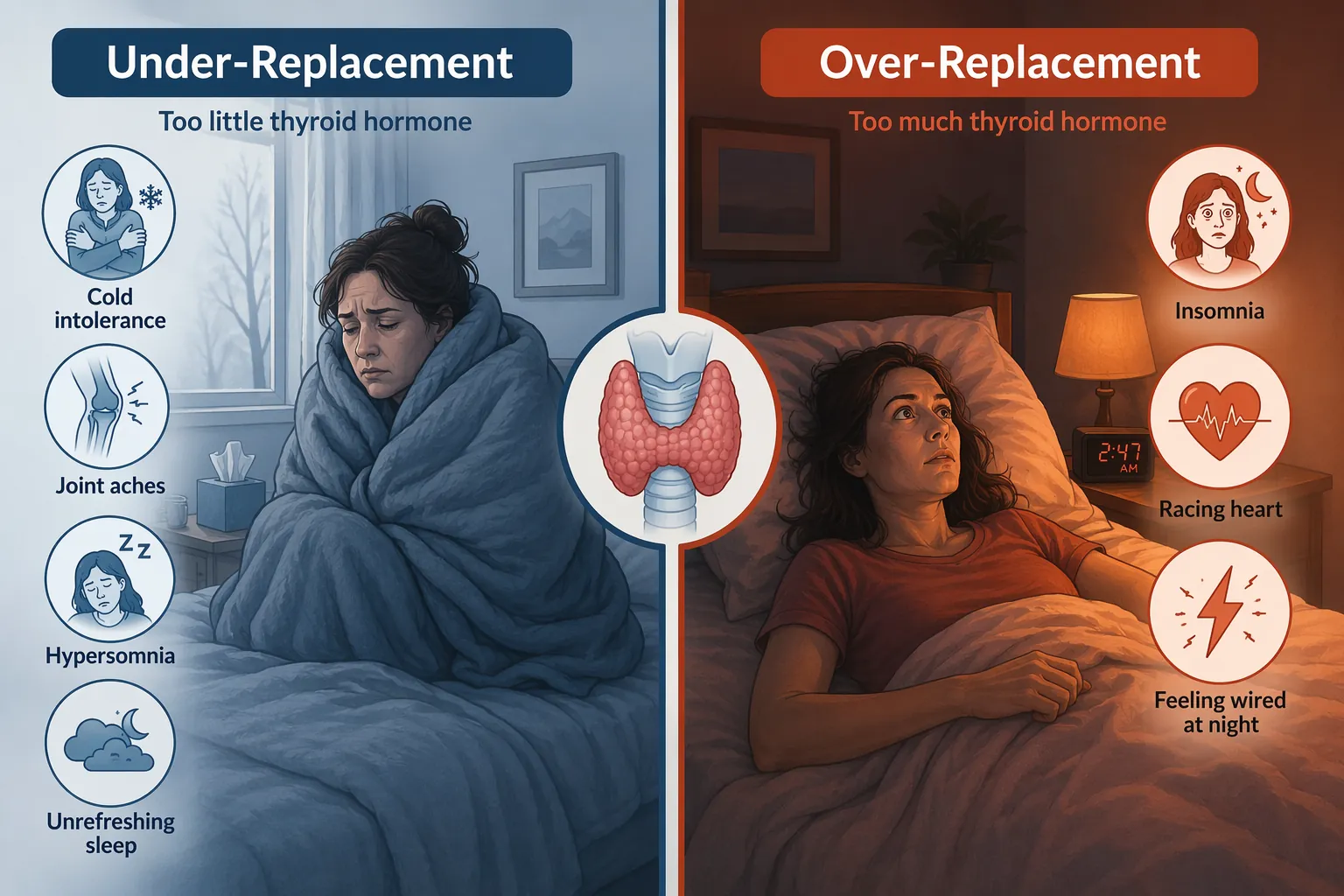
The recall can disturb sleep in opposite directions. Subpotent tablets can leave you under-replaced, which often feels sluggish, cold, achy, and unrefreshed. A replacement product or brand switch can, in some people, feel activating if the effective dose your body receives changes upward. Those two situations do not call for the same bedtime response.
Track 1: sleep that looks like under-replacement
If you took subpotent tablets for days or weeks, the sleep problem may not look like classic insomnia. It may look like lying in bed longer, sleeping but waking unrefreshed, needing more sleep than usual, feeling cold at night, or waking because aches and joint pain keep pulling you out of deeper sleep. Sleep Foundation’s overview links hypothyroidism with poor sleep quality, longer sleep onset, shorter sleep duration, and hypersomnia, and describes hypothyroidism as a leading endocrine cause of excessive sleepiness.[4]
In this track, the goal is not to push through fatigue with caffeine or to take extra levothyroxine. The goal is to reduce avoidable sleep disruption while you and your clinician determine whether the recalled supply affected you.
- Write down bedtime, estimated time to fall asleep, wake time, and whether sleep felt restorative.
- Note cold intolerance separately from ordinary room temperature. “Needed two blankets when everyone else was comfortable” is more useful than “slept badly.”
- Track aches, joint pain, constipation, low mood, and daytime sleepiness if they appear with the sleep change.
- Use warmth cautiously and practically: warmer socks, an extra blanket, or a warmer room if cold is waking you. Do not use this advice if you are feeling hot, wired, or sweaty at night.
- Avoid late-day caffeine as compensation for heavy fatigue, because it can create a second sleep problem that obscures the medication pattern.
When you contact your prescriber, give the pattern in a compact form: “My recalled bottle was confirmed on Monday. I may have taken it for about three weeks. Since then I am sleeping nine hours but waking exhausted, feeling cold at night, and having more joint aches.” That is much more actionable than “My sleep is terrible.”
Track 2: sleep that looks like over-replacement after a switch
The other sleep pattern is more activating: you feel wired at bedtime, your heart races, you wake with a jolt, or sleep gets lighter after a replacement product starts. The NHS lists insomnia as a common side effect when the levothyroxine dose is too high.[5] Nighttime racing heart can also be part of the clinical picture clinicians watch for when levothyroxine dosing or timing is not fitting well.[6]
This is the track where generic sleep advice can become unsafe if it ignores the medication issue. If your body is acting over-stimulated after a product change, do not respond by skipping tablets, splitting tablets differently, or alternating doses unless your prescriber gives that instruction. The fact that sleep is worse does not tell you at home whether your TSH, free T4, or effective dose has shifted enough to justify a change.
- Record when the replacement product started and whether the manufacturer, brand, tablet color, or tablet markings changed.
- Track sleep onset insomnia separately from early-morning waking. They may feel similar at 3 a.m., but the timeline helps your clinician.
- Write down racing heart, shakiness, heat intolerance, sweating, anxiety-like activation, or unusually frequent bowel movements if they occur.
- Keep the room cooler only if heat or sweating is part of the problem. Do not apply the under-replacement warming advice to this track.
- If symptoms feel severe, new, or cardiac—especially chest pain, fainting, or a sustained racing heartbeat—seek urgent medical guidance rather than waiting for a routine message reply.
A useful message sounds like this: “I switched from the recalled Major Pharmaceuticals tablets to a new manufacturer on Thursday. Since then I fall asleep two hours later, wake with a racing heart, and feel hot at night. I have not changed the dose myself. Do you want labs or a dose review?” That gives the prescriber timing, direction, and restraint.
Medication timing: do not turn it into a sleep hack
Levothyroxine timing matters because absorption matters. The NHS advises taking levothyroxine on an empty stomach, usually before breakfast, and avoiding food or caffeinated drinks for a period afterward.[5] If your usual morning routine is chaotic during the recall—new bottle, new tablet appearance, anxious checking—it is reasonable to ask whether your dosing schedule is still the best fit. It is not reasonable to keep moving the dose around every few days because sleep is bad.
There is some evidence that bedtime dosing can work for certain patients. SingleCare summarizes a 2022 randomized crossover trial that found no significant difference in TSH between morning and bedtime levothyroxine dosing.[7] That is a conversation starter, not permission to improvise. Bedtime dosing still has to be separated from food, supplements, and other medications, and it may be a poor choice for someone whose main problem is feeling wired at night.
| Sleep pattern | Timing question to ask |
|---|---|
| Cold, sluggish, sleeping longer but unrefreshed | “Could the recalled supply have left me under-replaced, and when should we check labs or symptoms?” |
| Wired, hot, racing heart, new insomnia after replacement | “Could the new product be affecting me differently, and should we review dose, labs, or manufacturer consistency?” |
| Morning dose is often missed or taken with coffee or breakfast | “Is there a safer timing plan I can follow consistently without interfering with absorption?” |
| Considering bedtime dosing | “Would bedtime levothyroxine be appropriate for me, and how far from food, supplements, or other medications should it be?” |
What to put in your sleep-and-recall log
You do not need a perfect wellness journal. You need a record that separates medication facts from sleep symptoms and separates sluggish symptoms from activating symptoms. A clinician can use that. A page of general complaints is harder to act on.
- Medication: manufacturer, strength, lot number if known, start date of recalled bottle, stop or replacement date, and new manufacturer or brand.
- Dose behavior: missed doses, late doses, doses taken with food or coffee, and any accidental double doses.
- Sleep timing: bedtime, estimated sleep onset, number of awakenings, final wake time, naps, and whether sleep felt restorative.
- Under-replacement signs: cold intolerance, unusual fatigue, aches or joint pain, constipation, low mood, hypersomnia, or fragmented sleep that feels heavy rather than activated.
- Over-replacement signs: insomnia, racing heart, heat intolerance, sweating, tremor-like shakiness, feeling wired, or anxiety-like nighttime activation.
If you use a wearable, do not argue with it at 4 a.m. Use it as supporting information only. “My resting heart rate rose after the new manufacturer started” may be useful. “My sleep score was 61” is less useful unless it matches symptoms you can describe.
If sleep stays bad after the medication issue is corrected
Not every sleep problem during a recall is caused by the recall. Anxiety about taking a recalled medication can keep people awake. So can pain, perimenopause, alcohol, another medication, untreated restless legs, or sleep apnea. Some research cited by Everyday Health suggests about 30% of people with hypothyroidism have sleep apnea, but that figure should be treated as a caution rather than a diagnosis.[8]
The practical point is simple: once the pharmacist has replaced the recalled supply and your prescriber has decided whether monitoring is needed, persistent snoring, gasping, morning headaches, marked daytime sleepiness, or ongoing insomnia deserve their own evaluation. Do not let the recall become the explanation for every bad night indefinitely.
A levothyroxine recall is unsettling because the same event can push sleep complaints in two opposite directions: under-replacement can make nights heavy, cold, achy, and unrefreshing; over-replacement after a switch can make nights hot, alert, and sleepless. You do not have to solve that distinction alone. Verify the lot, work through the pharmacist and prescriber, avoid self-adjusting the dose, and report your sleep symptoms by direction rather than dumping them into one vague complaint.
References
- Commonly Prescribed Thyroid Medication Recalled Nationwide, FDA Warns, Prevention
- Levothyroxine Recall 2026, Passion Health Physicians
- Clinical Thyroidology for the Public, Vol 13 Issue 7 p.5-6, American Thyroid Association
- Thyroid Issues and Sleep, Sleep Foundation
- Levothyroxine, NHS
- Thyroid Rx's and heart racing at night: Why levothyroxine, Ubie Health
- Can I take levothyroxine at night?, SingleCare
- Sleep Better With Hypothyroidism, Everyday Health
Read the full guide: How the 2026 Levothyroxine Recall Affects Your Sleep