How the 2026 Libra Full Moon Affected Sleep
If you slept badly around the 2026 Libra Pink Moon, the grounded answer is: yes, the full moon could plausibly have contributed, but probably in a modest and uneven way. The April full moon peaked on April 1, 2026, at 10:12 p.m. ET, at 12°21′ Libra; depending on time zone, some readers experienced the calendar date differently, but the relevant sleep window was the cluster of nights around it, not only that exact clock moment.[1]
The strongest sleep evidence does not show a special, clinically proven “Libra” mechanism. It shows a lunar-cycle pattern: sleep tends to start later and run shorter around the days before a full moon, especially 3 to 5 nights before peak illumination. In the largest field study usually cited on this question, sleep duration varied by 46 to 58 minutes across the lunar cycle, with the shortest sleep before the full moon; depending on the group, people slept about 20 to 90 minutes less and fell asleep about 30 to 80 minutes later.[2]
What “Libra Pink Moon Sleep Effects” Can Mean Without Overstating It
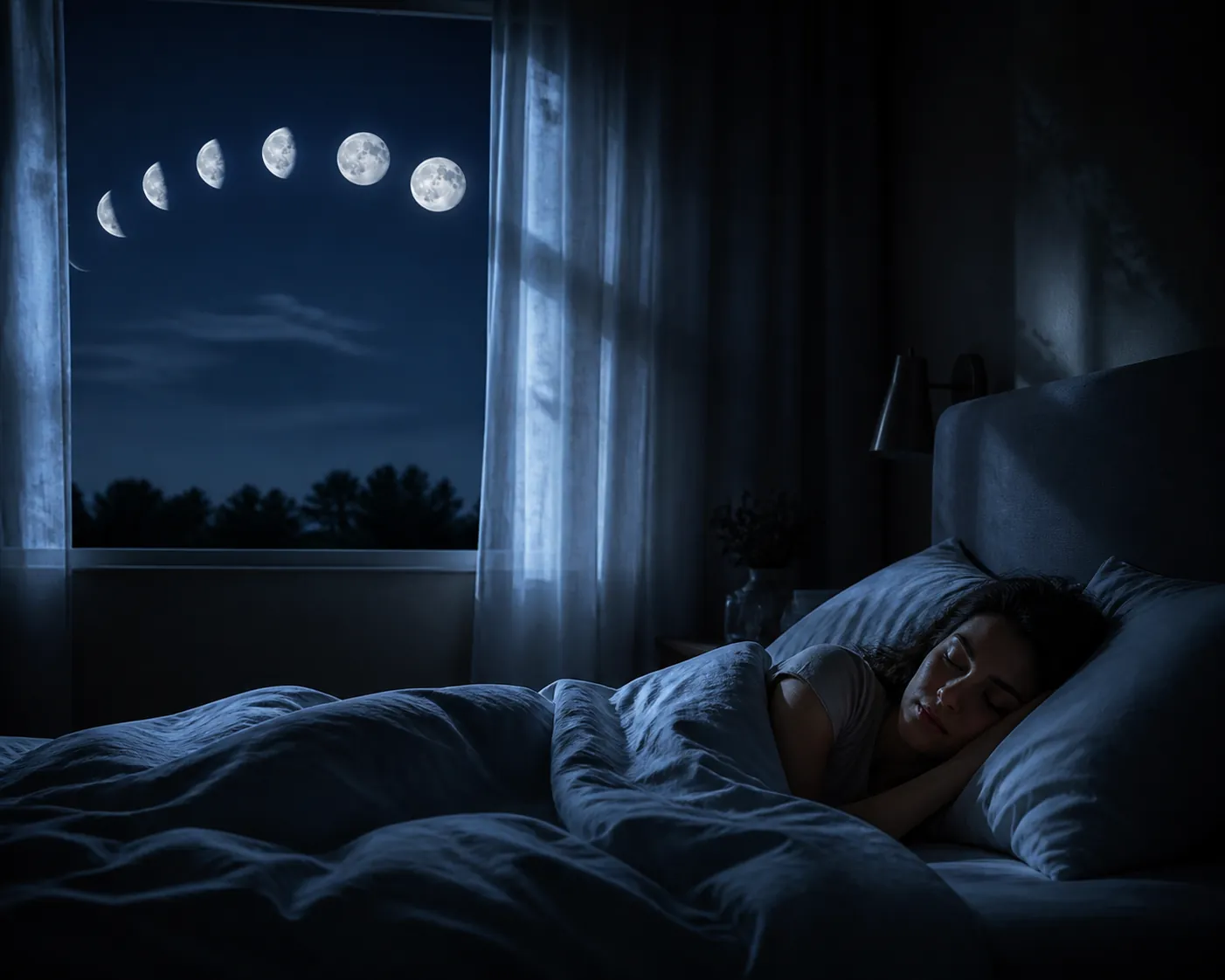
The phrase “Libra Pink Moon” carries two different kinds of claims. “Pink Moon” is the traditional name often used for April’s full moon; it does not mean the moon turned pink. “Libra” is the zodiac placement many astrology readers used to frame the night as relational, emotionally balancing, Venus-ruled, and set opposite the Sun in Aries. Some 2026 astrology discussions also emphasized a Jupiter square as a sign of emotional amplification.
That language may be how someone made meaning of the night. It is not, by itself, a sleep mechanism. The medically useful question is narrower: did the lunar phase around April 1, 2026 line up with known changes in sleep timing, sleep duration, or sleep depth? On that point, the answer is more interesting than a flat dismissal.
| Claim | What the evidence supports |
|---|---|
| The 2026 Libra full moon guaranteed poor sleep | No. The evidence supports increased risk or tendency for some people, not a universal effect. |
| The full moon can delay sleep | Yes. Field data found sleep onset delayed by about 30 to 80 minutes around the pre-full-moon window.[2] |
| The exact full moon night is always the worst night | Not necessarily. The strongest pattern appears 3 to 5 nights before the full moon in the main field study.[2] |
| Artificial light makes the moon irrelevant | No. Urban groups showed a smaller pattern, but it was not fully erased.[2] |
| Libra, Venus, Aries, or Jupiter are proven sleep causes | No. Those are astrological interpretations, not clinically validated explanations. |
The Best Evidence Points to the Nights Before the Full Moon
The most useful study for this question is Casiraghi et al.’s 2021 field study, which tracked sleep in three Toba/Qom Indigenous communities in Argentina and in University of Washington students in Seattle. The study included 98 Toba/Qom participants across communities with different access to electricity, plus 464 university students. Across these groups, sleep showed a repeated lunar rhythm: people tended to go to bed later and sleep less in the nights before the full moon.[2]
That timing matters. Many people check the full moon date after a rough night and assume the peak night itself should be the only suspect. The field data suggest a slightly different pattern. The shortest sleep occurred about 3 to 5 nights before the full moon, when the waxing moon is bright in the early evening sky. That is the part of the night when light can most readily push sleep later.[2]
The size of the effect also matters. In communities without electricity, the average reduction was larger; in the urban student group, the same pattern appeared at lower magnitude, around 11 minutes less sleep compared with about 25 minutes in electricity-free communities.[2] For a person already sleeping on the edge, even a small average shift can feel larger in real life: a later bedtime may collide with a fixed alarm, caregiving, shift work, anxiety, pain, or an early commute.
Why Moonlight Could Delay Sleep
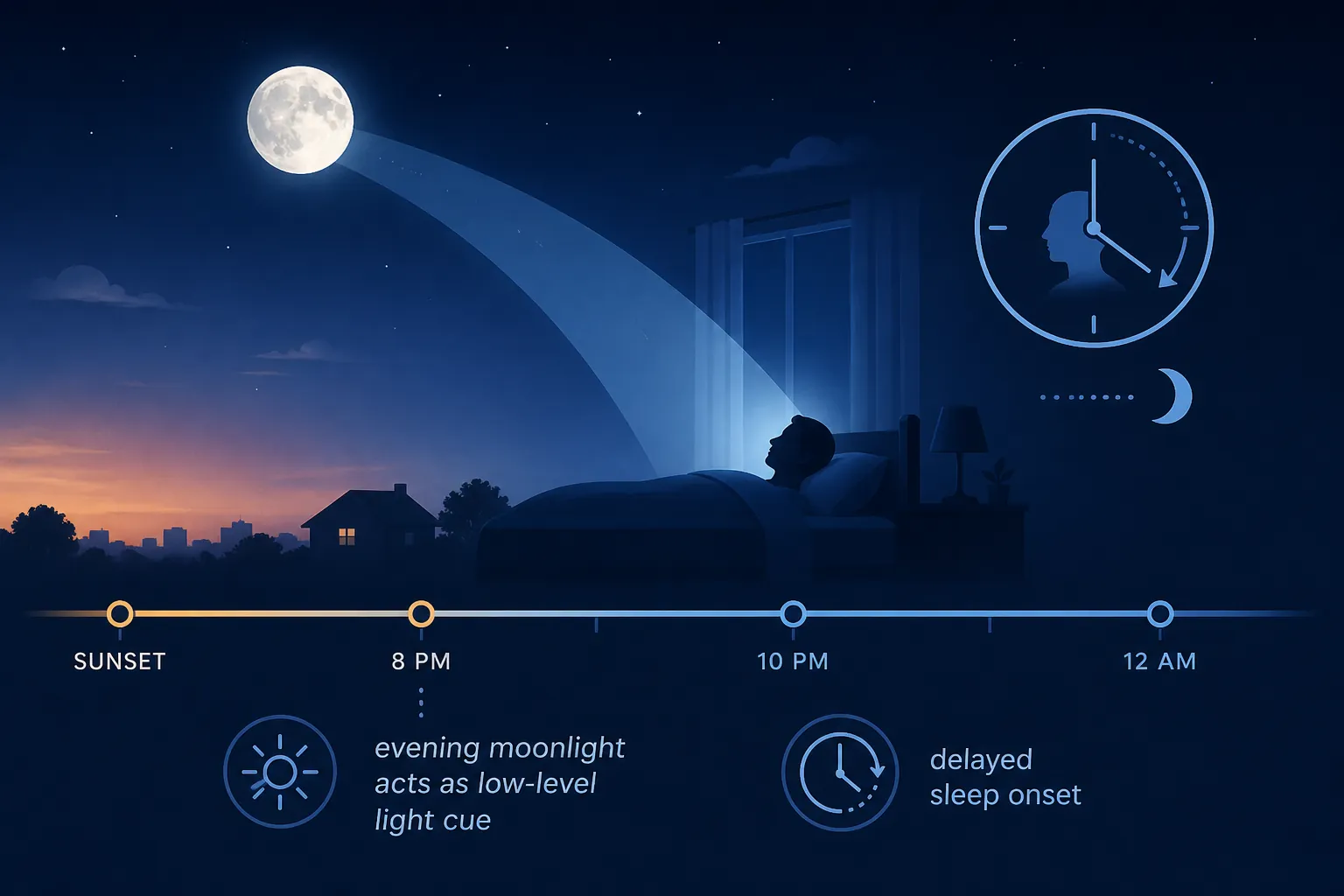
The proposed mechanism is not mysterious. Moonlight before the full moon appears during the first hours after dusk. That gives it a plausible route into sleep physiology: evening light can act as a low-level signal to delay circadian sleep onset. The Casiraghi study authors interpreted the pattern as consistent with moonlight extending evening activity and delaying sleep, especially where artificial lighting is limited.[2]
Artificial light complicates the picture rather than canceling it. In a brightly lit city apartment, the moon is rarely the strongest light source in the evening. Screens, overhead LEDs, streetlights, and irregular schedules may dominate the signal. But the urban student data still showed a weaker version of the lunar rhythm, which is why the careful conclusion is not “the moon controls sleep.” It is closer to: lunar light may add a small timing pressure that some people notice and others never feel.[2]
The same study also observed a 15-day semilunar component, which the authors noted could hint at a secondary gravitational influence.[2] That part is intriguing but not the most practical explanation for a reader trying to understand one bad week of sleep. The light-and-timing pathway is easier to connect to ordinary behavior: more brightness in the first part of the evening, later sleep onset, shorter sleep if wake time stays fixed.
What Lab Data Adds: Sleep Was Shorter and Deep Sleep Was Lower
A smaller controlled lab study gives this question a different kind of support. Cajochen et al. published an analysis in 2013 reporting that, around the full moon, participants had about 30% less EEG delta activity during deep NREM sleep, took about 5 minutes longer to fall asleep, and slept about 20 minutes less overall.[3]
That study is useful because it was not simply asking people whether they believed the moon affected them. It looked at sleep architecture under controlled conditions. The finding that deep NREM sleep changed is one reason the full moon question should not be waved away as only folklore. At the same time, the study was small, and its sleep-onset delay was much smaller than the largest field estimates. It supports plausibility, not certainty for any individual night.
A later study by Turányi et al. also reported an association between lunar phase and sleep, adding to the evidence that the relationship has appeared in more than one dataset.[4] Taken together, the research is enough to answer a reader respectfully: your observation is not absurd. It is also not a diagnosis, and it cannot prove that the April 2026 Libra full moon caused your particular wake-up at 3 a.m.
Why One Person Notices It and Another Does Not
The average effect in a study is not the experience of every sleeper. Some people may notice almost nothing. Others may lose an hour or more around the bright-moon window, especially if several vulnerabilities stack up at once: a bedroom that admits moonlight or streetlight, a late chronotype, irregular bedtime, stress, alcohol, perimenopausal night waking, pain, caregiving, travel, or a fixed early alarm.
Expectation can also matter, but it should be handled carefully. If someone reads that a full moon will be emotionally intense, they may monitor sleep more closely, feel more activated at bedtime, or interpret normal awakenings as significant. That does not make the sleep loss fake. It means the pathway may be mixed: some light exposure, some schedule drift, some stress physiology, some attention to the moon, and sometimes ordinary coincidence.
This is where the 20-to-90-minute range is more useful than a yes-or-no answer. A 20-minute loss may be barely noticeable for a well-rested person. A 90-minute loss can change mood, appetite, pain sensitivity, reaction time, and patience the next day. The full moon does not have to be the sole cause to be a meaningful contributor.
How to Read Your April 2026 Sleep in Hindsight
If you are looking back at the Libra Pink Moon, the most useful question is not “Was it the moon or was it me?” A better question is: did your sleep timing change in the 3 to 5 nights before April 1, and did that change mainly show up as later sleep onset or shorter total sleep?
- Look first at bedtime and sleep onset, not only wake-ups. The strongest field signal was delayed sleep onset before the full moon.[2]
- Compare several nights, not one dramatic night. A single poor night can come from many causes.
- Check whether wake time stayed fixed. A later bedtime becomes a sleep-loss problem when the morning alarm does not move.
- Notice light exposure. Open blinds, outdoor evening time, bright rooms, and screens can all push the same circadian direction.
- Separate meaning from mechanism. Libra themes may describe how the night felt; the sleep evidence points mainly to light, timing, and sensitivity.
Accessible summaries from Harvard Health and Sleep Foundation make the same general point in less technical language: full-moon sleep changes are plausible and measurable in some studies, but they are modest, variable, and not a reason to assume every full moon will disrupt every sleeper.[5][6]
What to Watch During the Next Full Moons
For future moons, the practical window starts before the calendar peak. If you are curious about the August 28, 2026 Sturgeon Moon or the September 26, 2026 Harvest Moon, watch the 3 to 5 nights beforehand rather than waiting for the full moon night itself.[1] Track sleep onset, total sleep time, and how much evening light you received. That gives you a cleaner signal than trying to remember how you felt after the fact.
You do not need an elaborate lunar sleep protocol. On those pre-full-moon evenings, dim indoor lights earlier, close curtains if moonlight or streetlight reaches the bed, keep screens lower and warmer, and avoid turning the moon into a bedtime threat. If the moon is part of a calming ritual for you, keep the calming part. If moon-tracking makes you vigilant and tense, it may be better to collect data quietly for a few cycles and look for patterns later.
The calibrated judgment is simple enough: the 2026 Libra full moon likely contributed to some sleep disruption for sensitive sleepers, in a way consistent with evidence showing roughly 20 to 90 minutes less sleep and delayed onset around full moons. It should not be treated as a guaranteed cause of any one bad night, and the Libra astrology should not be mistaken for a proven sleep mechanism.
References
- Full Moon Calendar 2026, The Old Farmer’s Almanac.
- Moonstruck sleep: Synchronization of human sleep with the moon cycle under field conditions, Science Advances, 2021.
- Evidence that the lunar cycle influences human sleep, Current Biology, 2013.
- Association between lunar phase and sleep characteristics, Sleep Medicine, 2014.
- Does the moon affect our sleep?, Harvard Health Publishing, 2021.
- Does the Moon Affect Sleep?, Sleep Foundation.
Read the full guide: How the July 2026 Full Moon Disrupted Sleep in 3 Populations