How the July 2026 Full Moon Disrupted Sleep in 3 Populations
The morning after the July 2026 Buck Moon, the complaints sounded oddly specific: a perimenopausal reader woke hot and wired at 3 a.m.; a third-trimester pregnant reader took forever to fall asleep and then had no room left to recover; an ADHD adult watched bedtime slide later again, even after trying to be careful. If you searched for full moon sleep disruption horoscope july 2026, the useful answer is not that the Buck Moon controlled your sleep. It is that a modest lunar sleep effect may have landed on a sleep system that was already out of slack.
That distinction matters. A healthy adult losing 15 to 30 minutes may notice little more than a slow morning. Someone already losing sleep to hot flashes, reflux, nighttime urination, delayed circadian timing, stimulant rebound, or a narrowed sleep window may feel that same extra burden as the night that finally tipped over.
What the full moon effect actually measured
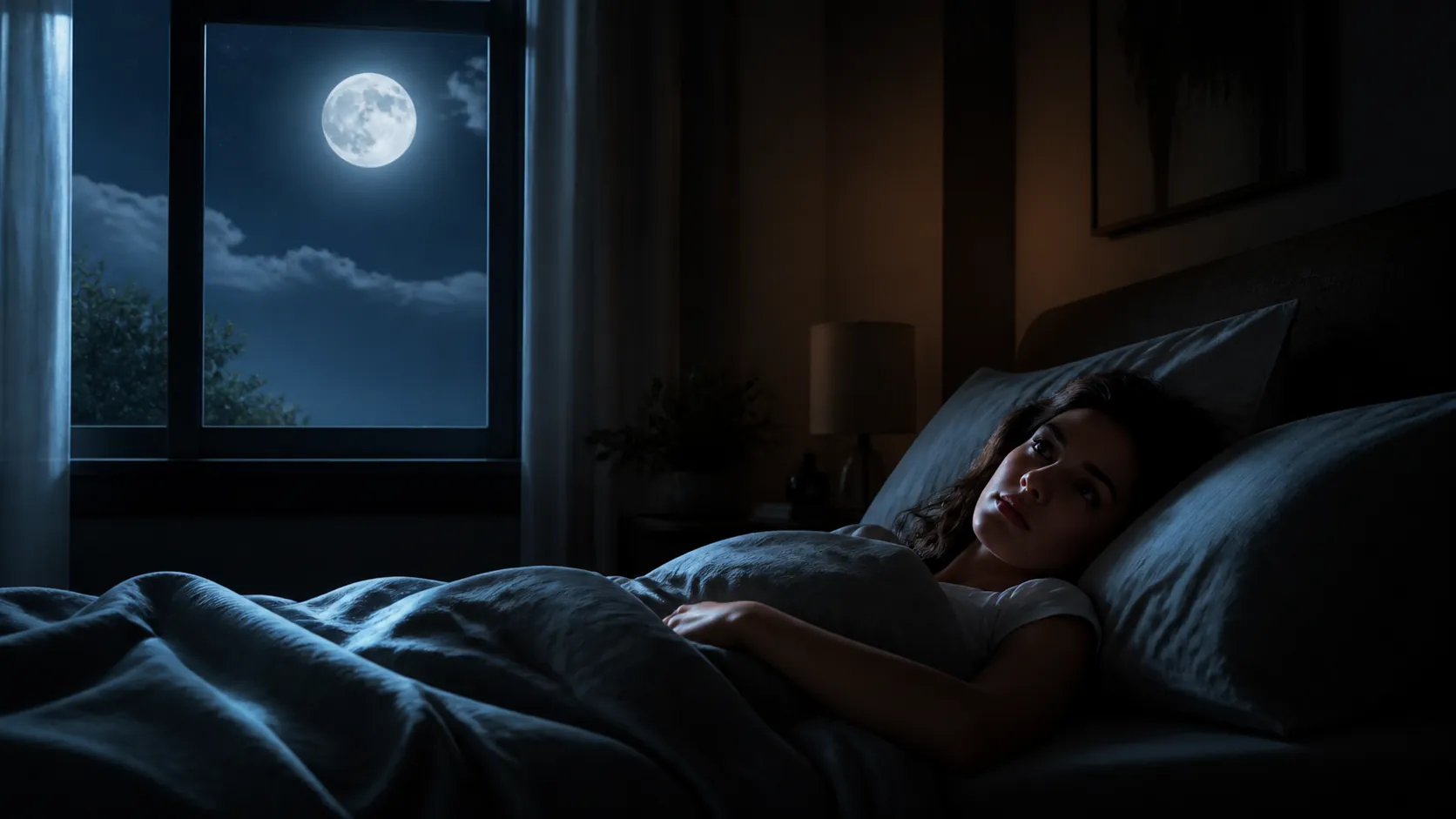
The cleanest place to start is a small laboratory study that has been repeatedly overinterpreted and underinterpreted in equal measure. In 33 healthy adults studied under controlled conditions, Cajochen and colleagues found that around the full moon, participants slept about 20 minutes less, took about 5 minutes longer to fall asleep, and showed a 30% reduction in EEG delta activity during NREM sleep.[1]
The last number is the one that most needs careful handling. A 30% reduction in EEG delta activity is not the same thing as “30% less sleep.” Delta activity is an electrical marker related to the intensity of deep NREM sleep. In plain terms, the study suggests that sleep was not only a bit shorter but also measurably lighter in one important deep-sleep signal. That is more biologically interesting than a horoscope claim, and less dramatic than saying the moon stole a third of the night.
A larger field study gives the timing that was more relevant for July. Casiraghi and colleagues studied sleep in rural communities without electricity and in urban U.S. college students, with 464 participants across samples. They found that sleep onset was delayed by 30 to 80 minutes and total sleep was reduced by 20 to 90 minutes in the 3 to 5 nights before the full moon.[2]
That means the practical window for the July 29, 2026 Buck Moon was not just the full moon night itself. The higher-risk stretch was July 24 through July 28, the 3 to 5 nights before the peak. The Buck Moon peaked on July 29 at 10:36 a.m. EDT, so a person who slept badly on the nights leading into it was not necessarily imagining the timing.[3]
| Measured finding | What it means | What it does not prove |
|---|---|---|
| About 20 minutes less total sleep in the controlled lab study | A modest shortening of the night in healthy adults | That every person loses the same amount of sleep every full moon |
| About 5 minutes longer to fall asleep in the controlled lab study | A small sleep-onset delay under controlled conditions | That the moon is the main cause of chronic insomnia |
| 30% lower EEG delta activity during NREM sleep | A reduction in a deep-sleep intensity signal | That total sleep duration dropped by 30% |
| 30 to 80 minutes later sleep onset in field conditions before full moon | A larger pre-full-moon timing shift in real-world settings | That moonlight is stronger than artificial light exposure |
Why a modest change can feel large
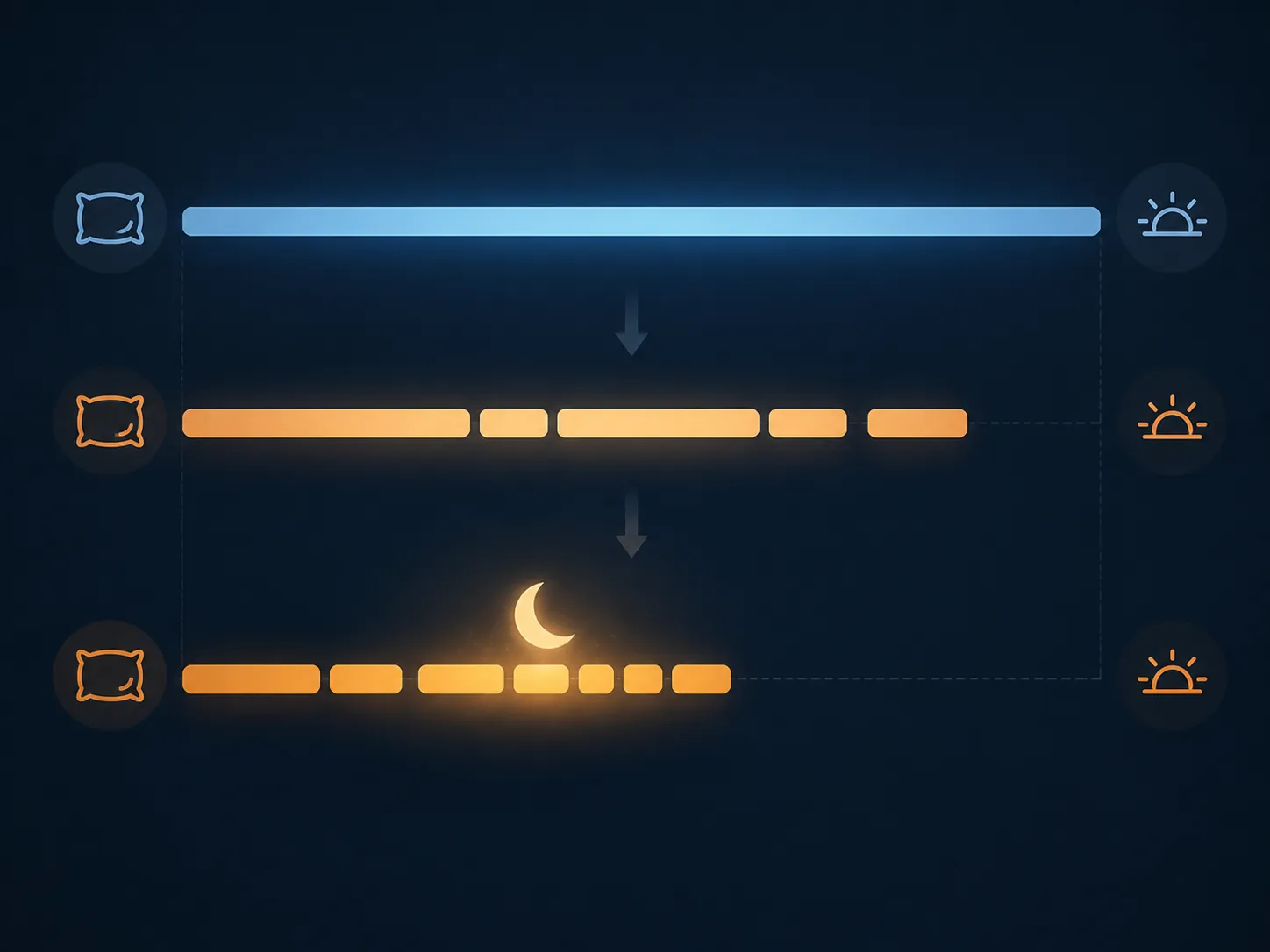
The full moon effect is easiest to dismiss when it is treated as a standalone event. Fifteen to 30 minutes is not a medical catastrophe. But sleep complaints rarely arrive in a clean laboratory life. The reader who felt wrecked after the Buck Moon may have entered that week already short by 30 to 60 minutes, already waking several times, or already starting sleep too late to meet the next morning’s demands.
This is the compounding problem. A slight delay matters more when the sleep window is already compressed. A lighter deep-sleep signal matters more when awakenings are already fragmenting the night. A bright bedroom matters more when the body is already struggling with temperature, hormones, reflux, or circadian timing.
Perimenopause: the clearest overlap
Of the three groups here, perimenopausal sleepers have the strongest case for feeling a small full-moon burden more sharply. Perimenopause is already associated with lower sleep efficiency, more night awakenings, and hot-flash-related sleep fragmentation.[4] That baseline is important: the person is not starting from a quiet, consolidated night and then adding moonlight. She may be starting from a night that is already being broken into pieces.
Thermoregulation is one reason this overlap is so believable. Hot flashes can wake a person abruptly, and even after the heat passes, the nervous system may not settle quickly. If the pre-full-moon window also nudges sleep onset later or makes sleep lighter, the result can feel disproportionate: not because the moon caused perimenopause insomnia, but because it added friction to an already unstable night.
Melatonin is another plausible bridge, though it should not be exaggerated. Full moonlight is weak compared with most artificial indoor and outdoor light, but moonlight still sits in the conversation about circadian timing. When a person’s sleep is already sensitive to hormonal shifts and body-temperature changes, a small circadian-delaying influence in the wrong week may be noticeable.
There is also a preliminary sex-difference signal in the literature. Turányi and colleagues reported lower sleep efficiency and longer REM latency around the full moon, with some suggestion that women may be more affected.[5] That finding should stay small in the interpretation: the samples are limited, and it is not enough to claim that full moons reliably disrupt women’s sleep more. It is enough to keep the question open rather than dismissing the experience outright.
For a deeper look at this overlap, Restful Ground’s perimenopause and full-moon sleep guide goes further into hot flashes, circadian timing, and why the pre-full-moon nights can feel worse than the peak itself.
Third-trimester pregnancy: less direct evidence, very little margin
Pregnancy deserves a more cautious claim. The available evidence does not support saying that full moons have been directly studied as a sleep trigger in pregnant populations. The better statement is narrower: third-trimester sleep is often already fragmented by physical discomfort, frequent urination, and reflux, so a pre-full-moon delay in falling asleep could be more costly than it would be for someone with a wide sleep window.
The mechanism is not mysterious. If a pregnant person needs extra pillows to get comfortable, wakes to urinate, sits up with reflux, and has an early alarm, the front end of the night becomes precious. A 20-minute delay is no longer “just” 20 minutes. It may be the only uninterrupted stretch that was likely to happen before the first bathroom trip.
That does not make the Buck Moon the diagnosis. If sleep is severely reduced, breathing feels abnormal at night, snoring has changed, blood pressure concerns are present, or daytime sleepiness becomes unsafe, the explanation should not stop at lunar timing. A calendar pattern can help identify a vulnerable week; it should not replace pregnancy care.
ADHD adults: the circadian-delay problem
ADHD is another place where the argument is plausible but not directly proven by lunar-phase studies. ADHD is associated with a higher prevalence of delayed sleep phase syndrome and altered melatonin profiles. If bedtime already tends to drift late, the pre-full-moon pattern reported in field studies is the kind of added delay that can push a fragile schedule past the point of recovery.[2]
The practical consequence is familiar to many ADHD adults: the night does not fall apart dramatically; it slides. One more task, one more screen check, one more burst of alertness, and the intended bedtime becomes theoretical. If brighter evenings, moonlit bedrooms, or later outdoor light exposure coincide with that pattern, the person may feel the full moon week more than someone whose circadian rhythm is less easily delayed.
Medication timing belongs in this conversation, but carefully. ADHD adults should not change stimulant timing or dosing casually because of the moon. If a pattern repeats across several full-moon cycles, it is reasonable to bring a dated sleep log to the prescribing clinician and discuss whether the current schedule is protecting sleep well enough.
How much should you blame the Buck Moon?
Blame it a little, if the timing fits. Do not blame it for everything. The measured full-moon sleep effect is real enough to take seriously, especially in the 3 to 5 nights before the peak, but it remains modest in healthy adults. It is not evidence that full moons cause psychiatric crises, emergency-room surges, or inevitable insomnia.
Artificial light is the necessary corrective. A full moon provides roughly 0.1 to 0.3 lux, while a streetlight can be around 15 lux and a phone screen can exceed 40 lux.[6] In other words, the light you brought to bed may have been a much stronger circadian signal than the light outside the window.
That does not erase the lunar findings. It changes the action. If the moon week repeatedly bothers you, the most useful response is not lunar anxiety. It is controlling the larger light exposures that you can actually control, then watching whether the pattern softens.
What to do before the next full moon
The next practical test is the August 28, 2026 Sturgeon Moon. It also coincides with a partial lunar eclipse in which 96% of the moon enters Earth’s umbral shadow, so the light pattern will not be identical to July’s Buck Moon.[3] Still, the preparation window is the same idea: protect sleep most carefully in the 3 to 5 nights before the peak.
- Keep the same wake time during the pre-full-moon window, even if the previous night was rough.
- Use blackout curtains or a sleep mask if moonlight or streetlight reaches the bed.
- Stop screens in the last 60 minutes before bed, especially if ADHD time-drift or pregnancy discomfort already delays sleep.
- Limit caffeine after 2 p.m.; a small lunar delay is harder to absorb when caffeine is still active.
- If you use magnesium glycinate, keep it within your clinician’s guidance; pregnant readers should clear supplements with prenatal care, and ADHD adults should review stimulant timing with the prescriber rather than improvising changes.
Perimenopausal readers who want a more structured wind-down around the same timing window can use the Buck Moon sleep ritual for perimenopause insomnia. If awakenings include gasping, loud snoring, morning headaches, or persistent daytime sleepiness, the more useful next read is Sleep Apnea or Perimenopause? How to Spot the Difference, because not every full-moon pattern is actually about the moon.
The July Buck Moon may have made a vulnerable sleep system feel worse. That is a calibrated explanation, not a mystical one: a small delay, a shorter night, or lighter deep-sleep signal can matter when the margin is already gone. Treat the full moon as a timing signal to prepare for, not as a diagnosis, destiny, or complete explanation for chronic insomnia.
References
- Evidence that the lunar cycle influences human sleep — Current Biology / Cell.com, 2013
- Moonstruck sleep: Synchronization of human sleep with the moon cycle under field conditions — Science Advances / PMC, 2021
- Full Moon July 2026: 'Buck Moon' Sets Up A Total Eclipse Of The Sun — Forbes, July 24, 2026
- Do Moon Phases Affect Your Sleep? — Sleep Foundation
- Association between lunar phase and sleep characteristics — ScienceDirect, 2014
- Does the full moon make us sleepless? A neurologist explains the science — The Conversation
Read the full guide: How to Manage Full Moon Sleep Disruption During Aquarius 2026