
Lockout Sleep Remedies for Power Outages With Medical Devices
FAQ: Can you safely stay here tonight?
If the power is out and someone in the house depends on a CPAP machine, refrigerated medication, or another powered medical device, sleep is no longer just a comfort problem. The first question is whether the room, the equipment, and the medication can stay within safe limits until power returns.
Long outages are not rare inconveniences. U.S. electricity customers averaged 11 hours of power interruption in 2024, nearly double the prior-decade average, according to the U.S. Energy Information Administration [1]. Harvard Health also summarized a March 2026 PLOS Medicine study finding that blackouts lasting eight hours or more were tied to increased emergency hospitalization for cardiovascular and respiratory disease among Medicare beneficiaries [2]. That does not mean every outage becomes a medical emergency. It does mean an older adult with sleep apnea, heart disease, lung disease, insulin, or nighttime equipment should not be told to simply “try to sleep.”
- Keep the indoor temperature between 50°F and 80°F if possible. Hypothermia risk rises when indoor temperature stays below 50°F for an extended period, and the CDC treats indoor temperatures above 80°F as potentially unsafe for vulnerable people [3][4].
- Keep insulin refrigerated at 36°F to 46°F. If the refrigerator rises above 46°F, move insulin to a small cooler with ice packs immediately [2].
- Do not assume a CPAP interruption is harmless, especially when sleep apnea is severe or the person also has cardiovascular or respiratory disease. If backup power will not last as long as the expected outage, relocation is safer than improvising all night.
The stay-or-leave rule
Stay home only if three things can be kept under control: indoor temperature, medication storage, and required device power. If the home cannot be kept between 50°F and 80°F, or if backup power for a required nighttime device cannot last through the expected outage, the safer sleep remedy is leaving for a powered, temperature-controlled place: a relative’s home, a cooling or warming center, a hotel, or an emergency shelter.
That decision can feel too large when everyone is tired. Make it smaller. Read the thermometer. Check the refrigerator. Look at the CPAP battery. Ask how long the utility expects the outage to last. If any of those answers are missing and the person is medically fragile, do not build the night around hope.
Active outage: what to check before bedtime
Start with the items that can become unsafe while everyone is trying to be polite and wait it out.
- Check the person, not the room first. Shortness of breath, chest pain, confusion, faintness, or severe overheating or chilling is not a sleep problem. Seek urgent medical help.
- Read the indoor temperature. Do not guess by comfort. Older adults may not sense heat and cold as reliably, and a caregiver walking in from outside may misjudge the room.
- Check medication storage. If insulin or another refrigerated medication is involved, read the refrigerator thermometer if one is available.
- Check the device list. CPAP is the common one, but the same logic applies to oxygen concentrators, powered hospital beds, nebulizers, lift equipment, and charging-dependent monitors.
- Estimate the outage window. A battery that can cover a short evening outage may not cover a full hot night or a second night.
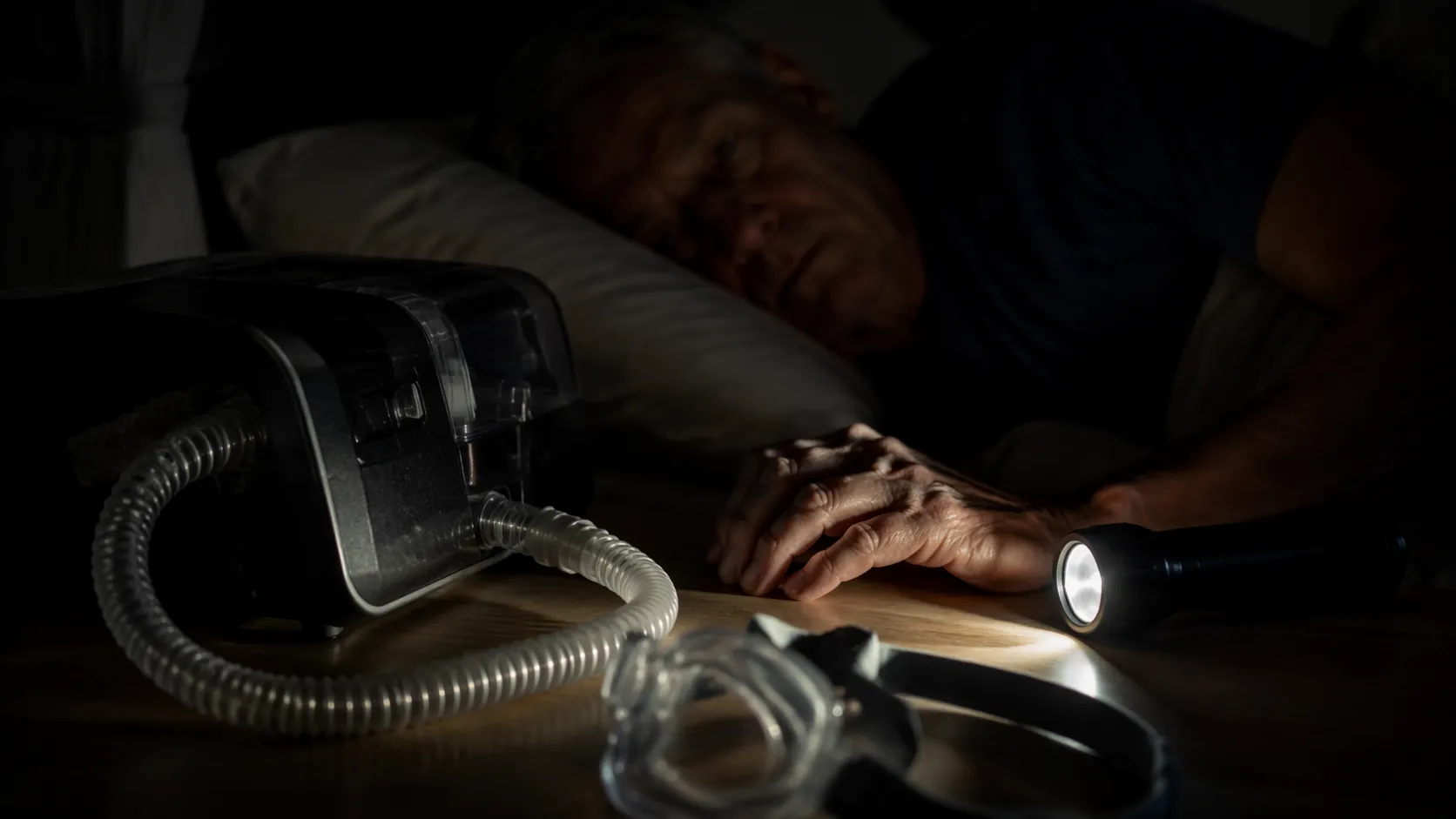
If you are already close to a threshold, move early. It is easier to leave at 8 p.m. with medications still cold and a person still steady on their feet than at 1 a.m. after the house has warmed, the CPAP battery has died, and the caregiver is doing math by flashlight.
If the CPAP still has power
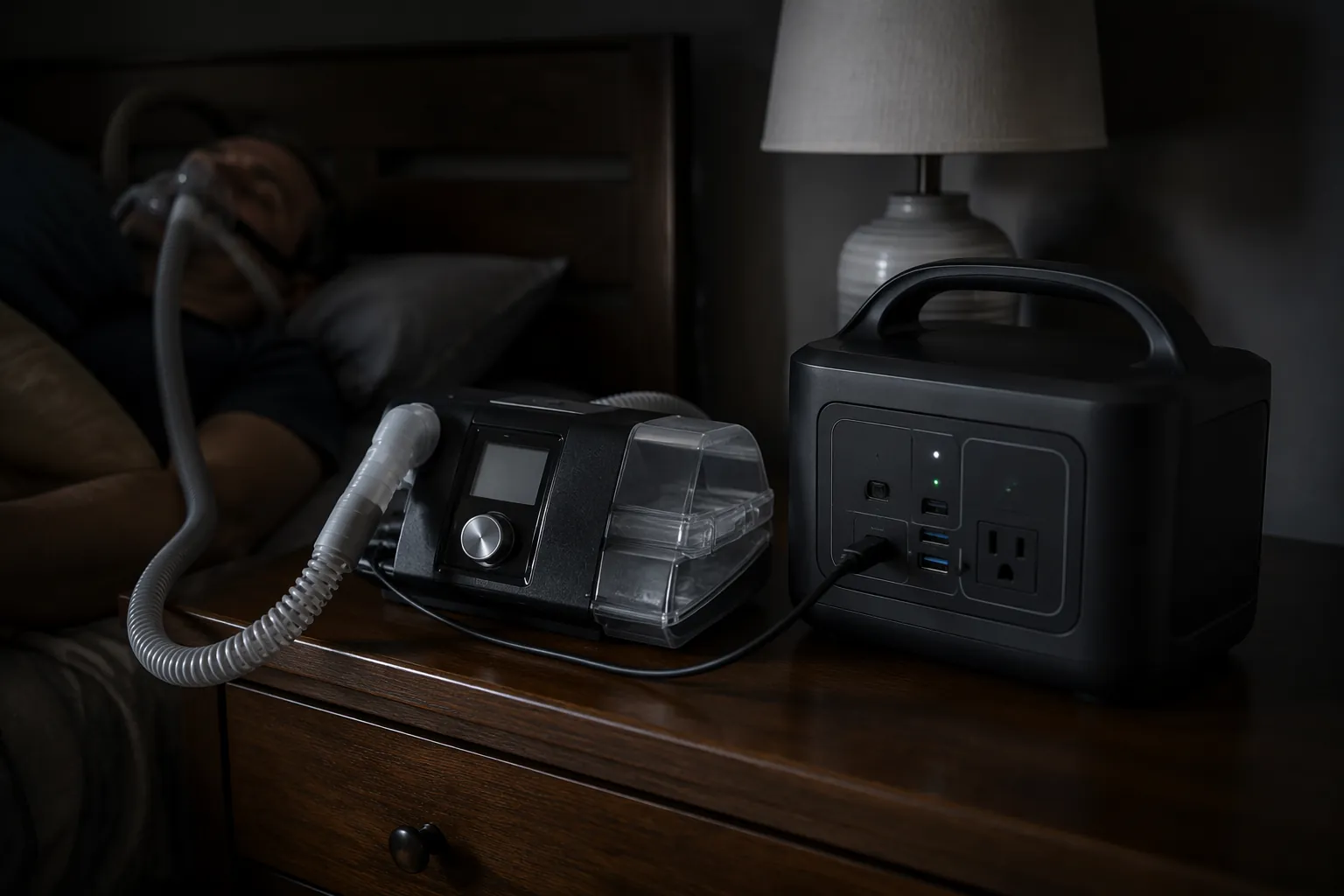
Run the CPAP from a dedicated battery if one is available. Most CPAP machines draw about 30 to 90 watts, and a dedicated CPAP battery pack may power one to two nights depending on the device, pressure settings, battery size, and comfort features [5]. Treat those numbers as estimates, not promises. A high pressure setting, an older battery, or cold conditions can change the result.
Turn off heated comfort features before bedtime. Heated humidifiers and heated tubes can draw much more power than the blower alone; turning them off may reduce power consumption by 3 to 5 times and extend battery runtime substantially [5]. The tradeoff is a drier nose or throat. During an outage, that is usually a better trade than waking at 3 a.m. to a dead machine.
If there is no CPAP power for one night
For a person with mild sleep apnea who has been told side-sleeping is medically reasonable, side-sleeping may be a one-night fallback. It is not a replacement for CPAP. It is also a thin plan for someone with severe apnea, oxygen needs, significant heart or lung disease, heavy daytime sleepiness, or a history of dangerous nighttime breathing events.
If the person cannot safely sleep without the machine, arrange a powered location rather than trying to make the bedroom look normal. Bring the CPAP, mask, tubing, power cord, medications, and chargers. If there is time, call the prescribing clinician, durable medical equipment supplier, or local nonemergency medical line for device-specific guidance.
Medication storage is not a bedtime detail
Insulin is the clearest example because it has a narrow storage range. Harvard Health, citing Dr. Scott Goldberg of Brigham and Women’s Hospital, gives the refrigerated range as 36°F to 46°F. If the refrigerator temperature rises above 46°F, insulin should be moved to a small cooler with ice packs immediately [2].
Do not keep opening the refrigerator to check casually. Read the thermometer, close the door, and decide. If there is no thermometer and the outage is expected to continue, a cooler with ice packs may be the safer controlled environment. Keep the medication with the person if relocating; do not leave it behind in a warming refrigerator while taking the CPAP somewhere else.
The practical breaking point is simple: if you cannot keep required medication within its safe range and cannot confirm when power will return, stop protecting the bedtime routine and start protecting the medication and the person who needs it.
Temperature decides more than comfort
For an older adult, a bedroom that is “uncomfortable but tolerable” to a younger caregiver may already be risky. The CDC notes that older adults are more vulnerable during power outages, and reduced ability to sweat and regulate blood vessel dilation makes heat harder to manage [4]. On the cold side, indoor temperatures below 50°F for extended periods raise hypothermia concern [3].
| Indoor condition | What it means tonight |
|---|---|
| 50°F to 80°F | Staying may be reasonable if medication storage and device power are also safe. |
| Below 50°F for an extended period | Cold exposure becomes a safety issue, especially for an older adult sleeping for hours. |
| Above 80°F | Treat as potentially unsafe for vulnerable people; seek a cooler powered location if the temperature cannot be reduced. |
| Temperature moving toward either limit and outage duration unclear | Relocate earlier rather than waiting until mobility, alertness, or medication storage becomes worse. |
Fans, open windows, extra blankets, and closed curtains can buy time, but they do not change the thresholds. If the house is outside the safe band or clearly heading there, the remedy is not better sleep hygiene. It is a powered, temperature-controlled place.
Before the next outage
Preparation is easier when the lights are on, but it should be specific. A drawer full of candles does not run a CPAP or protect insulin.
- Buy or borrow a dedicated CPAP battery that matches the machine, then test it at home for one full night before relying on it.
- Write down the CPAP’s wattage range and how to turn off the heated humidifier and heated tube. Do this in daylight, not during the outage.
- Keep a refrigerator thermometer and a small cooler with ice packs available for insulin or other temperature-sensitive medication.
- Choose a powered backup location before storm season or planned grid work: a family member’s home, a neighbor with a generator, a hotel route, or a local shelter plan.
- Pack one small medical go-bag with CPAP mask and tubing, device power cords, medication supplies, a medication list, insurance cards, and a flashlight.
The defensible decision is not complicated: stay only if temperature, medication storage, and required device power can be kept within safe bounds for the expected outage. If one of those cannot be maintained, leave for a powered, temperature-controlled place while leaving is still manageable.
References
- Hurricanes in 2024 led to the most hours without power in the United States in 10 years — U.S. Energy Information Administration, December 2025.
- How to protect your health in a power outage — Harvard Health, May 2026.
- How to Sleep Comfortably Without Electricity — Amerisleep.
- What to Do to Protect Yourself During a Power Outage — Centers for Disease Control and Prevention.
- Power Outage Sleep Ontario Guide — Mattress Miracle.
Read the full guide: Why Power Restoration Disrupts Sleep More Than the Outage