
Mystery Miniseries You Can Actually Watch Before Bed
A mystery before bed is not automatically a sleep mistake. The question is whether the show lets your brain settle, or keeps handing it unfinished business: one more clue, one more suspect, one more cliffhanger, one more episode before the credits have even finished.
That distinction matters because a lot of bedtime advice treats every screen as the same problem. In real bedrooms, the pattern is messier. Some people lie awake after a tense thriller. Some drift off happily to the same detective rerun they have watched for years. The useful filter is not “mystery or no mystery.” It is whether the mystery is low-challenge enough to support wind-down.
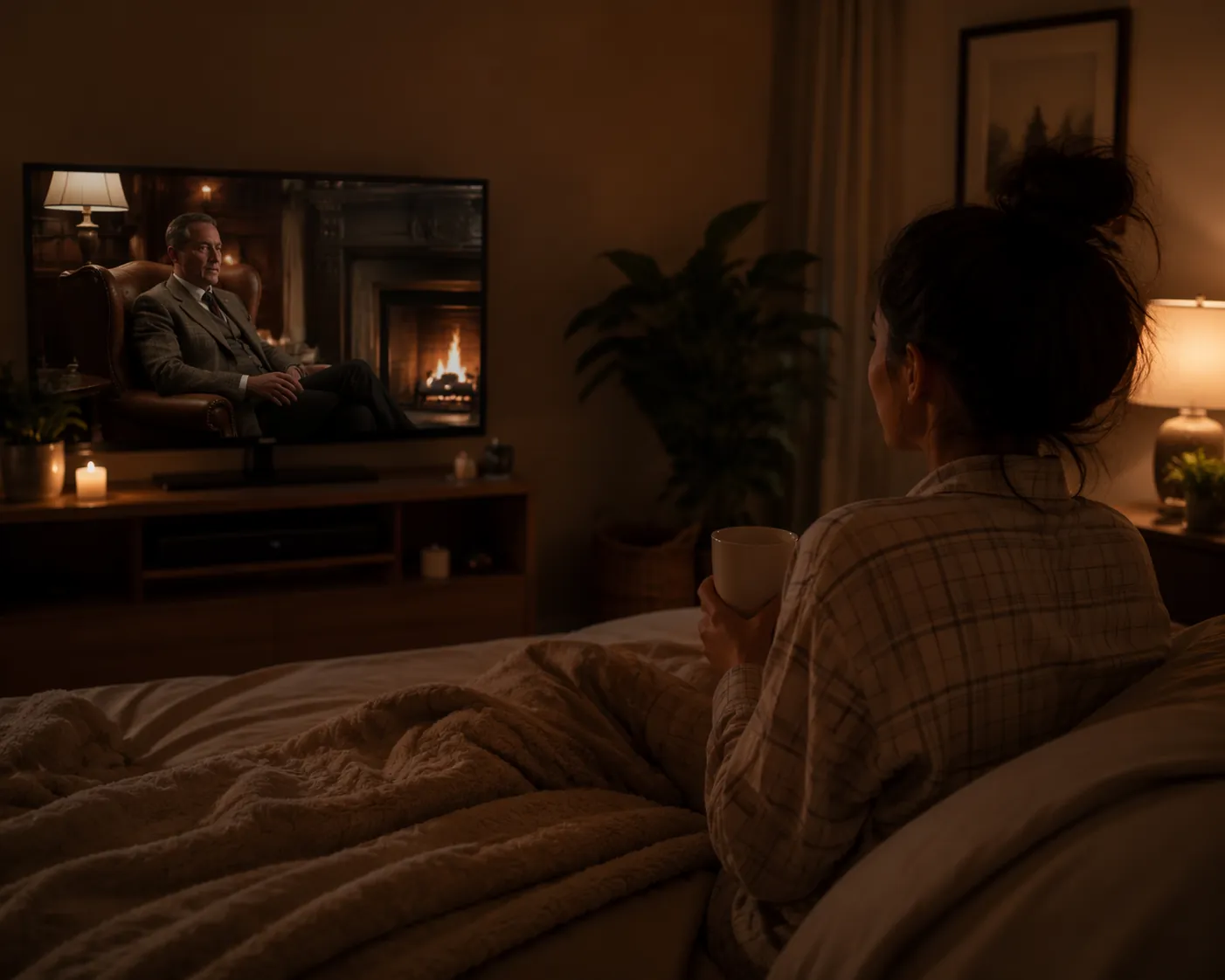
What makes a mystery low-challenge enough for bedtime
Clinical psychologist Dr. Janet Kennedy has described the best sleep-adjacent television as “low-challenge”: familiar, predictable, emotionally undemanding, and easy to leave when you feel drowsy. The point is not that television is a sedative. It is that certain shows can occupy the mind just enough to reduce rumination without demanding active problem-solving or emotional vigilance.[1]
For mystery miniseries, that means the safest bedtime choices usually share a few structural traits. The violence is not graphic. The investigator is steady rather than frantic. The setting is legible. The episode gives you some form of arrival, even if the larger story continues. The show does not punish you for stopping by ending every hour with a body, a betrayal, or a withheld identity.
This is where cozy mystery is a helpful label, but only if it means something more specific than knitwear, teacups, and a village square. PBS Masterpiece describes cozy mysteries as lighthearted crime stories with limited graphic violence, close-knit communities, amateur sleuths, satisfying resolutions, and a sense that things are “put right again by story’s end.”[2] That is a genre description, not a sleep prescription, but it maps surprisingly well onto the low-challenge framework.
A bedtime mystery does not have to be boring. It has to be bounded. A tidy whodunnit can give the mind a container: a small world, a known set of suspects, a detective who will keep moving calmly toward order. A high-challenge mystery does the opposite. It keeps widening the threat, delaying resolution, and asking you to stay alert.
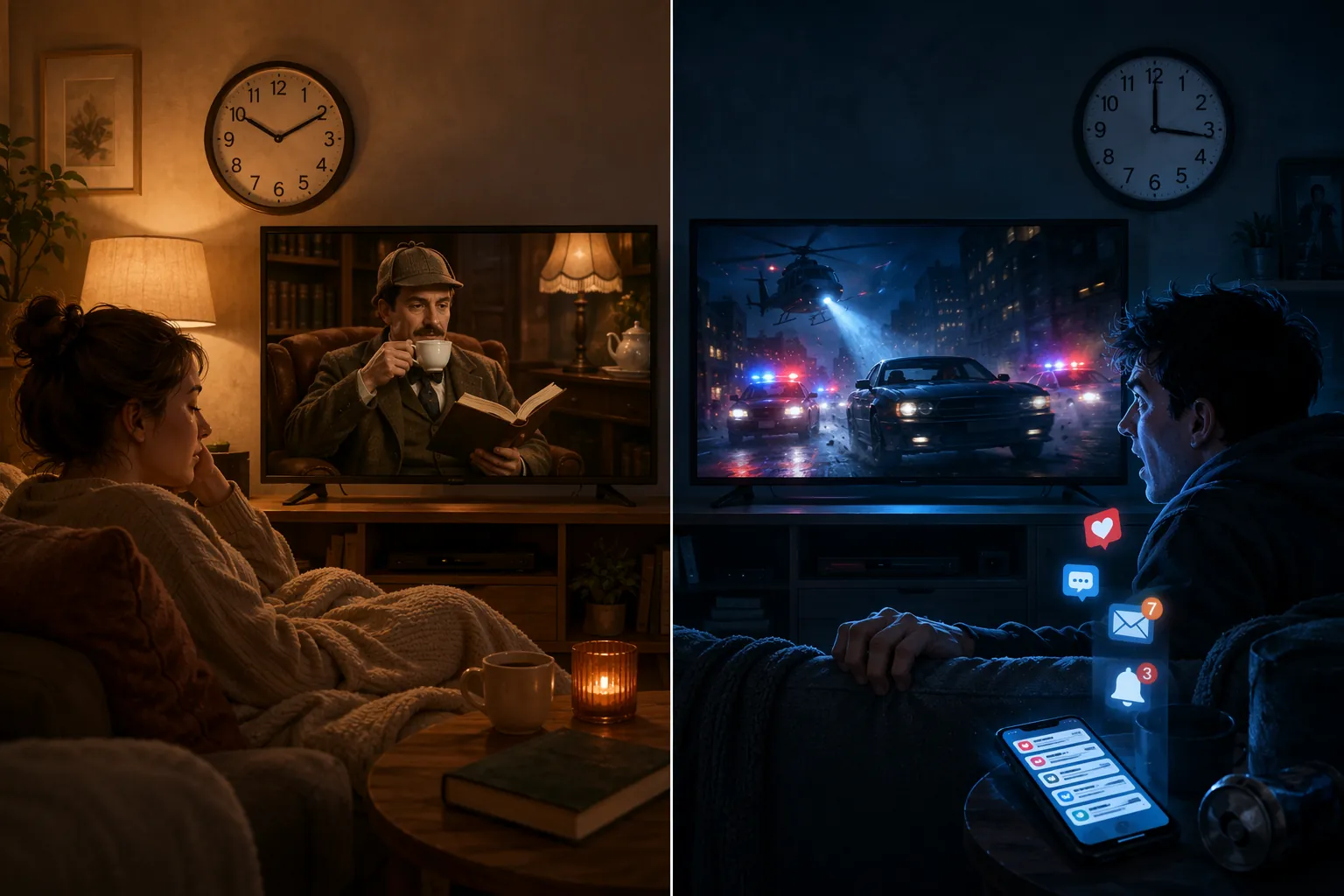
The real risk is often stopping, not suspense itself
It is tempting to make a simple rule: suspense raises arousal, so suspense before bed is bad. The evidence is not quite that neat. Dr. Vanessa Hill’s 2025 analysis found that suspenseful shows raised cortisol, yet participants still fell asleep 3 minutes faster on average. The bigger sleep disruptors were the inability to stop watching, cliffhanger-driven streaming, and phone notifications after bed.[3]
That finding should make bedtime viewing advice less scolding and more precise. A single contained mystery episode may be easier to exit than a social feed. A familiar detective story may be less mentally sticky than tomorrow’s inbox. But a mystery platformed as an endless queue, with autoplay enabled and a final-scene reveal dangling over the next episode, can turn a 45-minute wind-down into a negotiation with yourself.
Dr. Morgan Ellithorpe’s work on intentional media use also helps explain why the same screen can affect two nights differently. Media chosen deliberately for recovery can function differently from media consumed reactively, especially when the content is familiar and predictable enough to lower cognitive effort.[1] In plain terms: choosing the old comfortable mystery at 9:30 p.m. is not the same behavior as letting an app choose the next episode at 12:15 a.m.
A quick filter before you press play
Before choosing a mystery miniseries for bed, look less at the premise and more at the shape of the viewing experience.
| Better before bed | Riskier before bed |
|---|---|
| Episodic or semi-episodic structure | Highly serialized structure with unresolved endings |
| Known culprit, gentle investigation, or predictable clue path | Hidden mastermind, constant reversals, or puzzle-box plotting |
| Low graphic threat and emotionally contained stakes | Violence, dread, panic, or danger that escalates late in the episode |
| Natural stopping points after each episode | Final-minute cliffhangers designed to trigger the next episode |
| Something familiar or easy to rewatch | Something you feel you must finish to understand |
The miniseries format helps because it has a built-in boundary. It also hurts when the whole story is designed as one long withheld answer. For bedtime, the best mystery miniseries are not necessarily the most acclaimed or ingenious. They are the ones you can stop watching without feeling deprived.
Columbo is the model, even when it is not technically a miniseries
Columbo is nearly the ideal pre-bed mystery because it removes the sharpest hook before the episode really begins. Vulture’s sleep-TV guide singles it out for exactly that reason: “you won’t need to stay up to figure out who committed a crime — Columbo solves every crime within seconds, but he will spend the next 60-plus minutes walking through it anyway.”[4]
That inverted structure changes the bedtime experience. You are not lying there trying to identify the killer. You are watching a patient, slightly rumpled detective close the gap between what the viewer already knows and what the culprit has not yet admitted. The suspense is procedural, not existential. The show asks for mild attention, not vigilance.
If sleep is fragile, this is the kind of mystery grammar to look for elsewhere: early containment, a competent investigator, low visual brutality, and the feeling that the episode is moving toward restoration rather than rupture.
Mystery miniseries that fit the low-challenge test
The following picks are not ranked by quality. They are grouped by why they may work before bed. Availability changes, especially across PBS, Prime Video, Netflix, and regional catalogs, so treat any platform note as a July 2026 check rather than a permanent promise.
For the gentlest bedtime structure: The Marlow Murder Club
The Marlow Murder Club is built around retiree sleuths, a contained community, and a calmer amateur-detective rhythm. PBS lists the series as six episodes of about 45 minutes, which is a manageable shape for bedtime if you stop at one episode and do not let the next one begin automatically.[5]
Its appeal for sleep is not that nothing happens. It is that the investigative world is socially legible and emotionally less punishing than a grim serial-killer thriller. The viewer’s job is to follow curiosity, not brace for dread. That makes it a better candidate for nights when you still want a story but do not want your nervous system recruited into the case.
For literary puzzle comfort: Magpie Murders and Moonflower Murders
Magpie Murders and Moonflower Murders are more puzzle-forward, so they are not quite as effortless as Columbo. PBS describes Magpie Murders as a six-part mystery-within-a-mystery, and Moonflower Murders also runs six episodes of about 45 minutes.[6][7] That structure can be satisfying for viewers who like a bookish frame and can stop cleanly, but it carries more “I want to know how this fits together” risk.
These are good choices when your mind wants a proper puzzle but not a brutal one. They are less ideal on a night when you are already overtired, wired, or prone to bargaining with yourself. If you choose them before bed, decide the stopping point before the episode begins. The puzzle should be the evening’s container, not the reason you override sleepiness.
For short-run period whodunnit energy: Agatha Christie’s Seven Dials
Agatha Christie’s Seven Dials is a three-episode 2026 Netflix adaptation, which gives it one obvious bedtime advantage: the total commitment is limited.[8] A three-part run can feel less dangerous than an open-ended series, especially if you avoid starting the final episode too late.
The caution is that Christie adaptations often depend on withheld explanation. That is pleasurable; it is also exactly the mechanism that can keep a tired viewer alert. Treat this as a weekend-evening bedtime mystery rather than the thing to start when you have an early alarm.
For postwar bookshop calm with a stopping plan: Bookish
Bookish, a 2026 PBS mystery, is described as a six-episode post-World War II bookshop-centered series.[9] On paper, that is a promising bedtime mix: period setting, literary environment, and a contained season length. As with any new release, the practical question in July 2026 is where it is currently available and whether the platform pushes autoplay.
Because newer shows are less familiar, they demand more attention than a rerun. If your sleep has been uneven, save Bookish for a night when you can start early. If you are using it as true wind-down, one episode is the unit. The season is not the unit.
How to watch a bedtime mystery without turning it into a sleep problem
The best mystery miniseries to watch before bed still needs the right setup. A gentle show played too bright, too close, too late, with autoplay and phone alerts running, is no longer a gentle experience. General screen-before-bed guidance remains cautious because light exposure, stimulation, and late-night device use can all interfere with sleep timing and sleep quality.[10]
- Set a sleep timer before the episode starts, not when you already feel drowsy.
- Turn off autoplay so the platform does not make the next decision for you.
- Dim the screen and room lighting; the viewing environment matters, not just the plot.
- Keep the TV across the room if possible, instead of holding a phone near your face.
- Put your phone on Do Not Disturb so the mystery is not followed by messages, headlines, or work notifications.
- Choose a rewatch when sleep is fragile; novelty is more demanding than familiarity.
The strongest stopping cue is a natural resolution point. If an episode ends with the case mostly settled, stop there. If it ends with a reveal that makes you sit up straighter, do not reward the show by continuing. That is the moment to let the unresolved thread wait for tomorrow.
If you are trying to make all evening media more sleep-friendly, the same low-arousal logic applies beyond mysteries. A broader guide to free movies to stream before sleep can help when you want a film instead of a series, while bedtime movie color palette choices are worth considering when the screen itself feels too stimulating. For the bigger sleep-timing picture, the shift from sleep hygiene to circadian hygiene is the more useful frame.
When a mystery is the wrong bedtime choice
Even a cozy mystery can be the wrong choice on the wrong night. If you notice that you are watching to avoid going to bed, the genre is no longer the issue. If you are scanning forums after the episode, replaying clues, or feeling irritated that you have to stop, the show has crossed from wind-down into cognitive arousal.
The clearest warning signs are behavioral: you keep extending the timer, you ignore sleepiness to finish the reveal, you move from the TV to your phone, or you choose a new, twist-heavy series when you already know you need rest. At that point, the kinder move is not to shame yourself for liking mysteries. It is to choose a lower-demand episode, an old favorite, or no screen at all.
A gentle mystery can belong in a wind-down routine when it is predictable, bounded, emotionally contained, and easy to leave. It becomes a sleep problem when the show, the platform, or the habit keeps asking for one more answer.
References
- Is Falling Asleep to TV Really So Bad? An Investigation, Vulture
- The Cozy Mystery Explained, PBS Masterpiece
- Does what you watch before bed affect your sleep? [part two], Nessy Hill Substack, 2025
- The 23 Best TV Shows to Watch While Falling Asleep, Vulture
- The Marlow Murder Club, PBS Masterpiece
- Magpie Murders, PBS Masterpiece
- Moonflower Murders, PBS Masterpiece
- Agatha Christie’s Seven Dials, Netflix, 2026
- Bookish, PBS Masterpiece, 2026
- Is it bad to watch TV before bed? Sleep experts weigh in, CNN, 2025
Read the full guide: Where Can You Legally Sleep While Camping in Tennessee?