
How surgery pain disrupts sleep and delays recovery
Yes. Painful surgery can disrupt sleep quality in a way that is deeper than “I’m uncomfortable.” After an operation, pain, surgical inflammation, anesthesia effects, and pain medications can change the structure of sleep itself: total sleep time can collapse, REM sleep can be sharply reduced or absent, and slow-wave sleep can be suppressed. That matters because poor sleep can also make pain feel worse the next day, setting up a loop in which pain breaks sleep and broken sleep amplifies pain. Polysomnography studies have reported total sleep time reductions of up to 80% after surgery, while reviews describe marked REM and slow-wave sleep disruption in the early postoperative nights.[1][2] Experimental sleep-loss research has also found that losing even one hour of sleep can alter pain perception the next day.[3]
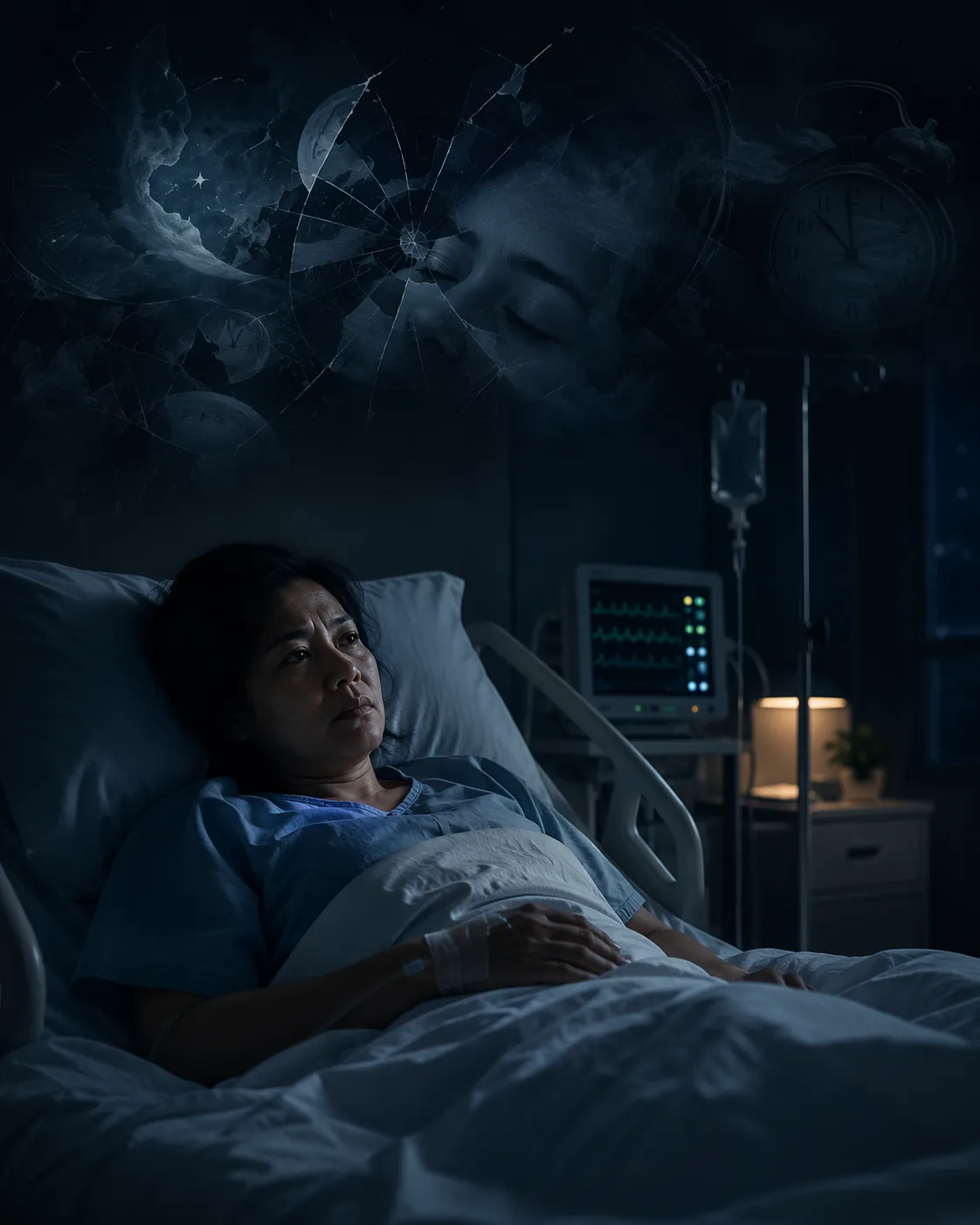
That is the important point for the person awake at 3 a.m. after an abdominal incision, a joint replacement, or chest surgery: the surgery may be “over,” but the body is still responding to trauma. Sleep is not simply refusing to cooperate. It is being interrupted by pain signals, inflammatory chemistry, hospital routines, medication effects, and the stress response that follows tissue injury.
What surgery does to sleep architecture
Normal sleep is not one uniform state. Across the night, the brain moves through lighter sleep, deeper slow-wave sleep, and REM sleep. After surgery, that architecture can be badly rearranged, especially on the first postoperative night.
| Part of sleep | What has been reported after surgery | Why it matters |
|---|---|---|
| Total sleep time | Can drop by up to 80% in postoperative polysomnography studies.[1] | The patient may spend long stretches awake or drifting in and out instead of getting consolidated sleep. |
| REM sleep | Reduced by about 18–20% on the first night and may be completely absent in some reports.[2] | REM disruption can leave sleep feeling strangely nonrestorative, even when the patient has been in bed all night. |
| Slow-wave sleep | Depressed by about 10% in postoperative sleep findings summarized in review literature.[2] | Slow-wave sleep is one of the stages most associated with physical restoration and stable, deep sleep. |
Those figures should be read carefully. The most dramatic sleep-architecture findings come from relatively small polysomnographic studies, many of them older and conducted in specific surgical settings. They do not mean every patient loses 80% of sleep or has no REM sleep. They do mean that the miserable first night after painful surgery has been measured physiologically. It is not only a bad mood, a weak pain tolerance, or poor discipline around bedtime.
This is also why a person can feel as if they “slept” but still wake up foggy and sore. Time in bed is not the same as normal sleep architecture. A night made of alarms, position changes, incision pain, medication timing, and shallow dozing may fail to deliver the deeper stages the body usually uses to recover.
Why painful surgery makes normal sleep biologically hard
The simplest mechanism is also the one patients recognize immediately: pain wakes you up. Incision pain, swelling, muscle guarding, drains, coughing after abdominal or chest surgery, and the effort of turning in bed can fragment the night into short scraps. Pain has been identified as the most common cause of nighttime disturbance after surgery.[3]
But postoperative sleep disruption is not only the result of waking because something hurts. Surgical trauma activates inflammatory pathways, and inflammatory mediators such as tumor necrosis factor, interleukin-1, and interleukin-6 are involved in sleep regulation. After surgery, those signals can disturb sleep architecture directly, not merely by making the wound tender.[1]
The intensity of the surgical insult also appears to matter. Reviews of postoperative sleep disturbance note that laparoscopic surgery tends to produce less sleep disruption than open surgery, which fits the broader pattern: more tissue trauma and inflammation generally give the sleep system more to contend with.[1]
Then there is the medication paradox. Opioids may be necessary after some painful operations because uncontrolled pain itself destroys sleep. Yet opioids can also reduce REM sleep and increase arousals, meaning the drug that makes rest possible can still degrade the shape of that rest.[2][3] That does not mean a patient should avoid prescribed pain medicine or endure severe pain in the name of “natural sleep.” It means postoperative sleep is being pulled in competing directions: pain needs treatment, but some treatments alter the same sleep architecture the body is trying to rebuild.
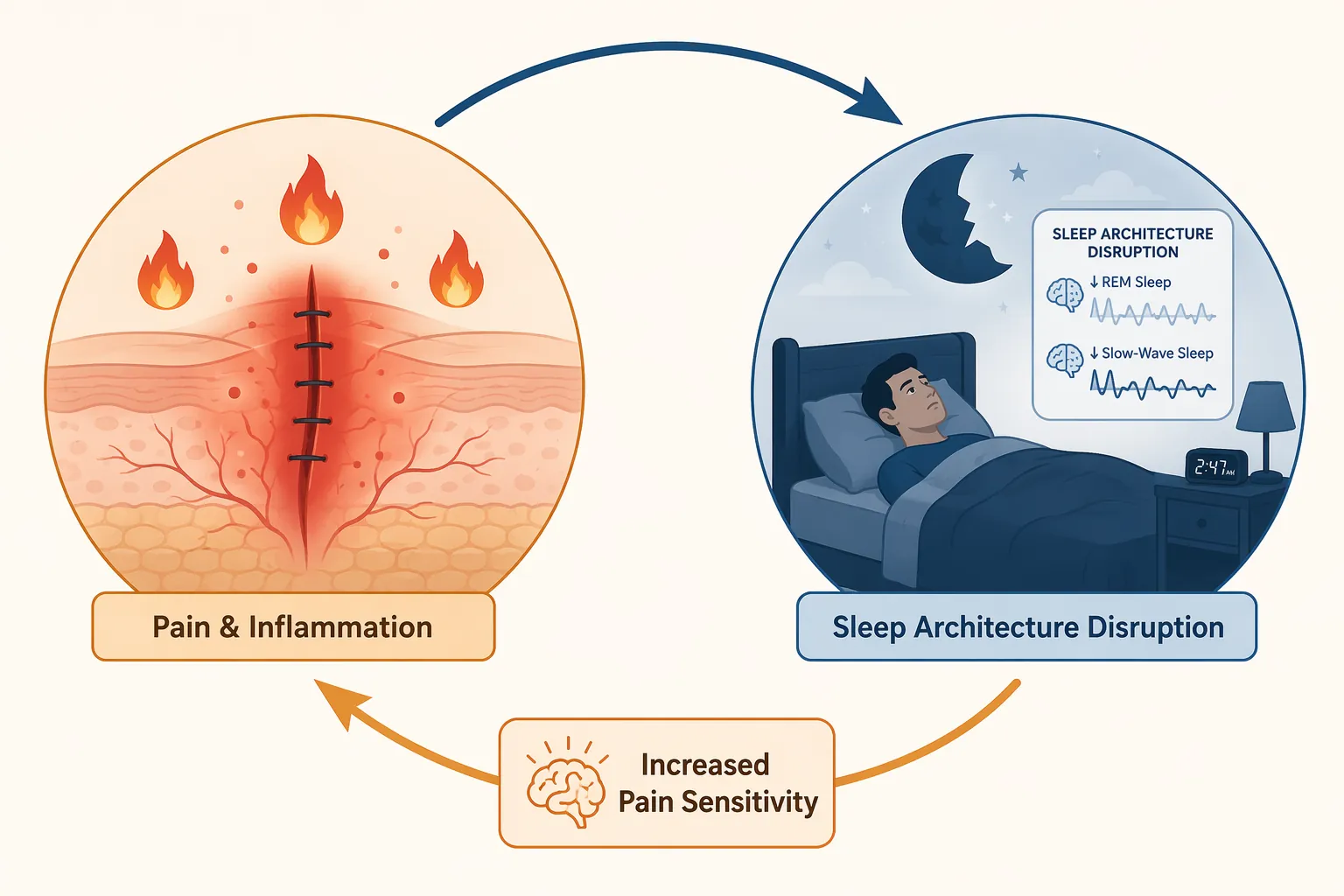
The loop: pain breaks sleep, then poor sleep increases pain
The part that often gets missed is the return arrow. Poor sleep after painful surgery is not only a consequence of pain. It can become one of the reasons pain feels worse the next day.
In sleep-loss research, even one hour of lost sleep has been shown to change pain perception the following day.[3] After surgery, that matters because the patient is rarely losing just one neat hour. They may be losing consolidated sleep, deep sleep, REM sleep, and the predictable cycling between stages. The next day, the nervous system can be more reactive. Pain that was barely tolerable in the evening may feel sharper in the morning; walking to the bathroom may feel like a larger event; physical therapy may feel more punishing than expected.
That worsened pain then makes the following night harder. The patient delays movement because movement hurts, becomes stiff, needs more help getting comfortable, wakes when medication wears off, and enters another night already sensitized. This is the pain-sleep cycle after surgery: pain fragments sleep, fragmented sleep raises pain sensitivity, and increased pain further fragments sleep.
This cycle helps explain why two patients with similar procedures can look different on day two or three. One may be sore but sleeping in longer blocks. Another may be awake most of the night, increasingly foggy, more pain-sensitive, and less able to participate in the small tasks that recovery depends on: coughing well, walking safely, eating enough, doing breathing exercises, or tolerating rehabilitation.
Why this can affect recovery
Postoperative sleep problems are common enough that they should not surprise patients or caregivers. In a 2025 study of elective surgery patients, sleep disturbances within two days after surgery affected more than 90% of patients.[4] That number describes early postoperative sleep quality in a study population; it does not prove that every bad night causes a complication. It does show that disrupted sleep is part of the early recovery landscape for many surgical patients.
The recovery concern is not that one poor night automatically ruins healing. The concern is that repeated or severe sleep disruption can interact with pain, inflammation, mobility, immune function, and cognition. A patient who sleeps in fragments may move less, breathe less deeply, eat poorly, need more daytime sedation, or struggle to follow postoperative instructions. None of those downstream effects is dramatic in isolation. Together, they can slow the practical work of recovery.
Wound healing is one area where the association deserves attention without exaggeration. A 2025 study of 110 emergency-laparotomy patients in India found a strong association between poor sleep quality and wound complications, reporting an odds ratio of 78.14.[5] That number is striking, but it comes with major caution: the sample was small, the setting was specific, most participants were male, mean BMI was low, and the confidence interval was extremely wide, from 3.65 to 1,670.62.[5] The sensible reading is not “bad sleep guarantees wound trouble.” It is that poor sleep may be a meaningful recovery signal, especially in higher-risk surgical patients.
Hospital stay has also been linked with postoperative sleep. In research summarized on improving postoperative sleep, poorer sleep after surgery was associated with a hospital stay about 12 hours longer.[3] Again, that is an association, not a promise about an individual discharge date. But it fits what bedside recovery often looks like: the patient who cannot sleep may have more pain, less stamina, slower mobilization, and more difficulty clearing the ordinary milestones needed to leave safely.
A special concern for older adults: delirium
For caregivers of older surgical patients, sleep disruption is not just about comfort or patience. It can overlap with postoperative confusion. Review literature reports a six-fold increase in postoperative delirium risk among older cardiac surgery patients with sleep disturbance.[2] That finding should not be generalized to every older adult after every operation, but it is clinically important because delirium can look like a parent becoming suddenly foggy, agitated, unusually sleepy by day, awake at night, or unable to track familiar conversations.
In that situation, the question is not whether the patient is being difficult. The question is whether pain, sleep loss, medications, infection, dehydration, low oxygen, or another postoperative problem is contributing to a change in mental status. New or worsening confusion after surgery deserves medical attention.
How long does postoperative sleep disruption last?
The worst disruption is often early. Reviews of postoperative sleep studies report that sleep commonly begins improving around the seventh postoperative night, and REM sleep may rebound above baseline after being suppressed in the first nights.[1] That rebound can be reassuring: the sleep system is not necessarily permanently damaged; it may be recovering from the combined effects of surgery, inflammation, pain, anesthetic exposure, medication changes, and the hospital environment.
Still, “common” does not mean “safe to ignore.” A few rough nights immediately after surgery are expected. Severe pain that prevents sleep, sleep loss that is worsening rather than improving, breathing pauses or heavy sedation, new confusion, inability to participate in basic recovery tasks, or wound concerns should be raised with the surgical team. The goal is not to chase perfect sleep while the body is healing. The goal is to stop the pain-sleep cycle from becoming another barrier to recovery.
This is why generic advice about pillows, room temperature, and screens is too small for the main problem. Comfort measures can help, and they may be worth using if the surgeon’s instructions allow them. But after painful surgery, poor sleep often comes from a biological collision among tissue injury, inflammation, pain signaling, medication effects, and disrupted sleep stages. A patient who is sleeping badly is not failing recovery. They may be showing one of the ways recovery is still actively underway.
Postoperative sleep loss is common, biologically explainable, and sometimes recovery-relevant. It is not just an annoyance, and it is not something patients should feel embarrassed for mentioning when the nights become the hardest part of healing.
References
- Postoperative sleep disorders and their potential impacts on surgical outcomes — 2020
- Perioperative Sleep Disorder: A Review — 2021
- Improve postoperative sleep: what can we do?
- Latent profiles and determinants of postoperative sleep quality in elective surgery patients — 2025
- Effect of sleep quality on wound healing among patients undergoing emergency laparotomy — 2025
Read the full guide: How Severe Storm Flight Delays Disrupt Sleep