How a power grid emergency affects your sleep during a heat wave
The frightening part of a grid emergency during a heat wave is not only that the air conditioner stops. It is that the room may keep getting hotter after sunset, while the body is trying to do the opposite.
Sleep is not a passive collapse into darkness. Before sleep begins and during the night, the body has to shed heat. Human sleep depends on a circadian-driven drop in core body temperature of about 1–2°C, and warmer nights interfere with that process; research on nighttime temperature and sleep has linked ambient heat above about 24°C, or 75°F, with more fragmented sleep, including disruption to REM sleep.[1]
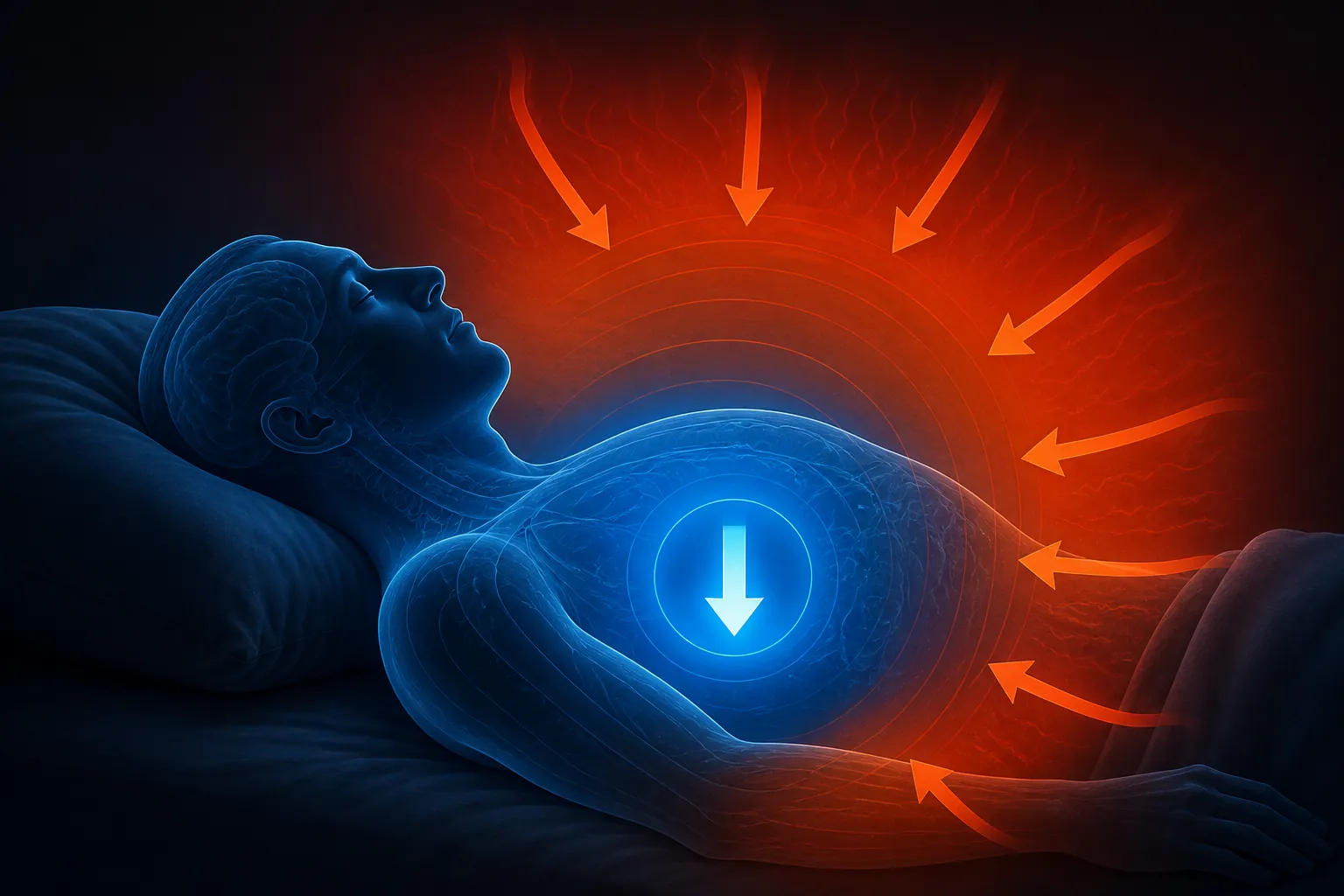
In sleep terms, that is the direct answer to how a power grid emergency affects sleep during a heat wave: it removes the machinery that lets indoor air stay cool enough for the body to dump heat. If the room stays hot, the body’s normal nighttime cooling is harder to complete. Sleep onset can be delayed. Awakenings become more likely. REM sleep can become more fragile. The person in bed may experience this as restlessness, sweating, thirst, a pounding heart, or the strange fatigue of being exhausted but unable to settle.
At bedroom level, that is already serious. During a heat wave blackout, the larger problem is that thousands or millions of bedrooms can become heat traps at the same time.
Why the night does not rescue the body
On an ordinary hot day with a working grid, a person may move through several layers of protection without thinking much about them: cooled housing, a refrigerator, running water, a charged phone, a fan, an elevator, a medical device, a transit system, a staffed clinic. At bedtime, the air conditioner is the protection most directly tied to sleep because it changes the air surrounding the skin.
The body cools itself partly by moving heat from its core toward the skin and then into the surrounding environment. If the room is cooler than the body, that heat has somewhere to go. If the room is hot and still, the gradient narrows. If humidity is high, sweating becomes less effective. If windows are closed for safety, smoke, noise, or outdoor heat, ventilation may be poor. The body keeps working, but the room is no longer cooperating.
This is why advice that sounds reasonable during a mild summer night can become almost insulting during a grid emergency. Breathable sheets may help at the margin. A consistent bedtime may help in normal conditions. A fan may help when it has power and when the air it moves is not dangerously hot. None of those solve the basic failure: the indoor environment can become too warm for safe overnight heat loss.
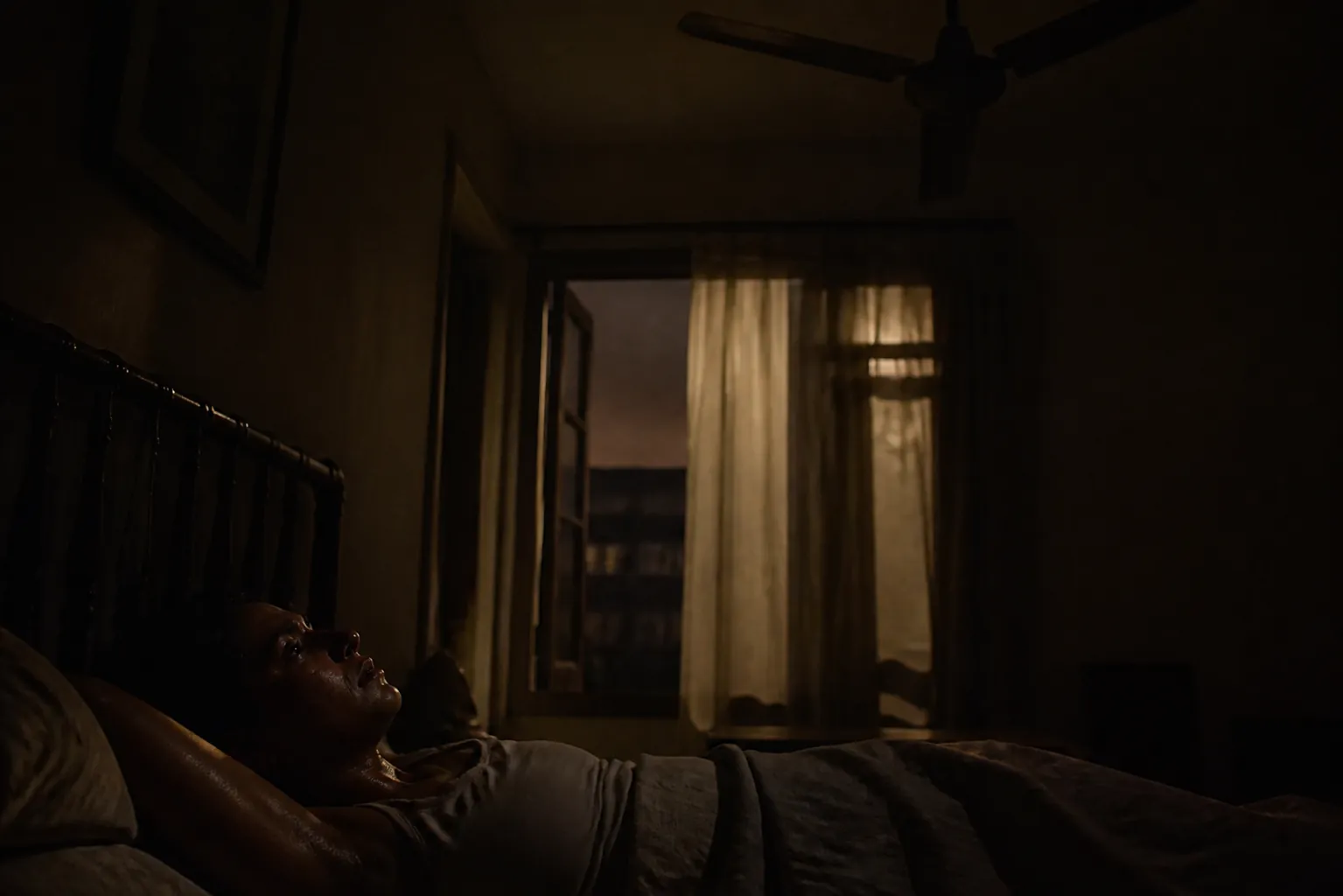
Older adults are an obvious concern because thermoregulation changes with age. So are people whose medical conditions or medications affect sweating, circulation, hydration, cognition, or temperature perception. People dependent on powered medical devices face an added layer of risk: the same outage that removes cooling may also threaten the equipment that helps them breathe, move, monitor blood sugar, or maintain treatment. For those readers, the practical planning belongs in more specialized guidance, such as Restful Ground’s pieces on medical-device outage preparation, heat-dome sleep for older adults, and extreme-heat cooling by life stage. The point here is narrower and more severe: once indoor heat keeps rising, sleep is not merely less comfortable. It can become part of a larger heat illness cascade.
The blackout turns private heat into a citywide exposure
The strongest evidence for the scale of this problem comes from modeling work on compound heat-wave and blackout events. In a 2023 study, Stone and colleagues modeled 5-day citywide blackouts during historical heat waves in Atlanta, Detroit, and Phoenix. Their results were not a projection of poor sleep. They were a projection of heat exposure, heat exhaustion risk, emergency medical demand, and mortality under blackout conditions.[2]
The modeled outcomes were stark. Across the three cities, 68–100% of the urban population faced elevated heat-exhaustion risk during the modeled blackout scenarios. Heat mortality more than doubled in Atlanta and Detroit. In Phoenix, modeled heat mortality rose by roughly 700%, and more than half of residents were projected to require emergency medical attention.[2]
| Modeled condition | What the study found |
|---|---|
| 5-day citywide blackout during historical heat waves | 68–100% of urban populations faced elevated heat-exhaustion risk |
| Atlanta and Detroit | Heat mortality more than doubled under blackout conditions |
| Phoenix | Heat mortality increased by roughly 700% |
| Phoenix emergency medical demand | More than half of residents were projected to require emergency medical attention |
| Cooling-center capacity | Existing cooling centers could accommodate only 1–2% of the urban population |
The cooling-center number is the one that should stop any casual talk about simply “going somewhere cooler.” In the same modeling work, existing cooling centers could accommodate only 1–2% of the urban population.[2] Cooling centers can save lives for people who can reach them, know they are open, can bring dependents or medical equipment, and are not blocked by transportation, disability, caregiving, work, language, documentation, or safety barriers. But a 1–2% capacity figure means the recommendation is not, by itself, a citywide solution.
This is where the sleep question becomes inseparable from emergency management. A bad hot night is an individual experience. A citywide blackout during a heat wave is synchronized exposure. Many people become sleep deprived, dehydrated, overheated, and medically vulnerable in the same window. Emergency departments, ambulance systems, caregivers, and public agencies absorb the consequence.
The air-conditioning paradox
Air conditioning prevents heat illness and makes sleep possible in climates where nighttime temperatures remain high. The paradox appears when a city becomes so dependent on mechanical cooling that a grid failure produces a large sudden shift in indoor exposure.
Stone and colleagues’ blackout-and-heat modeling found that Phoenix, where air-conditioning prevalence was about 99%, had the largest individual indoor heat-exposure shift when the grid failed: an indoor exposure increase of more than 6°C, compared with 1.6–2.2°C in the other modeled cities.[2] That does not mean air conditioning is the problem. It means near-universal air conditioning can hide how little passive protection remains when power disappears.
The distinction matters. The data support a narrower conclusion than a slogan about modern comfort making people weak. In extreme heat, mechanical cooling can be lifesaving. But if buildings, neighborhoods, and emergency plans assume that cooling will always be powered, the failure mode is brutal: indoor temperatures can climb just when nighttime recovery should begin.
This scenario is modeled, but not imaginary
The Stone studies model specific 5-day citywide blackouts during historical heat waves. Real outages may be shorter, partial, localized, staggered, or restored unevenly. The studies also do not calculate blackout-caused insomnia. The sleep evidence comes from research on warmer nights and sleep disruption; the morbidity and mortality evidence comes from compound-event modeling. Those boundaries should stay visible.[1][2]
Still, the compound event is not far-fetched. Earlier work by Stone and colleagues reported that major U.S. blackout events increased by more than 60%, while the same line of research emphasized that heat waves and power failures can interact rather than arrive as separate problems.[3] Climate Central has also reported that heat-season power outages rose by about 60%.[4] Reporting on heat waves and energy systems has documented the same pressure from the infrastructure side: extreme heat can drive up electricity demand while also straining generation, transmission, and distribution systems.[5]
Heat itself remains the underlying hazard. The World Health Organization describes heat stress as the leading weather-related cause of death and notes that heat can worsen underlying conditions including cardiovascular disease, diabetes, mental health conditions, and asthma.[6] A blackout does not create those vulnerabilities. It removes one of the main barriers between vulnerable bodies and dangerous indoor heat.
What changes at the bedside
In the first hours of an outage, the bedroom may still feel tolerable, especially in a well-insulated home that had been cooled before power failed. That can be deceptive. Insulation that slows outdoor heat from entering can also hold accumulated indoor heat once cooling stops. Upper-floor rooms, sealed apartments, manufactured housing, poorly shaded buildings, and units with limited cross-ventilation can become difficult places to recover overnight.
For sleep, the immediate changes are practical and physiological at the same time:
- The air conditioner stops removing heat and humidity from the room.
- Fans stop unless battery-powered, and even moving air cannot substitute for cooling when indoor heat becomes dangerous.
- The body has less ability to shed heat from the core to the environment.
- Sleep onset may be delayed because the normal nighttime temperature drop is harder to achieve.
- Awakenings, sweating, thirst, and REM fragmentation become more likely as heat stress continues.
- The next day begins with less recovery, while the heat wave and outage may still be ongoing.
That last point is where a restless night becomes a safety problem. Poor sleep can impair judgment, coordination, mood, and the ability to notice symptoms early. Heat strain can do the same. In an extended outage, people may be making consequential decisions while tired, overheated, and cut off from normal cooling: whether to leave, where to go, whether a relative is confused from heat, whether a battery will last through the night, whether an infant or older adult is still safe in the room.
Comfort advice has a ceiling
There is still room for household tactics before conditions become dangerous: pre-cooling when warnings are issued, charging batteries, identifying cooler rooms, reducing heat from appliances, checking on neighbors, keeping water accessible, and knowing where official cooling sites are. Restful Ground’s existing heat-wave sleep guides are better places for detailed life-stage cooling strategies and preparation for nights when the body already runs hot.
But during a power grid emergency in a heat wave, the threshold question is not how to perfect sleep hygiene. It is whether the indoor environment still allows the body to cool safely. If the answer is no, the problem has moved beyond sleep optimization. People who are older, medically fragile, pregnant, caring for infants, isolated, cognitively impaired, or dependent on powered medical devices need plans that assume the room may not remain survivable just because it is nighttime.
The evidence does not let anyone calculate a precise number of hours of sleep lost in a blackout heat wave. It does support a clearer and more urgent conclusion: a grid emergency affects sleep by taking away the cooling that permits the body’s nightly core-temperature drop, and the danger extends from fragmented sleep into heat exhaustion, emergency medical demand, and preventable deaths at a scale existing cooling-center capacity is not built to absorb.
References
- “Rising temperatures erode human sleep globally,” Cell / One Earth, 2022.
- “How Blackouts during Heat Waves Amplify Mortality and Morbidity Risk,” Environmental Science & Technology, 2023.
- “Compound Climate and Infrastructure Events,” Environmental Science & Technology, 2021.
- “Heat Season Power Outages,” Climate Central.
- “When heat waves cripple energy systems,” DW.
- “Heat and health,” World Health Organization.
Read the full guide: Power Grid Emergency? How to Protect Your Sleep Tonight