Power Grid Emergency? How to Protect Your Sleep Tonight
Last reviewed: July 31, 2026. Evidence tier: clinical sleep guidance supported by peer-reviewed sleep and heat research, public-health guidance, and manufacturer device specifications where noted.
If a DOE section 202(c) emergency order is in the news and your regional grid operator is warning about demand, the sleep plan for tonight is not complicated, but it does need to be specific. A blackout can take away three things your sleeping brain and body quietly rely on: a tolerable sleep temperature, familiar sound control, and a predictable room.
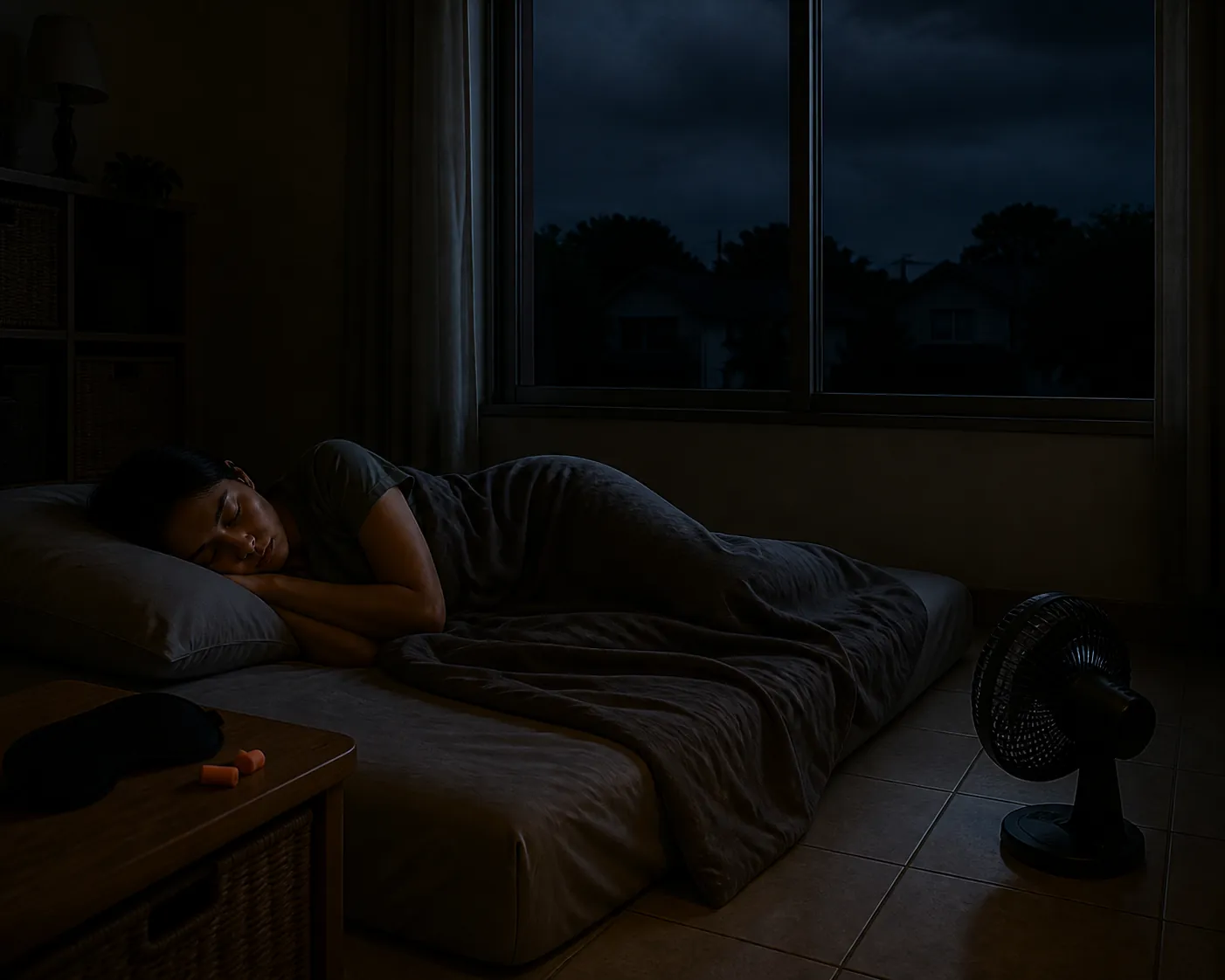
Start before bedtime. Move the sleep setup to the coolest safe place you have, usually a lower level or interior room. Put a battery fan, damp cloth, drinking water, flashlight, medications, earplugs, and an eye mask within reach. If you use a CPAP, oxygen concentrator, refrigerated medication, pregnancy monitoring plan, or child-calming routine, decide now what happens if the power stops at 2 a.m.
The grid numbers are large enough to feel abstract. In PJM territory, one megawatt is often described as enough electricity for about 750 homes, and PJM forecast demand of 166,147 MW on July 2, 2026, above its prior all-time record of 165,563 MW set in 2006.[1] That context matters because rolling blackouts are not just an inconvenience after dinner. At night, they can turn ordinary sleep supports into clinical stressors.
What should I do before bed if rolling blackouts are possible?
Think in three systems, not one emergency kit. You are protecting temperature, sound, and predictability. Food storage and generator shopping may matter for household readiness, but they are not the first sleep problem at midnight.
| Sleep system that may fail | What changes during a blackout | Low-cost action before bed |
|---|---|---|
| Thermoregulation | Air conditioning, fans, and cooled bedrooms may stop working | Sleep lower in the home, use light bedding, pre-cool the room if power is still on, stage a battery fan and damp cloth |
| Auditory masking | White-noise machines, fans, and familiar HVAC sounds disappear | Set out earplugs, use an eye mask, and reduce loose objects that may rattle or startle |
| Environmental predictability | The room feels unfamiliar, hotter, darker, and less controllable | Choose the sleep location before bedtime and tell everyone the plan in one plain script |
A good script is short enough to remember half-awake: “If the power goes out, we move to the hallway mattress, use the battery fan, put on earplugs, and check the thermometer and medical devices.” This is the same kind of boring, useful preparation that helps during severe-weather nights; the tactics overlap with sleeping safely during a tropical storm landfall: interior room, floor mattress, battery fan, earplugs, and an eye mask.
Temperature is the sleep problem to take most seriously
Sleep is not passive cooling. Your body has to shed heat at the right time to fall asleep and stay asleep. A commonly cited optimal sleep temperature range is 68–72°F, or 15.6–19.4°C.[2] Once the room rises above about 75°F, sleep disruption becomes more likely; when conditions become too cold, shivering can interfere with sleep, with temperatures below 12°C described as incompatible with sleep.[2]
The exact number on your thermostat is not a promise about how your night will go. People differ by age, pregnancy status, medications, bedding, humidity, housing, and baseline health. But the direction is clinically useful: heat makes sleep lighter and more fragmented, and the body does not simply shrug it off after several nights.
In a 2025 Environment International analysis from USC Keck School of Medicine using 14,232 adults and more than 12 million Fitbit-recorded nights, a 10°C rise in nighttime temperature was associated with 2.63 fewer minutes of sleep per night on average; West Coast residents lost nearly three times that amount.[3] That population average should not be read as “you will lose 2.63 minutes tonight.” It is useful because it shows a measurable sleep effect across millions of nights, even before considering the particular stress of a power outage.
Repeated hot nights do not reliably train the sleeping body to tolerate heat. A 2024 systematic review in Sleep Medicine Reviews concluded that heat-related sleep disruption did not attenuate even after five consecutive hot nights, and projected annual sleep loss of 8.5 to 24 hours by 2099.[4] For an outage week, that means the second or third hot night deserves at least as much attention as the first.
Tonight’s cooling moves, in the order I would actually do them
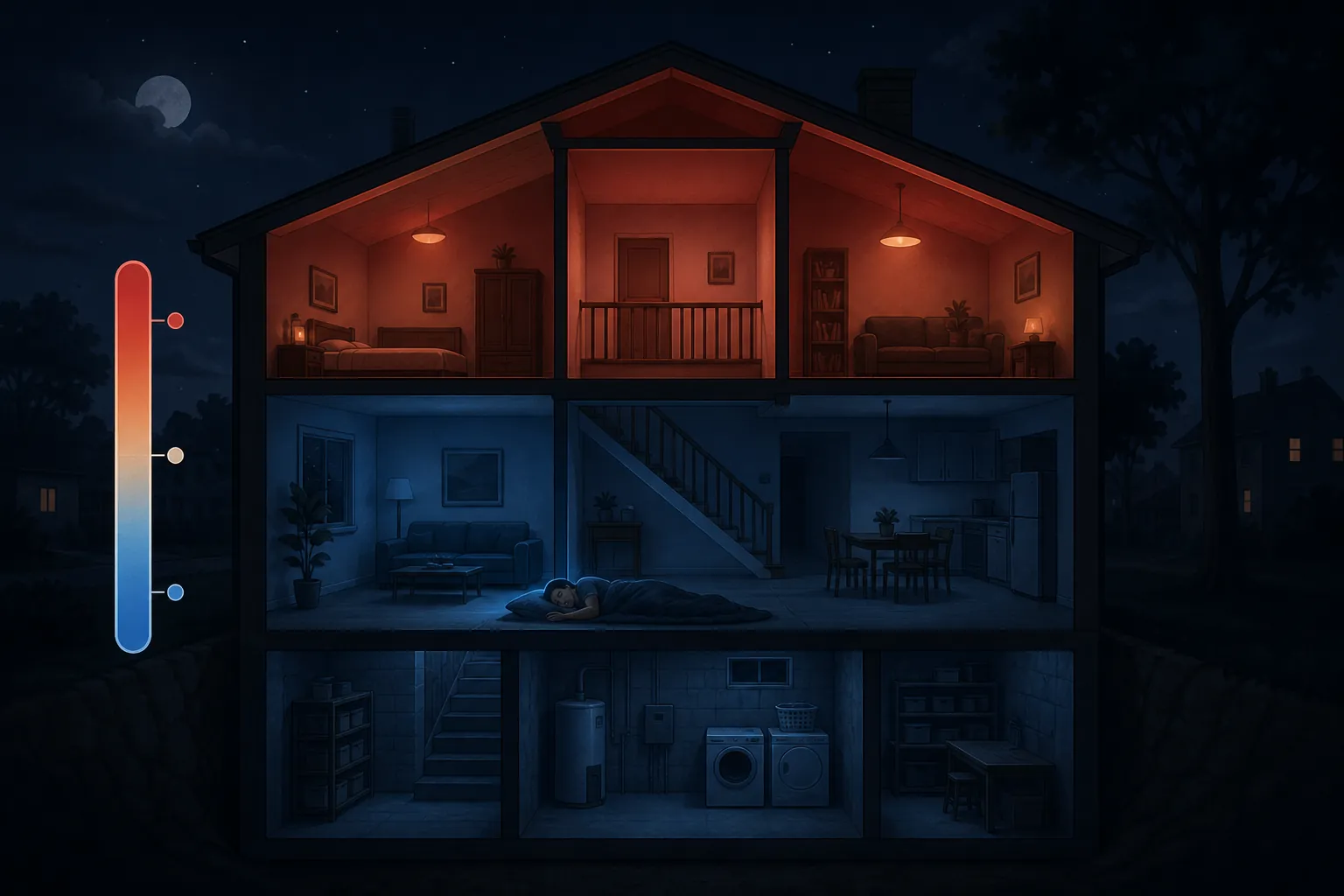
- Pre-cool the bedroom while power is still on, then close blinds or curtains before sunset if heat is still entering the room.
- Move sleep to a lower level, interior room, or floor mattress if that space is cooler and safe.
- Use the lightest bedding that still feels tolerable; overheating under a comforter is a fixable problem.
- Set a battery fan where it moves air across the body, not where it becomes a trip hazard.
- Keep a damp cloth or cooling towel nearby, especially for the neck, wrists, or forehead.
- Check the room temperature again if you wake sweating, dizzy, nauseated, confused, or unusually weak.
A fan can make a hot room more bearable, but it is not a heat-illness shield. CDC guidance cautions that fans do not prevent heat illness when temperatures are above 90°F.[5] In that situation, the sleep question changes from “How do I stay comfortable?” to “Do I need a cooler location?” That may mean a designated cooling center, a neighbor or family member with power, or another safe indoor place.
Cooling products can help, but only if they match the actual problem. A breathable sheet may help someone trapped under too much insulation; a cooling pillow will not make an unsafe room safe. If you are comparing products, use cooling sleep deals by life stage as a product-specific route rather than treating every “cooling” label as equivalent.
When the white noise stops, your brain may start listening
Many people do not realize how much their sleep depends on a sound they barely notice: a fan, HVAC hum, air purifier, white-noise machine, or CPAP airflow. When that sound disappears, the room may not become peaceful. It may become too quiet, and then every hallway creak, siren, dog bark, transformer pop, or neighbor’s generator becomes more salient.
A 2021 Sleep Health study supports the basic mechanism: sound masking can raise the arousal threshold, meaning a sleeper may be less likely to wake in response to disruptive noise when masking is present.[6] In a blackout, you may lose the masking source at the same time the neighborhood gets stranger and louder.
The low-tech substitute is not glamorous. Put earplugs by the bed before you need them. If earplugs bother you, try one plug in the exposed ear when side-sleeping, or use soft fabric around the ear without covering the nose or mouth. An eye mask can help when power returns suddenly and lights flash on, or when utility trucks, emergency lights, and neighbors’ flashlights sweep past the window.
Do not run a phone all night for white noise if that phone is also your emergency communication, alarm, and medical contact tool. If you use an app, set a timer and keep enough battery margin for the morning.
Make the room predictable before it becomes strange
The first-night effect is a sleep-lab finding with very practical implications. In a novel sleep environment, one brain hemisphere can remain more alert, a pattern described in Current Biology in 2016.[7] A blackout can make your own bedroom feel novel: wrong sounds, wrong airflow, wrong light, wrong temperature, wrong sense of control.
This is why “we’ll figure it out if it happens” is a poor sleep plan. Figuring it out at 2 a.m. means turning on flashlights, arguing over rooms, waking children, hunting for batteries, and making medical-device decisions while half-awake. Prepare the alternate sleep space before bedtime even if you hope not to use it.
- Clear the path from bed to bathroom and from bedroom to the cooler sleep area.
- Put shoes or slippers where bare feet will not meet glass, toys, cords, or hot flooring.
- Place flashlights where hands naturally reach, not in a junk drawer.
- Decide who checks the thermostat, medical devices, children, pets, and doors.
- Tell children or anxious adults the plan once before bed, using the same words you will use overnight.
For households already practicing severe-weather sleep plans, borrow that muscle memory. The sleep setup used for a tornado warning while pregnant—interior room, prepared supplies, and a lower-stimulation script—can overlap with a blackout plan even when the hazard is different. Pregnant readers can use tornado-warning pregnancy sleep guidance for that emergency mindset.
Pregnancy: use a lower threshold for changing the plan
Pregnancy changes the blackout sleep plan because heat risk is not only about comfort. EPA materials state that pregnant people experience heat illness more easily.[8] CDC clinical guidance links heat exposure in any trimester with preterm birth, low birth weight, and preeclampsia.[9] Those findings do not mean one hot bedroom causes those outcomes for one individual, but they do mean generic “just use a fan” advice is too thin for a pregnant reader in a hot outage.
For a more concrete indoor trigger, HealthLink BC uses 26°C, or 79°F, as a level above which risk rises for pregnant people, and 31°C, or 88°F, as high-risk.[10] These are Canadian thresholds, not a granular U.S. standard, so use them as practical routing points rather than as a universal clinical cutoff.
- If the room is approaching 79°F and cooling is failing, move earlier to the lowest safe indoor area rather than waiting until sleep is already broken.
- If the room is near 88°F, treat the night as a heat-risk problem, not a sleep-comfort problem.
- If you have dizziness, faintness, contractions, decreased fetal movement, confusion, vomiting, or symptoms your obstetric team has warned you about, follow your clinical instructions or seek urgent medical advice.
- If a partner or family member is present, assign that person the overnight temperature and supply check. The pregnant person should not be the household’s only monitor.
If your main pregnancy sleep problem is not heat—reflux, hip pain, restless legs, anxiety, or positioning—use Match Your Pregnancy Sleep Problem to the Right Remedy to avoid applying the wrong fix to the wrong symptom.
Older adults: sleep planning may be medical-device planning
CDC identifies older adults as one of the groups at highest risk during heat.[11] In a nighttime outage, that risk can be compounded by sleep apnea equipment, oxygen needs, mobility limits, medications, and a reduced ability to sense or respond to overheating.
If CPAP or oxygen is part of the night, do not wait until the room is dark to discover the backup limit. ResMed’s Power Station II is listed with up to 13 hours of runtime, and the cited device information notes that insurance typically does not cover it.[12] That is a device-specific figure, not a guarantee for every pressure setting, humidifier use, battery age, or oxygen setup. The useful action is to know your own equipment’s runtime and who to call if it is not enough.
Medication storage also belongs in the sleep plan when it affects whether someone can safely stay home overnight. Insulin can degrade above 77°F, according to the cited guidance.[13] If insulin or another temperature-sensitive medication is in the home, the person responsible for sleep support should also know where the cooler, thermometer, and backup storage plan are.
- Put mobility aids, glasses, hearing aids, and a flashlight on the same side of the bed.
- Move to a cooler room before fatigue makes moving harder.
- Check whether CPAP humidification can be safely reduced or turned off to preserve battery only if the device instructions allow it.
- Do not leave an older adult alone to monitor both symptoms and equipment if someone else can share that job.
Neurodivergent sleepers need sensory predictability, not a lecture about flexibility
For ADHD, autistic, and otherwise neurodivergent adults, the blackout may disrupt the very supports that make sleep possible: the same fan sound, the same light level, the same weighted or textured bedding, the same bedtime sequence, the same device charging pattern. Heat can also make sensory irritation and emotional regulation harder, even before sleep loss is counted.
The workaround is to preserve as much sameness as possible while reducing heat load. If a weighted blanket is calming but too hot, try placing it over the legs only, using it briefly before sleep, or substituting firm pressure from pillows. If earplugs are intolerable, try predictable sound from a battery device for a limited time, or reduce sudden noises by closing interior doors and choosing a room away from the street.
- Write the outage plan as a visible sequence: power out, flashlight, bathroom, cooler room, fan, ear protection, sleep.
- Keep one familiar object in the alternate sleep area before bedtime.
- Avoid adding unnecessary novelty: new sleep app, new scent, new bedding texture, new room rules.
- If another adult is helping, ask them to use the same script rather than improvising reassurance every time.
For tonight, the clinical point is simple enough: routine disruption is not a preference problem when it keeps the nervous system on alert.
What if the outage lasts more than one hot night?
Do not assume the first bad night is the only bad night. Heat-related sleep disruption may persist across consecutive hot nights rather than fading with exposure.[4] After the first outage night, the job is to prevent accumulated sleep loss, dehydration, device failure, and decision fatigue.
- Recharge every sleep-critical item as soon as power returns: phone, battery fan, power bank, medical-device battery, flashlight.
- Reset the room before sunset, not at bedtime.
- Track the hottest indoor room temperature, especially for pregnancy, older adults, infants, medically fragile household members, and temperature-sensitive medications.
- Plan one cooler recovery sleep opportunity if nighttime sleep has been repeatedly shortened.
- Escalate sooner if symptoms appear: confusion, fainting, chest pain, shortness of breath, severe weakness, or inability to keep fluids down.
A power grid emergency cannot be made sleep-neutral. It can, however, be made less chaotic. Protect the coolest safe sleep location, replace lost sound masking with low-tech control, and make the overnight plan boring before anyone is scared, overheated, or half-awake. For higher-risk readers, the right threshold is not “Can I tough this out?” It is “When does generic sleep advice stop being enough?”
References
- PJM demand data and one-megawatt household estimate, ElectricChoice/PJM, 2026.
- Effects of thermal environment on sleep and circadian rhythm, Journal of Physiological Anthropology.
- Nighttime temperature and human sleep loss using Fitbit data, USC Keck School of Medicine / Environment International, 2025.
- Systematic review of heat-related sleep disruption, Sleep Medicine Reviews, 2024.
- Heat and fans guidance, Centers for Disease Control and Prevention.
- Sleep Health 2021 sound masking study, Sleep Health, 2021.
- Night Watch in One Brain Hemisphere during Sleep Associated with the First-Night Effect in Humans, Current Biology, 2016.
- Climate Change and the Health of Pregnant, Breastfeeding, and Postpartum Women, Environmental Protection Agency.
- Clinical Overview of Heat and Pregnancy, Centers for Disease Control and Prevention.
- Extreme heat and pregnancy, HealthLink BC.
- People at Increased Risk for Heat-Related Illness, Centers for Disease Control and Prevention.
- ResMed Power Station II specifications, ResMed.
- Insulin temperature sensitivity guidance.
Read the full guide: How a power grid emergency affects your sleep during a heat wave