
How to Sleep in a Power Outage When You're Pregnant, Older, or Use CPAP
Last reviewed: July 28, 2026. This guide separates comfort advice from safety advice because a power outage changes the calculation for pregnant people, older adults, and CPAP users.
Most “how to sleep during a power outage without electricity” tips start with the same tidy list: open a window, run a fan if you can, wear layers, keep the room dark. Those may help if the room is still safe and your body can regulate temperature normally. They are not enough if you are pregnant in a hot room, caring for an older adult who may miss alerts or fall in the dark, or depending on a CPAP machine that just lost power.
Start with the safety question, then worry about sleep: identify who is medically vulnerable, check the indoor temperature, confirm whether essential sleep equipment can run all night, and decide early whether another location is safer. A comfortable sleep range is often given as 68–72°F, and sleep initiation depends in part on the body’s core temperature dropping by about 1–2°F, but that comfort range is not a medical clearance to stay in a hot or cold house indefinitely.[1]
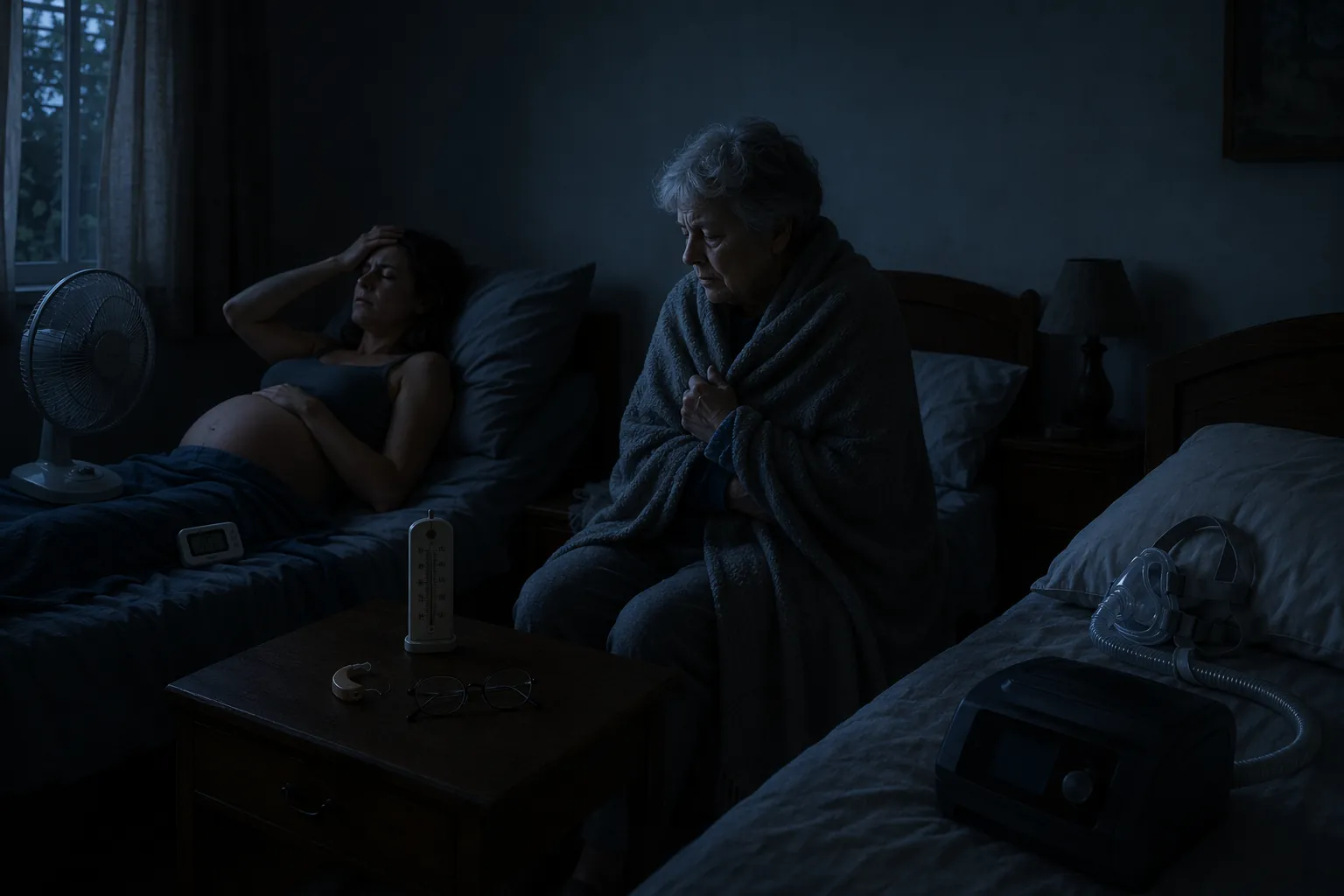
The stay-or-leave check before bedtime
Do this before everyone is exhausted. At 11:40 p.m., the question should not be “Can we make this bearable?” It should be “Is this room still safe for this person, with this body and this equipment?”
| If this is true tonight | Treat it as | What to do |
|---|---|---|
| You are pregnant and the room is above 90°F | A heat-risk situation, not just an uncomfortable bedroom | Do not rely on a fan as the main fix; move to a cooler location if cooling the room safely is not possible. |
| A CPAP machine cannot run for the full sleep period | A treatment interruption risk | Use a tested battery backup if available, or follow the plan you made with your clinician or equipment provider. |
| An older adult may not hear alerts or see well in the dark | An emergency-alert and fall-risk problem | Set up visual/tactile alerts if available, keep a clear path to the bathroom, and check in directly rather than assuming they will wake. |
| The home is losing heat and approaching 50°F indoors | A cold-exposure warning, especially for older adults | Add insulation and layers immediately, monitor the person, and consider a heated location before the situation worsens. |
| Someone is confused, very drowsy, shivering intensely, no longer shivering despite cold exposure, or has a body temperature below 95°F | Possible hypothermia emergency | Seek emergency medical help. |
| A generator is running near doors, windows, vents, a garage, or sleeping areas | A carbon monoxide hazard | Shut it down if needed and move it outside at least 20 feet from openings; use CO detection near sleeping areas. |
Those thresholds come from different kinds of evidence, so they should not be blended into one universal “safe temperature.” The 90°F fan warning is pregnancy-specific. The 50°F cold-home warning is most urgent for people with higher cold vulnerability. CPAP planning depends on the exact device, battery, pressure settings, humidifier use, and mask setup.
If you are pregnant, heat is the first risk to sort out
For pregnancy, power-outage sleep advice has to be stricter about heat. The CDC’s September 2025 clinical overview says heat exposure in any trimester has been associated with preterm birth, stillbirth, and low birth weight, and that as little as one day above the 95th percentile mean temperature may increase risk.[2] That does not mean one hot night guarantees harm. It does mean a hot bedroom should not be treated as a normal sleep inconvenience.
The fan advice is where generic guidance can become actively misleading. The CDC warns that fans may be ineffective when indoor temperatures are above 90°F for pregnant people and may actually increase body temperature.[2] If the power is out, the room is hot, and the only plan is battery fan plus damp cloth, that plan has a limit.
- Check the actual indoor temperature, not just how the room feels.
- If the room is under 90°F and airflow is available, use shade, cross-ventilation when outdoor air is cooler, light clothing, and hydration to reduce heat strain.
- If the room is above 90°F and cannot be cooled safely, plan to leave for air-conditioned shelter, a cooling center, a hospital-recommended location, or a trusted home with power.
- Do not wait until symptoms are severe before calling your prenatal clinician, local nurse line, or emergency services if you feel faint, confused, unusually weak, or unable to cool down.
The point is not to panic pregnant readers out of their homes. It is to stop pretending that a powerless fan and an open window are an adequate plan at every temperature.
If you use CPAP, the sleep plan is a power plan
A CPAP machine is not a comfort accessory. If you use one every night, the outage question is whether your treatment can continue long enough for real sleep. The American Lung Association notes that CPAP machines draw about 30–90 watts, but that range is not a substitute for checking your own device. Heated humidifiers can increase power draw three- to five-fold, and battery packs should be tested for a 6–8 hour runtime before an outage.[3]
That test matters because a battery that looks adequate on a product page may not last through your pressure settings, humidifier settings, mask leak, and actual sleep duration. If your backup battery only lasts three hours in a real test, you do not have an overnight plan; you have a partial bridge.
Before storm season
- Find the wattage or power requirements for your specific CPAP, BiPAP, or APAP device.
- Test the backup battery for the full sleep window you need, not just for a short daytime trial.
- Repeat the test with the humidifier off if your clinician or equipment provider says that is acceptable for you.
- Keep the correct DC adapter, charged battery, extension cord for safe generator use if applicable, and mask parts together.
- Ask your sleep clinician or durable medical equipment provider what to do if treatment is interrupted, especially if you have severe sleep apnea, oxygen needs, heart or lung disease, or a history of dangerous daytime sleepiness.
During the outage, do not spend the first hour guessing whether the machine might make it. Turn off nonessential add-ons if that is part of your pre-approved plan, preserve battery for sleep, and move sooner if the only safe way to use your machine is somewhere else.
For older adults, the bedroom hazard is often the part no one sees
Older adults do not just face “the same outage, but less convenient.” Alerts, darkness, temperature, medication schedules, mobility, and sleep equipment can all fail at once. PowerOutage.us, citing NIH-linked hearing data, notes that 22% of adults ages 65–74 and 55% of adults 75 and older have disabling hearing loss, which makes audible emergency alerts unreliable for many people; vision impairment can also compound fall risk in a dark home.[4]
That changes what a caregiver should check. A flashlight on the nightstand is helpful only if the person can find it, turn it on, and walk safely with it at 2 a.m. A weather alert is useful only if it wakes the person who needs it. A pile of blankets helps only if the room has not become dangerously cold and the person is still warm, alert, and able to move safely.
Cold deserves early attention. A Canadian winter power-outage guide reports that a typical home without heat in January can fall to about 10°C, or 50°F, within 8–12 hours, and that older homes can drop below 5°C, or 41°F, overnight. The same guide identifies a body temperature below 95°F as hypothermia territory and a medical emergency.[5] Those home-cooling figures are location- and building-dependent, but they are a useful warning against waiting until morning to check on someone vulnerable.
- Before bed, clear the path from bed to bathroom and remove loose rugs, cords, pet bowls, and low furniture.
- Put a flashlight or lantern where the person’s hand naturally reaches, not across the room.
- Use a check-in plan that does not depend only on the older adult hearing a phone, siren, or weather radio.
- Move medications, glasses, hearing aids, mobility aids, water, and a charged phone within reach before sleep.
- If the person also uses CPAP or oxygen-related equipment, treat the outage as a medical equipment problem, not just a lighting problem.
For a narrower caregiver-focused plan, see Restful Ground’s guide to how older adults can sleep safely during a storm power outage.
Generator use: solve the power problem without creating a sleeping-area hazard
A generator can keep medical equipment running, but it can also make sleep dangerous if carbon monoxide enters the home. CDC/FEMA guidance says generators should be placed at least 20 feet from any window, door, or vent, and that carbon monoxide detectors should be used in sleeping areas.[6]
Do not run a generator in a garage, on a porch, near a cracked window, or close to an intake vent. Do not bring grills, camp stoves, or outdoor heaters inside to warm a bedroom. If the CO alarm sounds, leave the area and follow emergency instructions; do not troubleshoot it from bed.
Low-tech sleep tactics, once the room is still safe
After the safety thresholds are handled, ordinary sleep tactics can matter. They just need to stay in their lane. Darkness, layering, room setup, and airflow can help you rest; they should not be used to rationalize staying in a dangerous temperature range or sleeping without required medical equipment.
Keep the room dark without using candles
Total darkness supports melatonin production, so it is reasonable to block stray light and keep screens low if you are checking outage updates.[7] Use battery lanterns, headlamps, or flashlights instead of candles, especially around older adults, children, pets, oxygen equipment, or anyone who may get up in the night.
Use layers that can be adjusted quickly
In a cold outage, use layers rather than one heavy covering that is hard to adjust. Oregon State University Extension recommends wool layering for cold conditions because wool helps insulate even when damp.[8] Keep socks, a hat, and an extra blanket within reach for people who chill easily, but keep checking alertness, shivering, coordination, and room temperature.
Cool the sleeper, not just the room
If heat is the problem and the room is still within a safe range for the person sleeping there, reduce bedding, choose light clothing, move to the lowest safe level of the home, and open windows only when outdoor air is cooler or ventilation is otherwise safe. Avoid blocking exits with mattresses, extension cords, or makeshift cooling setups.
For pregnant people, remember the 90°F fan limit. For older adults, keep the walking path clear if you move the sleep area. For CPAP users, make sure the new sleep spot still allows safe equipment placement and power access without cords becoming a fall hazard.
A short preparation path for the next outage
The useful work happens before the house is dark. You do not need a complicated sleep kit. You need the few items and decisions that prevent a bad night from becoming a medical emergency.
- Put a thermometer where you can read the bedroom temperature during an outage.
- Decide now where you will go if heat, cold, or medical equipment failure makes sleeping at home unsafe.
- If you use CPAP, test your backup power for a full 6–8 hour night and label what settings were used during the test.
- Place a working carbon monoxide detector near sleeping areas and test it on schedule.
- For older adults, create a check-in plan that accounts for hearing loss, vision impairment, mobility limits, and nighttime bathroom trips.
- For pregnancy, keep your prenatal care contact information and the nearest cooling options easy to find.
Safe sleep during a power outage depends on matching the advice to the sleeper. A healthy adult in a mildly warm room may need darkness and patience. A pregnant person in a 92°F bedroom, an older adult in a rapidly cooling house, or a CPAP user with a dead battery needs a different plan, and sometimes a different place to sleep.
References
- Tips for Sleeping Without Air Conditioning — HealthPartners.
- Clinical Overview of Heat and Pregnancy — Centers for Disease Control and Prevention, September 2025.
- Power Outage Preparation — American Lung Association.
- Power Outage Preparedness for Seniors & Elderly — PowerOutage.us.
- Power Outage Sleep Ontario Guide — Mattress Miracle.
- What to Do to Protect Yourself During a Power Outage — Centers for Disease Control and Prevention.
- Light and Sleep — Sleep Foundation.
- Emergency Preparedness: Power Outages — Oregon State University Extension.
Read the full guide: How to Sleep Without AC When the Power Goes Out