
How to Sleep Without AC When the Power Goes Out
If you are trying to figure out how to sleep during a power outage without AC, start with the forecast low, not the bedding. When the overnight low is expected to stay above 75°F, Ashley Ward of Duke University’s Heat Policy Innovation Hub told PBS News that heat illness and mortality risks rise; that threshold is especially important if you are 65 or older, pregnant, living alone, or taking medications that affect heat tolerance.[1]
That does not mean 74°F is automatically safe or 76°F is the same for everyone. It means a hot night with no AC needs a stay-or-leave decision before anyone starts arranging damp towels. If the night will not cool down enough for your body to recover, a cooling center, a powered public building, or another air-conditioned place is the safer sleep plan.
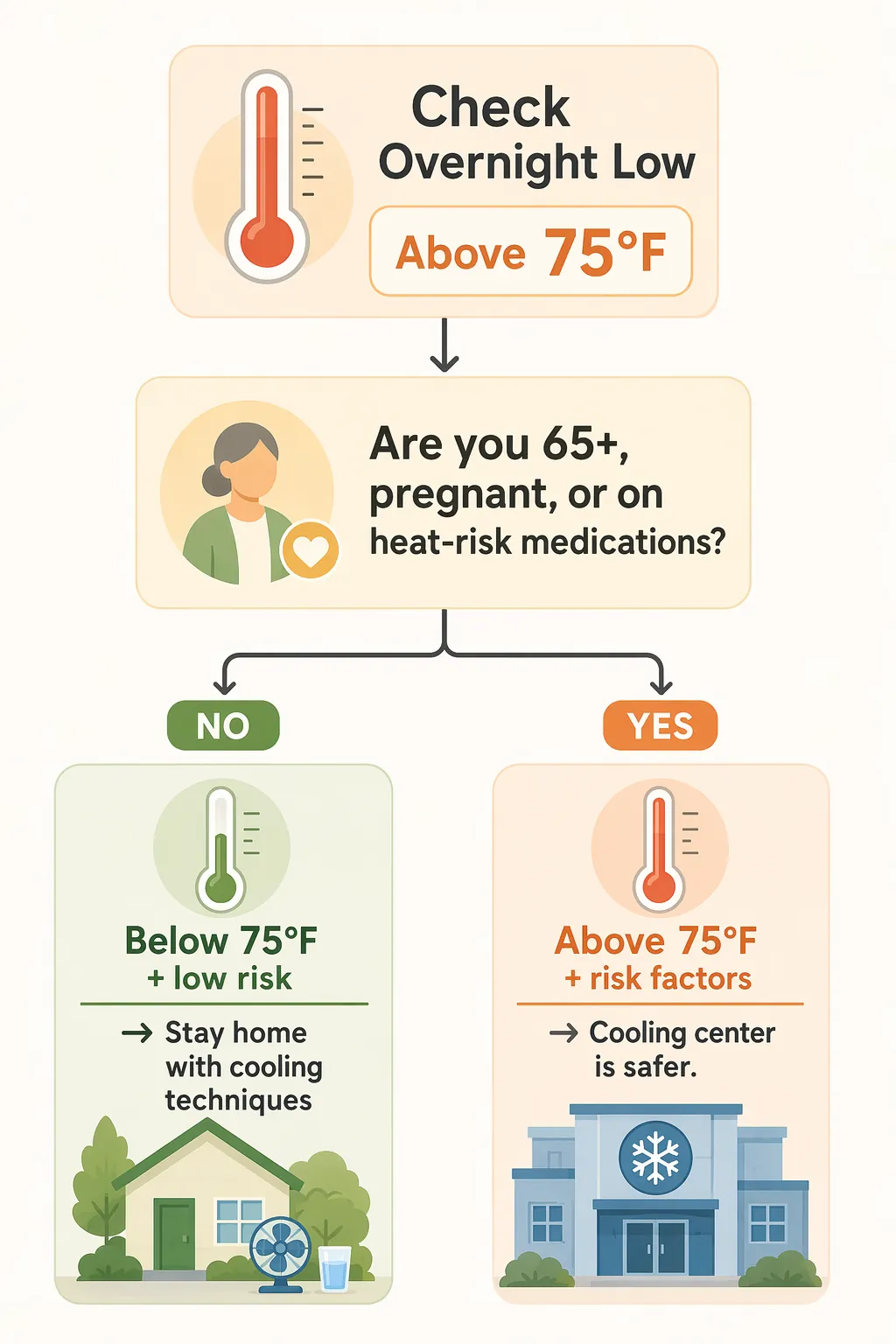
Decide before bedtime: stay, leave, or get medical help
Use three checks while there is still enough daylight, phone battery, and judgment left to act.
- Check the forecast overnight low. If it will stay above 75°F, treat sleeping at home without AC as a higher-risk choice, not an inconvenience.[1]
- Screen for personal risk. Adults 65 and older have a harder time adjusting to sudden temperature changes, and chronic conditions or common medications can make heat less tolerable.[2][3]
- Look for heat-illness symptoms. If symptoms are present, the plan is not “try to sleep cooler.” It is to cool the person now and get medical help when warning signs point to heat stroke.[4]
| What you find at 8–10 p.m. | Safer next move |
|---|---|
| Forecast low above 75°F, and the person is older, pregnant, on heat-risk medications, or alone | Do not wait for the bedroom to become unbearable. Look for a cooling center, call 2-1-1 in the U.S., or arrange to sleep somewhere air-conditioned. |
| Any signs of heat stroke: confusion, loss of consciousness, very high body temperature, or symptoms rapidly worsening | Call emergency services. Move the person to a cooler place and begin cooling while waiting for help. |
| Heat exhaustion symptoms such as heavy sweating, weakness, dizziness, nausea, headache, or fainting | Stop trying to sleep. Move to the coolest available place, loosen clothing, use cool cloths or damp sheets, sip water if fully alert, and seek medical advice if symptoms do not improve. |
| Forecast low below the danger threshold, no high-risk condition, no symptoms, and the home can be ventilated safely | Use no-power cooling techniques, but keep checking the person and the indoor temperature through the night. |
The Red Cross separates heat cramps, heat exhaustion, and heat stroke because the action changes. Muscle cramps may be an early warning. Heat exhaustion can bring cool, moist, pale or flushed skin; heavy sweating; headache; nausea; dizziness; weakness; or exhaustion. Heat stroke is an emergency, especially with confusion, loss of consciousness, vomiting, or very high body temperature.[4]
Do not ask an older adult, a pregnant person, or someone who is already dizzy to “just try to get through the night.” Heat illness can move faster than a cooling trick can fix.
Why older adults should leave earlier, not later
For an older adult, “I’ve handled heat before” is not a reliable safety standard during a power outage. The CDC notes that older adults do not adjust as well as younger people to sudden temperature changes, and they are more likely to have chronic medical conditions or take medicines that affect the body’s ability to control temperature or sweat.[2]
Medication risk is not rare or obscure. Mayo Clinic lists several drug classes that can raise heat-stroke risk, including diuretics, beta blockers, antihistamines, and antipsychotics.[3] A person taking a beta blocker may not respond to heat stress the way a younger, unmedicated person does. A person on a diuretic may be more vulnerable to dehydration. An antihistamine can reduce sweating. None of that is visible from across the room.
This is why the 75°F overnight-low threshold deserves attention but not blind use. It is a practical warning point from an expert quoted in a news report, not a personalized medical clearance line.[1] For an 80-year-old upstairs, alone, with heart disease and no working fan, the safer cutoff may come sooner.
If you are caring for an older adult, check directly. Do not rely only on “I’m fine.” Ask about dizziness, nausea, headache, weakness, muscle cramps, confusion, and whether they have urinated normally. Look at the room they will actually sleep in, not the downstairs hallway. Upstairs rooms can stay hot long after sunset.
For more on older-adult heat physiology in non-outage conditions, see Restful Ground’s guide to heatwave sleep tips for older adults. A power outage is the more acute version: the backup plan matters earlier.
Pregnancy changes the risk calculation
During pregnancy, overheating is not just miserable sleep. The CDC’s clinical overview says that even one day of high heat may increase the risk of adverse pregnancy outcomes, including preterm birth, stillbirth, and low birthweight.[5] Mayo Clinic Health System guidance also states that a pregnant person’s core body temperature should not exceed 102°F.[6]
That does not mean every warm bedroom becomes an emergency. It does mean a pregnant person should not be expected to lie awake in a sealed, hot apartment because a list of sleep hacks promised relief. If the forecast low remains above 75°F, the power is out, and the room is not cooling, make the leaving plan while transportation and communication are still available.[1]
Hydration matters, but it is not a substitute for a cooler environment. Mayo Clinic Health System recommends at least 64 ounces of water per day as a baseline in pregnancy, with more needed in hot weather.[6] If nausea, dizziness, headache, faintness, contractions, or reduced ability to keep fluids down enters the picture, the question is no longer how to sleep without AC. It is how to get evaluated and cooled safely.
Restful Ground has a separate guide on sleeping during extreme heat while pregnant. In an outage, use that advice only after the safety screen is passed.
Find a cooling center before the bedroom becomes the test
In the U.S., the National Center for Healthy Housing maintains a Cooling Centers by State directory, and its June 2026 guidance also points people to 2-1-1 for local cooling-center information.[7] If you are outside the U.S., look for the equivalent local emergency-management, public-health, or municipal alert system rather than a generic web list.
Call earlier than feels necessary. Ask whether the location is open overnight, whether pets are allowed, whether medical devices can be charged, whether transportation is available, and what you need to bring. If someone depends on a powered medical device, do not wait until the battery is nearly gone to ask those questions.
If leaving is possible but difficult, make it smaller: one bag, medications, water, phone charger or battery pack, ID, keys, glasses, mobility aids, and a light layer in case the cooling center is chilly. For a neighbor or relative, the useful offer is not “let me know if you need anything.” It is “I can pick you up now and take you to the cooling center or my place.”
If you stay home, cool the body first
Once the safety screen supports staying home, the best no-power tactics are the ones that remove heat from the body directly. Cooling the mattress is nice. Cooling the person matters more.
Use a damp sheet or towel
A lightly damp sheet can help by evaporation. Amerisleep describes the damp-sheet method as a way to sleep more comfortably without electricity: dampen a sheet with cool water, wring it out well, and use it as a light cover rather than soaking the bed.[8]
Keep it practical. The sheet should be damp, not dripping. If the person starts shivering, feels worse, becomes confused, or cannot get comfortable, stop treating this as a sleep setup and reassess for heat illness. Damp fabric is a tool, not a monitor.
Take a lukewarm shower before bed if water is available
A lukewarm or warm shower about 60 to 90 minutes before bed may help the body release heat afterward; Dr. Jennifer Dunphy told Real Simple that cold showers do not produce the same rebound drop in core temperature.[9] During an outage, keep the shower short and safe. Sit if dizzy. Do not shower alone if faintness is already present.
For someone at higher risk, this is not a reason to stay in a dangerously hot home. It is something to do only when the night is otherwise within a safe range and symptoms are absent.
Move the sleep location, then manage the air
Heat rises, and upper rooms can hold heat late into the night. If you stay home, sleep on the lowest safe floor. A living room floor may be safer than an upstairs bedroom. If there is a basement that is dry, ventilated, and safe to access, it may be cooler than the main level.
Windows should follow temperature, not hope. Open windows when outdoor air is cooler than indoor air and you can do so safely. If the air outside is still hotter than the room, open windows may bring in more heat. If you can create cross-ventilation from opposite sides of the home during a cooler window of time, use it; when sun or hot air returns, close the exposed side again.
During the day and early evening, reduce heat gain before bedtime. Close curtains or blinds on sun-exposed windows. Real Simple cites Andy Fox of 3M, who points to U.S. Department of Energy guidance that reflective blinds can reduce heat gain by about 45% when fully lowered and closed.[10] That figure is useful, but it is not permission to sleep through a high-risk hot night without AC.
Be careful with generators, carbon monoxide, and fans
If you use a generator, carbon monoxide safety comes before comfort. The CDC says generators must not be used indoors and should be kept away from sleeping areas; a working carbon monoxide detector is an important safety protection during an outage.[11] Do not run a generator in a bedroom, hallway, enclosed porch, or any indoor space because the room is hot.
Fan advice gets repeated so often that it can sound like a plan. It is not always one. The Red Cross and CDC both warn that electric fans alone do not prevent heat-related illness when temperatures reach the high 90s.[4][11] In a power outage, the fan may not work at all unless you have safe backup power.
If a battery fan is available and the room is not dangerously hot, aim it across damp skin or a damp sheet rather than relying on moving hot air alone. Stop if it makes the person feel worse, dries them out, or delays leaving when leaving is the safer choice.
The small sleep-comfort moves come last
After the safety decision, after the cooling-center question, after symptoms have been checked, ordinary sleep tactics can help a safer night feel less punishing.
- Wear loose, light sleepwear or sleep with minimal covering if privacy and safety allow.
- Use a single breathable sheet instead of layered bedding.
- Keep skin exposed where possible so evaporation can work.
- Lie with arms and legs slightly away from the body if comfortable; Zinus describes spread-out positions such as starfish or log positions as better for exposing surface area to cooler air.[12]
- Keep water nearby, but do not force large amounts quickly if nausea or confusion is present.
These are comfort aids for someone who has already passed the safety screen. They do not cancel an unsafe forecast low, pregnancy risk, older-adult medication risk, or signs of heat illness.
When the safest sleep plan is not sleeping at home
A power outage during extreme heat is not a normal bad night of sleep. If the forecast overnight low stays above 75°F, especially for an older adult, a pregnant person, someone on heat-risk medications, or someone alone in an upstairs home, the better plan may be to leave before bedtime.[1][2][3][5]
A damp sheet, a lukewarm shower, an open window, or reflective blinds can make a survivable night more tolerable. They do not change the safety threshold when the night will not cool down enough for the body to recover.
References
- PBS News report quoting Ashley Ward of Duke University’s Heat Policy Innovation Hub, PBS News, June 2026
- Heat and Older Adults, CDC, June 2024
- Heatstroke risk factors, Mayo Clinic
- Extreme Heat Safety, American Red Cross
- Clinical Overview of Heat and Pregnancy, CDC, September 2025
- Pregnancy and heat guidance by Abbey Rose, CNM, Mayo Clinic Health System
- Cooling Centers by State directory, National Center for Healthy Housing, June 2026
- How to Sleep Comfortably Without Electricity, Amerisleep
- Real Simple article quoting Dr. Jennifer Dunphy on warm showers before bed, Real Simple, July 2026
- Real Simple article quoting Andy Fox of 3M and citing U.S. Department of Energy guidance on reflective blinds, Real Simple
- What to Do During a Power Outage, CDC
- Zinus guidance on sleep positions and heat dissipation, Zinus
Read the full guide: How to Sleep When the Heat Index Reaches 100