
Do school smartphone bans improve teen sleep? It depends.
A smartphone ban at school improves teen sleep only if the word ban means something stronger than “put it away until dismissal.” The sleep question is not whether a phone is visible in algebra. It is whether the phone is still available when a tired teenager is trying to fall asleep, getting buzzed awake, or reaching for a screen after waking at 2 a.m.
That distinction matters because the strongest real-world school-only evidence does not show better sleep. The SMART Schools study, published in The Lancet Regional Health – Europe in 2025, looked at 1,227 adolescents across 30 schools and found that restrictive school phone policies were associated with about 40 fewer minutes of phone use during school. But the same study found no meaningful difference in total weekday or weekend phone time, sleep duration, sleep efficiency, physical activity, or mental wellbeing when restrictive schools were compared with permissive schools.[1]
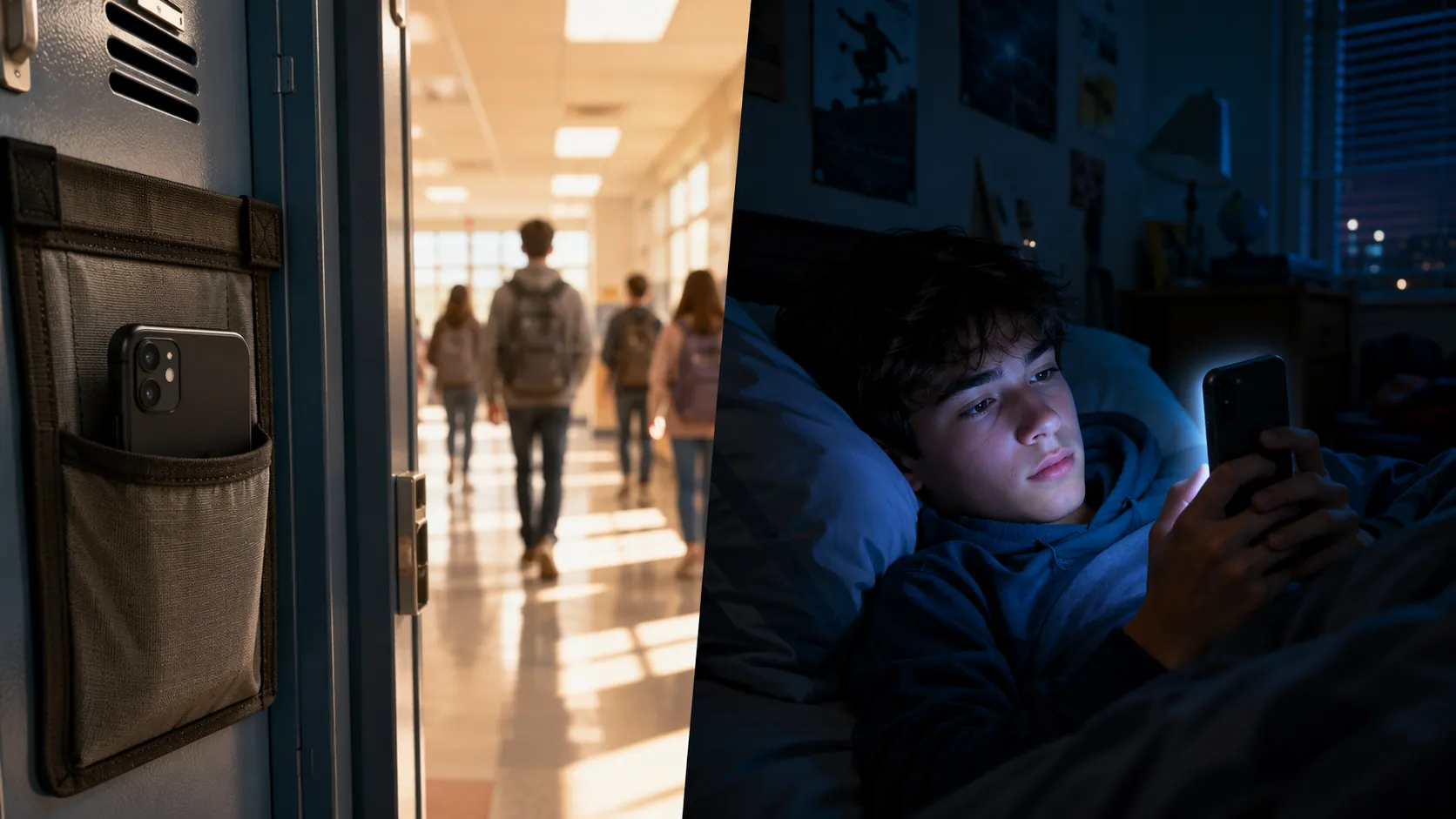
The school-day ban solves the visible part
The SMART Schools finding is uncomfortable because it is exactly the kind of policy adults can see working. Phones are not on desks. Teachers spend less time asking for devices to be put away. The hallway may feel calmer. None of that is trivial for a school day.
But sleep is not earned by a phone-free classroom if the missed phone time is simply pushed into the evening. In SMART Schools, the restriction changed where use happened more than how much use happened. For a teenager’s sleep, that is the difference between a cleaner school day and a changed night.
This is where many arguments about school phone bans overreach. A school-only rule can reduce in-school use. It may be justified for attention, classroom management, or social reasons. But the available evidence does not support telling parents that a school-day restriction, by itself, will make their teenager sleep longer or better.
The York experiment changed the part of the day sleep depends on
The study that sounds much more hopeful used a different kind of ban. In a 2024 University of York experiment, Year 8 students ages 12 to 13 in one school gave up smartphones for 21 days. The reported sleep changes were hard to ignore: students fell asleep 20 minutes faster, gained about 1 hour of nightly rest, and moved bedtime 50 minutes earlier. The total-ban group also reported a 17% reduction in depression-related feelings and an 18% reduction in anxiety-related feelings.[2]
Those are not small changes in a school nurse’s office. A teenager who falls asleep nearly an hour earlier and sleeps an extra hour is not just producing a nicer chart. That student is more likely to arrive in the morning with a nervous system that has had time to recover.
Still, this result needs a careful label. The York experiment was small, short, based in a single school and year group, and reported through a university news release rather than a peer-reviewed controlled trial. It is a striking signal, not a settled estimate of what every school or family should expect.
| Policy scope | What changed | What did not clearly change | Best sleep takeaway |
|---|---|---|---|
| School-only restriction | About 40 fewer minutes of phone use during school | Total phone time, sleep duration, sleep efficiency, activity, and wellbeing | Do not expect sleep gains from the school-day rule alone |
| Total smartphone abstinence for 21 days | Sleep onset, nightly rest, and bedtime timing | Long-term effects and generalizability remain uncertain | Removing access during evening and night can plausibly improve sleep |
Why these findings are not really contradictory
The SMART Schools and York findings point in different directions only if all bans are treated as one category. They are not. A school-only restriction removes access during a period when most students are supposed to be awake. A total abstinence policy removes access across the after-school, evening, bedtime, and overnight window, when sleep can actually be delayed or broken.
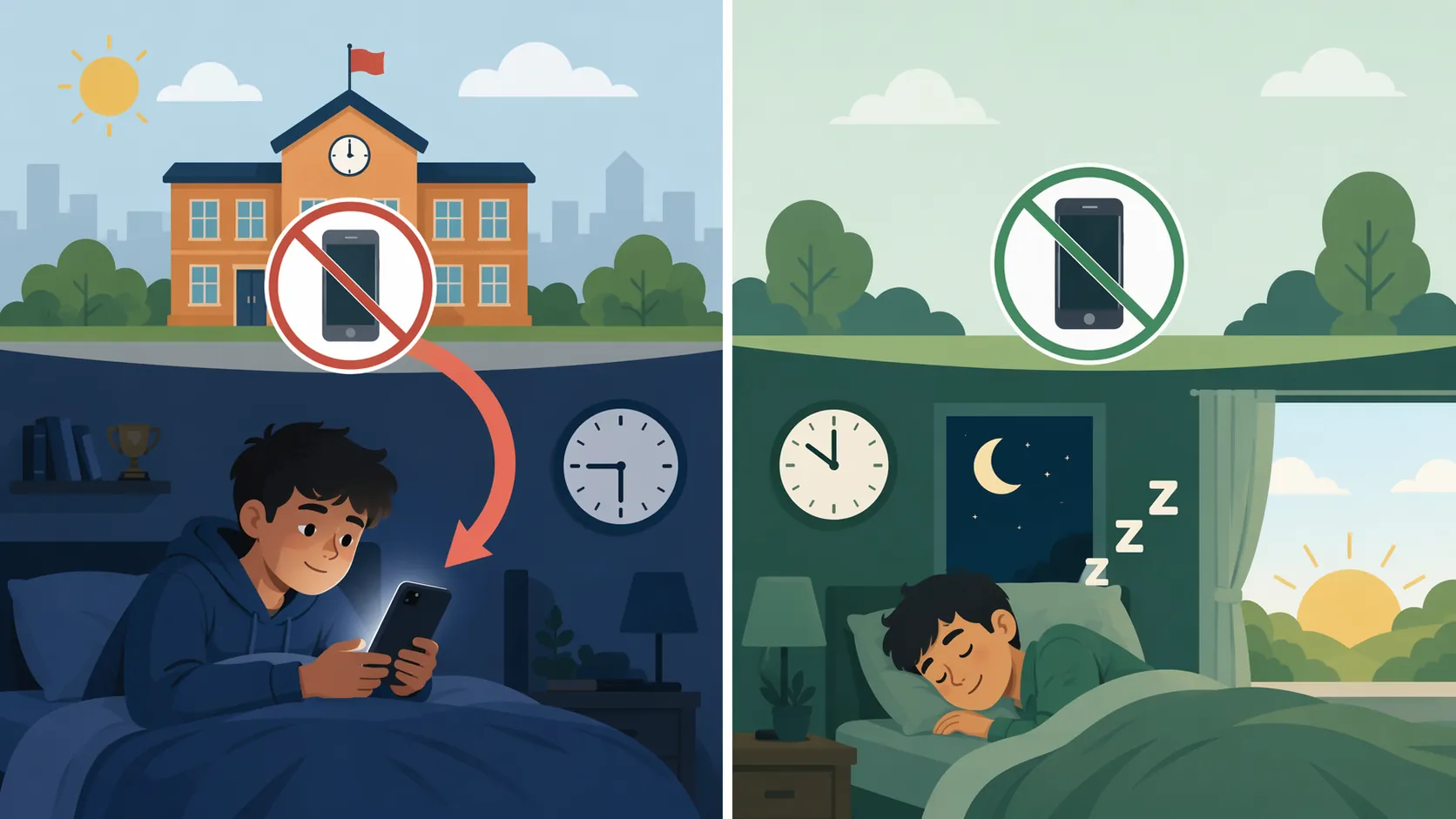
The mechanism is displacement. If a student loses access to a phone from morning bell to dismissal, the social feed, messages, videos, and games do not necessarily disappear. They can wait. The student can catch up on the bus, during homework, after dinner, or in bed. From a sleep standpoint, that shift may even move phone use into a more vulnerable part of the day.
Total abstinence is different because there is no easy “make-up” window at night. It reduces the chance that bedtime becomes the first quiet moment available for everything the phone has been holding all day. That does not make total abstinence easy, scalable, or automatically right for every household. It simply explains why the sleep results could differ so sharply.
The nighttime numbers explain why scope matters
Teen phone use is not just a daytime attention issue. CDC data from the National Health Interview Survey-Teen found that 50.4% of U.S. teens had 4 or more hours of daily screen time.[3] A 2026 JAMA Pediatrics study, reported by CNN, found that more than half of U.S. teens used phones for at least 1 hour after 10 p.m. on school nights, with average time on YouTube, Instagram, and TikTok totaling 33 minutes.[4]
Late use is not the same as proven harm in every individual teenager, but it is sleep-relevant. A 2025 Frontiers in Psychiatry study of about 40,000 university students found that each additional hour of screen use after going to bed was associated with a 59% higher chance of insomnia symptoms and 24 minutes less sleep per night.[5] That study involved university students, not middle schoolers, so it should not be pasted directly onto younger teens. It does, however, line up with the basic concern: screen use after bedtime occupies time that could have been sleep, and it may make settling harder.
The phone can also interrupt sleep after it starts. In a 2023 Sleep Health paper, 17% of adolescents reported being woken by phone notifications at least once per night, and 20% reported using their phone if they woke overnight.[6] That is not a classroom management problem. It is a bedroom access problem.
Blue light and melatonin often get most of the attention, and they are part of the broader sleep conversation. But for many families, the first practical issue is simpler: a phone in the room gives a tired brain more chances to keep going. For related background, Restful Ground’s explainers on bedtime and mental health, teen athlete sleep debt, and how much sleep young athletes need are more useful than treating every late-night screen problem as a single “blue light” problem.
What parents and educators can reasonably expect
If a school announces a smartphone ban, the sleep question to ask is not “Is it strict?” but “When does access return?” A pouch, locker, or office collection system may keep phones out of the classroom. If the phone comes back at dismissal with no change to evening routines, the best available evidence suggests sleep should not be the promised outcome.
- A school-only ban can reduce visible phone use during school, but it has not been shown to improve teen sleep duration or sleep efficiency.
- A household or school-home plan that removes phone access during the evening and overnight window is more likely to affect bedtime, sleep onset, and total sleep.
- A sleep claim should be judged by sleep measures, not by whether adults see fewer phones during the day.
- A teen who is still using a phone after 10 p.m. or after waking overnight has not had the sleep-relevant exposure removed.
This also means parents should not be told that the school has handled the problem for them. The hardest part of the sleep equation usually happens at home, when the phone is socially useful, emotionally comforting, and logistically convenient. Charging the phone outside the bedroom, setting a household cutoff, or using a basic alarm clock may do more for sleep than a rule that ends at 3 p.m.
For educators, the cleaner claim is also the safer one. Schools can argue for phone restrictions because they want fewer classroom interruptions. They can argue that students need protected time with peers and teachers. But if the public promise is better sleep, the policy needs to reach the hours when sleep is being displaced.
What the wider school-ban evidence adds
A Stanford/NBER pre-print looking at more than 43,000 schools found that school phone bans, including bans using pouches, did not produce immediate academic or behavioral improvements.[7] It is not a sleep study, and as a pre-print it should be treated cautiously. Its value here is narrower: it fits the warning that removing phones from school hours does not automatically produce the broader outcomes adults may hope for.
The practical answer, then, is restrained. School-only smartphone bans may have legitimate goals, but improved teen sleep should not be assumed from them. Sleep changes become plausible when the intervention changes total exposure during the after-school, bedtime, and overnight window. If the phone disappears from the desk but glows beside the pillow, the most important part of the sleep problem is still in the room.
References
- School phone policies and their association with mental wellbeing, phone use, and social media use (SMART Schools): a cross-sectional observational study, The Lancet Regional Health – Europe, 2025
- School smartphone ban results in better sleep for pupils, University of York, 2024
- Screen Time Among Adolescents: United States, July 2021–December 2023, CDC Preventing Chronic Disease, 2025
- Teen nighttime phone use study, CNN, 2026
- Screen use after bedtime and insomnia symptoms, Frontiers in Psychiatry, 2025
- Adolescent nighttime phone use and sleep, Sleep Health, 2023
- School phone bans and student outcomes, Stanford/NBER, 2026
Read the full guide: How to choose a kid-safe smartphone that protects sleep