
Why you can't sleep after a breakup (and what helps)
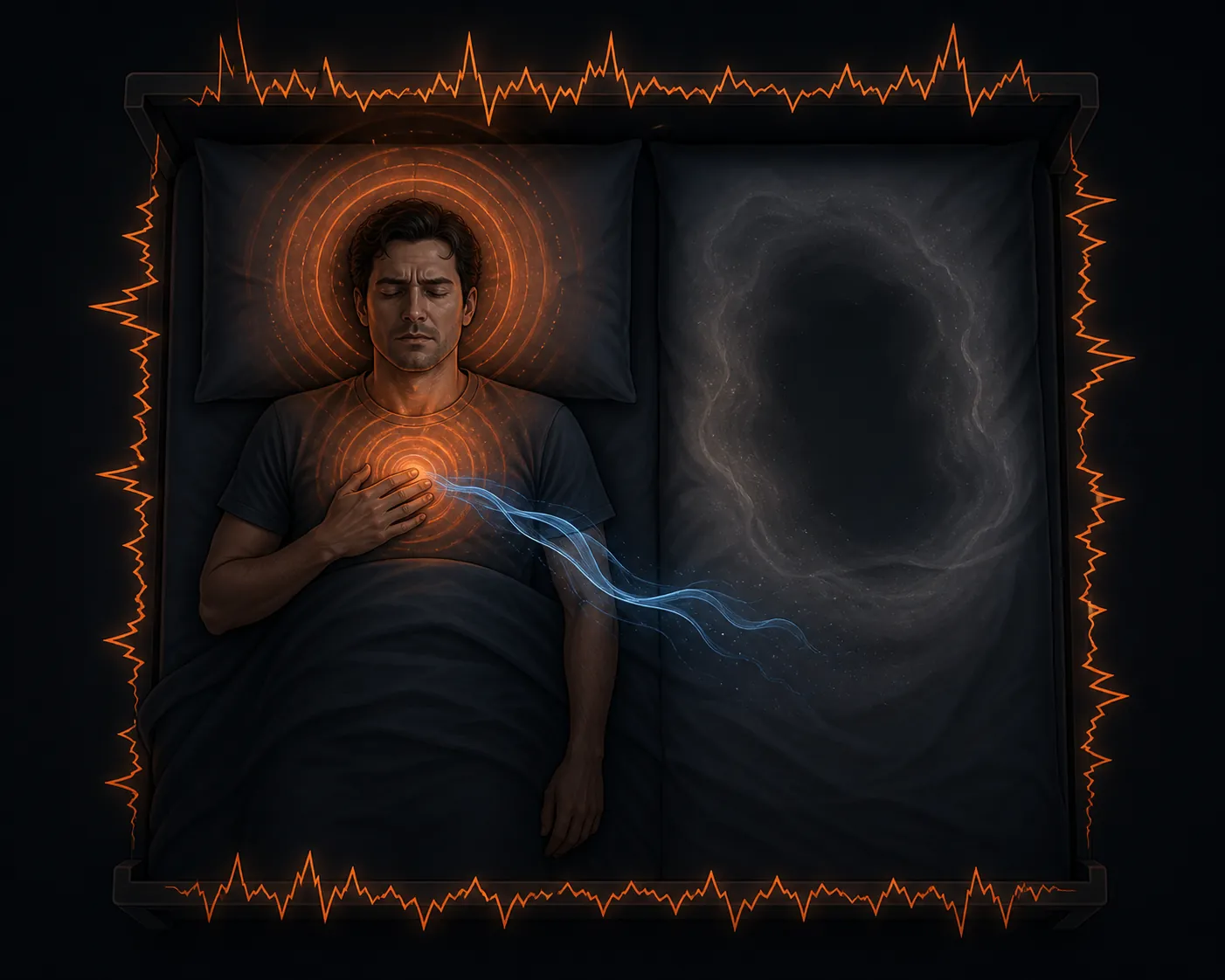
If you are searching for how to sleep after relationship changes because you did the reasonable things - turned off the phone, made tea, kept the room dark - and still lay awake for hours, the problem is probably not that you failed at sleep hygiene. After a breakup, separation, divorce, or the death of a partner, the body can treat the changed bedroom as a threat cue. You may be exhausted and still feel oddly alert, as if some part of you is waiting for a sound, a text, a key in the door, or another person breathing beside you.
That is why generic advice often lands badly here. The question is not only "How do I relax?" It is "Which part of my sleep system is being disrupted, and what intervention matches it?" The answer usually sits in four overlapping mechanisms: elevated night cortisol, dopamine withdrawal from an attachment bond, conditioned bed triggers, and the loss of a co-sleeping safety signal.

Why the bed suddenly feels unsafe
Emotional rejection can register in the body with surprising force. A small but influential fMRI study by Ethan Kross and colleagues found that unwanted romantic rejection activated brain regions also involved in physical pain; Washington Post reporting on breakup insomnia cites that study alongside expert commentary from sleep researchers including Wendy Troxel and Dr. Cunningham of Harvard Medical School.[1] It is a landmark finding, not a complete explanation of every sleepless night after a relationship ends. Still, it helps explain why "just calm down" is the wrong starting point.
The first mechanism is cortisol. Normally, cortisol should fall in the evening as the body moves toward sleep. After a relationship rupture, the stress-response system may keep acting as if the loss still needs immediate monitoring. Business Insider's reporting on breakup insomnia describes this elevated night cortisol pattern and how it can interfere with the normal transition into sleep.[2] For the person in bed, that can feel like a tired body with a vigilant brain.
The second mechanism is attachment withdrawal. A partner is not only a thought or a memory; for many people, they were part of the reward and regulation system of daily life. Their texts, voice, smell, touch, and predictable presence supplied cues the brain learned to expect. When those cues disappear, dopamine-linked reward pathways do not politely reset at bedtime. The missing person can feel most present at the hour when the nervous system used to receive the most evidence of safety.
The third mechanism is conditioning. The bed may have been trained for years to mean closeness, sex, conversation, reassurance, or shared silence. After the relationship changes, the same mattress may now present the empty side, the body impression, the pillow scent, the exact patch of cold sheet where someone used to sleep. In insomnia treatment, this matters because the bed can stop being a sleep cue and become an alarm cue. For a deeper look at the rejection-to-hyperarousal pathway, see why emotional rejection ruins your sleep.
The fourth mechanism is the loss of co-sleeping regulation. Couples do not always sleep better together, and some need separate beds for health. But when a person is used to sleeping beside a trusted partner, the partner's body can become part of the sleep environment. A laboratory study published through PMC/NIH found that bed-sharing in couples was associated with increased and stabilized REM sleep.[3] That does not prove every person sleeps worse alone after a breakup, but it supports something many people notice immediately: the absence is not just emotional. The sleep architecture may have been built around another body.
Match the fix to the mechanism
There is no strong randomized trial literature showing a special post-breakup insomnia protocol that works for everyone. The practical plan below borrows from better-established insomnia treatment, circadian science, and stress-sleep work, then aims those tools at the specific things that changed after the relationship ended.
| What is happening | What helps most | Why it fits |
|---|---|---|
| Cortisol stays high at night | Fixed wake time and morning bright light | They give the circadian system a strong daily anchor and help rebuild the morning-to-evening cortisol rhythm |
| The mind rehearses the loss in bed | Scheduled worry window 1-2 hours before bedtime | It gives grief, planning, anger, and unfinished conversations a place before the bed becomes the place |
| The bed has become an alarm cue | Stimulus control: leave the bed if awake after about 20 minutes | It retrains the bed as a sleep cue instead of a place for scanning and emotional problem-solving |
| The body lost daytime regulation | Moderate daytime exercise | It increases sleep pressure and helps discharge arousal without asking exercise to "fix" the breakup |
| The missing partner was part of the sleep setting | Change selected sensory cues | Fresh sheets, a different side of the bed, or a small room shift can reduce the shock of absence |
Keep wake time fixed, even after a bad night
A fixed wake time is not glamorous, which may be why it gets less attention than evening rituals. It is also one of the most useful tools when the stress system is running late into the night. Choose a wake time you can keep seven days a week for now. Get out of bed then, even if the night was poor. Sleeping in until late morning may feel merciful in the moment, but it often pushes sleep pressure and circadian timing later, making the next night harder.
Pair that fixed wake time with bright outdoor light as soon as practical. Morning light tells the brain that the day has started; over repeated days, that signal helps consolidate the body's timing. This is especially relevant when cortisol and alertness are appearing at the wrong end of the day. For a fuller explanation of that cortisol-melatonin conflict, see why anxiety gets worse at night.
Move the thinking out of bed
Rumination after a relationship ends has a cruel sense of timing. It may wait until the room is quiet, then replay the final conversation, the practical logistics, the thing you wish you had not said, or the thing you still want answered. Trying to suppress all of that at 11:30 p.m. usually fails.
Set a scheduled worry window 1-2 hours before bed. Ten to twenty minutes is enough for many people. Write down the thoughts that keep arriving at night: what needs action, what cannot be solved tonight, what belongs to grief, what belongs to legal or housing logistics, what belongs to the urge to contact the person. The purpose is not to make the thoughts disappear. It is to stop teaching the brain that the pillow is the meeting room for every unresolved part of the relationship.
Use stimulus control when the bed turns against you
If you are awake for about 20 minutes, or if you can feel yourself becoming more alert and distressed, get out of bed. Keep the lights low. Sit somewhere boring. Read something undemanding, fold laundry, or listen to a quiet neutral audio track. Return when sleepy, not when you have finished grieving correctly. This is stimulus control, a core CBT-I technique also discussed in breakup-sleep advice.[1]
The point is not punishment. It is retraining. If the bed has become the place where you scan the empty side, check your phone, calculate what went wrong, and brace for morning, staying there for hours deepens the association. If this pattern has spread beyond the breakup and now looks like sleep anxiety, CBT-I is the treatment framework worth understanding; start with CBT-I for sleep anxiety.
Change the cues that keep announcing absence
Do not redesign your whole life at 2 a.m. Do change the cues that hit your nervous system before you have a chance to think. Wash or replace sheets. Move one lamp. Sleep on the other side for a few nights if the old side makes you stare at the empty one. Put away a pillow that still carries scent. If the room is loaded with reminders, remove a small number of the strongest sleep-disrupting items before bedtime, not as a ceremony of closure but as stimulus control.
This is also where white noise may help, but not because it is magical. If the missing cue is the sound of another person breathing or moving, a steady low sound can make the silence less abrupt. It will not treat cortisol or grief by itself.
Exercise helps, but it is not a moral test
Moderate daytime exercise is useful because it builds sleep pressure, improves mood regulation, and gives the stress system somewhere to put some of its charge. A walk in morning light is often a good first version because it combines movement with circadian anchoring. Hard late-night workouts may backfire if they leave you more activated close to bed.
Exercise is not proof that you are moving on. It is not a cure for missing someone. It is a way of giving the body a clearer day so it has a better chance at night.
What to do tonight
If you need a simple plan for the next 24 hours, make it narrow enough to actually do:
- Pick tomorrow's wake time now and keep it, even if tonight is bad.
- Get outdoor light soon after waking, ideally paired with a short walk.
- Schedule a 10-20 minute worry window 1-2 hours before bed; write instead of rehearsing in bed.
- Change one strong bedroom cue: sheets, pillow, side of the bed, or one visible reminder.
- If awake and increasingly alert after about 20 minutes, leave the bed and return only when sleepy.
Keep caffeine early, alcohol out of the sleep plan, and phone-checking away from the bed if you can. Those basics matter, but in post-relationship insomnia they are supporting actors. The larger work is teaching a changed nervous system that night is no longer an emergency.
How long breakup insomnia usually lasts
The honest answer is a range, not a promise. The available timeline guidance is partly drawn from clinical commentary and lower-authority sleep sites rather than a clean body of post-breakup-insomnia trials. Still, the ranges are useful if held lightly.
| Time since the relationship change | Common sleep pattern | What matters most |
|---|---|---|
| First 1-2 weeks | Acute disruption: trouble falling asleep, early waking, sudden alertness, appetite and mood shifts | Stabilize wake time, light exposure, food timing, and safety |
| About 2-8 weeks | Adjustment phase: some nights improve, then reminders or contact restart poor sleep | Use stimulus control and a worry window consistently instead of judging each bad night |
| About 2-3 months | Many people see meaningful improvement, though not necessarily full emotional recovery | Look for trend, not perfection: shorter awakenings, fewer panic-like nights, easier mornings |
| Beyond 3 months without improvement | Insomnia may be becoming persistent or tied to depression, anxiety, grief, alcohol, or health strain | Consider CBT-I, mental health care, or medical evaluation |
Sleep Recovery describes post-breakup insomnia as often moving through an acute phase of roughly 1-2 weeks, an adjustment phase around 2-8 weeks, and broader recovery over the following months, with many people improving meaningfully within 2-3 months.[5] That timeline should not be read as a deadline. If the relationship was long, unsafe, legally complicated, financially destabilizing, or connected to caregiving or bereavement, the body may take longer to stand down.
Track direction rather than demanding a clean line. A useful sign is not "I sleep perfectly now." It is that you fall asleep a little faster, wake with less alarm, spend fewer hours in the bed thinking, and recover more easily after a bad night. Recovery often arrives as a reduction in nightly threat, not as a single peaceful sleep that proves the breakup is over.
Bereavement is not just a breakup with different language
If the relationship change is the death of a partner, sleep deserves more careful attention. Sleep Foundation reports that more than 800,000 American seniors lose a spouse each year, and that 91% of complicated grief cases report sleep problems, with an average Pittsburgh Sleep Quality Index score of 9.44 - nearly double the threshold of 5 commonly used to indicate poor sleep.[4] That is not ordinary inconvenience. Poor sleep can become part of a larger grief and health-risk pattern.
The same sleep tools may still help: morning light, fixed wake time, stimulus control, and reducing the bedroom cues that trigger panic or yearning. But bereavement can also need grief-specific care, especially when the person feels stuck in acute grief, avoids sleep because dreams are distressing, or cannot function during the day. For more on that loop, see why grief makes it hard to sleep.
When to get help
Post-relationship insomnia is common enough that a bad first week does not mean you are broken. It also should not be allowed to harden into months of untreated sleep loss. Get professional help if any of these are true:
- There is no meaningful sleep improvement after about three months.
- You need alcohol, cannabis, sedatives, or extra medication to sleep.
- You have persistent depression, panic, hopelessness, or thoughts of self-harm.
- Your blood pressure, migraines, pain, blood sugar, or other health conditions are worsening.
- You are afraid to sleep because of dreams, memories, or what you might feel when the room gets quiet.
If the relationship change was a divorce or separation and sleep has stayed disrupted for weeks, the health side matters too. When divorce insomnia becomes a health risk explains why ongoing insomnia after separation deserves active treatment rather than watchful waiting.
Positive relationship changes, such as moving in together or learning to sleep beside a new partner, can also disrupt sleep, but that is a different problem with different cues. This article is about loss-type changes: breakup, separation, divorce, and bereavement.
Most post-relationship insomnia improves. The work is not to prove you are fine. It is to give the body repeated evidence - morning, evening, and in the changed bed - that the danger signal can come down.
References
- I recently broke up with my longtime partner. How do I sleep better alone? - The Washington Post, July 2025
- Why I Had Insomnia and Couldn't Sleep After My Breakup - Business Insider
- Bed-Sharing in Couples Is Associated With Increased and Stabilized REM Sleep - PMC/NIH
- How Grief and Complicated Grief Affect Sleep - Sleep Foundation
- How Long Does Post-Breakup Insomnia Last? - Sleep Recovery
Read the full guide: Why Your Sleep Stays Disrupted After a Power Outage