
Why Your Sleep Stays Disrupted After a Power Outage
Power restoration fixes the electrical problem before it fixes the sleep problem. If you are still lying awake after the lights, fan, air conditioner, router, and bedside clock are working again, the most likely reason is that two systems are still catching up: your stress response may still be elevated, and your bedroom may have started to feel like a place where you have to monitor danger instead of fall asleep.
The sleep impact after power outage restoration can feel confusing because the room looks normal. The body may disagree. After the April 28, 2025 Iberian blackout, clinicians at IIS Sleep Institute described lingering cortisol elevation and “anticipatory insomnia” as two reasons sleep may remain disrupted after service returns.[1] That observation is not a controlled trial, and it should not be treated as proof that every post-outage sleeper has the same pattern. It is still a useful clinical map for the first few nights: ask whether tonight’s problem is mostly a wired body, a wary bedroom, or both.
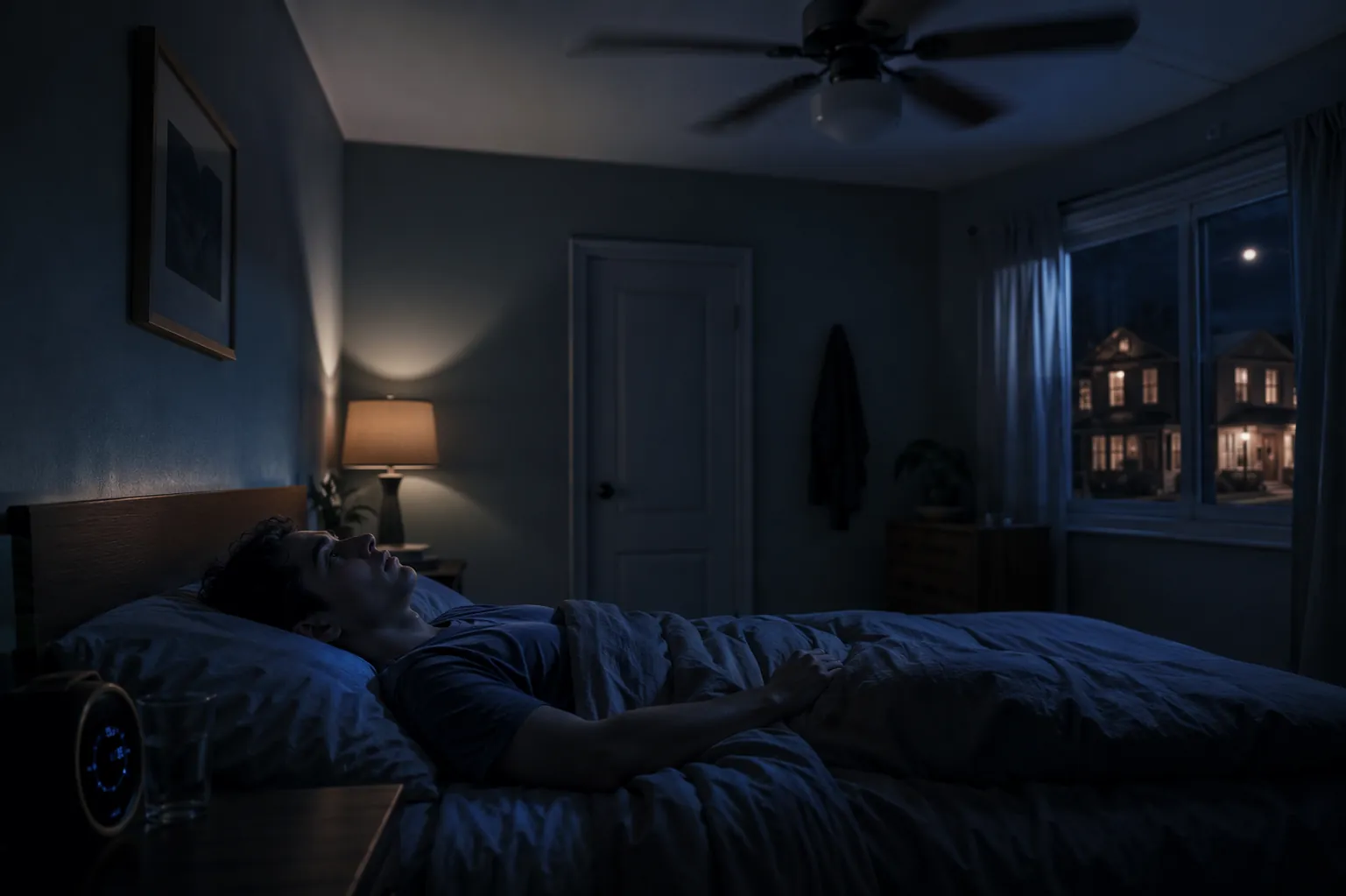
Why the first restored night can still feel unsafe
During an outage, sleep is not only shortened. It is interrupted by heat, darkness, decision-making, device concerns, battery alarms, storm noise, family check-ins, and the practical question of whether the situation is getting worse. Even when nothing medically dangerous happens, the night can train the brain to stay on watch.
The stress layer is the more physical one. Cortisol helps the body mobilize under threat. Melatonin helps the body move toward sleep. IIS clinicians described a post-blackout cortisol-melatonin imbalance in which stress activation can interfere with sleep onset even after the immediate event has passed.[1] In plain terms: the house may be quiet, but the body may still be running the outage protocol.
The conditioned layer is easier to mistake for weakness. If the bedroom became the place where you overheated, listened for appliance beeps, checked a CPAP, worried about an older parent, or watched the clock while the room got darker and warmer, the bed can temporarily become a cue for alertness. Anticipatory insomnia is not “thinking too much.” It is the nervous system predicting another bad night before the night has had a chance to prove otherwise.[1]
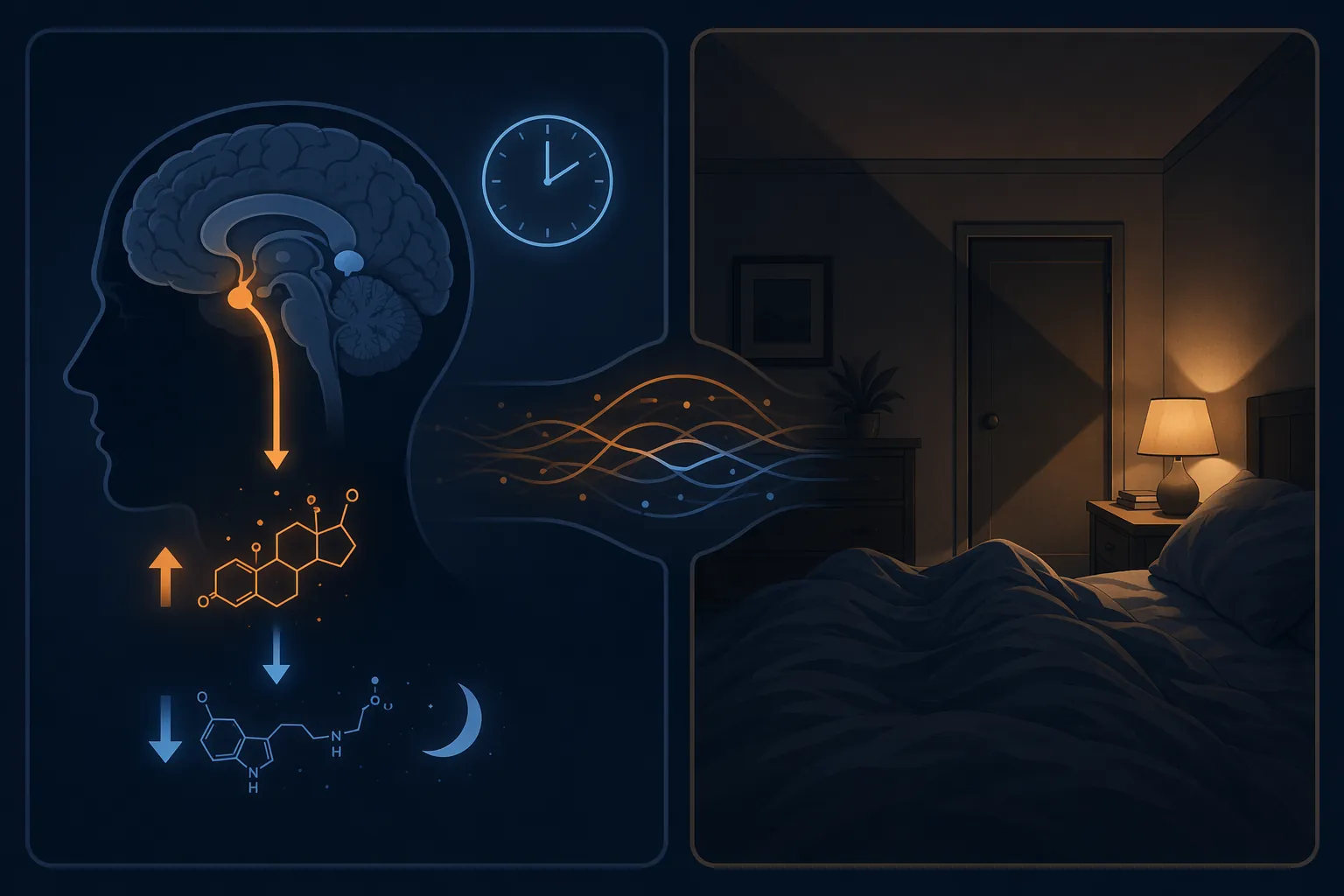
Why heat and sudden light make the disruption stick
Temperature is one reason an outage night can feel so different from ordinary insomnia. Sleep Foundation places the ideal bedroom temperature for sleep around 65 to 68 degrees F and explains that body temperature regulation changes across sleep stages, including REM sleep.[4] When an outage shuts down cooling or airflow, the body has to work harder to stay comfortable, and sleep can become lighter, more fragmented, and easier to break.
Light can jolt the system in the other direction. Light at night can suppress melatonin, and bright or sudden light exposure can send wake-promoting signals when the body is trying to settle.[5] Research does not give a neat, outage-specific number for what happens when power returns at midnight and lamps, clocks, chargers, or appliances come back on. But the mechanism is familiar enough to treat the restoration moment gently: do not let the first working hour become a second bedtime disruption.
Power outages also sit inside a wider health frame. A 2020 narrative review by Casey and colleagues found that outages are associated with increases in hospitalizations for respiratory and cardiovascular conditions, with particular concern for older adults and people who rely on electrically powered medical equipment.[2] That review is not a sleep-recovery calculator. It is a reminder that for some readers, “the power is back” does not automatically mean the body is recovered or the device routine is trustworthy again.
A post-outage sleep reset for the next few days
If you are still in the outage, start with the during-outage guide instead: how a power outage disrupts your sleep. Once power is restored, the task changes. You are no longer trying to get through the emergency; you are trying to teach the body and the room that the emergency has ended.
| Timing | Main job | What to do |
|---|---|---|
| First restored evening | Prevent a second surge of stimulation | Dim lights, silence nonessential alerts, restore cooling gradually, and keep cleanup out of the bedroom if possible. |
| First night | Separate bed from monitoring | Do one safety check before bed, write down any remaining tasks, then stop using the bed as a command center. |
| Next morning | Restart timing cues | Get daylight, eat at a normal time, and avoid sleeping late enough to move the whole schedule. |
| Days 2 to 3 | Retrain the bedroom | Use the room for sleep and calm pre-sleep routines; if anxiety spikes, step out briefly rather than lying in bed rehearsing the outage. |
| Several days out | Avoid fear of the rebound | Expect some uneven sleep; seek more help if severe insomnia, panic, medical-device concerns, or daytime impairment continues. |
First restored evening: keep the house from re-startling you
Restoration often arrives with sensory clutter: lights flicking on, electronics rebooting, appliances chirping, phones charging, neighbors moving around, and everyone checking what still works. Treat that hour as part of sleep recovery, not just cleanup.
- Turn off or dim lights you do not need, especially in the bedroom.
- Reset clocks and alarms once, then stop checking them repeatedly.
- Let the room cool, but do not turn the bedroom into a troubleshooting station.
- Move generator, battery, device, and food-safety decisions outside the sleep space when you can.
- If the outage happened during extreme heat, give your body time to cool before expecting immediate sleep.
This is not fussy sleep hygiene. It is stimulus control after an abnormal night. The bedroom needs fewer signals that say, “Stay up and manage things.”
First night: do one safety check, not twenty
A single check can be calming. Repeated checking can keep the stress system active. Before bed, choose one short restoration check: cooling or heat, medication refrigeration if relevant, medical equipment, doors and windows, phone charge, alarm settings. Write down any task that truly must wait until morning.
Then make the next cue deliberately boring. Wash up. Put the phone down. Use a low-light routine. If you cannot sleep after a while and the bed starts to feel charged, leave the room briefly for something quiet and dim, then return when sleepiness comes back. Readers whose anxiety is now driving the night may want the more detailed CBT-I-style strategies in what to do when anxiety keeps you up at night.
Next morning: anchor the day even if the night was poor
The morning after restoration is where the schedule can either steady or drift. Get outdoor light if it is safe. Eat at a normal time. Move your body gently. Keep caffeine reasonable and early enough that it does not become tonight’s problem. A short nap may be necessary for safety, but a long late nap can make the second restored night harder.
Sleep Foundation summarizes general sleep-deprivation research suggesting the body may need about four days to fully recover for each hour of sleep lost.[3] That estimate is not specific to power outages, and it should not be used as a personal deadline. Its value is expectation-setting: if the outage cost you meaningful sleep, one restored night may not erase the debt.
Days 2 and 3: make the bedroom ordinary again
This is the part most checklists skip. If the room has become associated with heat, darkness, alarm sounds, or fear, waiting in that room for sleep to return can strengthen the wrong association. You are not trying to force sleep; you are trying to make the room predictable again.
- Put outage supplies away from the bed once they are no longer needed.
- Restart your usual wind-down sequence, even if it feels too simple for what happened.
- Keep the room cool, dark, and quiet enough to support sleep rather than vigilance.
- If you wake and scan for danger, name the check you already completed and return to a neutral cue, such as breathing, a familiar audio track, or a low-stimulation relaxation practice.
- If the bed starts to feel like a place where you rehearse the outage, step out briefly and come back when sleep pressure returns.
Pregnancy, perimenopause, ADHD, and older adulthood can all change how strongly heat, sleep loss, and stress are felt, but the outage-specific evidence does not give separate recovery rules for each group. Use the same recovery logic, with a lower threshold for comfort adjustments, medication or device checks, hydration needs, and clinical advice when symptoms are intense. If you need during-outage guidance for pregnancy, older adulthood, or CPAP use, use how to sleep in a power outage when you're pregnant, older, or use CPAP.
Several days out: do not fear rebound sleep
Recovery sleep can feel messy. After sleep deprivation, REM sleep can rebound, and REM may recover before other parts of sleep do.[7] For a sleeper, that can show up as vivid dreams, a strange-feeling night, or waking earlier than expected after a dense dream period. Those experiences are not proof that you are getting worse.
What matters is the direction over several days: less dread before bed, fewer long awakenings, more stable daytime energy, and less urge to keep checking the room. If the first post-outage nights are choppy but gradually less threatening, the system is probably relearning safety.
If you use CPAP or another powered medical device
For CPAP users, sleep recovery is not only emotional. Trust in the device has to be restored. Casey and colleagues identify people dependent on electrically powered medical equipment as a higher-concern group during outages.[2] A Canadian outage guide from Mattress Miracle also emphasizes battery backup planning and re-establishing sleep routines for CPAP users after an outage.[6]
- Confirm the CPAP powers on normally before bedtime, not after you are already exhausted.
- Check mask, tubing, humidifier chamber, filters, and settings if the device was moved or unplugged.
- If you used a battery, recharge it and note whether it actually lasted as expected.
- If therapy felt interrupted, unsafe, or unusually uncomfortable, contact your sleep clinic, durable medical equipment provider, or prescribing clinician.
- Do not treat repeated device anxiety as a personal failure; build a clearer backup plan before the next storm season.
For more device-specific planning, see lockout sleep remedies for power outages with medical devices. Older adults who had heat exposure, shortness of breath, chest symptoms, confusion, falls, or medication disruption should not wait for sleep advice to solve a medical problem; the sleep plan comes after safety.
When lingering post-outage insomnia needs more help
A few unsettled nights after a serious outage can fit the recovery pattern. More help is warranted when insomnia is severe, panic keeps returning at bedtime, daytime sleepiness creates driving or work risk, nightmares become persistent, or the bedroom still feels unsafe after the immediate recovery window.
Get medical guidance sooner if you are pregnant, medically fragile, an older adult recovering from heat stress, using CPAP or another powered device, or managing a condition that worsened during the outage. The public-health literature does not treat outages as harmless inconveniences for these groups, and neither should a sleep plan.[2]
Restoration fixes the power supply. Sleep recovery usually needs two quieter repairs: calming the stress system and making the bedroom feel like a place where nothing has to be monitored.
References
- How the April 28 blackout affected sleep, IIS Sleep Institute
- Power outages and community health, Casey et al., 2020
- Sleep Deprivation, Sleep Foundation
- Best Temperature for Sleep, Sleep Foundation
- Light and Sleep, Sleep Foundation
- Canadian outage guide, Mattress Miracle
- Sleep Physiology, NCBI Bookshelf
Read the full guide: Why Power Restoration Disrupts Sleep More Than the Outage