
What Triggers Sleep Apnea Screening During a DOT Physical?
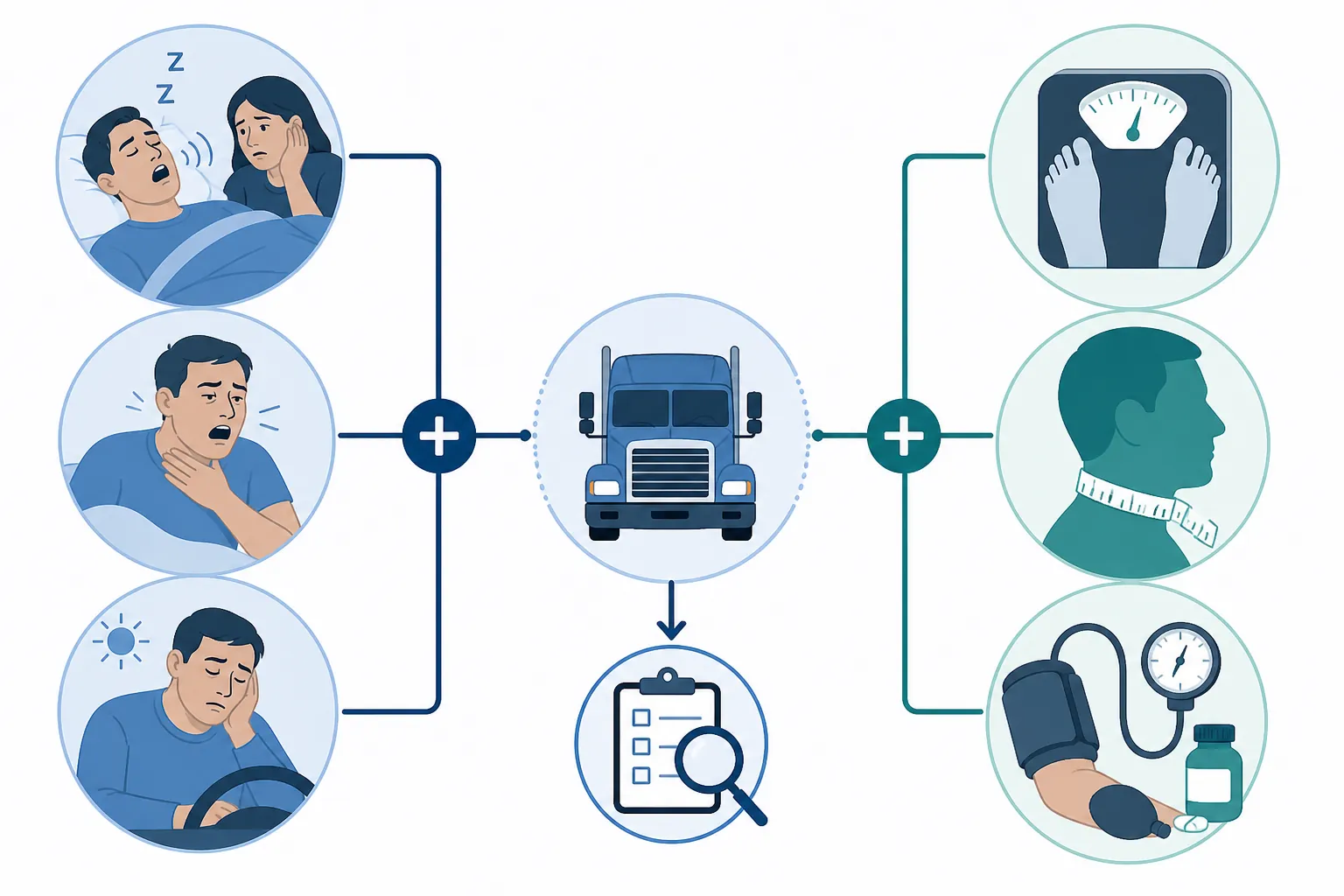
Sleep apnea screening for truck drivers is not an automatic part of every DOT physical. What usually triggers it is a pattern: a symptom that suggests obstructive sleep apnea, combined with measurable findings such as a high BMI, large neck circumference, or difficult-to-control blood pressure. That distinction matters, because drivers are often told only that they “look high risk,” which is not useful when a medical card and a work schedule are on the line.
Medical examiners care about sleep apnea because untreated obstructive sleep apnea can affect alertness behind the wheel. One commercial-driver study reported a relative crash risk of 2.43 for drivers with untreated OSA compared with matched controls, and noted that up to 30% of commercial motor vehicle crashes have been attributed to drowsy driving.[1] Those numbers do not mean every tired driver has OSA, or that every driver with OSA is unsafe. They do explain why the condition appears inside a safety fitness exam instead of being treated as a private sleep complaint only.

The practical trigger: symptoms plus objective findings
The screening pattern many examiners use comes from consensus recommendations rather than from a single universal federal testing rule. The most important version for everyday exam-room decisions is the 2006 Joint Task Force approach: one OSA-related symptom plus two objective findings.
| Category | Findings that may matter during the DOT physical |
|---|---|
| Symptoms | Witnessed apneas, choking or gasping during sleep, or an elevated Epworth Sleepiness Scale score |
| Body size | BMI of 35 or higher |
| Neck size | Neck circumference of 17 inches or more in men |
| Blood pressure | Hypertension that is uncontrolled or treated with two or more medications |
Later commercial-driver studies found that this kind of combined screening had a positive predictive value ranging from 79% to more than 95%, depending on the study and the exact criteria used.[2][3][4] Positive predictive value is not the same thing as diagnosis. It means that among drivers who screened positive under those criteria, a high share were later found to have OSA when tested. The medical examiner still cannot diagnose sleep apnea from a neck measurement or a questionnaire alone.
This is where drivers often feel ambushed. A driver may come in for a blood pressure check, a urine test, vision, hearing, and the usual review of medications, then suddenly hear that a sleep study is needed. But the referral usually does not come from one casual impression. It comes from the examiner putting several items together: what the driver reports, what the examiner measures, what is in the medical history, and whether the pattern points to a condition likely to interfere with safe driving.
Symptoms still matter, but self-report is a weak screen by itself
The symptom side includes things like loud snoring with witnessed pauses in breathing, waking up choking or gasping, and daytime sleepiness. Some examiners also use the Epworth Sleepiness Scale, which asks how likely someone is to doze in ordinary situations. A high score can raise concern, especially when it lines up with physical findings.
The problem is that drivers do not always report symptoms, and not always because they are trying to hide something. Some sleep alone. Some have normalized fatigue. Some know exactly what a “Yes” answer might do to their appointment timeline. In one study, 85% of high-risk drivers answered “No” to the single FMCSA sleep question on the medical form.[2] That is why many examiners do not rely on the form question alone.
BMI is a common shortcut, but it is not the whole decision
BMI gets a lot of attention because it is easy to calculate and easy to document. It is also where drivers hear the most inconsistent advice. Some clinics flag BMI at 30. Others become much more concerned at 35 or 40. The evidence supports being careful about treating BMI alone as the whole answer.
One analysis found that a BMI threshold of 30 produced about 50% positive screens, but with a 38% positive predictive value and a 19% yield. At BMI 35, positive predictive value was about 45% to 56%. At BMI 40, positive predictive value rose above 95%, but the positive rate was only 6% to 7%, which means that threshold mainly captured the most obvious severe cases and missed many others who could still have OSA.[5]
In plain exam-room terms: BMI 35 or higher is a serious flag, but BMI by itself is a blunt instrument. A driver with BMI 36, a 17.5-inch neck, and hypertension on multiple medications is in a very different screening position than a driver whose only finding is an elevated BMI with no symptoms, no blood pressure issue, and a smaller neck measurement. The first pattern gives the examiner a documented safety concern. The second may still be watched, but it is not the same case.
Neck circumference changes the picture
Neck circumference matters because obstructive sleep apnea is about airway obstruction during sleep. A larger neck measurement does not diagnose OSA, but it is an objective finding that can make a symptom report more meaningful. Under the commonly cited Joint Task Force criteria, a neck circumference of 17 inches or more in men is one of the objective findings used in the screening combination.[2]
This measurement is also harder to argue with than a vague impression. The examiner should measure it, document it, and explain how it fits with the rest of the findings. A referral based on “large neck, BMI 35 or higher, and reported choking at night” is different from a referral based on a passing comment that someone “looks sleepy.”
Hypertension can turn concern into a referral
Blood pressure is already central to the DOT physical. For sleep apnea screening, the concern rises when hypertension is uncontrolled or requires two or more medications, especially when it appears with symptoms and body-size findings. That does not mean every driver on blood pressure medication needs a sleep study. It means treated or uncontrolled hypertension can serve as one of the objective findings in a broader OSA risk pattern.[2]
This is one reason it helps to bring an accurate medication list and current treating-provider information. If a driver is on blood pressure medication, the examiner needs to know whether the condition is controlled, how many medications are involved, and whether there are other signs pointing toward sleep-disordered breathing.
There is no blanket federal sleep apnea test requirement
The legal hook is 49 CFR 391.41(b)(5), which says a driver must not have a respiratory dysfunction likely to interfere with the ability to safely operate a commercial motor vehicle.[6] Obstructive sleep apnea can fit under that safety standard when it is moderate to severe, untreated, or associated with sleepiness. But the regulation does not list a BMI cutoff, neck measurement, or universal sleep study rule for every commercial driver.
That uncertainty is not accidental. FMCSA and FRA withdrew their advance notice of proposed rulemaking on obstructive sleep apnea in 2017, so a proposed path toward a specific federal rule did not become a universal testing mandate.[7] The FMCSA Medical Examiner’s Handbook 2024 is the current handbook, and it rescinded the older 2015 bulletin without replacing it with a mandatory national screening formula.[8]
So if two drivers compare notes and hear different clinic practices, that does not automatically mean one examiner is making things up. It does mean the process depends heavily on the medical examiner’s safety judgment, the clinic’s protocols, and the documentation in front of them. Fair screening should still be tied to objective findings, not guesswork.
What a sleep study referral usually means
A referral does not mean the examiner has diagnosed sleep apnea. It means the examiner believes there is enough risk to require evaluation before giving a longer certification period. Many drivers are issued a short conditional certification, commonly 90 days, while they complete a home sleep apnea test or an in-lab polysomnography.[8][9]
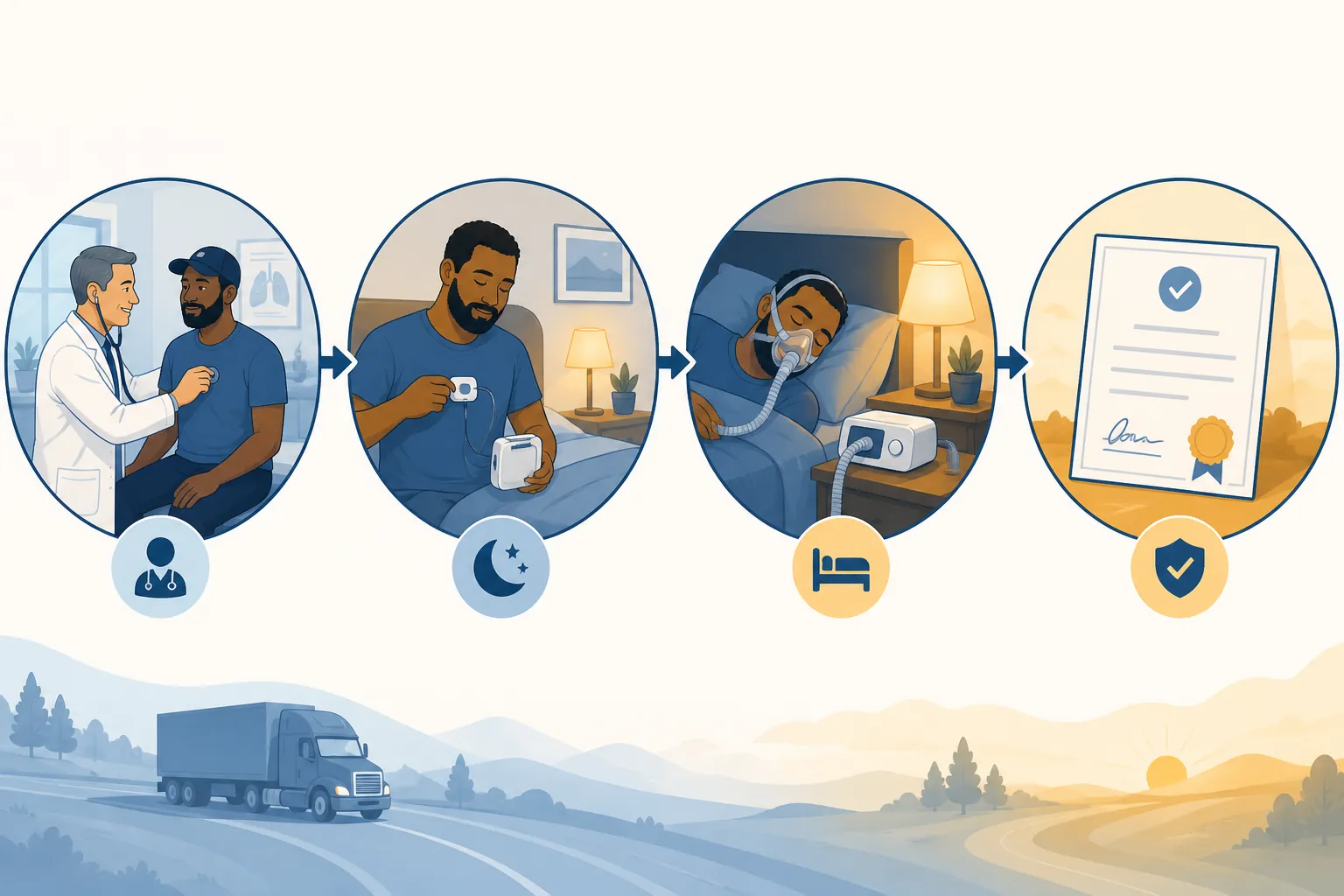
The test type depends on the medical situation and the provider. A home sleep apnea test is often used when uncomplicated obstructive sleep apnea is suspected. An in-lab sleep study may be used when the case is more complex, when another sleep disorder is possible, or when the sleep specialist needs more detailed monitoring. The DOT examiner’s role is usually not to choose the exact test; it is to require that the safety concern be evaluated by an appropriate clinician.
A practical sequence often looks like this:
- The DOT examiner identifies a risk pattern during the physical.
- The driver receives a referral for sleep evaluation and may receive a short conditional medical certificate.
- The driver completes a home sleep apnea test or in-lab sleep study.
- If OSA is diagnosed, treatment begins, most often with CPAP.
- The driver returns with treatment documentation, including compliance data when CPAP is used.
If sleep apnea is diagnosed, the key word is compliance
A sleep apnea diagnosis does not automatically end a commercial driving career. The major change is that the driver now has to show that the condition is treated and controlled well enough for safe driving. With CPAP, the commonly used compliance standard is at least 4 hours per night on at least 70% of nights.[8][9]
This is why the CPAP download matters so much. The examiner is not just asking, “Do you use it?” The examiner needs a report showing dates, hours of use, and whether the driver meets the compliance threshold. A driver who brings a current CPAP compliance report, sleep specialist note, and treatment plan is in a much stronger position than a driver who says the machine is at home and working fine.
Certification also usually becomes shorter. A driver without a disqualifying condition may receive up to a 24-month medical certificate, but a driver treated for OSA is commonly certified for up to 12 months with annual review when compliance is documented.[8][9] That shorter interval is frustrating, especially for drivers already juggling dispatch pressure, clinic appointments, and equipment costs. Still, in the usual treated-and-documented path, the consequence is more frequent renewal rather than removal from driving.
What to bring if you are worried about being flagged
The best preparation is not trying to guess the examiner’s mood. It is walking in with the pieces that make the safety question easier to answer. If you already have a sleep apnea diagnosis, bring objective treatment records. If you do not have a diagnosis but know you have risk factors, bring accurate medical information so the examiner is not left sorting through incomplete history under time pressure.
- A complete medication list, especially blood pressure medications
- Recent blood pressure readings if you monitor at home or with a treating clinician
- Any prior sleep study results
- A current CPAP compliance report if you use CPAP
- A note from your sleep specialist or treating provider if your treatment plan recently changed
If you have symptoms such as witnessed breathing pauses, choking or gasping during sleep, or significant daytime sleepiness, it is better to address them before the card is about to expire. The hardest version of this process is the one where a driver discovers the referral at the appointment, has no sleep clinic lined up, and is trying to protect a certificate that runs out in days.
The bottom line for DOT sleep apnea screening
There is no blanket federal rule requiring every truck driver to get a sleep study during a DOT physical. The referrals that hold up best are based on documented risk factors: OSA symptoms, BMI of 35 or higher, large neck circumference, and hypertension that is uncontrolled or treated with multiple medications.
If the examiner sends you for testing, the next question is not whether your driving career is over. The next question is whether the condition is diagnosed, treated, and documented. For drivers using CPAP, meeting the compliance standard and bringing the download report is usually what keeps certification moving, often on a shorter annual schedule.
References
- Employer-Mandated Sleep Apnea Screening and Diagnosis in Commercial Drivers, PubMed Central.
- Commercial Motor Vehicle Driver Obstructive Sleep Apnea Screening and Treatment in the United States: An Update and Recommendation Overview, PubMed Central, 2014.
- Obstructive sleep apnea and commercial motor vehicle driver safety, PubMed.
- Obstructive sleep apnea, health-related factors, and long distance heavy goods vehicle drivers, PubMed.
- Screening for Obstructive Sleep Apnea in Commercial Drivers, PubMed Central.
- 49 CFR § 391.41 - Physical qualifications for drivers, Electronic Code of Federal Regulations.
- Evaluation of Safety Sensitive Personnel for Moderate-to-Severe Obstructive Sleep Apnea; Withdrawal, Federal Register, August 8, 2017.
- FMCSA Medical Examiner’s Handbook 2024 Edition, Federal Motor Carrier Safety Administration, 2024.
- DOT Physicals: Can You Pass with Sleep Apnea?, Concentra.
Read the full guide: How to Sleep During a Dangerous Heat Wave