How to Sleep Better During Hurricane Anxiety
If a hurricane is approaching and you cannot sleep, your brain is probably trying to keep watch. That does not mean you are overreacting. It means the threat system is doing what it was built to do: scanning for changing information, listening for danger, and resisting the drop in vigilance that sleep requires.
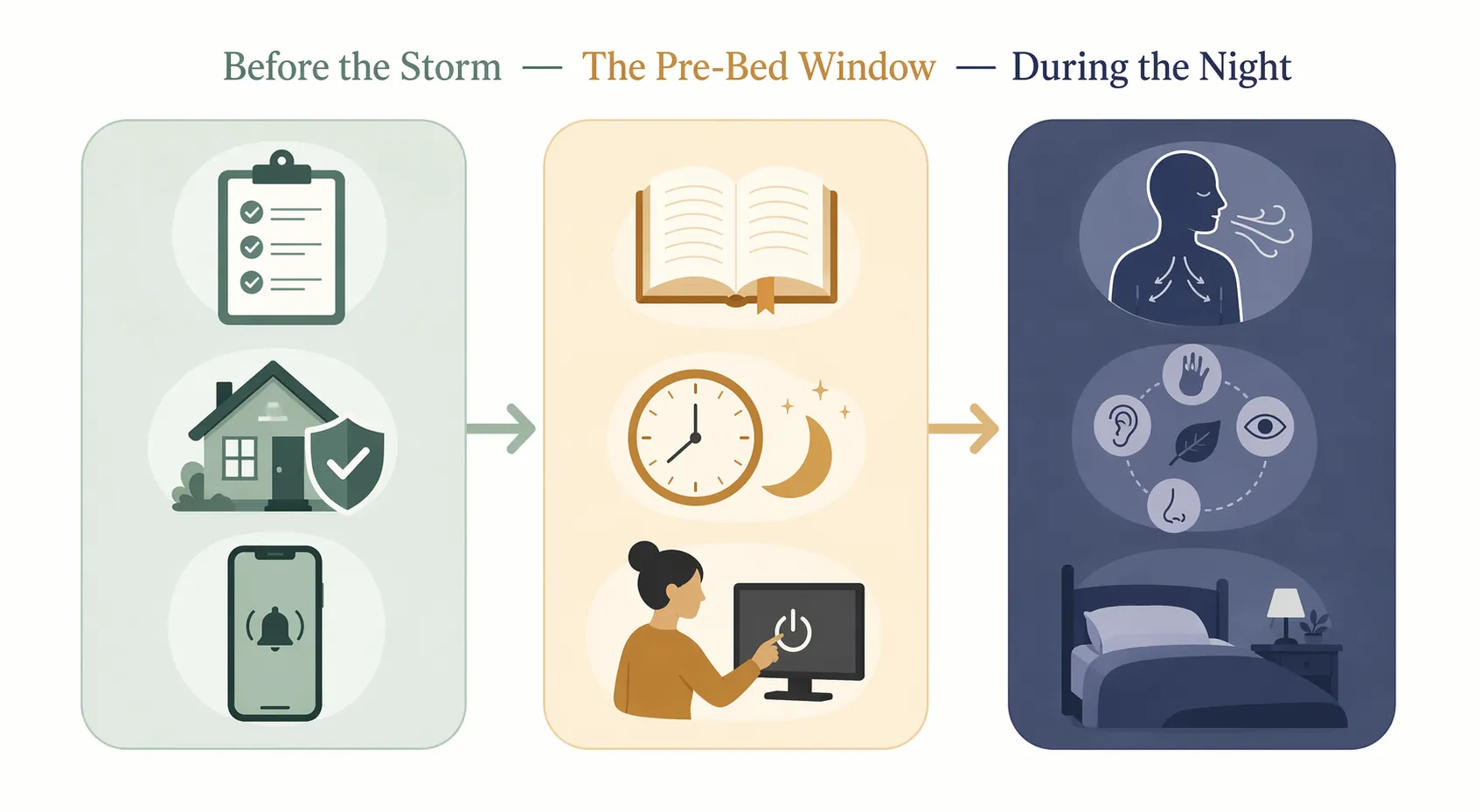
The practical answer is not to force yourself to “calm down.” To sleep better during hurricane anxiety, give your brain enough verified safety to stop checking, stop feeding it high-intensity storm coverage before bed, and make the place where you are sleeping feel more controllable. In real life, that means three moves: prepare the parts you can control, protect the few hours before bed, and use a short grounding routine if anxiety wakes you anyway.
Start with the kind of preparation that lets sleep feel less reckless
Hurricane anxiety often gets worse at bedtime because the day’s unfinished decisions come due all at once. Where will everyone sleep if the wind picks up? Who checks on the older relative? Is the medication packed? Which forecast source is trustworthy? A tired brain can turn each unanswered item into another reason to stay awake.
Lee Health’s guidance on hurricane anxiety emphasizes creating an emergency plan and kit before the storm as a way to reduce anticipatory anxiety, including the kind that interferes with sleep.[1] Weather.gov’s storm-anxiety guidance also treats preparation as a mental-health measure, not only a safety task: know your safe place, gather supplies, and make a communication plan before the weather becomes urgent.[2] The Anxiety and Depression Association of America gives similar advice for hurricane season, including preparing supplies, planning ahead, and limiting unnecessary exposure to distressing coverage.[3]
For sleep, the useful version of a hurricane plan is not a giant binder you build at midnight. It is a short list that answers the questions your brain will otherwise keep reopening.
- Where you will sleep if conditions worsen: bedroom, hallway, interior room, shelter, or another household.
- Which official source you will use for updates: local emergency management, the National Weather Service, local alerts, or a chosen text-based news source.
- Who needs to hear from you, and when: one check-in text can prevent a chain of late-night messages.
- What must stay charged: phone, backup battery, medical devices, flashlights, radio, and any mobility or accessibility equipment.
- What must be within reach: medication, glasses, shoes, water, documents, pet supplies, and comfort items for children or adults.
This is not meant to erase fear. It is meant to reduce the number of open loops your nervous system has to monitor in the dark. If you are already inside the storm window, do the smallest complete version: write the plan on paper or in a phone note, tell one other person in the household, and put the essentials where you can find them without turning the room upside down.
Use the three hours before bed to stop adding fuel
The pre-bed window is where many responsible people accidentally make sleep harder. They check one more advisory, then watch a live broadcast, then zoom in on radar, then compare social posts, then repeat the loop because none of it feels quite final. The body receives that as a fresh threat signal every few minutes.
Baylor College of Medicine psychiatrist Dr. Asim Shah recommends reading storm updates rather than watching video coverage when anxiety is high, because text does not carry the same visual and auditory triggers that can intensify the stress response.[4] That distinction matters at night. A written update can tell you whether the track, timing, evacuation status, or local warning has changed. A looping video can keep your body braced long after you already know what to do.
| If you are doing this at night | Try this instead |
|---|---|
| Watching live storm footage continuously | Read one chosen text update from an official or trusted source |
| Checking several apps for reassurance | Pick one forecast source and one alert source |
| Leaving the TV on for background information | Keep alerts enabled, but turn off nonessential video and commentary |
| Trying to decide every hour whether the plan is still good | Set one planned check-in time unless an emergency alert requires action |
A reasonable rule for the night is: check once, decide what would change your action, then stop checking until the next planned time or an official alert. For example, you might read the 9:30 p.m. local update, confirm that phones are charged and the safe room is ready, then set the next check for a specific time. If a warning, evacuation order, flood alert, tornado warning, or household safety issue occurs, you respond to that. Sleep routines never outrank real safety instructions.
Build a buffer, even if the night is already messy
Northwell Health psychologist Courtney Bancroft, PsyD, recommends a deliberate 20- to 40-minute buffer zone before bed, using soothing activities to help signal safety to a nervous system that has been in fight-or-flight mode.[5] In hurricane conditions, that buffer may not look like a perfect bath, candle, and clean bedroom. It may be sitting in the hallway with a book, lowering the screen brightness, listening to quiet audio, stretching your shoulders, or sorting the last few supplies so they are no longer scattered across the floor.
Worry journaling is useful here because storm anxiety is full of practical thoughts pretending to be mental noise. Northwell’s sleep-anxiety guidance recommends writing worries down before bed so they are externalized rather than rehearsed in the mind.[5] Keep it plain: one column for the worry, one column for the next action, and one column for when you will revisit it.
| Worry | Next action | When I will revisit it |
|---|---|---|
| What if the power goes out? | Put flashlight, battery pack, and water beside the bed or safe-room spot | Only if power changes or at the planned update time |
| What if family cannot reach me? | Send one check-in text with the plan and phone battery status | Tomorrow morning or after the next official update |
| What if I miss an alert? | Turn on official emergency alerts and keep the phone charged nearby | No extra checking unless an alert sounds |
Those examples are hypothetical, but the method is the point. A worry that has a next action can become a task. A worry that has no new action can be scheduled for the next check-in instead of being litigated every time the wind hits the window.
Make the safe sleep space easier to tolerate
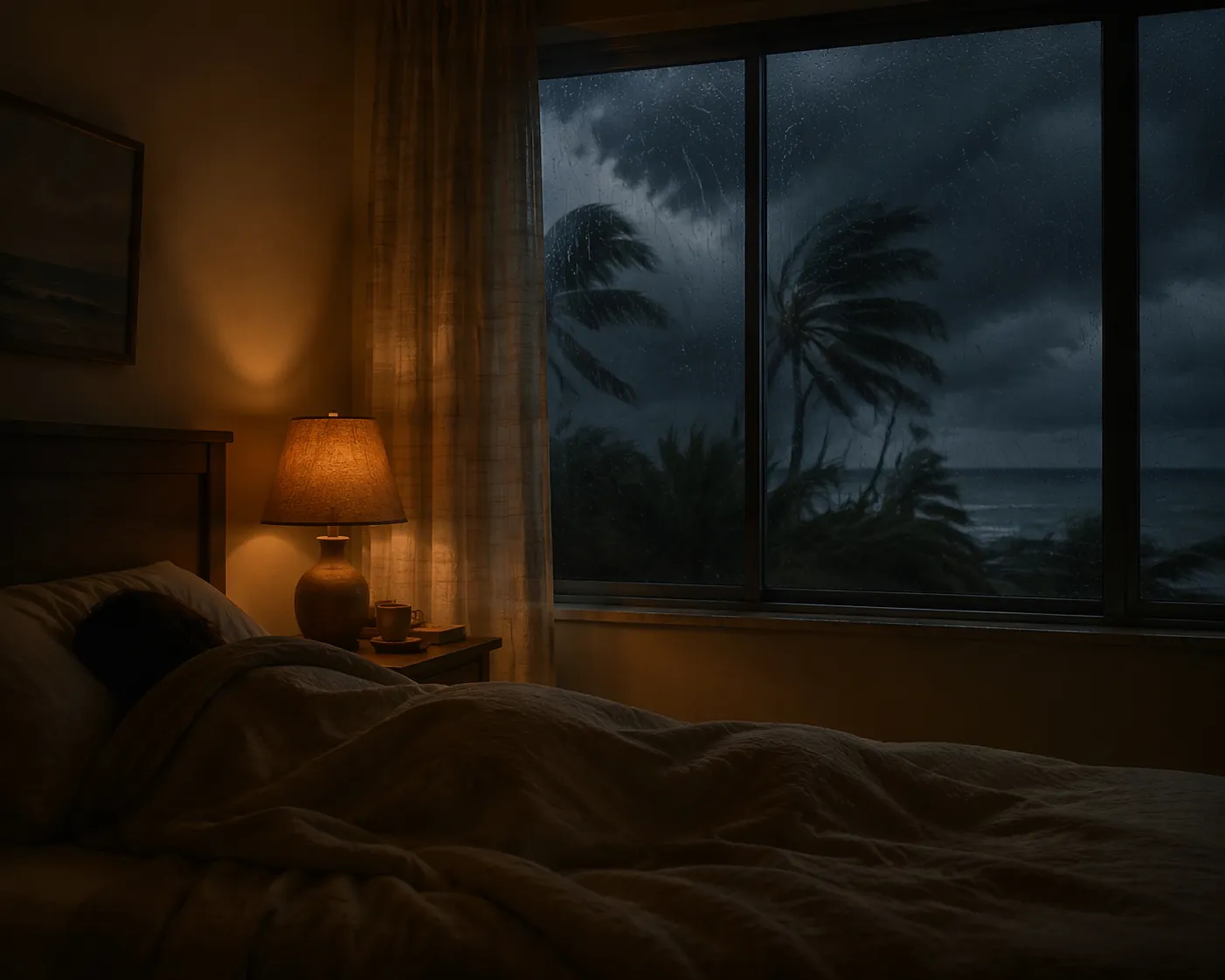
Hurricane sleep often happens somewhere less comfortable than your usual bed: an interior room, a hallway, a family member’s house, a shelter, or a room where children, pets, and supplies are all sharing the same square footage. That loss of control is part of why the body stays alert. The goal is not to recreate an ideal bedroom. It is to reduce the sensory cues that keep saying, “stay on duty.”
Valley Sleep Center recommends practical storm-night adjustments such as white or brown noise, earplugs, comfort items, dim lighting, and sleeping near a person or pet when that feels reassuring.[6] In a hurricane, those are not decorative sleep tips. Earplugs can soften harmless rattling. A dim light can make an unfamiliar hallway feel less exposed. A familiar blanket can help the body identify the space as a place to rest rather than only a place to wait.
- Sound: use earplugs, a battery-powered white-noise option, a fan if power is safe and available, or low-volume calming audio that will not bury emergency alerts.
- Light: keep lighting dim enough for sleep but bright enough to move safely if you need to get up.
- Temperature: dress in breathable layers and keep water nearby, especially if power loss could affect air conditioning.
- Body position: use pillows, folded towels, or blankets to make a floor, couch, or interior-room setup less punishing.
- Company: if being alone increases panic and it is safe, sleep near another person or pet rather than trying to prove you are fine.
Keep shoes, a flashlight, medication, glasses, and your phone in the same reachable place. Then stop rearranging unless safety changes. Repeatedly “improving” the setup can become another form of checking.
When anxiety wakes you up, give the brain a job that is not forecasting
Nighttime storm anxiety can feel convincing because it arrives with body evidence: tight chest, alert hearing, a stomach drop, heat, restlessness. Before treating it as a new emergency, check the basics once. Is there an official alert? Is water entering the home? Is anyone in immediate danger? Has the agreed plan changed? If yes, act on the safety issue. If no, the next task is to bring your attention back into the room.
Use 5-4-3-2-1 grounding
The 5-4-3-2-1 grounding method is commonly recommended for acute weather-related anxiety because it redirects attention through the senses instead of letting the mind stay locked onto imagined outcomes.[7] Sleep Foundation also describes grounding techniques as a way to manage anxiety at night.[9]
- Name five things you can see, even if the room is dim.
- Name four things you can feel: blanket, floor, pillow, shirt, the phone in your hand.
- Name three things you can hear, without deciding that each sound is dangerous.
- Name two things you can smell.
- Name one thing you can taste, or take a sip of water and notice it.
If the wind is loud, do not argue with every sound. Label it broadly: wind, rain, house noise, distant traffic, someone shifting in bed. The purpose is not to decide whether you like the sound. It is to stop the brain from turning every noise into a separate investigation.
Slow the breath without making it a performance
Dartmouth Health sleep expert Alexandria Jarvis, MSN, APRN, recommends slow diaphragmatic breathing during stress because it can help engage the parasympathetic nervous system, the part of the nervous system associated with settling the body.[8] Sleep Foundation also lists slow breathing among acute nighttime anxiety strategies.[9]
Try this for a few minutes: place one hand on the belly or lower ribs, inhale gently through the nose if comfortable, let the belly or ribs expand, then exhale longer than you inhale. You do not need a perfect count. If counting helps, use a simple pattern such as inhaling for three or four and exhaling for four, five, or six. If counting makes you more tense, drop the numbers and focus only on making the exhale slow and easy.
Pair the breath with one sentence that does not overpromise: “I have checked the plan; I will respond if an alert requires it.” That is different from telling yourself nothing bad can happen. The body is often more willing to soften around a truthful statement than a grand reassurance it does not believe.
If you still cannot sleep, aim for rest rather than a battle
There may be nights when the storm, the alerts, the heat, the household noise, or the memories of past storms make normal sleep unrealistic. On those nights, lying down with eyes closed, breathing slowly, and staying off high-intensity media is still useful. Rest is not identical to sleep, but it is less costly than sitting upright for hours in a loop of radar, video, and dread.
If you get up, keep the rule narrow: do something quiet, dim, and non-forecast-based unless a safety update is due. Read a familiar book. Sit near another person. Recheck the written plan once if you truly need to, then put it down. Avoid turning the wake-up into a full restart of storm coverage.
After the storm, help your sleep system stand down
Once immediate danger has passed, the nervous system may not switch off as quickly as the weather does. ADAA recommends returning to normal routines when possible and limiting media exposure after the storm, especially repeated images or stories that keep the threat feeling current.[3] That can mean checking recovery information at set times, then stepping away from damage footage that does not change your next action.
Persistent sleep disruption after a catastrophic event is not unusual enough to dismiss. The American Academy of Sleep Medicine reported on a 2007 study by Dr. Denise Sharon that examined patients at one sleep center before and after Hurricane Katrina; because the sample was small and limited to that setting, it should be read as a warning signal rather than a population-wide prevalence estimate.[10] The useful takeaway is more modest and more important: severe storms can leave sleep problems behind after the immediate crisis ends.
Consider professional help if insomnia continues, nightmares or intrusive memories are frequent, you feel unable to function, panic keeps returning after the storm has passed, or you are using alcohol or medication in unsafe ways to force sleep. That is not a failure of toughness. It is a sign that the alarm system may need more support than a storm-night routine can provide.
Hurricane anxiety makes sleep harder because the brain is scanning, screens are amplifying threat, and the environment feels less under your control. The workable response is smaller than perfect calm: verified safety, fewer threat cues, a tolerable sleep space, and one body-level routine you can repeat in the dark.
References
- Hurricane Anxiety: Strategies for Coping This Storm Season. Lee Health.
- Storm Stress and Anxiety. Weather.gov.
- Hurricane Season Is Here: How to Reduce Your Anxiety. Anxiety and Depression Association of America.
- Navigating pre-storm anxiety. Baylor College of Medicine.
- 5 ways to sleep better when anxiety takes hold. Northwell Health.
- Does Weather Affect Your Sleep? Six Tips to Sleep Through Storms. Valley Sleep Center.
- Finding Calm in the Storm: How to Cope with Weather-Related Anxiety. Nashville Psych.
- How to sleep in times of stress. Dartmouth Health.
- Anxiety at Night: Causes, Symptoms, and Treatments. Sleep Foundation.
- Catastrophic Events Can Affect a Person’s Sleep. American Academy of Sleep Medicine. 2007.
Read the full guide: How to Sleep Safely During Hurricane Prep