
How to sleep better when relationship stress is keeping you up
It is a particular kind of awake: the room is dark, the argument is technically over, and your body is acting as if the conversation is still happening. One person may be asleep beside you. Or they may be turned away, equally rigid, pretending not to be awake. Either way, the immediate problem is not how to solve the whole relationship before morning. It is how to get enough sleep that tomorrow is not made worse by tonight.

Relationship stress disrupts sleep because it can put the body into a threat state. That does not mean the relationship is unsafe in every sense, or that the argument was catastrophic. It means the nervous system may be reading disconnection, criticism, uncertainty, or unresolved conflict as something that needs monitoring. Sleep asks the body to stand down. Relationship stress often asks it to stay alert.
Daily-diary research summarized by the American Association for Marriage and Family Therapy describes the loop plainly: when couples argue during the day, sleep efficiency drops that night; after poor sleep, partner interactions tend to become more negative the next day.[1] That bidirectional pattern is why sleep tips for relationship stress need to start with the loop itself, not with a scolding reminder to “calm down.”
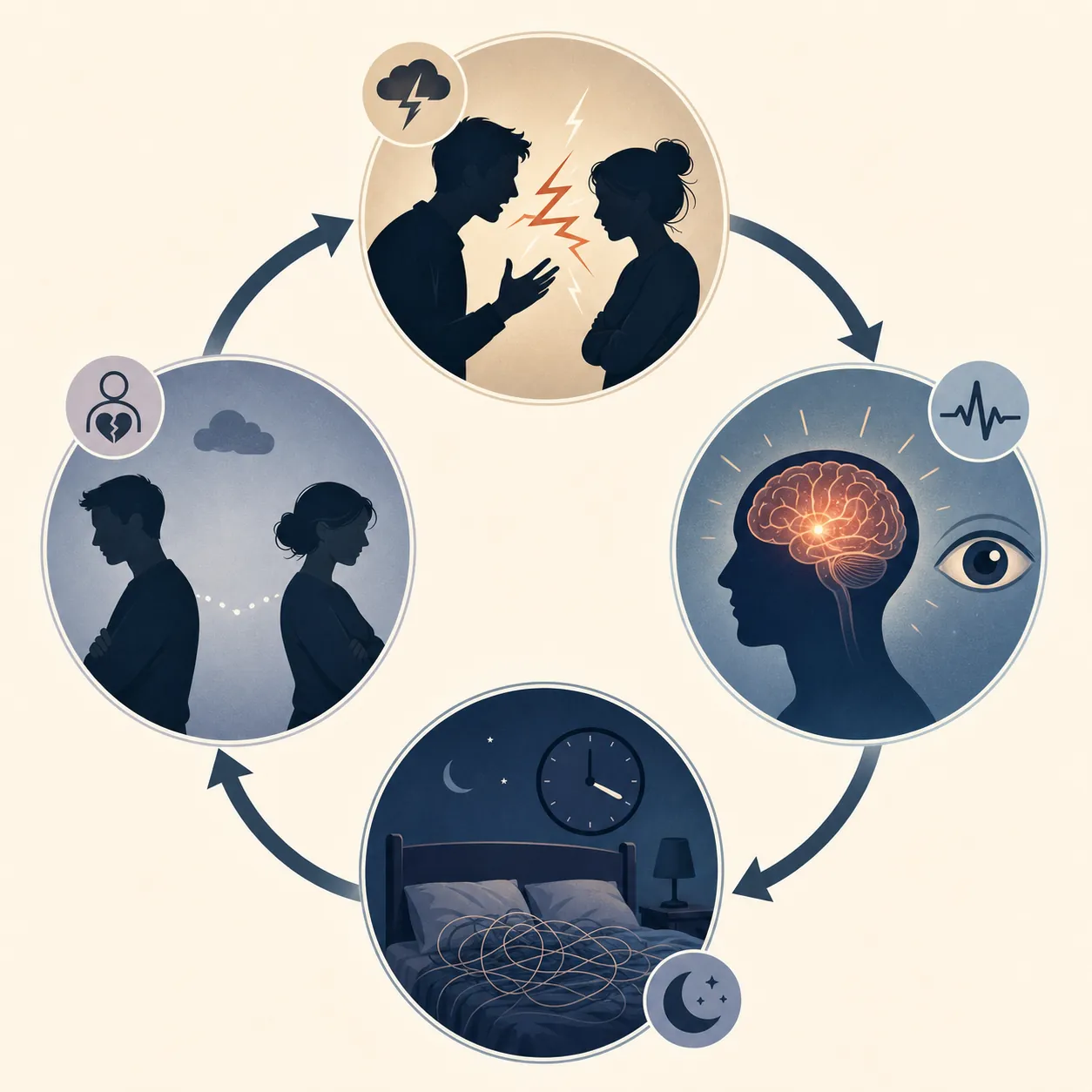
Why the fight follows you into bed
After conflict, the mind often keeps working because it is trying to prevent more injury: replaying tone, searching for proof, drafting the message you might send in the morning, wondering whether silence means punishment or exhaustion. The body can join that project. Stress activates the hypothalamic-pituitary-adrenal axis, increasing cortisol and other arousal signals that oppose the parasympathetic quiet needed for sleep onset.[2][3] For a deeper look at that stress cascade, see how emotional breakdowns disrupt your sleep.
That is why some common advice lands badly at midnight. If your heart is pounding, your stomach is tight, and your attention keeps snapping back to the argument, “just relax” can feel like another task you are failing. The problem is not a lack of willpower. It is hyperarousal: a state in which the brain and body are prepared to detect threat, not drift into sleep.
The next-day cost matters because poor sleep does not stay politely inside the sleep category. Amie Gordon’s work, described by Greater Good at UC Berkeley, found that one partner’s poor sleep can make both partners more irritable, less empathic, and less able to resolve conflict the next day.[4] That last detail is easy to miss. The sleep-deprived person is not the only one affected; the couple’s whole repair system gets weaker.
This is the cruel rhythm many couples recognize: conflict makes sleep worse, and sleep loss makes the next conversation harder to have well. By morning, the original issue may still be there, but now it is being handled by two people with shorter fuses and less access to generosity.
The first goal is not closure. It is interruption.
Some conversations should not continue simply because they are important. Importance does not create the physical conditions for repair. If both people are exhausted, defensive, or repeating themselves, pushing for resolution can turn the bedroom into a second argument location. The sleep-protective move is to pause the conflict without pretending it is solved.
A useful pause is specific. “I’m done” can sound like abandonment. “I want to keep talking, but I’m too activated to do it well tonight. I’m going to sleep now, and I can talk tomorrow after work” gives the nervous system a clearer boundary. The exact words matter less than the structure: name the limit, affirm that the issue still matters, and set a realistic return point.
| When the conversation is still productive | When sleep needs protection |
|---|---|
| Both people can pause, listen, and correct misunderstandings. | One or both people are repeating the same point with rising intensity. |
| The discussion is specific enough to move toward a decision. | The discussion has widened into old injuries, character judgments, or global fears. |
| There is still some tenderness or curiosity available. | The body feels flooded: racing heart, clenched jaw, nausea, trembling, or numbness. |
| A next step is possible tonight. | The only available goal is to win, prove, withdraw, or stop feeling exposed. |
A boundary is not a threat if it protects the next repair attempt. It becomes punitive when it is used to scare, punish, or make the other person chase. The difference often shows up in the follow-through: if you say you will return to the conversation tomorrow, return to it. Sleep protection works better when it is reliable.
Do not make your partner the only off-switch
It is natural to want reassurance from the person who also triggered the stress. Sometimes that works: a softer voice, a hand on the shoulder, a brief repair. But during relationship stress, the partner may also be the cue that keeps the body alert. If sleep depends entirely on getting the exact right response from them, the night can become another negotiation.
An independent wind-down protocol gives you something to do that is not another attempt to extract certainty. It should be simple enough to use when you are flooded. Think of it as a sequence you can repeat, not a performance you have to perfect.
- Move the conflict out of the bed: if you need to write, breathe, stretch, or cry, do it in another dim, quiet place when possible.
- Write the unfinished material down: what happened, what you are afraid you will forget, and the one next conversation you want to have.
- Use a body-based downshift: slow breathing, progressive muscle relaxation, or a grounding exercise that brings attention away from rehearsing the argument.
- Return to bed only when sleepiness is present, not merely when you are tired of being awake.
- If your mind starts arguing again in bed, leave the bed briefly and repeat the quietest part of the routine.

Journaling is not there to solve the relationship on paper at 1 a.m. It is there to reduce the brain’s need to keep the argument open as a memory aid. A short note such as “I need to talk about the comment at dinner, the money decision, and what happens when one of us shuts down” is often more sleep-protective than a five-page prosecution.
Getting out of bed can feel counterintuitive when you are desperate to sleep, but it protects the bed from becoming the place where the relationship is mentally litigated. The point is not to start your day in the middle of the night. Keep the light low, choose something quiet, and return when the body has shifted from wired to sleepy.
Loving help can accidentally train insomnia
Partners often try to help insomnia in ways that make emotional sense but less sleep-science sense. In a 2017 study presented by the American Academy of Sleep Medicine, 74% of partners encouraged early bedtimes or late wake times, 42% encouraged reading or watching TV in bed, and 35% encouraged naps.[5] These are usually caring gestures. They can also conflict with cognitive behavioral therapy for insomnia principles, especially when they increase time awake in bed or reduce sleep pressure.
After a hard night, “sleep in as long as you want” may sound tender. So can “just stay in bed and watch something until you drift off.” The risk is that the body learns the bed is a place for wakefulness, rumination, entertainment, and emotional recovery attempts. Over time, that learning can outlast the argument that started it.
A more useful partner role is usually smaller and clearer: respect the pause, lower stimulation in the room, avoid restarting the conflict in bed, and support the agreed return time for the conversation. Care does not have to mean extending the whole sleep window or turning the bed into a coping station.
If you sleep apart, make it a sleep decision
Temporary sleep separation can be protective when sharing a bed keeps one or both people activated. It is not the same thing as ending the relationship, and it is not the same subject as insomnia during an actual marital separation or divorce. If that is the situation you are facing, see when divorce insomnia becomes a health risk. Here, the question is narrower: can two people who are still together choose separate sleep spaces for a night, or for a defined period, to protect rest?
Survey data suggests this is not rare. In a 2025 American Academy of Sleep Medicine survey, 31% of U.S. adults reported trying a “sleep divorce,” or sleeping separately from a partner to improve sleep.[6] Sleep Foundation reports that 53% of people who tried sleep separation said their sleep quality improved, and those who maintained it reported an average of 37 more minutes of sleep per night.[7] Those numbers are useful, but they should not be treated as proof from a controlled trial that separate beds are best for every couple.
The emotional meaning of sleeping apart matters. For one partner, the spare room may feel like oxygen: no whispered follow-up, no tense breathing beside them, no waiting for the other person to roll away. For the other, the same move may feel like rejection. If separation is used, it needs a frame: “I am sleeping in the other room because I need my nervous system to settle, not because I am leaving the relationship. I will check in tomorrow.”
It also helps to decide in advance what temporary means. One night is different from an open-ended migration. A planned reset after a major argument is different from silently disappearing whenever a conversation becomes uncomfortable. The more vulnerable the couple feels, the more explicit the agreement needs to be.
Sometimes the safer bed is the shared bed
Separate sleep is not automatically the mature choice. For some people, partner presence is regulating, even during stress. In a Journal of Sleep Research study of 179 cohabiting heterosexual couples with children, women with lower attachment security or higher attachment avoidance slept better when they spent more time in bed with their partner; securely attached women slept well regardless.[8] That finding does not automatically generalize to same-sex couples, child-free couples, or non-cohabiting partners, but it is a useful warning against one-size-fits-all advice.
Bed-sharing can also support sleep physiology under the right relational conditions. A 2020 study in Frontiers in Psychiatry found that couples who shared a bed showed about 10% more REM sleep and longer uninterrupted REM fragments, while noting that relationship quality and felt safety matter.[9] The same bed can be a cue for safety or a cue for vigilance. The body usually knows the difference before the mind has language for it.
So the decision is not “healthy couples share a bed” versus “smart couples sleep apart.” A better question is: tonight, does closeness help my body stand down, or does it keep the conflict alive? If closeness helps, keep it simple. You do not need to keep talking to earn the right to share space. If distance helps, make the distance kind, named, and temporary.
A practical plan for tonight
When relationship stress is keeping you awake, the night needs fewer decisions, not more. Use a short sequence and repeat it when necessary.
- Stop the conflict in a way that preserves repair: name that you are too activated or tired to continue well, and set a time to return to the issue.
- Leave the bed if your mind is rehearsing the argument rather than drifting toward sleep.
- Write down the few points you are afraid of losing, then stop writing before it becomes another version of the fight.
- Use a physiological downshift that does not require your partner’s participation.
- Choose togetherness or temporary separation based on what lowers vigilance tonight, not on what would look best from the outside.
- Return to the conversation when there is enough sleep, steadiness, and time for it to have a chance.
This will not resolve every conflict. It is not couples therapy in miniature, and it should not be used to avoid conversations that genuinely need to happen. But protecting sleep is a legitimate part of protecting the relationship. A rested nervous system has a better chance of repair than a threatened, sleep-deprived one.
References
- Sleep Problems Are Relationship Problems, AAMFT
- When Love Keeps You Awake: How Relationship Stress Impacts Sleep, ANCsleep
- Nocturnal insomnia symptoms and stress-induced cognitive intrusions in risk for depression: A 2-year prospective study, 2018
- Sleep Before You Bicker, Greater Good / UC Berkeley
- Bed partners may unintentionally contribute to the perpetuation of insomnia, research shows, American Academy of Sleep Medicine, 2017
- New survey data: Sleep divorce, American Academy of Sleep Medicine, 2025
- What Is a Sleep Divorce?, Sleep Foundation
- The role of couple sleep concordance in sleep quality: Attachment as a moderator of associations, Journal of Sleep Research, 2019
- Bed-Sharing in Couples Is Associated With Increased and Stabilized REM Sleep and Sleep-Stage Synchronization, Frontiers in Psychiatry, 2020
Read the full guide: How to sleep when it's 110°F without risking heat illness