
How to sleep when it's 110°F without risking heat illness
If the bedroom is near 110°F, or the air conditioner has failed during a 110°F heat event, the first rule is not about sleep comfort. Stop trying to make the room feel cozy enough to tolerate. Check the indoor temperature, check the people in the room, and decide whether the household needs a cooler place tonight.
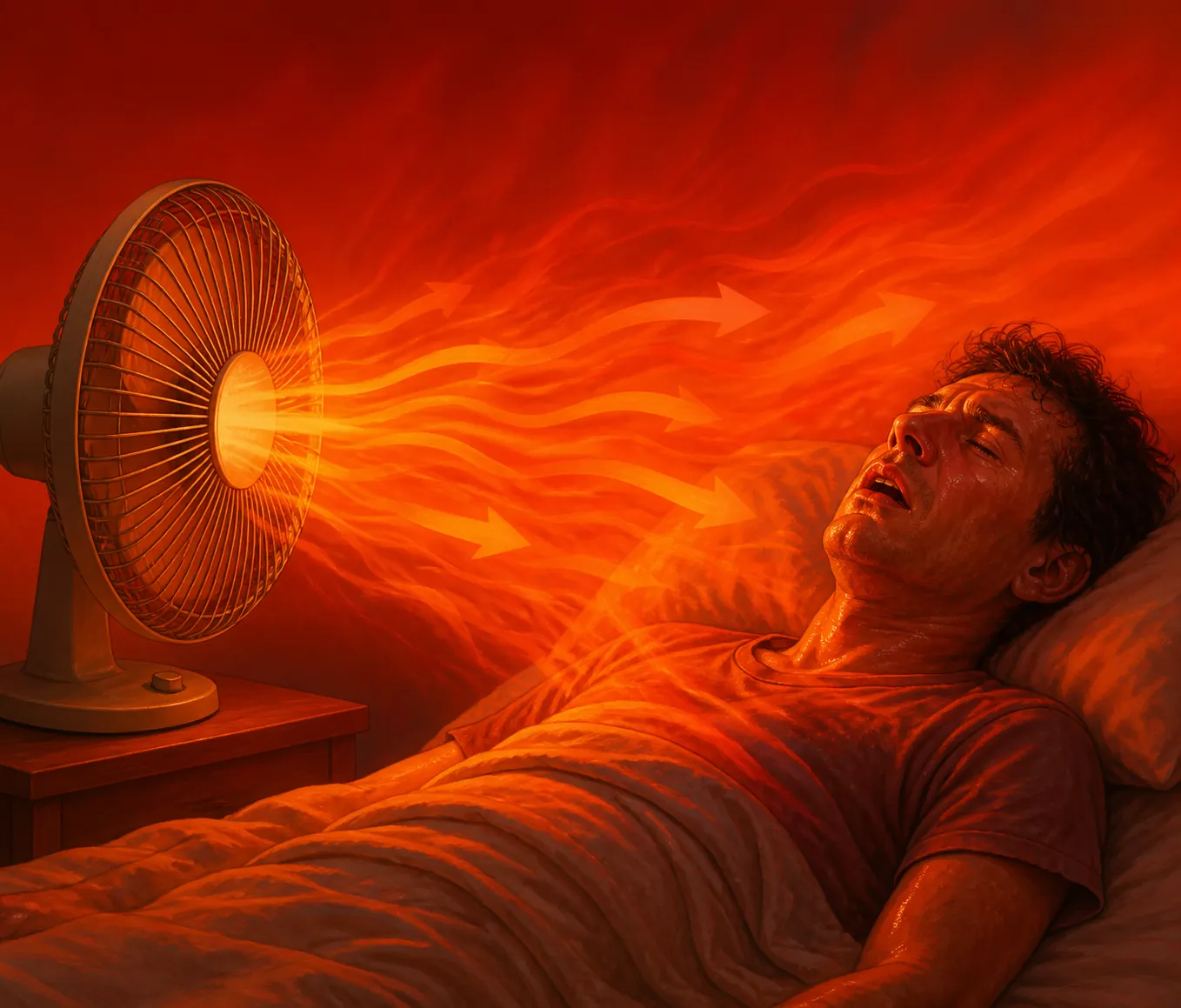
The red line is plain: CDC heat guidance currently warns that fans can increase body temperature when indoor air temperature is above 90°F. Other heat-safety sources sometimes use 95°F, but that difference should not comfort anyone lying in a hot apartment during a 110°F desert night. If the room itself is above the CDC threshold, a fan blowing across the bed is not automatically a safety tool; it can push hot air over skin and add heat instead of removing it. [1]
First decide whether the room is safe enough to sleep in
At 2 a.m., nobody needs a lecture about perfect sleep hygiene. They need a decision. Use the indoor temperature, the condition of the people in the home, and whether cooling can be restored tonight.
- If indoor air is above 90°F and there is no working air conditioning, treat the room as a heat-exposure problem, not a restless-night problem. A fan alone is not a safe plan under the CDC warning. [1]
- If anyone has confusion, fainting, vomiting, severe weakness, very hot skin, or symptoms that are worsening, seek emergency help rather than trying another cooling trick.
- If an older adult, pregnant person, infant, person with heart disease, or person taking heat-sensitive medications is in the room, narrow the “wait and see” window. Check them directly, not from across the hallway.
- If cooling cannot be restored quickly, use a cooling center, a cooled public building, a friend’s home with reliable AC, or local emergency resources. The American Red Cross specifically advises spending time in air-conditioned places such as libraries, shopping malls, or cooling centers during extreme heat. [2]
That last option belongs near the beginning, not after a page of pillow hacks. If you do not have transportation, call local non-emergency services, emergency management, 2-1-1 where available, a neighbor, a relative, a building manager, or a community organization. The practical question is not whether the bedroom can be improved by a few degrees. It is whether a vulnerable body can keep shedding heat until morning.
Why the fan warning matters so much
A fan feels helpful because moving air speeds sweat evaporation and carries heat away when conditions allow it. That “when” is the part that gets skipped. If the surrounding air is hotter than the body can safely handle, and especially if sweating is limited by dehydration, age, medication, illness, or humidity, the fan can become a hot-air blower pointed at a person who is already losing the fight.
This is why the indoor number matters more than the outdoor headline. A forecast of 110°F does not tell you whether the bedroom is 84°F with AC struggling, 92°F after an outage, or far worse in an upstairs unit. Those are different nights. The first may be miserable but manageable for many healthy adults. The second has crossed the CDC’s fan danger threshold. The third is not a sleep setting.
Do not average the house in your head. Heat piles up in upstairs bedrooms, west-facing rooms, mobile homes, small apartments with weak insulation, and rooms where the door has been kept shut. Put a thermometer where the person is sleeping. If an older parent says they are “fine” but the room is above 90°F, take the room seriously.
Who needs a faster move to cooling
Extreme heat does not distribute risk politely. CDC guidance identifies adults aged 65 and older as more vulnerable because aging can reduce the body’s ability to adjust to sudden temperature changes, and chronic medical conditions and medications can add risk. [3] CDC clinical guidance also notes that some medications can interfere with thermoregulation, hydration, sweating, kidney function, electrolytes, blood pressure, or alertness during heat. [4]
That does not mean every older adult or every medication user must leave home every hot night. It means the threshold for action is lower. If the AC is failing and the bedroom is rising toward the fan danger line, make the cooling-center plan before the person is dizzy, confused, or too weak to move easily.
Pregnancy deserves the same seriousness. Heat stress can be harder to manage when the body is already carrying extra cardiovascular and thermoregulatory load, and the decision should not be reduced to “try a damp sheet.” For pregnancy-specific night guidance during an alert, use How to Sleep Well During Extreme Heat Alert When Pregnant. For hot flashes, cycle changes, and heat-dome planning around midlife, see Perimenopause Sleep Prep for Heat Dome Nights.
Why sleep becomes so hard before heat illness is obvious
Sleep is not just a decision to close your eyes. To initiate sleep, the body normally needs to lower core temperature by about 0.5–1°C. Extreme nighttime heat blocks that drop, so the person lying still in bed is not failing at relaxation; the room is interfering with a basic sleep mechanism. [5]
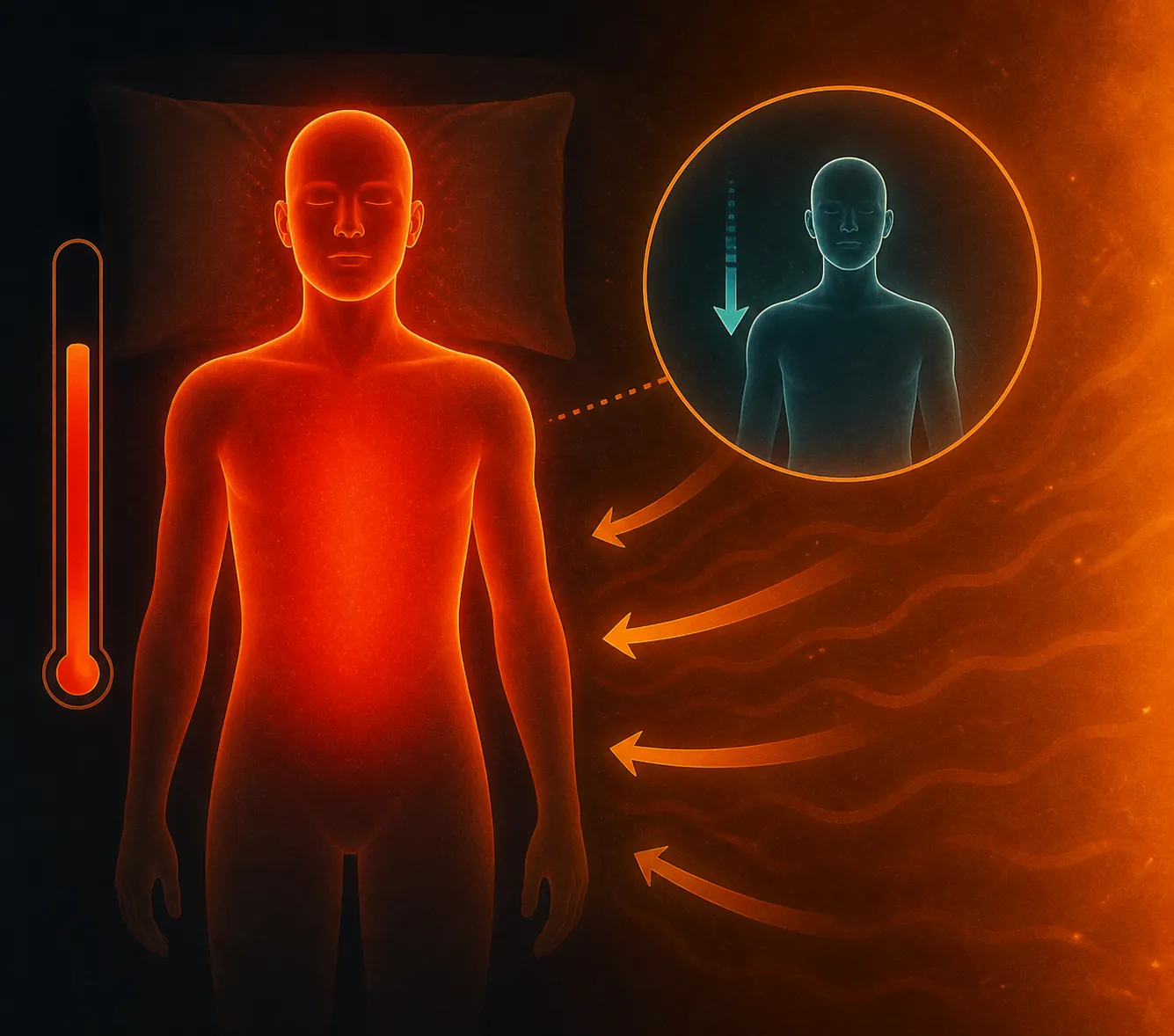
That mechanism explains the familiar pattern: you feel exhausted, the sheets feel wrong, every position feels sticky, and sleep keeps slipping away. The body is trying to dump heat at the same time the room keeps returning it. In a dangerous room, the solution is not more willpower. It is lowering exposure.
Large-scale sleep research supports what hot-night caretakers already see. Minor and colleagues reported in 2022 that warmer-than-normal nights erode sleep, with sleep loss increasing as nights get hotter and with unequal effects across populations. [6] Climate Central’s July 2026 analysis estimated that the average person now loses about 56 hours of sleep per year to nighttime heat, and that climate-attributed sleep loss has roughly doubled since the 1970s. [7]
Those annual numbers are useful because they keep nighttime heat from being dismissed as mere discomfort. But tonight’s decision still depends on the room and the person in it. A household without reliable AC during a 110°F event is dealing with a sharper problem than the average annual sleep-loss estimate can capture.
Heat at night is also a health signal, not only a sleep complaint
Nocturnal heat exposure has been linked with vascular risk. A 2024 European Heart Journal study in Augsburg, Germany, found that hot nights were associated with a 7% higher stroke risk, with older adults and women most affected. [8] That number should not be lifted and pasted onto Phoenix or Las Vegas as if the settings were identical. The German study population had low air-conditioning penetration, about 4.7%, and the temperature profile is not the same as a U.S. desert heat emergency. [8]
The cautious takeaway is still important: nighttime heat can carry cardiovascular consequences, and the people most likely to be told to “just sleep it off” may be the people with less reserve. In older adults, a 2023 study cited by the American Heart Association found sleep efficiency dropped 5–10% when nighttime temperature rose from 77°F to 86°F. [9] That is well below a 110°F emergency, which is exactly the point. Sleep can degrade before the room looks dramatic.
If the room is below the danger line, then use sleep-supportive cooling
There is still a place for ordinary cooling tactics, but only after the safety question is answered. If the indoor temperature is below the fan danger threshold, the household has some working cooling, and nobody is showing heat-illness signs, then the goal is to help the body shed heat without creating a new hazard.
| Situation tonight | Reasonable action |
|---|---|
| AC works but cannot keep up | Close sun-exposed coverings before evening, keep cooled rooms closed off, sleep in the coolest room, and reduce heat from lights, ovens, and electronics. |
| Indoor air is warm but below 90°F | A fan may help comfort if the person is sweating normally and drinking fluids, but keep checking the room temperature. |
| Dry climate with evaporative cooling available | Use it only if it is actually lowering indoor temperature; dry-climate strategies differ from humid-storm strategies. |
| Cooling products are available | Use breathable bedding, cooling pillows, or bed-cooling systems as support, not as substitutes for safe indoor air. |
| Windows cool after midnight | Ventilate only when outdoor air is cooler than indoor air and safety, smoke, dust, and security conditions allow it. |
For dry-climate cooling choices that are not the same as a humid heat event, How to Sleep During a Denver Heatwave is a better comparison point than generic summer advice. If you are deciding whether cooling sheets, pillows, or bed systems are worth buying for a specific household member, use Which cooling sleep deals suit your life stage? after the room-safety question is settled.
What not to let distract you at 110°F
Frozen sheets, chilled pillowcases, misting bottles, and damp towels can offer brief relief in a room that is otherwise controlled. They are not a plan for an unsafe indoor temperature. They also can make people underestimate how much heat the room is still delivering.
Opening windows is another conditional tactic, not a rule. In desert cities, outdoor air may stay dangerously hot late into the night. If the air outside is hotter than inside, or if smoke, dust, insects, security, or building conditions make ventilation unsafe, an open window is not a sleep solution.
Emergency sleep situations also share a pattern: the usual comfort rules fail when the environment itself becomes the hazard. For a different kind of emergency-night planning, Sleep During a Typhoon: Tips for Your Life Stage uses the same basic discipline: protect the person first, then protect sleep.
A practical overnight order
- Measure the indoor temperature where people are actually sleeping.
- Check high-risk people directly: older adults, pregnant people, infants, people with chronic illness, and people taking medications that may worsen heat vulnerability.
- If the room is above 90°F without reliable AC, do not rely on a fan as the safety plan. Start cooling bodies and arranging a cooler location.
- If symptoms suggest heat illness, seek emergency help.
- If the room is below the danger line and cooling is working enough to control exposure, then use fans, lighter bedding, cooled rooms, hydration, and bedtime adjustments for comfort.
In 110°F heat, successful sleep is not the goal until exposure is controlled. A safer room comes first. Sleep can follow.
References
- Heat Health, CDC, https://www.cdc.gov/heat-health/
- Extreme Heat Safety, American Red Cross, https://www.redcross.org/get-help/how-to-prepare-for-emergencies/types-of-emergencies/extreme-heat-safety.html
- Heat and Older Adults Aged 65+, CDC, https://www.cdc.gov/heat-health/risk-factors/heat-and-older-adults-aged-65.html
- Heat and Medications – Guidance for Clinicians, CDC, https://www.cdc.gov/heat-health/hcp/clinical-guidance/heat-and-medications-guidance-for-clinicians.html
- Why heatwaves disrupt our sleep, and how we can protect it, Le Monde, July 11, 2026, https://www.lemonde.fr/en/science/article/2026/07/11/why-heatwaves-disrupt-our-sleep-and-how-we-can-protect-it_6755384_10.html
- Rising temperatures erode human sleep globally, One Earth, 2022, https://www.cell.com/one-earth/fulltext/S2590-3322(22)00209-3
- Climate Change Sleep Loss, Climate Central, July 2026, https://www.climatecentral.org/climate-matters/climate-change-sleep-loss
- Nocturnal heat exposure and stroke risk, European Heart Journal, 2024, https://pmc.ncbi.nlm.nih.gov/articles/PMC11212822/
- Keep your cool and stay healthy with these hot weather sleep tips, American Heart Association, August 19, 2025, https://www.heart.org/en/news/2025/08/19/keep-your-cool-and-stay-healthy-with-these-hot-weather-sleep-tips
Read the full guide: How to Sleep When the Heat Index Reaches 100