
Are sleep problems early signs of Alzheimer's in older adults?
Sleep problems can be early symptoms of Alzheimer's, but the useful answer is narrower than that. A parent who wakes earlier, sleeps more lightly, or takes an occasional nap is not automatically showing dementia. The point at which sleep deserves a medical conversation is when the pattern is new, persistent, escalating, observable by someone else, or paired with memory changes, attention slips, or evening confusion.
Four patterns are worth tracking before you call it “just aging”: increasing daytime sleepiness, a weakened day-night rhythm, trouble staying asleep when memory complaints are also appearing, and new sundowning-type confusion. None diagnoses Alzheimer's. They do give you a reasonable threshold for asking a primary care clinician whether cognitive screening, medication review, and sleep-disorder evaluation should happen now rather than “sometime later.”
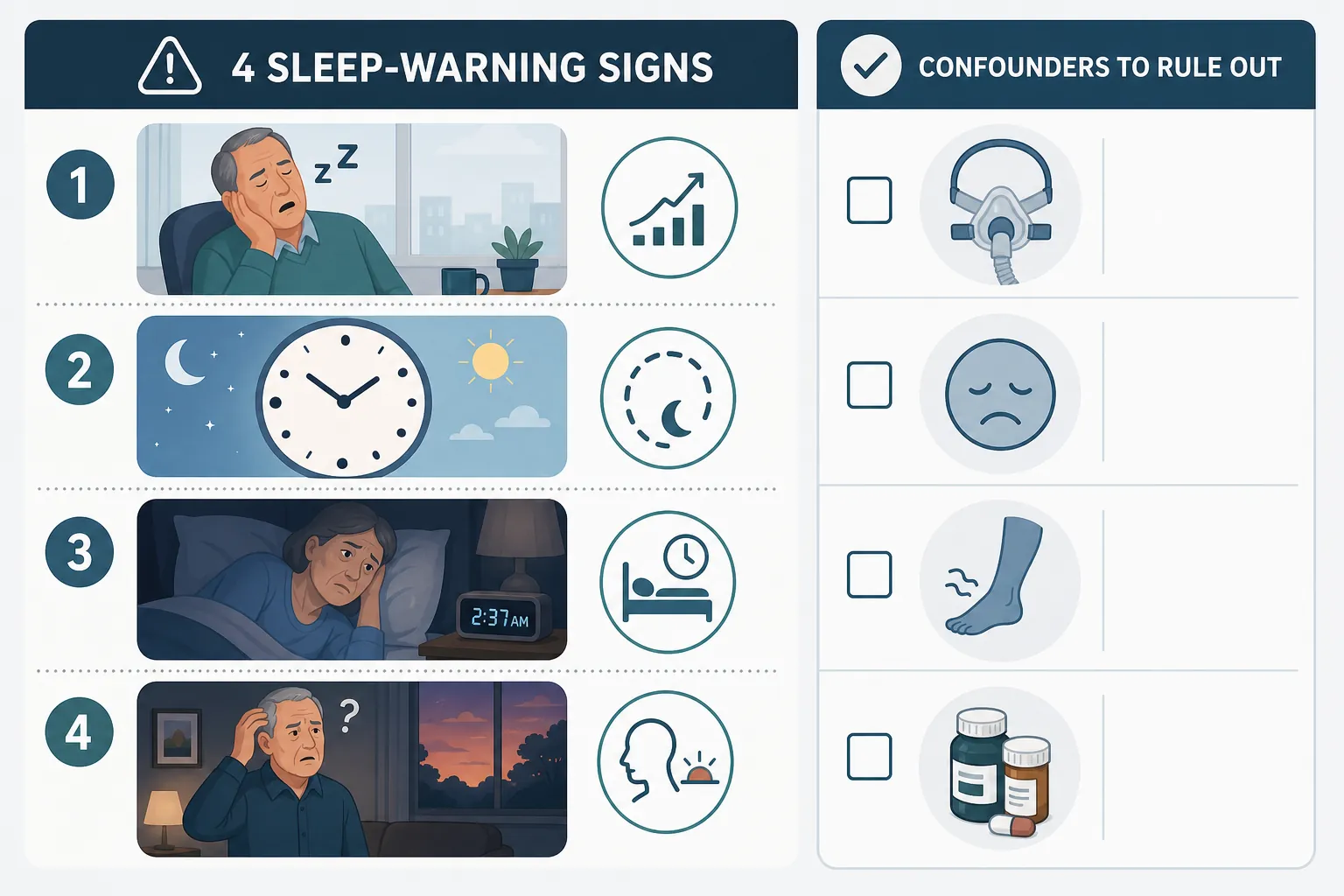
The four sleep changes that deserve attention
| Observed pattern | What it looks like at home | What to do next |
|---|---|---|
| Escalating daytime sleepiness | Longer or more frequent daytime dozing over months, especially if the person is harder to keep engaged during ordinary daytime routines. | Start a sleep and nap log; ask about sleep apnea, depression, medication changes, and cognitive screening. |
| Weak or fragmented circadian rhythm | Less clear separation between day and night: more daytime inactivity, more nighttime wandering or wakefulness, or a schedule that loses its usual anchor. | Document activity patterns across several weeks; ask whether actigraphy, sleep evaluation, or cognitive screening is appropriate. |
| Difficulty maintaining sleep with memory complaints | Repeated waking after falling asleep, especially when the person is also reporting forgetfulness or family members notice attention changes. | Review pain, bathroom trips, restless legs, medications, mood, and sleep apnea before assuming dementia. |
| New evening confusion or sundowning | Confusion, agitation, suspicion, or disorientation that predictably worsens late in the day or evening, not just one bad night. | Call primary care promptly, especially if the change is new, worsening, or unsafe. |
1. Daytime sleepiness that is increasing, not just an occasional nap
A nap after a poor night does not carry the same meaning as a steady change in daytime alertness. The more concerning pattern is the person who used to rest after lunch but now sleeps through much of the afternoon, dozes during conversations, cancels daytime activities because of fatigue, or seems less mentally present even after what looked like enough time in bed.
That distinction matters because prospective research has found a stronger signal in sleepiness that increases over time. In a study of 733 cognitively healthy women in their 80s, those whose daytime sleepiness rose over 5 years had a higher dementia incidence than those with stable sleep patterns: 19% versus 8%. [1]
At home, the practical question is not “Did she nap?” It is “Has the amount of daytime sleep changed enough that other parts of life are shrinking?” If the answer is yes, write down when the dozing happens, whether the person snores or gasps at night, whether mood has flattened, and whether any medication was started, stopped, or increased around the same time.
2. A day-night rhythm that is losing its shape
Many older adults get sleepy earlier in the evening and wake earlier in the morning. That can be frustrating without being alarming. Circadian fragmentation is different: the day becomes less like a day, and the night becomes less like a night. The person may sit inactive for long stretches during daylight, become restless at night, wander between rooms, snack at odd hours, or no longer have a reliable rhythm around meals, light, activity, and sleep.
This is one of the stronger decision-useful signals in the research. In a Neurology study of 2,183 seniors, weak circadian activity rhythms were associated with nearly 2.5 times the risk of developing dementia over 3 years. [2]
The important household detail is persistence. A holiday visit, a hospital stay, grief, pain, or a new living arrangement can disrupt sleep timing for obvious reasons. A rhythm that stays disorganized after the immediate trigger has passed deserves a more deliberate look. If family members are arguing over impressions, a simple two-week log often helps: lights out, estimated sleep time, awakenings, naps, meals, outdoor light, exercise, confusion episodes, and medication timing.
Researchers care about this pattern because circadian disruption has appeared even before obvious memory loss in some cohorts. In a WashU/JAMA Neurology study of cognitively normal older adults, those with preclinical Alzheimer's showed more fragmented activity patterns, including more daytime inactivity and more nighttime activity. [3]
3. Waking after sleep onset, especially when memory complaints are also present
Waking once to use the bathroom is common. So is lighter sleep with age. The more useful signal is repeated difficulty maintaining sleep: falling asleep, then waking again and again, with long awake periods or restless activity through the night. It becomes more relevant to cognitive screening when it travels with subjective memory complaints, missed appointments, repeated questions, trouble following a conversation, or new difficulty managing familiar tasks.
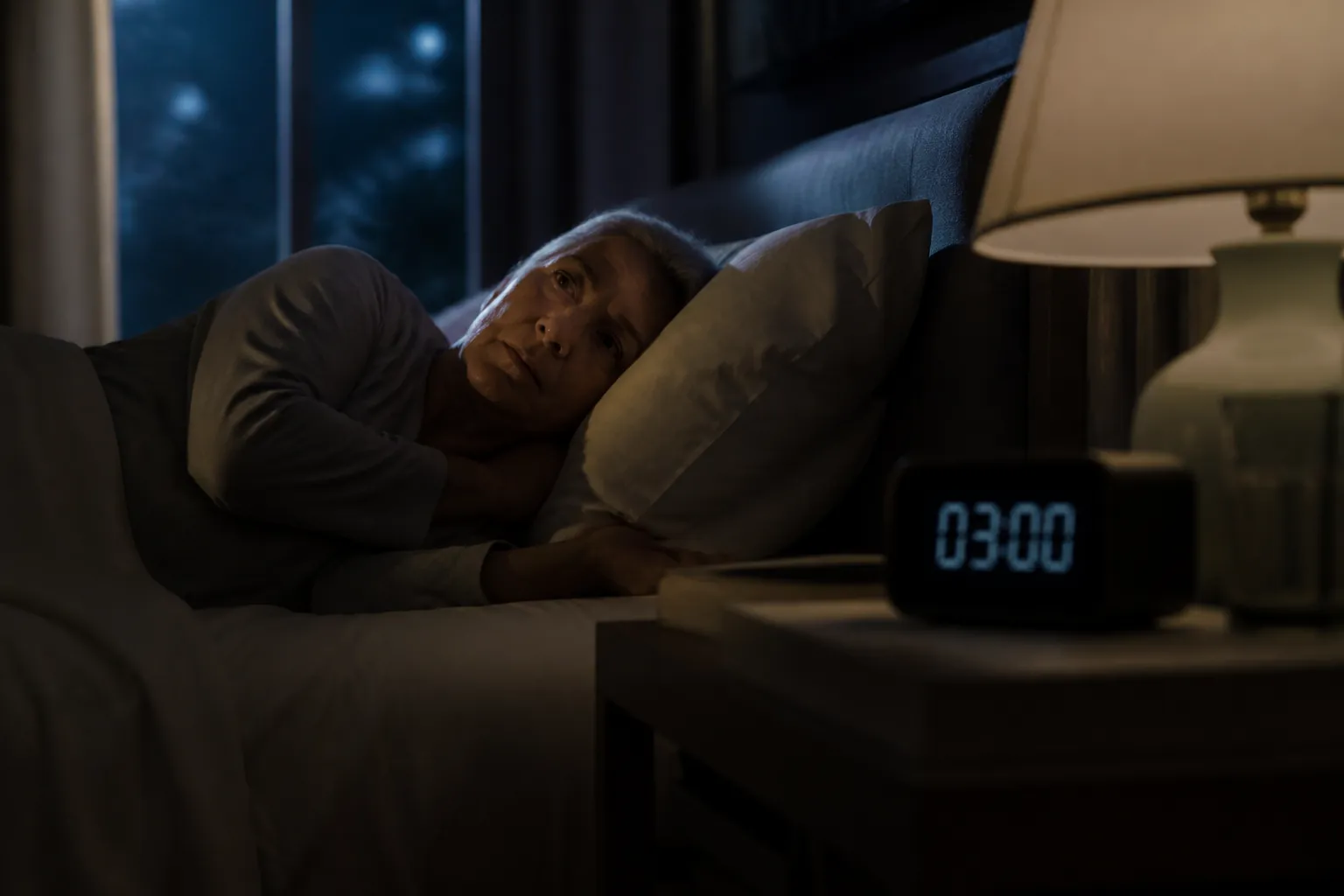
The biomarker evidence here is interesting but should be handled carefully. In a community sample of 66 middle-aged adults, waking after sleep onset was significantly associated with higher cerebrospinal fluid amyloid-beta, with a stronger association among APOE ε4 carriers. [4] That does not mean a person who wakes at 3:00 AM has Alzheimer's pathology. The study was small and cross-sectional, and the amyloid finding is not a simple household screening tool.
Still, the pattern is worth bringing to a clinician when it is new and paired with memory concerns. Sleep maintenance problems can come from pain, nighttime urination, alcohol, anxiety, depression, restless legs, periodic limb movements, untreated sleep apnea, or medication timing. Those causes matter because several are treatable, and because untreated sleep disruption can make anyone look more forgetful the next day.
4. New sundowning-type confusion
Sundowning is not simply being tired at dinner. The more concerning pattern is a repeatable late-day or evening change in cognition or behavior: confusion about where they are, suspicion toward familiar people, agitation, pacing, resistance to care, or disorientation that is clearly worse as the day winds down.
One strange evening after a poor night, an infection, dehydration, travel, or a medication change should not turn a family meeting into a dementia tribunal. But new recurrent evening confusion is a call-primary-care-this-week pattern, especially if it creates safety issues such as wandering, stove use, falls, or missed medications.
This is also where caregivers can unintentionally under-report quieter symptoms. If there is no dramatic episode, it can be tempting to wait. But a person who becomes less active by day, loses track of evening routines, or reports that their memory feels unreliable may still need evaluation, even without a frightening sundowning scene.
Rule these out before assuming Alzheimer's
The safest next step is usually not to choose between “sleep problem” and “Alzheimer's.” It is to ask a clinician to look at both, while checking the common conditions that can imitate or worsen cognitive symptoms.
- Obstructive sleep apnea: loud snoring, witnessed pauses in breathing, gasping, morning headaches, dry mouth, high blood pressure, or heavy daytime sleepiness should push sleep apnea high on the list.
- Depression: low mood is not always obvious in older adults. Watch for withdrawal, loss of interest, appetite change, slowed movement, guilt, irritability, early-morning waking, or fatigue that looks like sleepiness.
- Restless legs or periodic limb movements: an urge to move the legs at night, kicking during sleep, tangled sheets, or a bed partner noticing repeated jerks can explain fragmented sleep.
- Medication effects: anticholinergic drugs, beta-blockers, corticosteroids, diuretics, and SSRIs can affect sleep, alertness, bathroom trips, dreams, or confusion in some older adults.
- Recent illness or change in routine: infection, pain flare, hospitalization, grief, travel, alcohol use, and a move can disrupt sleep and cognition without being Alzheimer's.
A medication review deserves special attention because families often remember the diagnosis list better than the start date of a pill. Bring the actual bottles or a current medication list, including over-the-counter sleep aids, allergy medicines, bladder medicines, pain medicines, supplements, and “as needed” drugs. The question is not only what the person takes, but when they take it and what changed before the sleep pattern changed.
What the Alzheimer's sleep research can and cannot tell you
The broader research fits the same general picture: in Alzheimer's disease, sleep tends to become less efficient, less consolidated, and less tied to a stable day-night rhythm. In cognitively normal older adults, reduced slow-wave sleep has been linked with higher tau protein levels, and the researchers emphasized sleep quality rather than total sleep time as the relevant signal. [5]
A 2022 meta-analysis of 28 polysomnography studies also found that people with Alzheimer's had reduced total sleep time, sleep efficiency, slow-wave sleep, and REM sleep compared with age-matched controls, with slow-wave and REM reductions correlating with cognitive decline severity. [6]
That does not make a consumer sleep score a dementia test. These studies are observational. Sleep disruption may contribute to brain changes, reflect early brain changes, or both. Some samples were small; some were not very diverse; self-reported sleep can be inaccurate; and biomarker findings do not translate neatly into a decision a family can make at the kitchen table.
The practical use of the evidence is more modest and more useful: it helps separate ordinary aging from patterns that should be documented and discussed. If an older adult is sleeping lightly but functioning well, that is different from someone whose naps are expanding, nights are fragmenting, memory complaints are appearing, and evenings are becoming confused.
When to ask about cognitive screening
Ask a primary care clinician about cognitive screening when one of the four sleep patterns is new, persistent over weeks to months, escalating, observed by someone else, or paired with memory, attention, judgment, or evening-confusion changes. You do not need to arrive with a diagnosis. You need to arrive with a pattern.
- Write down sleep and wake times, naps, nighttime awakenings, and evening confusion episodes for at least one to two weeks if the situation is stable enough to wait.
- Note what changed first: sleepiness, memory, mood, medication, pain, breathing at night, bathroom trips, or daily activity.
- Bring a medication list and ask specifically whether any drug could be worsening sleep, alertness, or confusion.
- Ask whether sleep apnea, depression, restless legs, or periodic limb movements should be evaluated.
- Ask whether brief cognitive screening is appropriate now, and what follow-up would happen if the result is abnormal or borderline.
If there is sudden confusion, hallucination, fever, severe weakness, a fall, possible stroke symptoms, or an abrupt change over hours to days, treat that as urgent medical care rather than an Alzheimer's screening question. Delirium, infection, medication toxicity, dehydration, and other acute problems can look like dementia but require faster attention.
For the slower patterns, the threshold is calmer: document what you see, review treatable causes, and ask whether cognitive screening belongs in the visit. That is not overreacting. It is also not deciding in advance that every difficult night is Alzheimer's.
References
- Increasing Sleepiness May Be Early Sign of Alzheimer's in the Elderly, Fisher Center / Neurology, 2025
- What Our Body Clocks May Say About Our Alzheimer's Risk, Fisher Center / Neurology, 2026
- Circadian rhythms disrupted in patients with preclinical Alzheimer's, WashU Medicine
- Associations of insomnia symptoms with cerebrospinal fluid biomarkers of Alzheimer's disease pathology in middle-aged adults, Journal of Alzheimer's Disease, 2023
- Decreased deep sleep linked to early signs of Alzheimer's disease, WashU Medicine, 2019
- Sleep disturbances in Alzheimer's disease: a systematic review and meta-analysis of polysomnographic findings, Translational Psychiatry, 2022