
How to Sleep Cool Without Air Conditioning Tonight
If you need to sleep cool without air conditioning tonight, stop trying to make the whole bedroom perfect. Work on the body first: take a warm shower 1–2 hours before bed if you still have that window, cool the wrists/neck/feet with damp cloths or cool water, get more skin exposed to moving air, strip the bed down to the lightest breathable layer, and move humid air out of the room if you can.
That is not the tidiest answer, but it is the useful one at 1 a.m. Your body falls asleep more easily when core temperature drops by about 1–2°F, a cooling process that begins before sleep and is helped by heat leaving through the skin, especially the hands and feet.[1] A hot room gets in the way. A humid room is worse, because sweat can sit on the skin instead of evaporating and carrying heat away.
So the goal tonight is simple: help heat leave your body faster than the room is trapping it.
What to do in the next two hours
| If you can do one thing | Do this | Why it helps |
|---|---|---|
| You have 1–2 hours before bed | Take a warm shower, then let your skin cool in light clothing | Warm water brings blood toward the skin; afterward, heat can leave more easily |
| You are already in bed | Cool pulse points with a damp cloth or cool water | Wrists, neck, feet, inner elbows, and behind the knees sit near blood flow close to the surface |
| The room is hot but there is a fan | Expose more skin to moving air and use the lightest sheet you can tolerate | Air movement helps sweat evaporate and reduces heat trapped under fabric |
| The air feels sticky | Use an exhaust fan, dehumidifier, or window strategy to move humid air out | Lower humidity makes sweat evaporation more effective |
| The mattress or pillow feels hot | Rotate the pillow, use a light pillowcase, or briefly chill the pillowcase if practical | Less trapped heat around the head and neck can reduce the feeling of being sealed in |
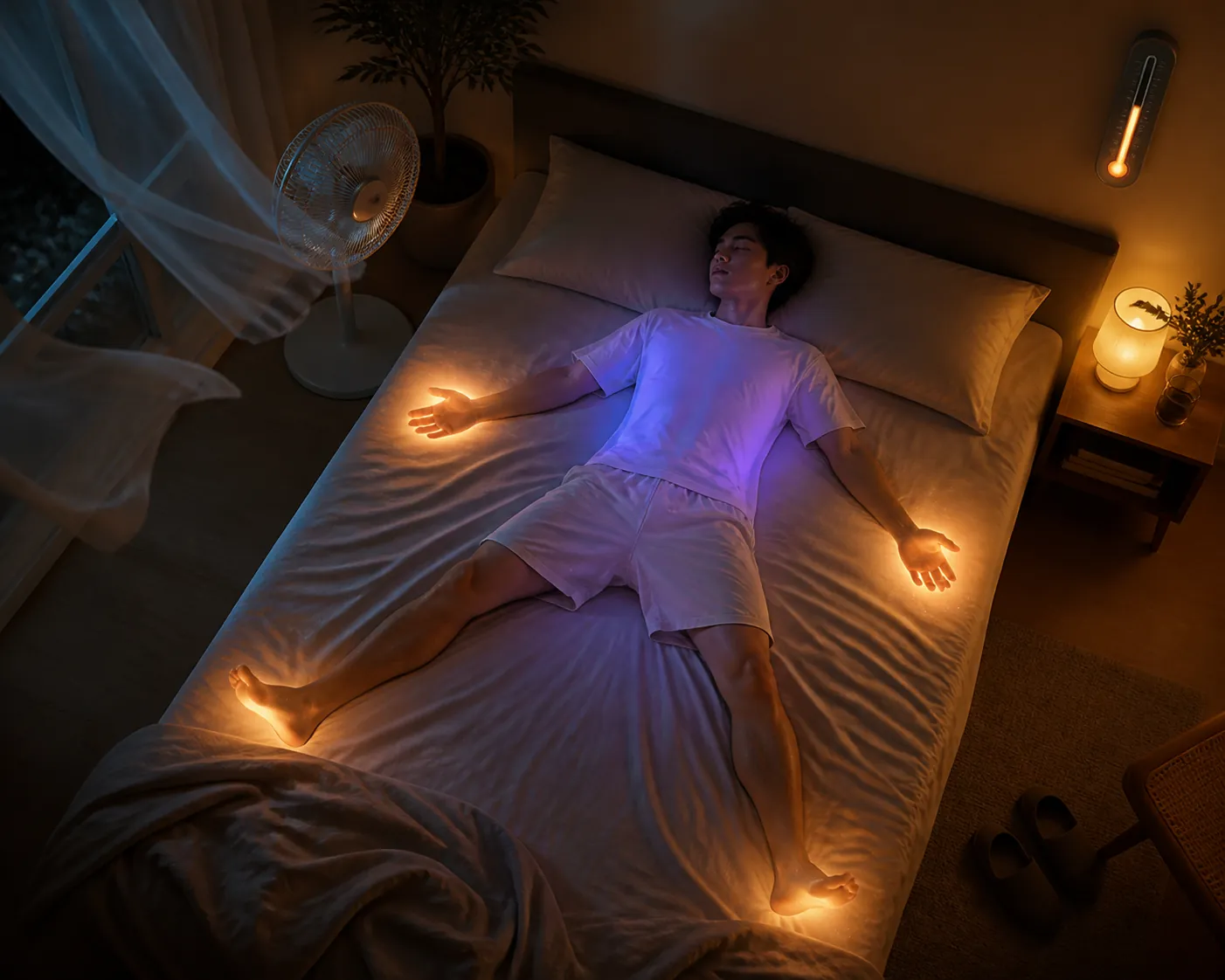
Why being hot keeps you awake
Sleep is not just a brain decision. It is also a temperature event. In the hours before sleep, the circadian system helps shift blood flow toward the skin so the body can release internal heat. The hands and feet matter here because blood vessels near the surface can widen and act like heat exits.[1]
This is why a hot bedroom feels different from a mildly annoying room. If the air around you is already warm, the temperature gap between your skin and the room shrinks. Heat has fewer places to go. If the air is humid, sweat cannot evaporate well, so one of the body’s main cooling tools is blunted.
Ideal bedroom temperature ranges vary by source. The National Sleep Foundation is commonly cited at 60–67°F, while Sleep Foundation gives 65–68°F as an ideal adult range.[2] Those are useful targets for another day. Tonight, the more important threshold is practical: once the bedroom is above roughly 75°F, sleep often becomes harder, and above 80°F many people struggle substantially. A 2023 study discussed by the American Heart Association found sleep efficiency fell by 5–10% as bedroom temperature rose from 77°F to 86°F in older adults.[3]
The point is not that everyone needs the same thermostat number. It is that a warm room can interrupt the body’s scheduled drop in temperature, and the consequences show up as longer sleep onset, more wakefulness, and that maddening feeling of being tired but physically unable to settle.
The warm shower paradox
A cold shower sounds logical when you are overheated. Sometimes it gives short relief. But if it makes your skin blood vessels clamp down, it can reduce heat loss from the core just when you need that heat to move outward.
A warm shower works differently. Warm water encourages blood vessels in the skin to dilate. After you get out, especially if the room air is moving and you are not wrapped in heavy fabric, that extra blood flow near the surface lets heat leave the body. The shower warms the skin and outer tissues so the core can cool afterward.
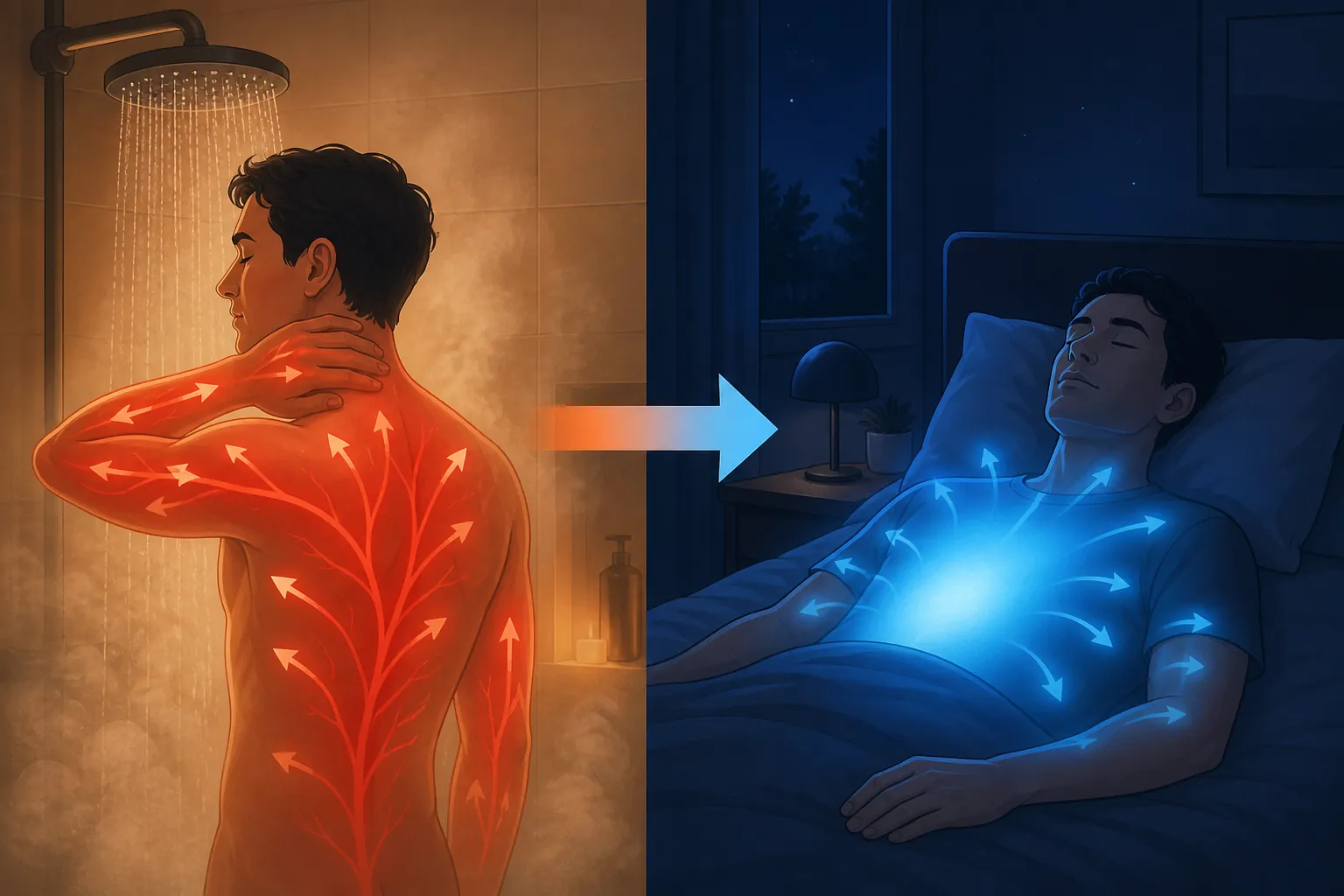
Research summarized in Sleep Medicine Reviews and later consumer sleep guidance has linked a warm bath or shower before bed with faster sleep onset, especially when timed about 1–2 hours before sleep. Some summaries cite a water temperature around 104–108°F for about 10 minutes.[4] Treat that range as a careful guide, not a dare. The water should feel warm, not punishing, and anyone prone to dizziness, fainting, pregnancy-related overheating, or cardiovascular concerns should be more conservative.
The part people miss is what happens after the shower. Do not step out and immediately seal yourself into thick pajamas or a heavy comforter. Dry off, wear something loose and breathable, and give your skin access to moving air. If you have a fan, this is when it earns its place.
Cool the places where heat can leave quickly
Pulse-point cooling is not magic; it is just anatomy used sensibly. Cooling areas where blood vessels run close to the surface can help reduce the body’s heat load, and practical sleep guidance often names the wrists, neck, inner elbows, backs of the knees, ankles, and feet.[5]
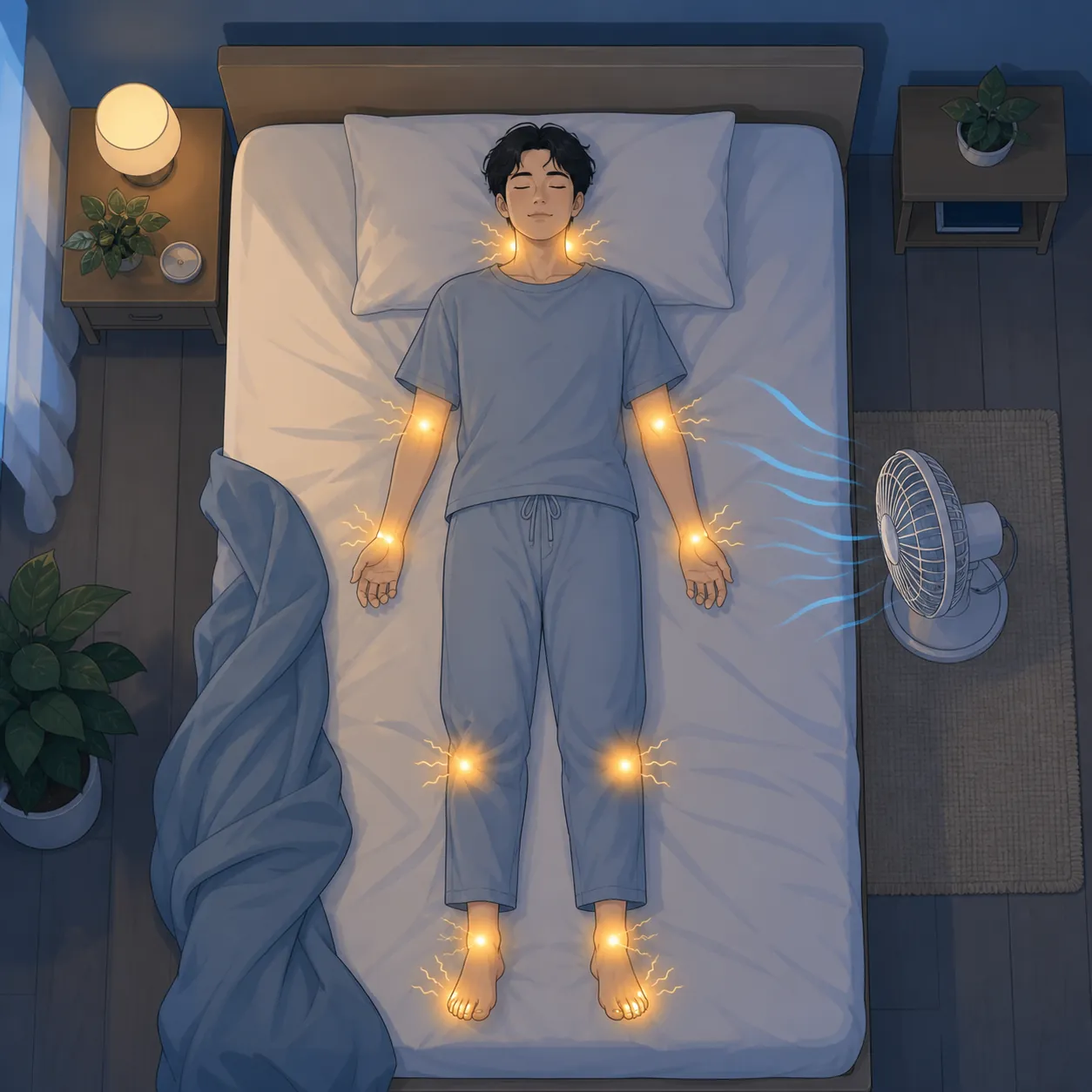
- Run cool, not icy, water over your wrists for a minute or two before bed.
- Place a damp cloth on the back of the neck, inner elbows, or behind the knees while you settle.
- Try a cool foot rinse, or wear thin damp socks briefly if airflow is available and the sensation does not bother you.
- Keep a small bowl of cool water and cloth by the bed if you are waking repeatedly from heat.
Avoid making yourself so cold that you start shivering. Shivering is heat production. It is the body doing the opposite of what you need.
Give sweat a chance to evaporate
A fan does not cool the room the way air conditioning does. It cools you when moving air helps sweat evaporate and carries heat away from skin. That distinction matters, because a fan pointed at a fully covered body is doing far less than a fan moving air across exposed arms, legs, feet, neck, and face.
If you can tolerate it, sleep in a loose starfish position instead of curling tightly. Separate your arms from your torso. Let your feet out from under the sheet. Use one thin cotton, linen, bamboo, or other breathable layer rather than stacking bedding that traps a pocket of humid heat around you.
Ceiling fans are often said to create a wind-chill effect that makes a room feel about 4°F cooler, though that figure is commonly cited in industry and consumer guidance rather than being the same kind of evidence as a sleep-lab finding.[4] The useful takeaway is narrower and more reliable: moving air across skin helps heat leave the body.
If the air is humid
Humidity is why two rooms at the same temperature can feel completely different. At higher humidity, sweat stays wet on the skin instead of evaporating efficiently. You feel sticky because that cooling step is failing.
- Run a bathroom exhaust fan if it pulls moist air out of the sleeping area.
- Use a dehumidifier if you already have one; this may help even when the room temperature does not drop much.
- Do not hang large wet towels in a closed bedroom unless there is enough airflow for evaporation to help rather than simply raising humidity.
- If outdoor air is cooler and less humid than indoor air, open windows strategically; if it is hotter and wetter outside, keep that air out.
Use the fan to move heat out, not just blow hot air in
If the room has one window and the air outside is cooler, a fan can help exchange air. Advice from sleep educator Heather Turgeon emphasizes that a fan in the window may work better blowing hot indoor air out rather than simply blasting outdoor air in, especially when you are trying to create cross-ventilation.[6]
With two openings, put one fan facing out on the warmer side of the room and let cooler air enter from the other side. With one fan and no useful outdoor air, aim it across your body, not straight into bedding. If the fan is drying your eyes or making you tense, angle it toward your torso and legs instead of your face.
A bowl of ice in front of a fan can create a small evaporative-cooler effect, and NPR has described versions of this kind of DIY setup for heat relief.[7] Keep expectations modest. It may cool the air immediately around the fan for a while; it will not turn a sealed hot bedroom into a cool one.
Lower the heat stored around the bed
The bed can become its own heat trap. Foam pillows, dense comforters, mattress toppers, and tight pajamas can hold warmth close to skin even if the air is moving. Tonight is not the night for a perfect bedding overhaul. Remove insulation first.
- Use a top sheet instead of a comforter, or cover only the part of your body that needs the weight.
- Turn or swap pillows when one side gets warm.
- Briefly chill a pillowcase in the freezer if that feels worth the effort and it will stay dry enough to be comfortable.
- Move to a lower floor, couch, or mattress on the floor if that space is genuinely cooler.
- Block late-day sun tomorrow with blinds, curtains, or reflective window coverings so the room starts the night with less stored heat.
Real Simple’s summer sleep guidance includes the frozen-pillowcase trick and reflective window coverings as non-AC cooling tactics, with the window advice tied to reducing solar heat gain before bedtime.[8] Those are secondary moves, but they can help if your bedroom has been baking all afternoon.
When heat is not just a room problem
Some people are not starting from the same thermoregulation baseline. Older adults can be more affected by mild heat exposure during sleep; research reviewed by Okamoto-Mizuno and Mizuno describes increased wakefulness and reduced REM sleep under heat exposure, with older adults showing particular vulnerability.[1] That does not mean every older adult will respond the same way. It does mean “just use a fan” can be too casual when the body has less thermal margin.
Perimenopausal hot flashes are vasomotor events, so they can collide badly with a hot room. Pregnancy can increase metabolic heat production, which may make overheating feel more intense. Some adults with ADHD also describe body-temperature sensitivity or difficulty settling when physically uncomfortable, though that is not the same as saying heat causes ADHD sleep problems. These situations deserve more specific guidance than a general FAQ can give.
For tonight, the same physical priorities still apply: support heat loss, preserve airflow over skin, reduce humidity where possible, and do not pile insulation over a body already trying to cool. If heat symptoms feel severe, if someone is confused, faint, vomiting, or not cooling down, that moves beyond sleep advice and into urgent heat-safety territory.
Without AC, the win is not an ideal bedroom. The win is helping your body finish the cooling process it was already trying to run.
References
- Effects of thermal environment on sleep and circadian rhythm, PMC/NIH, 2012
- The Best Temperature for Sleep, Sleep Foundation
- Keep your cool – and stay healthy – with these hot-weather sleep tips, American Heart Association, August 2025
- How to Keep Your House Cool Without AC: 10 Proven Methods, Evapolar
- Tips for sleeping in hot weather without AC, HealthPartners
- The Happy Sleeper, Heather Turgeon
- DIY ice-fan evaporative cooler, NPR
- 8 Tricks to Get the Best Night's Sleep During Summer Without AC, Real Simple, July 2026
Read the full guide: How to Watch a Blood Moon Without Ruining Your Sleep