Sleep During a Typhoon: Tips for Your Life Stage
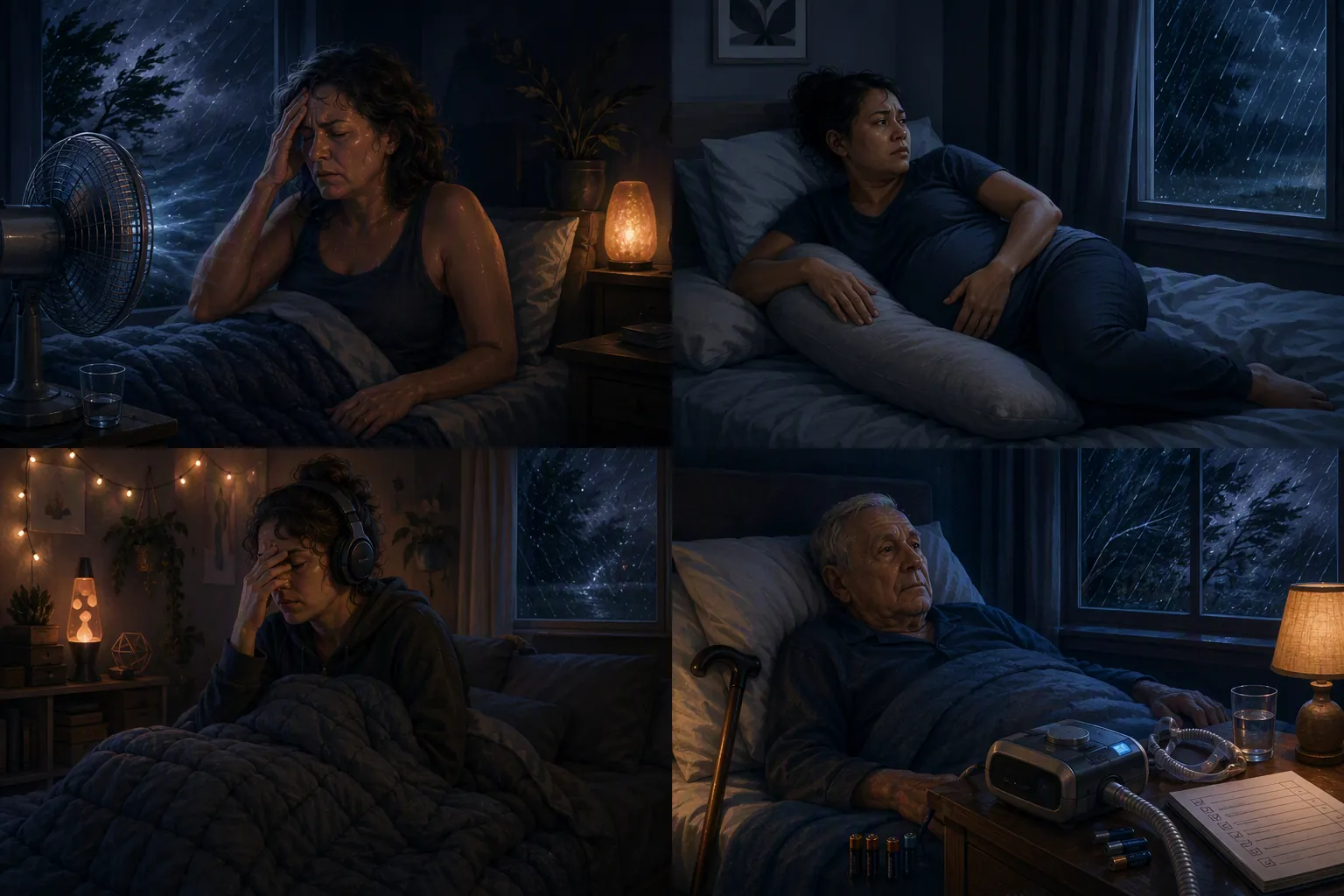
The hard part of trying to sleep during a typhoon often starts before the wind gets loud. It starts when your body is already doing something difficult: flushing hot, carrying late-pregnancy weight, scanning for the next sound, or deciding whether it is safe to cross a dark room. A typhoon adds noise, heat, phone alerts, danger appraisal, possible evacuation decisions, and power uncertainty. Those pressures do not land on every sleeper the same way.
This guide is a synthesis: typhoon safety guidance, storm-anxiety guidance, and sleep physiology for four groups that are often handed the same thin advice. It is not based on a single trial proving a storm-sleep protocol for perimenopause, pregnancy, ADHD, or older adulthood. That distinction matters. Typhoons require practical safety decisions, especially around sheltering, windows, emergency supplies, and family communication; UNICEF’s typhoon guidance for families treats preparation and safe sheltering as concrete actions, not mood management.[1]
Start With the Thing Most Likely to Wake You
Generic storm sleep tips usually begin with the room: lower the lights, play white noise, breathe slowly. Those can help some people. But during a typhoon, the better first question is more bodily and less decorative: what is most likely to wake you, and what happens next?
| If this is your baseline | The typhoon adds | Prepare for the wake-up, not just sleep onset |
|---|---|---|
| Perimenopause or menopause symptoms | Heat, stress, power-outage warmth, possible migraine triggers | Cooling within reach, breathable layers, rescue migraine medication nearby if prescribed |
| Pregnancy, especially late pregnancy | Positioning limits, bladder trips, anxiety about safety or labor logistics | A practiced side-lying setup away from windows, hydration, printed records, OB-approved calming plan |
| ADHD sensory sensitivity or racing thoughts | Unpredictable thunder, alerts, executive-function overload | A short pre-storm checklist, gentler sound masking, dimmed screens, pressure or grounding tools |
| Older adulthood, mobility limits, medications, or devices | Dark-room movement, power loss, medication disruption, missed warnings | Cleared paths, backup batteries, paper medication list, caution with sedating sleep aids |
That last column is the practical shift. The goal is not to force eight hours of uninterrupted sleep through a severe weather event. It is to know what is likely to break the night, and to make the first five minutes after waking safer.
Perimenopause: Heat, Sweat, and the Storm Before the Storm
For many perimenopausal and menopausal women, storm sleep starts at a disadvantage. Stanford Lifestyle Medicine reports that 40–60% of women in perimenopause and menopause experience sleep difficulties, while symptoms are often minimized or misunderstood.[2] That number does not prove typhoons have been studied as a specific perimenopause sleep trigger. It does show that many women are not beginning the night from a neutral place.
Hot flashes and night sweats are not a failure to calm down. They are thermoregulatory events: the body’s heat-control system misfires, sleep is interrupted, and the person wakes hot, damp, and irritated enough that falling back asleep may take time. A typhoon can make that loop worse in two ordinary ways. First, stress can provoke vasomotor symptoms. Second, power outages can take away air conditioning or reliable airflow at exactly the wrong hour.
Prepare the cooling before the weather arrives, not at 2 a.m. after the room is already hot. If you still have power in the afternoon or early evening, pre-cool the bedroom or the safest sleeping area. Put a cooling towel, spare breathable sleep shirt, water, and a battery-powered fan where you can reach them without turning the room into a search operation. Use lighter bedding than your anxious brain wants; heavy blankets can feel comforting before sleep and punishing after a sweat-soaked wake-up.
If storms and migraines are part of your history, treat that as a sleep issue too. Cleveland Clinic explains that drops in barometric pressure before or during a storm can expand tissue and stimulate pain-sensitive nerves, triggering or worsening migraine symptoms in susceptible people.[3] That does not mean every typhoon headache is a barometric-pressure migraine. It does mean that a perimenopausal person with a known migraine pattern should not leave prescribed rescue medication in another room, a car, or a bathroom cabinet blocked by furniture.
- Before nightfall, move prescribed rescue migraine medication, water, and any nausea supplies to the bedside or shelter area.
- Avoid using caffeine or alcohol as storm coping tools; both can complicate sleep, temperature regulation, and migraine patterns.
- Place the fan, towel, and dry shirt on the side of the bed you can reach without standing in the dark.
- If you sleep away from windows for safety, duplicate the cooling setup there instead of assuming you will move it later.
Pregnancy: Positioning Is Part of the Emergency Plan
Late pregnancy can make sleep fragile even on a quiet night: physical discomfort, frequent urination, reflux, fetal movement, hormonal changes, and anxiety can all crowd the same few hours. A typhoon adds a separate layer. The safest part of the home may not be the bed. The place away from windows may be narrower, warmer, or harder to arrange. Phone alerts may raise questions that are not abstract: what if contractions start, what if roads flood, what if records are only on a phone that loses battery?
Do the positioning rehearsal while there is light. If the safest sleep area is a hallway, interior room, or lower-risk room away from windows, lie down there before the typhoon peaks. Bring the body pillow, wedge, or cushions you actually use. It is not enough to know where you “should” go; you need to know whether your hips, belly, back, and breathing tolerate that space for more than five minutes.
A pregnancy-specific storm kit should be more boring than dramatic: prenatal vitamins, any regular medications, extra water, snacks you can tolerate, a charger or power bank, and printed medical information. Printed matters because phones die, networks fail, and passwords are not helpful when someone else has to speak for you. Include your clinician or hospital contact details, gestational age, medication list, allergies, relevant pregnancy complications, and insurance or identification information if applicable.
Anxiety management should also be pregnancy-specific. Slow breathing may be useful, but if you have shortness of breath, dizziness, high-risk pregnancy concerns, panic attacks, or any condition where breath control feels unsafe, ask your OB or maternity care team ahead of storm season what techniques are appropriate for you. This is not overplanning. It prevents the common late-night situation where the only available advice is generic and the stakes feel too personal for generic advice.
- Set up your side-lying position in the safest practical area before wind and alerts intensify.
- Keep a clear path to the bathroom, because reducing fall risk matters more than keeping the room perfectly dark.
- Keep hydration nearby, but balance it with the reality of repeated bathroom trips in a power outage.
- If evacuation is possible, keep shoes, records, and the pregnancy kit in one known place rather than scattered across the home.
ADHD: The Problem Is the Unpredictable Sound, Not Weak Willpower
For an ADHD adult, a typhoon can turn bedtime into a vigilance task. Thunder is not merely loud; it is irregular. Wind gusts rise and drop. Rain changes intensity. Alerts arrive with a sound designed to interrupt everything. If your sleep already tends toward racing thoughts, delayed sleep onset, or sensory overload, the storm gives your brain more loose ends to monitor.
This is where advice to “just use white noise” can backfire. Harvard Health notes that white noise may help some sleepers, but the evidence is mixed; it also points to early promise for pink noise in older adults, without turning that into a universal cure.[4] For ADHD sleepers, many community-informed strategies favor pink or brown noise because they can feel less sharp than white noise while still masking sudden changes. That preference is experiential, not storm-specific clinical proof. Use it as a practical experiment, not a rule.
The best ADHD storm-sleep preparation usually happens outside the bed. Offload the decisions before bedtime: where to sleep, which alerts stay on, where the flashlight is, whether the windows are checked, which device is charging, and who is responsible for pets, children, or older relatives. A checklist is not childish here. It is a way to stop the brain from reopening the same tabs every time the wind hits the wall.
| ADHD trigger during a typhoon | Try this before bedtime |
|---|---|
| Sudden thunder or debris sounds | Use steady pink or brown noise at a safe, comfortable volume; keep one trusted warning source audible enough to notice. |
| Alert-checking loop | Choose warning sources and alert settings before bed; avoid renegotiating them every few minutes. |
| Racing thoughts | Try a low-stakes mental task such as imagining random, unrelated objects; treat it as an experiment, not a medical treatment. |
| Body agitation | Use a weighted blanket only if it is comfortable, safe for your breathing and mobility, and easy to remove quickly. |
| Screen reactivation | Dim screens early, use night mode, and keep emergency information accessible without scrolling through feeds. |
If you do use headphones or earbuds, be careful. Total sound isolation can be unsafe if you need to hear an evacuation instruction, a family member, a smoke alarm, or a change in conditions. Masking the edge off storm noise is different from sealing yourself away from warnings.
Older Adults: The Wake-Up Plan Matters as Much as the Sleep Plan
For older adults, the main sleep risk during a typhoon may not be anxiety in bed. It may be what happens after waking: standing too quickly, walking to the bathroom without lights, searching for glasses, stepping around a power cord, missing a warning because hearing aids are charging elsewhere, or losing CPAP power in the middle of the night.
Clear the path before dark. That means the route from bed to bathroom, bed to safer shelter area, and bed to medication or device supplies. Move loose rugs, cords, low stools, laundry baskets, and anything that requires a half-awake person to remember where it is. If a cane, walker, glasses, dentures, hearing aids, or phone is part of getting safely upright, place it in the same reachable location every storm night.
Medical devices deserve their own check. CPAP machines, hearing aids, mobility-device chargers, refrigerated medications, and emergency phones all become sleep issues when the power is unstable. The National Weather Service advises people dealing with storm anxiety to have more than one way to receive warnings and to make practical preparations before storms arrive.[5] For an older adult, “more than one way” may mean a charged phone plus a weather radio, a caregiver check-in plan, or a warning system that accounts for hearing loss.
Keep a printed medication list in the emergency kit and near the sleep area. Do not rely only on a phone. Include medication names, doses, timing, allergies, prescribing clinicians, pharmacy information, and which medications need refrigeration. If refrigeration may fail, ask the pharmacist or clinician ahead of storm season what the safe time window and backup plan are for your specific medication; do not guess based on someone else’s prescription.
Be cautious with sleep aids during typhoons. Sedating medications can increase confusion, worsen balance, and make it harder to respond to warnings or move safely. Older adults are also more likely to be dealing with multiple medications, which raises the chance of interactions. If you already use a prescribed sleep medication, follow your clinician’s instructions. If you are considering adding something “just for the storm,” that is a conversation to have before the storm, not after the alerts start.
The Shared Tools That Are Actually Worth Keeping
Once the life-stage problem is handled, the shared tools become more useful. Preparation is one of them. The Anxiety and Depression Association of America recommends reducing hurricane-season anxiety through concrete steps such as making a plan, preparing supplies, limiting unhelpful media exposure, and focusing on what is controllable.[6] The National Weather Service makes a similar practical point in its storm-anxiety guidance: know where to get weather information, have multiple warning sources, and make a plan before the threat is at its peak.[5]
For sleep, that means preparation should be small enough to finish. A storm plan that lives only in your head is still a bedtime task. A printed list, charged power bank, filled water bottle, cleared walking path, packed medication pouch, and chosen sleep location tell the nervous system fewer things are unresolved. They also help if you wake groggy and need to act.
Breathing Helps Some People, but It Is Not the Whole Plan
Box breathing is simple: inhale for four counts, hold for four, exhale for four, hold for four. Cleveland Clinic describes it as a technique that can help activate the parasympathetic nervous system and lower stress physiology.[7] Sleep Foundation also includes breathing exercises among sleep-hygiene tools that may help some people relax before sleep.[8]
Use it where it fits. A perimenopausal person sweating through a sheet may need cooling first. A pregnant person who feels breathless may need an OB-approved variation. An ADHD adult may need the checklist done before breathing feels possible. An older adult may need the path to the bathroom cleared before closing their eyes. Breathing is a tool, not a substitute for the physical problem in the room.
Noise Masking Should Stay Modest and Safe
White, pink, or brown noise can make storm sounds less jagged. Keep the volume around a comfortable conversational level, and avoid making it so loud that it becomes another stressor. The evidence for white noise is not strong enough to promise better sleep for everyone, and the safest setup during a typhoon still lets you receive urgent warnings or hear someone in the household who needs help.[4]
Alerts Need Boundaries, Not Guesswork
Turn off nonessential notifications before bed, but do not silence the systems that tell you conditions have changed. Use official local warnings where you live, and add a backup source if power, mobile networks, hearing, or household responsibilities make one source unreliable. Typhoon warning systems vary by country and region, so this is not the place to copy advice written for a different storm system without checking local authorities.
Extreme weather can affect mental health, and that includes sleep, worry, and stress responses before, during, and after the event.[9] Still, not every wake-up during a typhoon is a mental-health problem. Sometimes the body is hot. Sometimes the sound is too sharp. Sometimes the safest room is uncomfortable. Sometimes the person who wakes has to make a medical or mobility decision in the dark.
During a typhoon, sleeping well may mean a shorter, safer night rather than a perfect one. Reduce the trigger most likely to break your sleep. Put the needed object where your waking hand can find it. Preserve a safe path if you sweat, panic, need to urinate, check a device, respond to an alert, or help someone else move.
References
- Typhoon safety information for parents — UNICEF
- How Perimenopause Affects Sleep — Stanford Lifestyle Medicine
- Barometric Pressure Headache: What To Know — Cleveland Clinic
- Can white noise really help you sleep better? — Harvard Health
- Storm Stress and Anxiety — National Weather Service
- Severe Storms: How to Reduce Your Anxiety — ADAA
- How Box Breathing Can Help You Destress — Cleveland Clinic
- Breathing Exercises for Sleep — Sleep Foundation
- Effect of Extreme Weather Events on Mental Health — PMC/NIH
Read the full guide: Which cooling sleep deals suit your life stage?