How to Sleep Through Fireworks Noise for Every Life Stage
FAQ: what actually helps you sleep during fireworks?
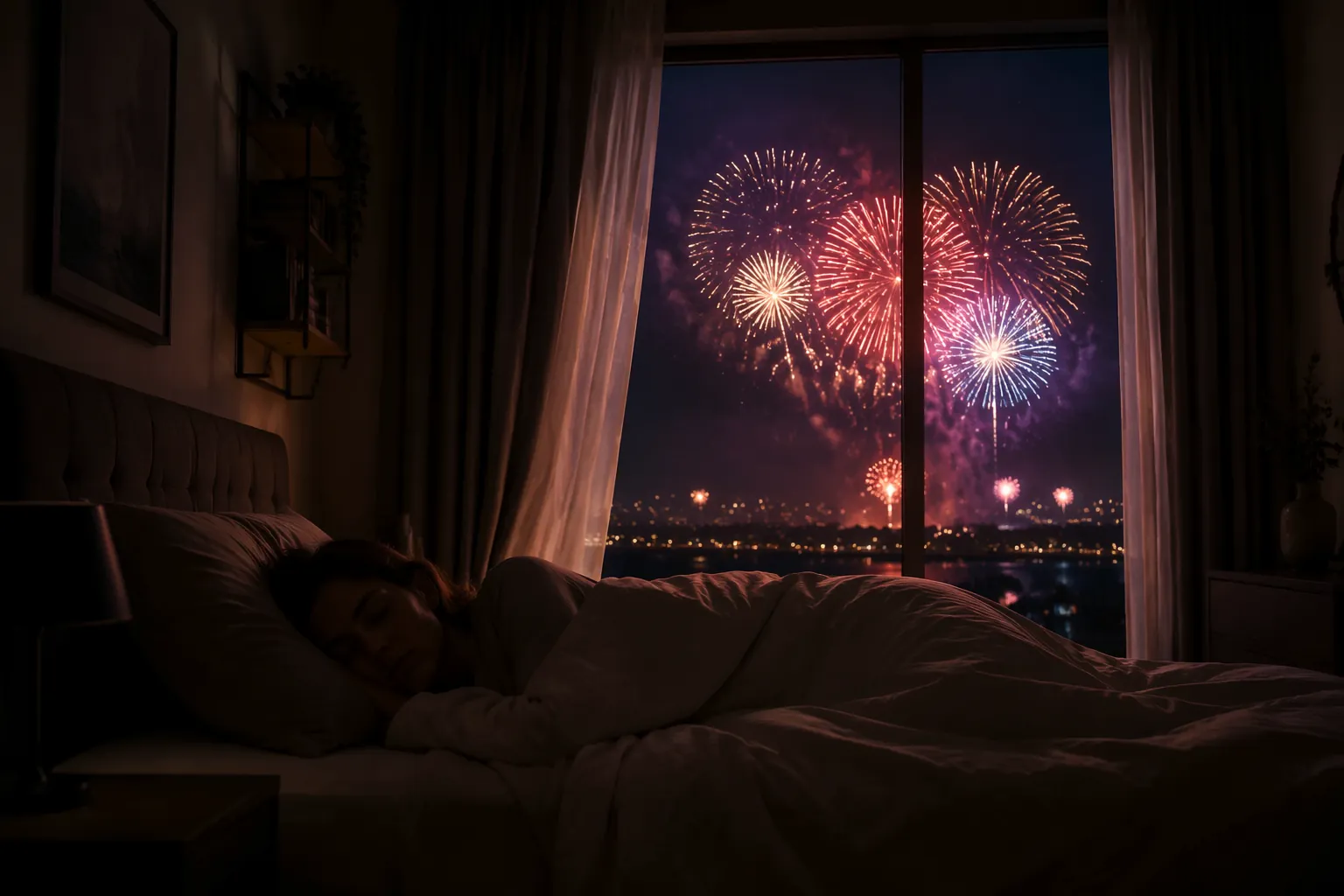
If you are lying in bed waiting for the next boom, the problem is not only that fireworks are loud. They are loud, sudden, and bright. Your brain gets a sharp sound spike, your room gets a flash of light, and your body may read both as something that deserves attention.
The most useful answer is a layered one: reduce the sound contrast, block the light, and give your nervous system something predictable to hold onto. Then adjust that stack for the person in the bed: pregnancy, ADHD, perimenopause, older age, or dementia caregiving all change what “good advice” looks like.
| Situation | Start with | Adjust for |
|---|---|---|
| Most adults | Foam earplugs or other hearing protection, fan or white noise, blackout curtains or an eye mask | Keep the sound source steady and the room dark before fireworks begin |
| Pregnancy | Distance from fireworks, indoor sleep setup, light blocking, comfortable sound masking | Avoid prolonged close exposure to impulsive loud sounds; do not panic about distant displays |
| ADHD | Predictable masking sound, familiar music if it helps, reduced visual stimulation | Unpredictable peaks may be harder to filter than steady noise |
| Perimenopause | Cool room, breathable bedding, light blocking, gentle masking sound | Hot flashes and already-fragmented sleep can make fireworks feel like the last straw |
| Older adult or dementia caregiving | Advance reminders, written reassurance, ear protection, interior room | Plan what to do if fear or agitation escalates |
Why fireworks wake you even when you are exhausted
Fireworks can reach about 150 to 175 decibels at the source, and one sleep-focused explainer places fireworks heard from a mile away around 75 to 87 decibels.[1] Those numbers do not mean everyone a mile away is in danger; distance, buildings, windows, terrain, and the type of firework all matter. They do explain why a bedroom that seems quiet at 9:30 p.m. can suddenly feel impossible at 10.
The more important sleep detail is contrast. A fan, air purifier, or white-noise machine gives the brain a consistent background sound. A firework is a peak. Wirecutter’s practical guidance frames masking as a way to make sudden booms stand out less against the room’s baseline sound, not as a magic wall that erases them.[2] SleepDr makes a similar point: steady noise can help reduce the difference between a quiet room and a sudden explosion outside.[3]
There is also a threat-detection piece. Sudden loud sounds can activate a fight-or-flight response, and consumer health coverage of fireworks has described the body’s stress response in terms of increased anxiety and cortisol-related arousal.[4] That does not mean every firework causes a clinically meaningful cortisol surge, but it does match the experience many readers describe: the body jumps before the mind has time to say, “It is only fireworks.”
Light matters too. Bright flashes through a window can make the night feel less stable, especially if you are already half-awake. Blackout curtains, a sleep mask, or moving to a darker interior room are not decorative sleep hygiene here. They remove one of the signals telling your brain to keep checking the environment.
One secondary-sourced survey, reported by Amerisleep and attributed to Each Night sleep studies, found that nighttime noise disturbances cost adults an average of 36 minutes of sleep per night, with sudden sounds among the hardest to acclimate to.[5] Because the original survey methodology was not independently verifiable from the material available here, that figure is best treated as a useful snapshot rather than a settled population estimate.
The basic stack: sound, light, and a calmer body
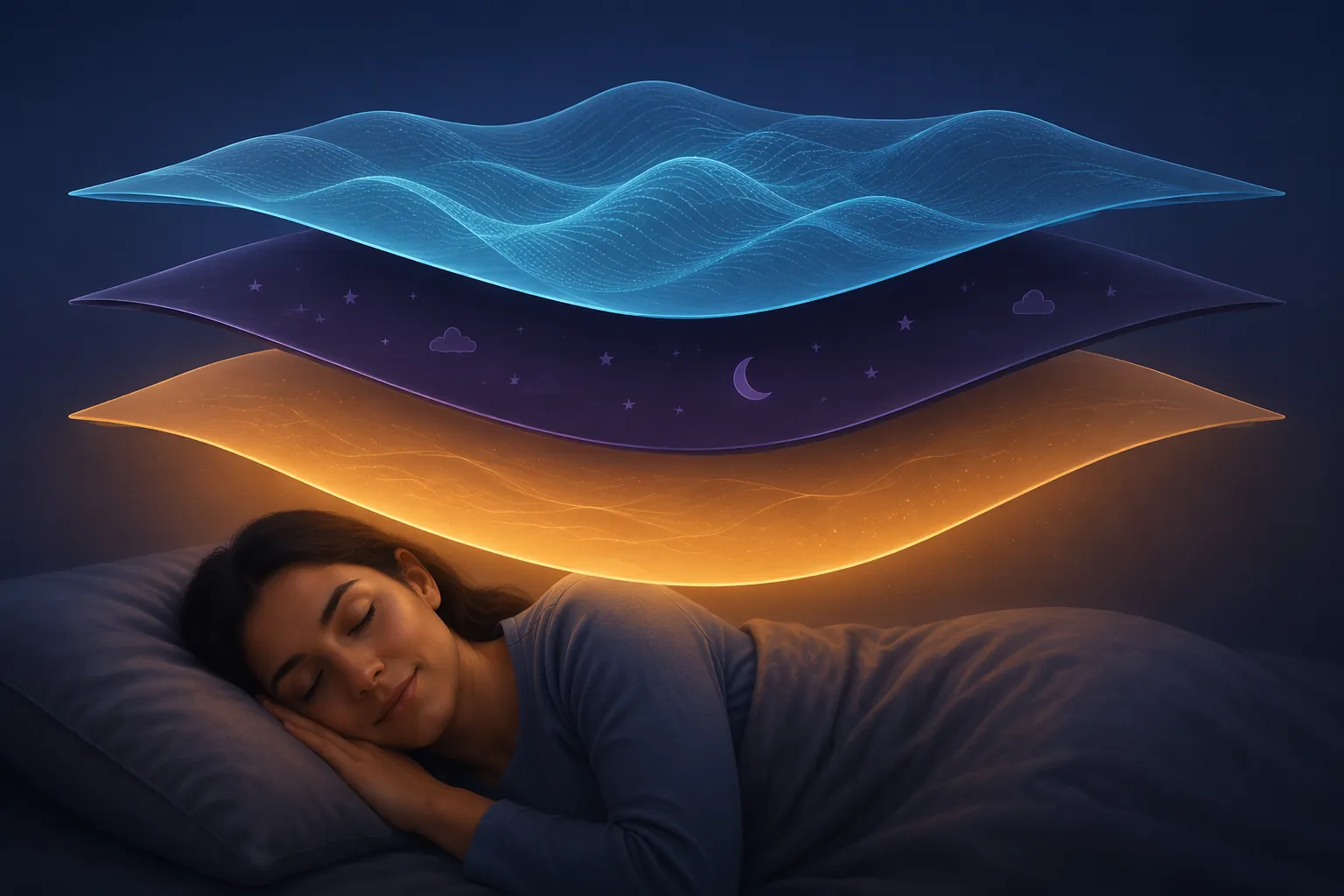
For many adults, the best starting setup is simple: use foam earplugs or another safe hearing-protection option, run a steady masking sound, and block the window light before fireworks begin. Waiting until the first boom means you are trying to solve the problem after your body is already alert.
Foam earplugs deserve more respect than they usually get. Wirecutter notes that foam earplugs can have a noise reduction rating up to 33 decibels and may outperform active noise-canceling headphones for fireworks because ANC is better at steady ambient noise than impulsive low-frequency booms.[2] If headphones are comfortable and help you relax, fine. But for the acoustic problem of sudden explosions, well-fitted foam earplugs are often the more practical tool.
- Put in earplugs before the fireworks start, not after you are startled awake.
- Run a fan, white-noise machine, air purifier, or steady audio at a comfortable volume.
- Close curtains fully, add an eye mask, or sleep in a room without a street-facing window.
- Keep the room cool enough that bedding and ear protection do not become another irritant.
- If anxiety rises, use a grounding exercise rather than lying still and monitoring every sound.
Sleep psychologist Dr. Leah Kaylor recommends the 5-4-3-2-1 grounding technique for firework-related anxiety: identify five things you can see, four you can feel, three you can hear, two you can smell, and one you can taste.[6] In a dark bedroom, you can adapt it gently: feel the sheet, the pillow, your breath, the mattress under your hips, and the air on your face. The point is to stop the nervous system from treating the next boom as the only thing in the room.
If you are pregnant: stay away from close, prolonged noise, but do not catastrophize distant fireworks
Pregnancy advice around fireworks should be careful. It is reasonable to want to protect fetal hearing. It is not reasonable for every distant neighborhood display to become a panic spiral.
Kamm McKenzie OBGYN summarizes pregnancy-specific evidence this way: fetal hearing structures develop around 16 weeks, fetal responses to outside sound are generally seen around 28 weeks, and the uterus plus abdominal wall dampen sound, especially higher frequencies.[7] The same source, citing American Academy of Pediatrics-style guidance, advises avoiding prolonged close exposure to impulsive loud sounds while noting that watching fireworks from a distance is safe.[7]
That distinction matters. Standing close to repeated explosive noise for a long period is different from being indoors, away from the launch site, trying to sleep while a display happens in the distance. For sleep, the more likely problem is your own arousal: the jolt, the worry, the disrupted position, the bathroom trip that turns into an hour awake.
- Choose distance over bravery: do not stand near launch areas or linger close to repeated impulsive noise.
- Sleep in the quietest part of the home, preferably away from street-facing windows.
- Use comfortable masking sound at a moderate volume; it should soften contrast, not blast over fireworks.
- Use blackout curtains or an eye mask if flashes make you more alert.
- If you are considering medication because you are desperate for sleep, treat that as a pregnancy safety question for your clinician, not as a fireworks hack.
The safest emotional message is boring and important: avoid close, prolonged exposure; create distance and dampening; do not assume that every muffled boom indoors is harming the baby. A calm plan helps more than spending the evening measuring fear.
If you have ADHD: predictable sound may work better than silence
For an adult with ADHD, “just ignore it” is often the least useful sentence in the room. The problem is not a lack of discipline. Unpredictable sound can keep pulling attention back to the environment, especially when the room is otherwise quiet.
This is where the standard white-noise advice becomes more specific. Silence can make each boom the main event. A steady sound gives the brain a baseline. Wirecutter’s guidance on fireworks noise includes familiar music as a practical option, with senior staff writer Lauren Dragan noting from experience and audio expertise that familiar music can be less disruptive than random noise for some listeners.[2] That is useful expert guidance, not a peer-reviewed ADHD treatment finding, so treat it as a tool to test rather than a rule.
If familiar music helps, pick something so well known that it does not invite active listening. No new album. No lyric-heavy song that makes you follow the story. No playlist that suddenly changes mood and becomes its own surprise. The aim is predictable audio that makes the fireworks less dominant.
| If your ADHD brain does this | Try this instead |
|---|---|
| Tracks every quiet gap while waiting for the next boom | Start masking sound before fireworks begin, then keep it steady |
| Gets irritated by white noise | Try brown noise, a fan, air purifier, or familiar low-stakes music |
| Gets more alert from changing audio | Avoid shuffle and choose one predictable track, album, or loop |
| Cannot tolerate earplugs | Use room-level masking and move farther from windows rather than forcing uncomfortable gear |
| Starts scanning flashes and shadows | Block light fully and turn clocks or glowing devices away |
The test is not whether the setup is aesthetically sleep-perfect. It is whether your attention has fewer sharp hooks to grab.
If you are in perimenopause: protect temperature first, then sound
There is not strong direct evidence in the materials here that fireworks affect perimenopausal sleepers differently as a studied fireworks-specific group. The practical concern comes from clinical reasoning: perimenopause often brings more fragmented sleep, night sweats or hot flashes, and a narrower comfort window. Add fireworks to that baseline and the night may unravel faster.
This changes the order of operations. A heavy comforter, tight headphones, and warm room may block noise but provoke heat. If a hot flash wakes you at 11:40 p.m., fireworks at 11:43 p.m. do not have to be the original cause to become the reason you stay awake.
- Cool the room before bedtime if you can; do not wait until you are overheated.
- Use breathable layers so you can remove warmth without fully waking up.
- Choose ear protection that does not trap heat around your head if that is a trigger.
- Use blackout curtains or a sleep mask, because light flashes can make a brief awakening stick.
- Keep water nearby, but avoid turning every awakening into a bright-light, phone-checking reset.
For this group, the best fireworks setup may look less like maximum gear and more like fewer triggers at once: cooler air, softer bedding, dim room, steady sound, and a plan for getting back down after the first wake-up. If the sleep disruption continues long after fireworks season, the fireworks may be revealing a larger sleep issue rather than causing all of it.
If you care for an older adult with dementia: prepare before the first boom
For dementia caregiving, the goal is not only sleep. It is preventing fear from escalating at a time of day when everyone has fewer reserves. Arista HealthCare recommends advance verbal reminders, written notes, ear protection, interior-room sleeping, and an exit strategy for overwhelm in people with dementia who may become distressed by fireworks.[8]
The written note is small but often worth doing. A person who wakes frightened may not retain a verbal explanation, and the caregiver may have to repeat it many times. A large, calm note can carry some of that burden: “Tonight there are fireworks outside. You are safe at home. I am nearby.”
- Earlier in the day, mention that fireworks may happen tonight and that they are expected.
- Before evening, prepare an interior room with dim light, familiar objects, comfortable seating or bedding, and steady background sound.
- Place a simple written reassurance note where the person is likely to see it.
- Offer ear protection if tolerated, but do not turn it into a struggle that creates more distress.
- Decide in advance what counts as escalation: pacing, panic, repeated attempts to leave, or inability to settle.
- Have an exit plan, such as moving to the prepared room, calling another caregiver, or using the person’s established clinical support plan if one exists.
Interior-room sleeping is not a glamorous tip. It is useful because it reduces window flashes, adds walls between the person and the sound, and gives the caregiver a defined place to guide the night. If fireworks are predictable in your neighborhood, setting up that room at 7 p.m. is easier than inventing it at 10 p.m. while someone is frightened.
If the night still goes badly
A failed fireworks night does not mean you failed at sleep. It usually means the disturbance was bigger than the tools you had ready, or that the tools solved only one pathway. Earplugs may reduce sound but do nothing for light. Blackout curtains may remove flashes but leave the body braced for booms. White noise may soften contrast but not calm worry after the first startle.
When you wake up, keep the repair small. Do not check neighborhood apps to see how long fireworks will last unless you need safety information. Do not turn on bright overhead lights. Do not start evaluating tomorrow. Reinsert earplugs, restart the masking sound if needed, use a grounding exercise, cool down if you are overheated, and return to the darkest, quietest setup you can manage.
If fireworks are legal and scheduled where you live, plan for the known window. If they are unpredictable, use a lower-effort version on high-risk nights: curtains closed, fan on, earplugs within reach, reassurance note ready for a vulnerable family member. You may not make fireworks disappear, but you can reduce contrast, block light, lower the threat response, and choose the safest version of those tools for the person actually trying to sleep.
References
- How To Block the Sound of Fireworks with White Noise — Yogasleep
- How to Block Fireworks Noise for Adults, Kids, and Pets — NYT Wirecutter
- Sleeping and Sparklers — SleepDr
- How Fireworks Affect You — Business Insider
- How to Sleep Through Fireworks — Amerisleep
- How to sleep during the 4th of July fireworks — Tom's Guide
- Can My Baby Hear Fireworks? — Kamm McKenzie OBGYN
- Firework Distress in Dementia Patients — Arista HealthCare
Read the full guide: Free Movies to Stream Before Sleep, Chosen by Your Life Stage