
How to sleep during a power outage thunderstorm
When the power is already out and thunder is still rolling, the bedroom stops being one problem. It becomes four: first safety, then temperature, then noise and light, then anxiety. The order matters. Earplugs are useful, but not before you know there is no generator exhaust drifting toward a window, no candle burning beside bedding, no medical device quietly losing backup power, and no refrigerator decision being postponed until morning.
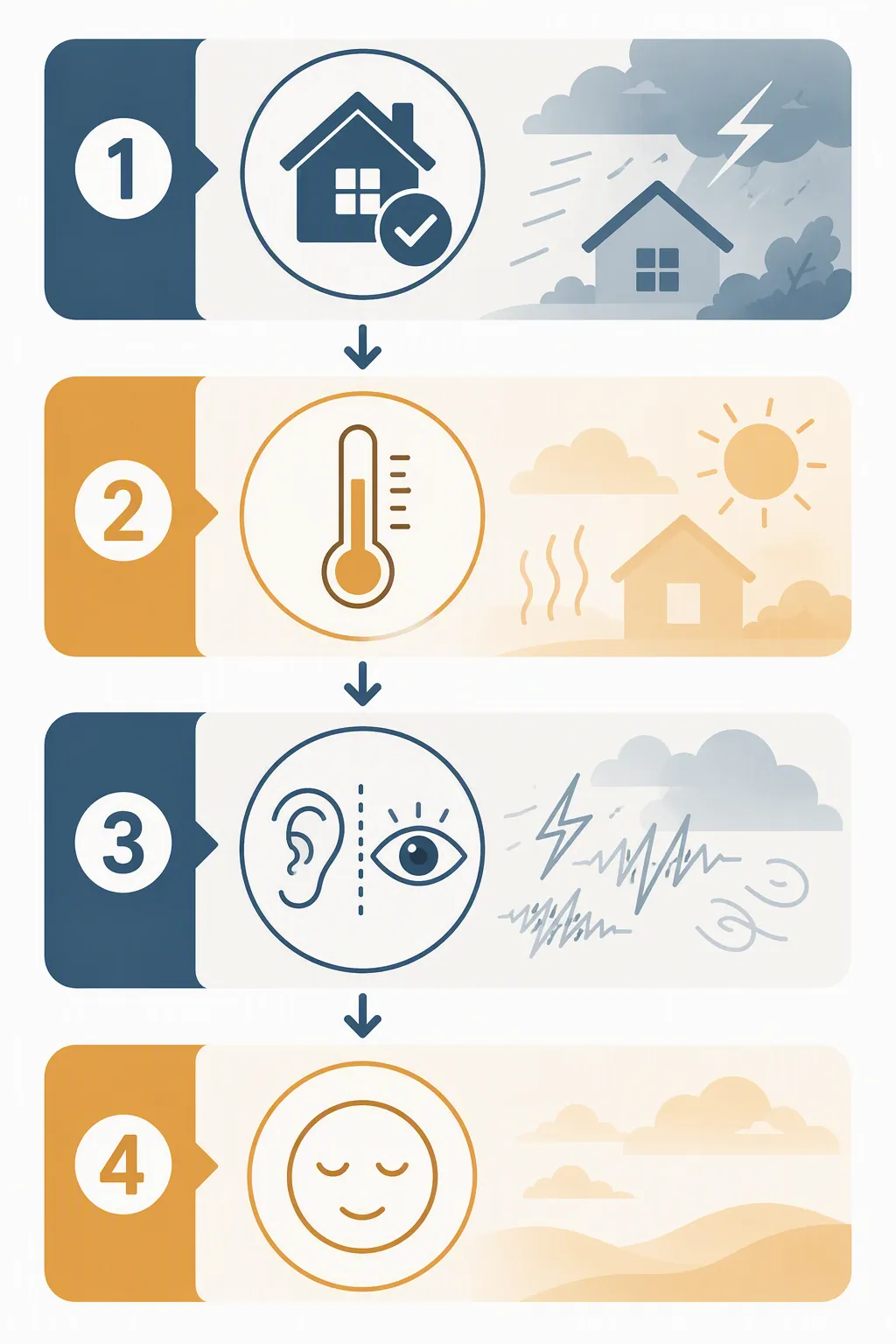
Make The Room Safe Before You Try To Make It Calm
Start with the hazards that can make sleep dangerous. If a portable generator is running, it belongs outside, at least 20 feet from windows, doors, and vents; it should never run indoors, in a garage, or in an enclosed space. A battery-powered carbon monoxide detector is part of the sleeping setup, not an optional accessory, because carbon monoxide can build while everyone is trying to rest [1].
Use battery-powered flashlights or lanterns instead of candles. The Red Cross specifically advises avoiding candles during power outages because fire risk is the wrong trade for a little softer light [2]. A lantern on the floor or nightstand gives enough visibility for bathroom trips, medication checks, and child care without adding flame to a room full of bedding, curtains, and half-awake people.
Then decide what needs attention before morning. Ready.gov says a refrigerator keeps food cold for about 4 hours during a power outage if the door stays closed; a full freezer holds temperature for about 48 hours, and a half-full freezer for about 24 hours. Food that has been above 40°F for 2 hours or more should be discarded [3]. That does not mean you need to inventory the whole kitchen at midnight. It means you should stop casual door-opening, make one plan for breakfast or medication access, and avoid turning a sleep problem into a food-safety problem.
If someone in the home uses a CPAP, oxygen-related equipment, refrigerated medication, or mobility equipment that depends on power, handle that before settling the room. A CPAP may draw roughly 30 to 90 watts, and turning off the heated humidifier can extend battery life by 3 to 5 times, according to outage-preparation guidance [4]. If insulin is in the house, temperature deserves the same practical attention: insulin can degrade above about 77°F, and inexpensive pharmacy temperature log strips can help show whether storage got too warm [5].
For a deeper safety-only version of this first pass, use Sleeping during a power outage? Start with safety. Tonight, the short version is enough: exhaust out, flame out, fridge closed, medical power accounted for, emergency contacts reachable.
Move Sleep To The Coolest Safe Place
After safety, temperature is the next thing that decides whether sleep is realistic. HealthPartners sleep psychologist James Davig, PhD, gives 68°F to 72°F as an optimal sleep range and notes that sleep can be disrupted below 65°F or above 75°F [6]. During a summer thunderstorm outage, the upstairs bedroom may trap heat long after the storm has cooled the air outside.
If the bedroom is hot, do not treat the bed as sacred. Move to the coolest safe room you can use: a downstairs room, shaded room, basement, or interior room with less sun exposure. Outage guidance notes that a basement may be 3°C to 5°C cooler than upstairs during summer outages [4]. That difference can matter more than the perfect pillow.
The goal is not to create a normal bedroom. It is to help the body shed enough heat to fall asleep. Outage guidance also notes that core body temperature must drop by about 1°C to 2°C to initiate sleep [4]. HealthPartners recommends a cool shower before bed as a way to lower skin temperature and signal the brain that it is time to sleep; a damp towel on the neck or chest can add evaporative cooling when fans and air conditioning are unavailable [6].
- Choose the lowest, coolest safe sleeping area rather than the usual room if heat is building upstairs.
- Use a light sheet or throw instead of heavy bedding; keep a warmer layer nearby in case the storm drops the temperature later.
- Take a cool shower if water service is safe and available, or use a damp towel on the neck, chest, or wrists.
- Keep windows closed if wind, rain, debris, or generator exhaust could enter; cooling is not worth bringing hazards into the room.
- Check on infants, older adults, pregnant people, and anyone with heat-sensitive medical needs before assuming everyone can tolerate the same room.
A battery fan can help if you already have one and can place it safely. If not, do not spend the night chasing airflow through unsafe windows or extension-cord improvisations. A cooler room, lighter bedding, and skin cooling usually do more good than a risky setup.
Block The Jolts, Not Every Sound
Once the room is safe and not overheated, deal with the things that keep startling the body awake: thunder peaks, lightning contrast, phone alerts, and the sudden absence of normal machine noise. This is where simple tools earn their place.
Earplugs are best used for the sharpest thunder peaks, especially if you are still able to hear required alerts through a phone, weather radio, or another adult in the home. If your usual white-noise machine is dead, a phone-based white-noise app can stand in if battery life allows. Keep the volume modest; the job is to smooth the silence between thunderclaps, not to drown out warnings.
Lightning is often less about brightness and more about contrast. A sleep mask helps some people; a dim battery lantern placed low in the room helps others because it reduces the flash-to-dark swing. During a 7-day outage described by Safe in the Seat in May 2026, battery-powered white-noise machines were identified as one of the most valued sleep items [7]. That is a useful household note: the device does not need to be fancy, but it does need to be charged before the night you need it.
For a fuller look at sound, light, and storm arousal, see Three barriers to sleeping through severe storms at night or the broader science explainer, How to Sleep Through a Thunderstorm: A Science-Based Breakdown.
Let Anxiety Come After The Practical Checks
Storm anxiety is not a character flaw, and it is not solved by pretending the storm is ordinary. The nervous system notices thunder, flickering light, weather alerts, and the sudden stop of fans and appliances. Reassurance works better after the practical risks are already handled, because the mind has fewer loose ends to keep reopening.
The National Weather Service emphasizes advance preparation: knowing the shelter location, warning sources, and family plan can reduce fear during severe weather [8]. The Anxiety and Depression Association of America gives similar storm-anxiety guidance: create a plan, accept what cannot be controlled, and limit repeated news checking [9]. In an outage bedroom, that can be as plain as deciding which alerts stay on, which app gets checked at set intervals, who wakes whom if a warning changes, and where everyone moves if sheltering becomes necessary.
There is also a small physiological wrinkle worth knowing, especially for people with sleep apnea. Harvard Health reported in 2010 on a University of Washington study of 537 sleep apnea patients that obstructive sleep apnea events increased on nights with lower atmospheric pressure, a condition that can accompany thunderstorms [10]. That does not prove every storm will worsen every person’s sleep apnea, and it is not a reason to panic. It is a reason to take CPAP battery planning seriously and to avoid dismissing storm-night sleep disruption as merely psychological.
- Check weather and outage information on a schedule rather than every few minutes, unless an alert changes.
- Keep one reliable warning source active, such as a charged phone, weather radio, or local alert system.
- Use a weighted blanket only if it is already safe and comfortable for the person using it; do not introduce it during heat, breathing difficulty, or mobility concerns.
- Give children or anxious adults a concrete job if appropriate: hold the lantern, keep the pet nearby, or listen for the next scheduled update.
- If distress becomes overwhelming, the Disaster Distress Helpline is 1-800-985-5990 [2].
If anxiety is the main sleep barrier after the room is safe, Sleep Through Thunderstorm Anxiety with These Three Room Fixes gives more room-level adjustments, while Thunderstorm Anxiety Is Wrecking Your Sleep — Here's Why goes deeper into the mechanisms.
Keep A Small Bedroom Outage Kit Where You Can Reach It
The most useful sleeping during power outage thunderstorm tips are boring before the storm and valuable after midnight. Nest Bedding’s June 2026 outage checklist includes a battery lantern, earplugs, a light throw blanket, and a written list of emergency contacts, staged in a closet or under-bed bin before storm season [11]. That is about the right scale. You are not building a bunker beside the bed; you are preventing the half-awake search through dark drawers.
| Put In The Kit | Why It Belongs There |
|---|---|
| Battery lantern or flashlight | Safe light without candle flame |
| Fresh batteries or charged power bank | Phone alerts, white noise, medical-device backup planning |
| Earplugs | Thunder peaks without blocking all awareness |
| Sleep mask | Lightning contrast and intermittent flashlight use |
| Light throw blanket | Flexible bedding when temperature changes overnight |
| Written emergency contacts | Useful when phones are low, locked, misplaced, or out of service |
| Medication and device notes | CPAP settings, battery instructions, insulin storage checks, caregiver contacts |
If the storm is part of a larger tropical system or you are planning for a specific life stage, route from here rather than trying to stretch one generic checklist too far. How to Sleep Safely During a Tropical Storm Landfall covers landfall-specific planning, and Tropical Storm Bertha Sleep for Pregnancy, Perimenopause, and ADHD points to population-specific concerns.
Once the generator, flame, food, medical-device, and heat questions are settled, sleep becomes less like a test of willpower and more like a sequence of small substitutions: a cooler room instead of the usual room, a lantern instead of a candle, earplugs instead of bracing for every thunderclap, one alert source instead of endless checking. Handle the failures in that order, and the night is still inconvenient, but it is no longer unmanaged.
References
- What to Do to Protect Yourself During a Power Outage, CDC.
- Power Outage Safety, American Red Cross.
- Power Outages, Ready.gov, June 2026.
- Ontario Guide To Sleeping During Power Outages, Mattress Miracle.
- Power Outage Safety For Seniors, PowerOutage.us.
- The Best Temperature For Sleep, HealthPartners.
- 7-Day Power Outage Sleep Lessons, Safe in the Seat, May 2026.
- Thunderstorm Safety, National Weather Service.
- Storm Anxiety Guidance, Anxiety and Depression Association of America.
- Weather and Sleep Apnea, Harvard Health, 2010.
- Power Outage Sleep Kit Checklist, Nest Bedding, June 2026.
Read the full guide: Sleeping during a power outage? Start with safety