
Sleeping during a power outage tornado watch can be reasonable, but only while it is still a watch. The National Weather Service uses a tornado watch to mean that tornadoes are possible in and near the watch area; a tornado warning means a tornado has been sighted or indicated by weather radar and that people should take shelter immediately.[1] That boundary matters more at night, because the usual safety net—TV, Wi-Fi alerts, plugged-in phones, lights, fans, and sometimes outdoor sirens—may already be gone.
So the answer is not “sure, just keep an eye on the weather.” A sleeping person is not keeping an eye on anything. The workable standard is stricter: sleep only if you have an alert that can wake you without grid power, a second alert path if the first one fails, a sleeping spot already chosen near shelter, and the basic tools to move in the dark.
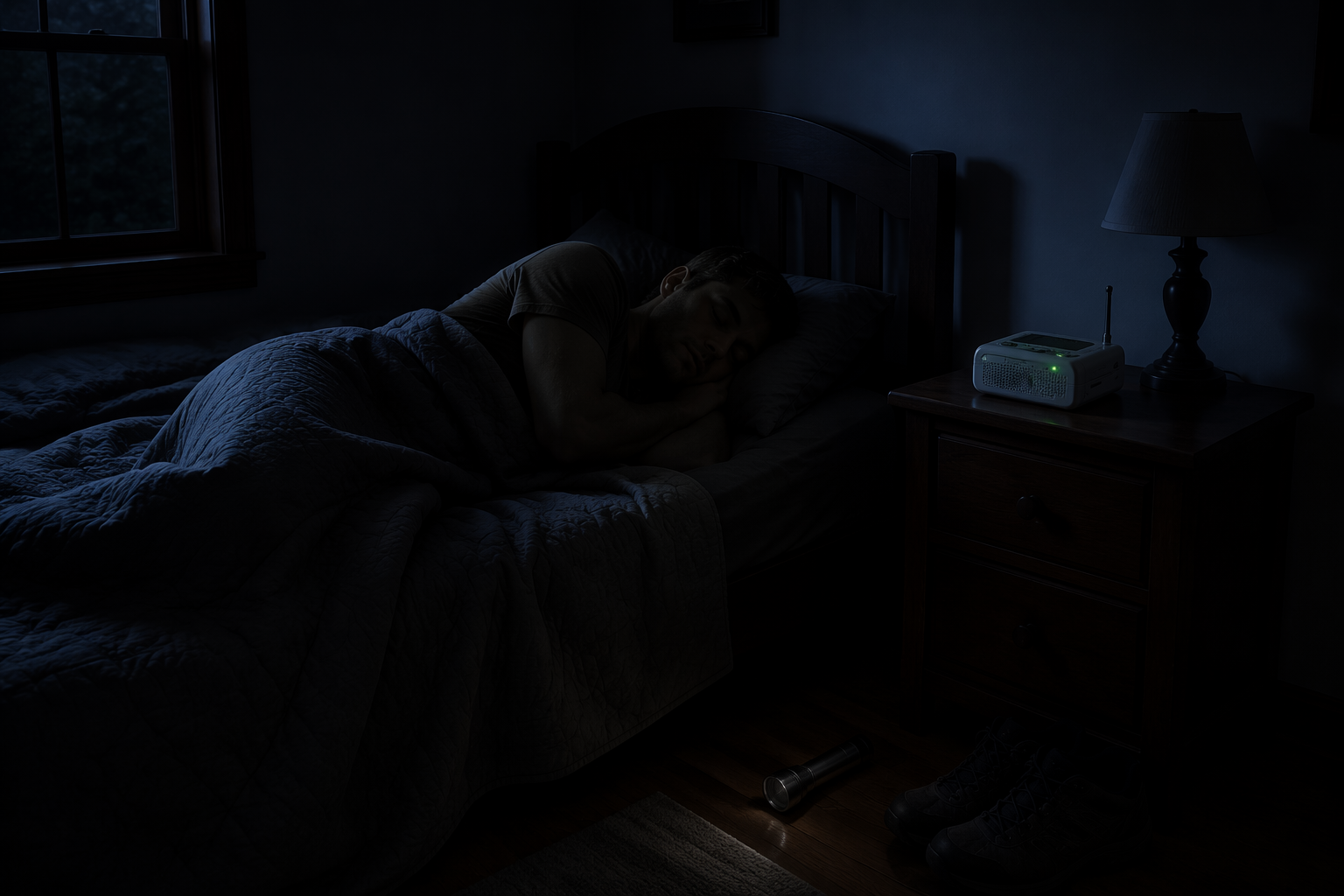
The alert stack has to work after the power fails
For an overnight tornado watch, a battery-powered NOAA Weather Radio should be the primary alert, not the decoration on the shelf. Ready.gov lists NOAA Weather Radio All Hazards as a nationwide network that broadcasts emergency information, and it also points people to Wireless Emergency Alerts on compatible phones for urgent local warnings.[2] The useful pairing is simple: NOAA Weather Radio with fresh batteries or battery backup first, WEA-enabled phone second.
That order is deliberate. A phone can be an excellent secondary alert, but it is still a battery device depending on signal, settings, and charge. Once the outage starts, you may already be rationing the phone for calls, radar checks, medical needs, or family updates. If the phone is also your alarm clock, flashlight, radio, and weather monitor, it is doing too many jobs for a night when the charger is dead.
- Set the NOAA Weather Radio to alert mode before lying down, and keep it close enough to wake you.
- Confirm the phone can receive Wireless Emergency Alerts, then take it off silent-only habits that might bury an alert.
- Charge a power bank before storms arrive, and connect the phone before sleep if the battery is low.
- Do not count on Wi-Fi-only notifications, streaming weather coverage, smart speakers, or plugged-in devices once power is out.
Outdoor sirens are not a bedroom alert system. They can be hard to hear indoors, and they are not designed to wake every sleeper in every house. If you know you tend to sleep through alarms, treat that as a planning problem before the watch begins, not as a character flaw at 2 a.m. The same issue is covered more directly in why people sleep through tornado warnings and how to fix it.
Choose the sleeping location before you are half-awake
The safest sleep plan is not just “sleep upstairs and run downstairs if needed.” It is to sleep where the warning response is short, obvious, and not dependent on lights. The American Red Cross tells people to go to a basement, storm cellar, or an interior room on the lowest floor of a sturdy building during a tornado, and to stay away from windows.[3]
If the basement is usable for sleeping, that is the cleanest answer. If not, move as close as practical to the lowest-floor interior shelter area: a hallway, closet, or bathroom without windows. The point is not comfort. The point is reducing the number of decisions between the alert and shelter. Stairs, pets, toys on the floor, locked interior doors, and a dark hallway all cost time when the warning tone has just pulled you out of sleep.
| If your normal bed is... | Better overnight watch setup |
|---|---|
| Upstairs | Sleep on the lowest floor, or stage bedding next to the lowest-floor interior shelter area |
| Near windows | Move away from glass, even if that means a less comfortable temporary sleep space |
| Far from the shelter room | Pre-position bedding, shoes, flashlight, and radio near the shelter path |
| In a mobile home | Relocate before sleeping; do not plan to ride out a warning there |
Mobile homes need their own blunt rule. During a tornado watch, the sleeping plan should be relocation to a sturdy building before the warning, not a faster dash after it. A watch is the usable window. Once a warning arrives, the time you needed to leave safely may already be gone.
Put the blackout jobs within arm’s reach
A bedside kit is not about buying the most dramatic emergency gear. It is about replacing the small things electricity normally does quietly: light the room, charge the phone, keep information flowing, and let you move without stepping barefoot through broken glass or debris. Tornado preparation guidance commonly includes a flashlight, extra batteries, sturdy shoes, a whistle, phone charging backup, and protective head covering or a helmet among practical storm supplies.[4]
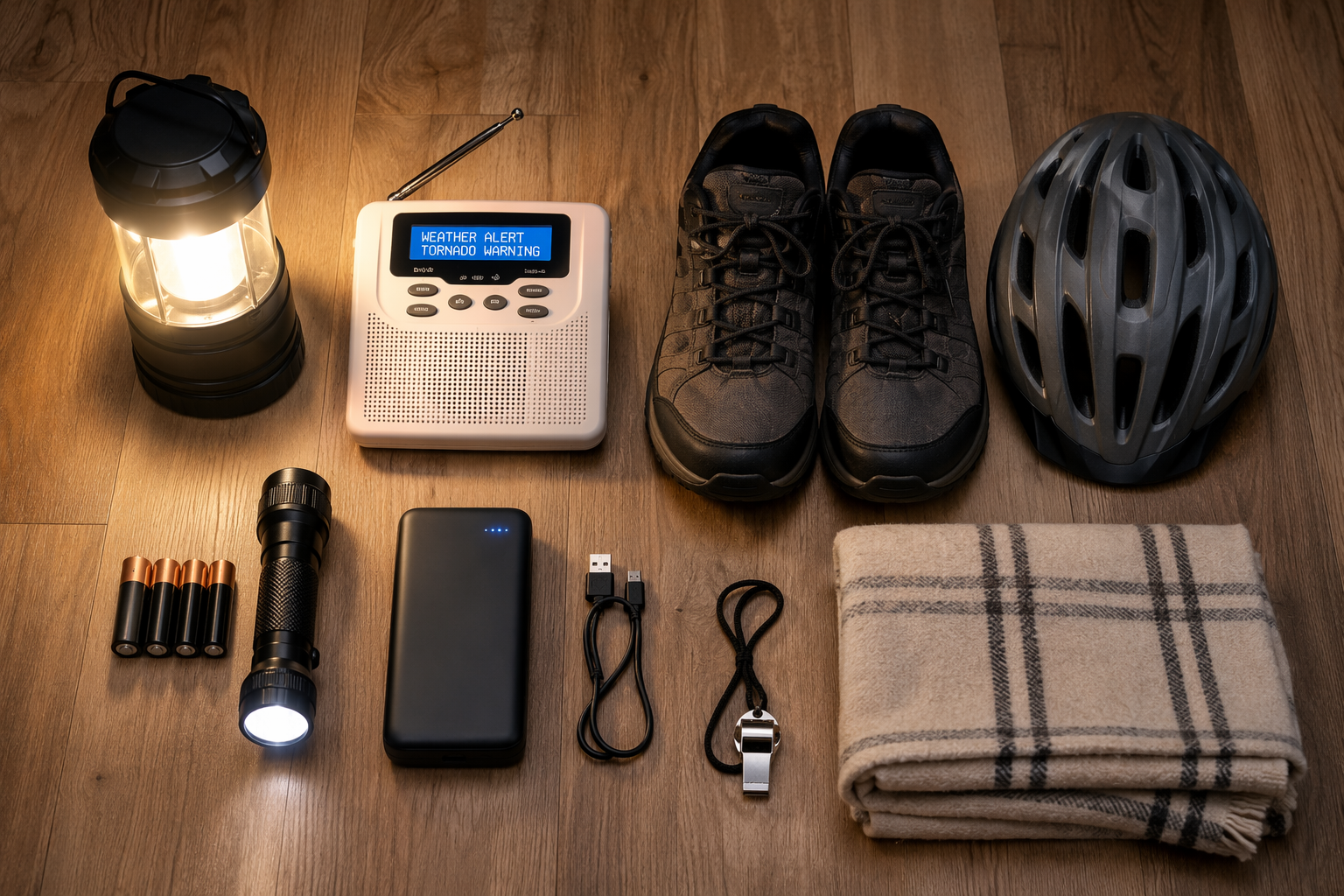
- Light: a flashlight or headlamp with fresh batteries, placed where your hand naturally reaches.
- Movement: closed-toe shoes beside the bed, not in a closet across the room.
- Alerts and communication: NOAA Weather Radio, phone, charging cable, and power bank.
- Protection: a bike helmet, hard hat, or thick padding you can grab quickly for head protection.
- Signaling: a whistle on a cord if debris, injury, or darkness makes shouting unreliable.
- Comfort buffer: a light blanket and any necessary medication or glasses you would need immediately.
Keep the kit boring and visible. If the flashlight is in a junk drawer, the shoes are under laundry, and the radio batteries are “probably fine,” the kit exists only in daylight theory. At night, the useful version is the one you can reach without standing up.
Heat, air, and food are supporting problems—not reasons to ignore the warning plan
A summer outage can make sleep genuinely difficult. HealthPartners notes that sleep can be disrupted when the room is above 75°F and that many people sleep best around 68°F to 72°F.[5] During a tornado watch, though, cooling tricks have to stay compatible with fast sheltering. Use the coolest safe room, breathable cotton or linen layers, closed blinds from earlier in the day, and a cool shower before bed if water service is normal. Do not set up a sleep space that puts you farther from shelter just because that room feels better.
Carbon monoxide is the non-negotiable outage hazard. The CDC says generators, grills, camp stoves, and similar fuel-burning devices should never be used inside a home, basement, garage, camper, or near a window, and generators should be kept at least 20 feet from windows, doors, and vents.[6] Sleeping people cannot reliably notice carbon monoxide symptoms in time, so a battery-powered or battery-backup carbon monoxide detector belongs in the overnight plan if any fuel-burning equipment is in use nearby.
Food is usually less urgent than alerts and shelter, but it still affects the night if the outage stretches on. CDC power outage guidance says food in a refrigerator is safe for up to 4 hours during a power outage if the door stays closed.[6] That does not mean standing in front of the open refrigerator every hour to inspect it. Put shelf-stable snacks and water near the bedside or shelter area so hunger does not become another reason to wander through a dark house.
CPAP, medications, and sleep aids change the margin
Anyone who depends on powered medical equipment needs a plan that exists before the outage. For CPAP users, that means knowing whether the machine can run on an appropriate backup battery or portable power station, how long the backup is expected to last under the actual settings used, and where the equipment will sit if the sleeping location moves to a lower floor. General advice to “charge everything” is too vague when breathing equipment is part of the night.
Medications, glasses, hearing aids, mobility aids, and a way to wake another person in the home should be handled with the same directness. If a warning would require help getting to shelter, decide who wakes whom and how. Do not leave that to a tired argument in the hallway.
Be careful with sedating sleep aids during severe weather. The issue is not moral toughness; it is response time. If something makes it harder to wake, hear an alert, walk safely, or make a shelter decision, it deserves extra caution on a tornado-watch night. A related severe-weather sleep discussion is available in which sleep aids are safe during a tropical storm.
When sleep is still defensible
During a tornado watch with no power, sleep is defensible only after the night has been simplified. The radio is on and able to wake you. The phone is charged or connected to backup power and able to receive emergency alerts. The sleeping spot is on the lowest floor or close to the interior shelter location. Shoes, light, phone, radio, and protection are within reach. The path to shelter is clear enough for a groggy person, not just a fully awake one.
If those conditions are not in place, the safer move is to stay awake long enough to fix them or relocate to a better sleeping setup. Severe weather affects sleep through more than noise; it changes temperature, safety, alerting, and the decisions people have to make while tired. That broader pattern is covered in how tropical storms affect sleep through four pathways, but the tornado-watch version comes down to one hard line.
A watch means conditions are favorable, so a prepared sleeper may rest. A warning means the frame has changed. Stop trying to sleep, wake the household, take the kit, and move to shelter immediately.
References
- Tornado Safety, National Weather Service
- Emergency Alerts, Ready.gov
- Tornado Safety, American Red Cross
- Tornado Preparation & Safety: Before, During & After, Survive-A-Storm
- Tips for sleeping without air conditioning, HealthPartners
- What to Do to Protect Yourself During a Power Outage, CDC
Comments
Join the discussion with an anonymous comment.