
Solo Sailor Sleep Deprivation Survival Tips
The direct answer: nap by plan, not by collapse
The shortest useful answer is this: solo and short-handed sailors do not stay safe by waiting for one perfect block of sleep. They survive by breaking sleep into short, planned naps, adding occasional full sleep cycles when conditions allow, and using alarms and watchkeeping systems so a nap does not quietly become a collision risk.
A workable offshore pattern starts with 20-minute naps for quick recovery, 90-minute sleeps when the boat and traffic picture give you enough margin, and shorter check loops when you are in busier water. The sailor’s job is not to prove endurance. The job is to wake able to steer, scan, trim, cook, reef, and make decisions without guessing at reality.
Ellen MacArthur’s often-cited solo sailing sleep pattern is useful because it is not pretty. In field data relayed through Claudio Stampi interviews and later boating sleep advice, MacArthur reportedly averaged 5.7 hours of sleep per day over 94 days at sea, divided into an average of 9.4 naps, with a mean nap length of 36.6 minutes; those figures should be treated as secondary reporting of field observations, not as a peer-reviewed table that proves every sailor can copy her pattern safely [1][2].
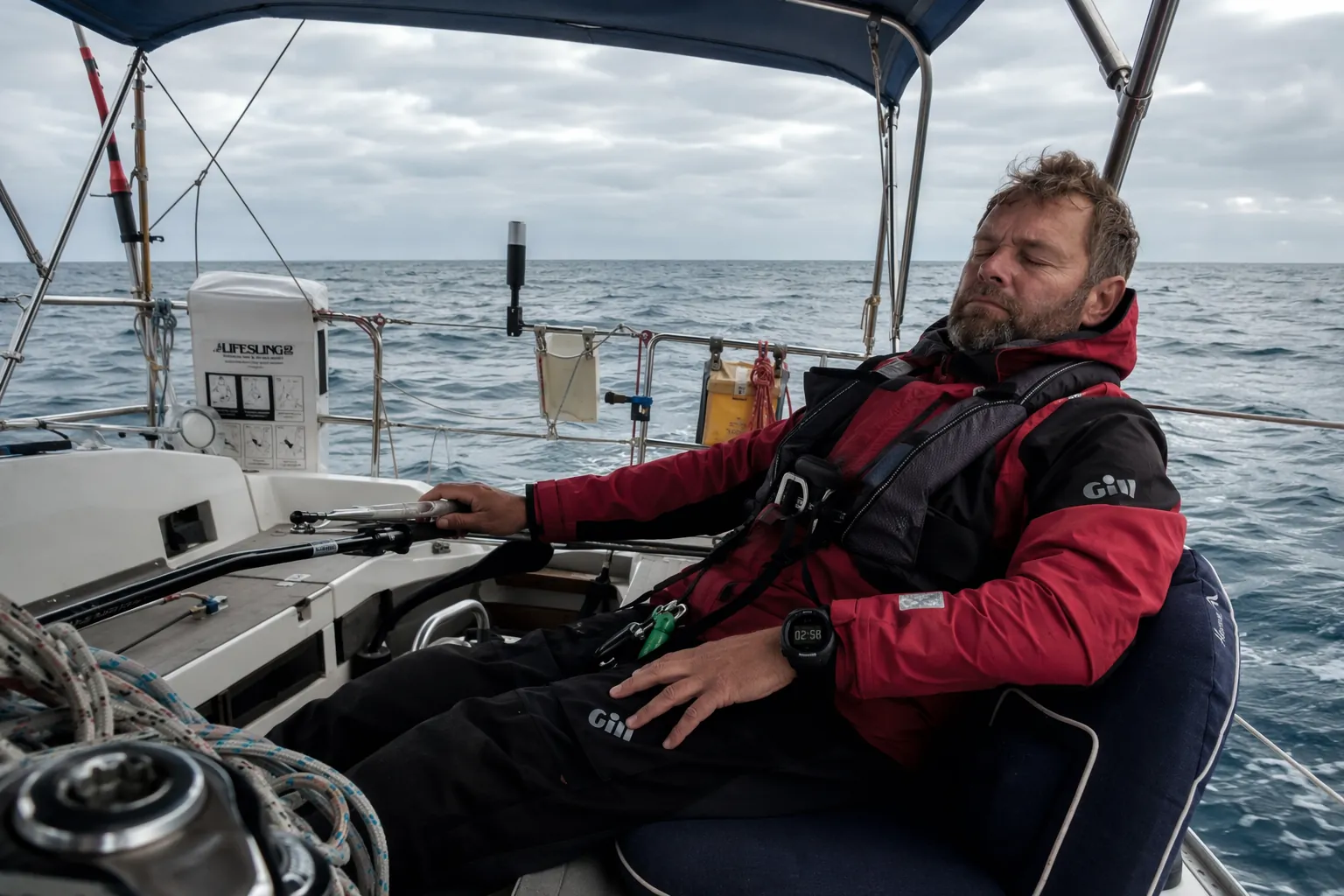
The at-sea napping protocol
Before you close your eyes, decide three things: how long this sleep is allowed to last, what will wake you, and what condition would cancel the nap. That decision has to happen before fatigue starts bargaining with you.
| Use this sleep block | When it fits | What it is meant to protect |
|---|---|---|
| About 20 minutes | Open water, stable sail plan, no immediate maneuver expected, alarms set | Alertness without dropping deeply enough to wake badly disoriented |
| About 90 minutes | Lower workload, wider sea room, steady weather, and enough confidence in alarms and traffic monitoring | One more complete sleep cycle, useful when short naps are no longer holding you |
| 30-minute nap/check loop | When conditions require frequent confirmation of course, traffic, sail trim, or weather | A hard ceiling on unattended time |
| No sleep yet | Traffic, squalls, sail changes, landfall, gear failure, or an unsettled boat | The boat’s immediate safety, even if it costs you a planned nap |
The table is deliberately plain because fatigue makes clever plans fragile. A 20-minute nap is the default tool. A 90-minute sleep is a larger withdrawal from the safety account and needs more sea room, better alarm discipline, and a calmer boat. A 30-minute check loop is not luxurious, but it gives the tired sailor a repeatable rhythm: inspect, decide, sleep, wake, inspect again.
Phil Haydon, a neuroscientist and offshore sailor, describes 20-minute naps as useful because they can provide restorative sleep while reducing the chance of waking from deeper sleep with heavy sleep inertia; he also emphasizes that solo sailors need to catch sleep opportunities when the brain is ready, rather than postponing them until the window has passed [3].
The longer 90-minute block has a different purpose. It is meant to let the brain pass through a fuller sleep cycle instead of living only on fragments. Jean-Luc Van Den Heede’s Global Solo Challenge sleep approach is described around 90-minute full sleep cycles, while Laura Dekker’s solo routine is cited as using 30-minute nap and check loops; those examples are useful because they show different answers to different workloads, not because one famous sailor’s pattern becomes a law [4].
How much total sleep should you aim for?
A solo passage does not usually give you the sleep a shore-based adult would call normal. The working target is often closer to enough sleep to keep judgment from unraveling than enough sleep to feel well. MacArthur’s reported 5.7 hours per day is a hard, disciplined number: not a boast, not a wellness target, and not proof that 5.7 hours will suit your body on your boat in your weather [1][2].
For many short-handed sailors, a practical planning range is roughly 4.5 to 5.5 hours of total sleep across a day when the sleep is distributed deliberately. That is not the same as saying the body is fully restored. It means the system is trying to preserve enough working alertness to keep the boat safe until the passage eases, the watch bill improves, or you can anchor and recover.
Count the sleep you actually get, not the sleep you intended to get. A sailor who lies down ten times and spends half of those naps staring at the cabin sole has not slept ten times. Keep a simple log: time down, time up, whether you actually slept, caffeine taken, and any waking confusion. It is dull bookkeeping. It is also how you notice, before the bad decision, that the system is failing.
The 20-minute nap and the 90-minute sleep do different jobs
Use 20 minutes when you need to wake sharp
A 20-minute nap is short enough to fit between checks and long enough to take the edge off sleep pressure. It is the nap to use when you must come back quickly to hand-steering, radar checks, squall watching, sail trim, or cooking on a moving boat. It is also the nap least likely to punish you with the thick, slow confusion that follows waking from deeper sleep [3].
Set more than one alarm. Put one where you must move to silence it. If you sleep in the cockpit, clip in and make sure your body position cannot slide you into a dangerous place. If you sleep below, know exactly what sound or display will pull you back on deck. A timer on your wrist is useful because it stays with the body that is about to become unreliable.
Use 90 minutes when the boat can spare you
The 90-minute sleep is not just a longer power nap. It is a different commitment. You use it when the sail plan is conservative, the weather picture is understood, traffic risk is low, and the boat is set up to forgive your absence for that period. It can be the difference between merely scraping through and restoring enough cognition to make the next set of decisions properly.
Do not wedge a 90-minute sleep into a place where you already know the boat needs a 20-minute check. The tired brain is good at presenting hope as seamanship. If the next squall line, shipping lane, lee shore, or gear concern is likely to demand attention, keep the sleep shorter and more frequent.
Build the day around the two low points
Adenosine is one reason sleep pressure feels cumulative: the longer you stay awake, the more the pressure builds. Circadian rhythm is the other half of the trap. Haydon points sailors toward two danger windows, roughly 3–5 a.m. and 2–4 p.m., when the body is especially prone to sleepiness [3].
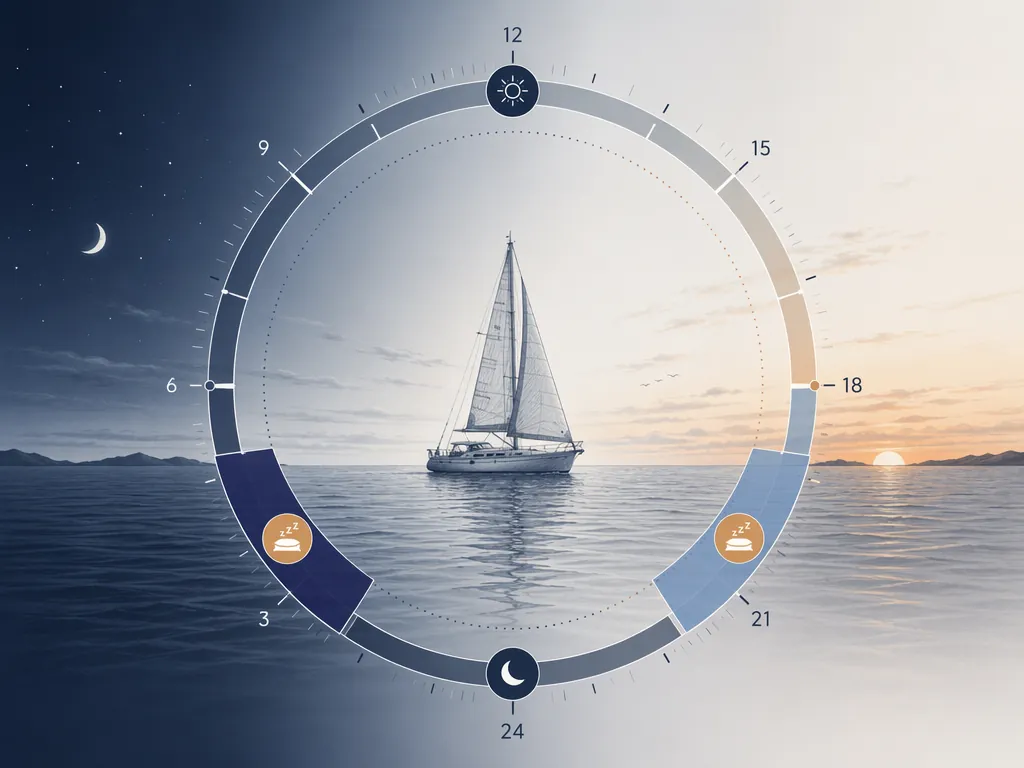
The pre-dawn low is the one that ambushes proud sailors. The boat may be settled, the horizon invisible, the sea state repetitive, and the mind too tired to generate alarm. If conditions allow, plan a nap before that window turns into an uncontrolled sleep attack. If conditions do not allow it, reduce other demands: simplify sail, eat something manageable, stand up, use light if available, and keep checks close together.
The afternoon low deserves respect too. It feels less dramatic because daylight gives the illusion of competence. If you are building a 24-hour routine, put one planned nap in the 2–4 p.m. trough when weather and traffic permit. Missing that window can leave you strangely wired later, tired but unable to sleep when the boat finally gives you permission.
That is the practical meaning of the “sleep train” advice: when the body offers a clean chance to sleep, take it. Delay can turn a useful nap into an hour of lying awake while fatigue continues to accumulate [3].
Caffeine is a tool, not a watch system
Caffeine can help you protect a watch, but it can also steal the next nap you were counting on. Haydon notes caffeine’s roughly 4-hour half-life and recommends limiting it to before noon so it does not interfere with later sleep opportunities [3].
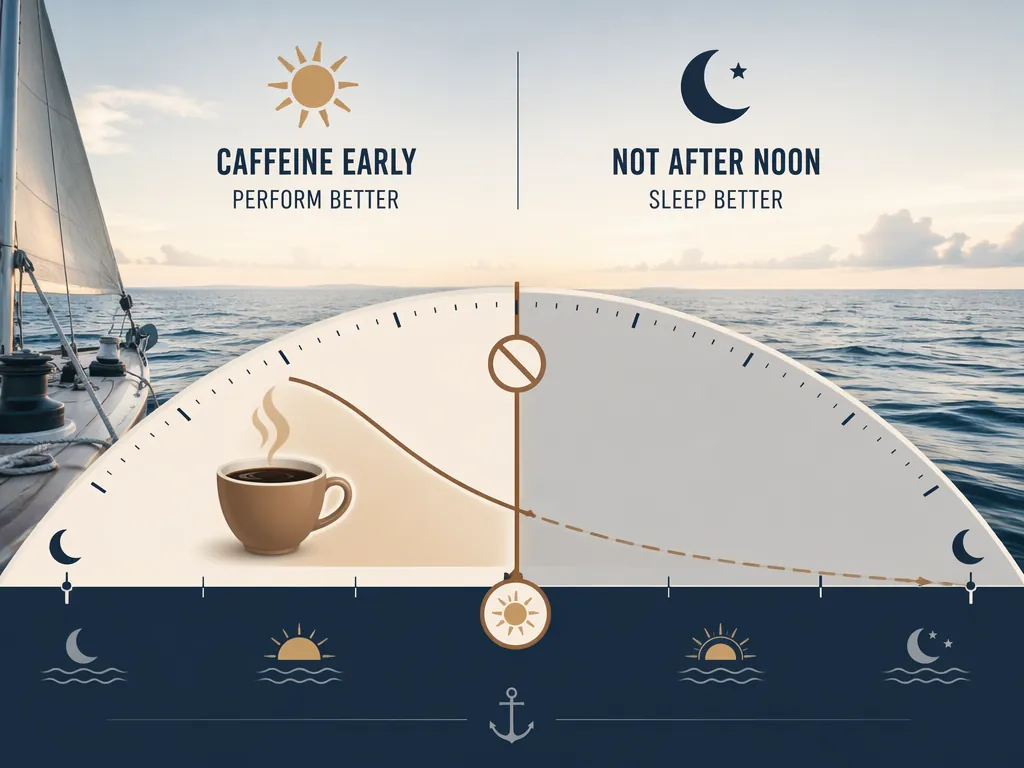
That rule is stricter than many sailors like. It is also cleaner. Morning caffeine can support the part of the day when you need to get the boat organized, inspect gear, cook, navigate, or repair something without blunting the afternoon and night nap windows. Afternoon caffeine may feel like rescue at the mug, then become sabotage at the bunk.
If you are using caffeine before a planned 20-minute nap, keep the plan simple: drink it, lie down immediately, and let the alarm end the nap before the stimulant fully takes hold. Do not use caffeine to justify extending a watch after you are already having microsleeps, seeing things that are not there, or forgetting the last check you made.
The first 3–4 days are the adaptation problem
Polyphasic sleep is not usually something the body accepts politely on the first night. Both Haydon’s napping guidance and the Global Solo Challenge discussion describe an adaptation period of about 3–4 days, with individual variation [3][4]. Some sailors settle into the rhythm sooner; others struggle to sleep on command, wake badly, or accumulate a dangerous deficit before the system starts working.
That matters because many coastal sailors begin a passage already short on sleep from provisioning, weather planning, last-minute repairs, and departure nerves. Starting a multi-day solo leg tired and then asking your brain to learn a new sleep architecture offshore is poor preparation. Practice the pattern before the passage. Learn whether 20 minutes actually wakes you cleanly, whether 30-minute alarms make you complacent, and whether a 90-minute sleep leaves you groggy or functional.
Practice does not need to imitate an ocean race. A safer rehearsal can be as modest as testing nap timing during a benign overnight, while another competent person is available or while the boat is in a controlled setting. The point is to discover your sleep inertia, alarm weaknesses, and caffeine sensitivity before the only witness is the autopilot.
Set the boat up as if you will become impaired
A tired sailor needs systems that assume failure, not systems that depend on pride. Before each nap, the boat should be made boring: conservative sail, clear cockpit, known traffic picture, alarms active, timer set, body secured, and the next required action written down if there is any chance you will wake confused.
- Use at least two wake-up methods: for example, a wrist timer plus a separate alarm placed out of reach.
- Before sleeping, scan the horizon, instruments, weather, sail trim, bilge concerns, and any gear that has been making noise or changing behavior.
- If using radar, AIS, depth, or wind alarms, set them deliberately rather than trusting yesterday’s settings.
- Write the next wake-up task in plain words: “check reef line,” “scan port quarter,” “plot position,” or “heat food.”
- After waking, do not make a major navigation or sail decision in the first confused seconds unless the boat is in immediate danger.
The written note is not theatrical. Sleep inertia can leave a competent sailor awake but not yet properly online. A note gives the waking brain a handhold. So does a fixed wake sequence: silence alarm, sit up, clip in or confirm you are clipped, drink water, check course and traffic, check sail plan, then decide whether to sleep again.
What to do when the protocol starts failing
There are warning signs that should change the passage plan, not become stories for the bar. Uncontrolled microsleeps, repeated alarm failures, waking without knowing where you are in the watch cycle, seeing or hearing things that are not there, and making the same check twice because you cannot remember the first one all mean the margin is going.
Haydon’s account is valuable here because he does not leave hallucinations as an abstract fatigue warning. He describes hallucination experiences during solo passages, which makes the neurological strain concrete enough to respect without exaggerating it [3]. If your brain is generating false information at sea, the answer is not to argue with it. The answer is to reduce demands on the system.
- Shorten the watch loop until you have rebuilt confidence in waking and checking.
- Reduce sail earlier than you would if fully rested.
- Avoid optional tasks: no elaborate cooking, non-urgent repairs, or unnecessary sail changes.
- If conditions permit, take a full 90-minute sleep cycle rather than stacking more broken fragments.
- If coastal options, crew help, heaving-to, slowing down, or seeking safer water are available, consider them seamanship rather than defeat.
Sleep inertia deserves its own suspicion. The dangerous moment may not be when you are asleep; it may be the minute after you wake, when the alarm is silent and you believe you are ready. Build a delay into non-urgent decisions. Let the first minute be for orientation and checks, not interpretation.
Polyphasic sleep is an emergency operating method, not a loophole
Polyphasic sleep can keep a solo or short-handed sailor functioning when the sea does not offer a normal night. The better examples are disciplined, repetitive, and unromantic: many short naps, occasional full cycles, strict alarms, caffeine used early, and a willingness to simplify the boat before the sailor becomes unreliable.
It is not harmless just because it is survivable. Use the protocol when offshore conditions demand it, practice before relying on it, and build redundant safety systems around the assumption that you will be impaired at some point. Treat hallucinations, sleep inertia, missed alarms, and uncontrollable microsleeps as instructions to reduce load or seek safer conditions, not as evidence that you are tough enough to continue unchanged.
References
- Cat napping the key to solo cruising — Soundings Online
- Importance of Sleep While Boating (and How to Do It Safely) — DAN Boater
- Sleep While Sailing Solo Offshore – A Brain-Based Guide to Napping — Phil Haydon, Ph.D., Tufts University, November 24, 2021
- Polyphasic sleep management: solo, double-handed and crewed — Global Solo Challenge