
Staged sleep strategies for tornado disaster insomnia relief
If you survived a tornado and cannot sleep tonight, that does not mean you are handling it badly. Your sleep has three things working against it at once: the place you are trying to sleep may not feel safe, your nervous system may still be scanning for danger, and the usual cues that tell your body “night is here” may have been wiped out. The answer is staged: first remove the most immediate barriers, then calm the high-alert body, then rebuild a few sleep anchors.
| When | Main sleep problem | What to do first |
|---|---|---|
| First 72 hours | Noise, light, crowding, unsafe-feeling rooms, damaged-home uncertainty | Choose the safest-feeling sleep spot, reduce light and noise, protect medical sleep needs, take rest in fragments if that is all available |
| First 1–2 weeks | Hypervigilance, replaying the event, waking at every sound | Use grounding, slow breathing, progressive muscle relaxation, and one trusted person or check-in plan |
| Week 2 onward | No regular wake time, nonstop updates, no bedtime cues | Rebuild one or two schedule anchors, especially a consistent wake time, and limit disaster scrolling before sleep while keeping essential alerts on |
First 72 hours: make sleep possible, not perfect
In the first few nights after a tornado, the goal is not an ideal bedroom. It is a sleepable patch of space. If you are in a shelter, on a relative’s couch, in a car, or inside a damaged home, start with safety and sensory control before you worry about bedtime routines.
Pick the place that feels safest, even if it is not the quietest or most “normal” place to sleep. For some people that means a cot near an exit, a spot beside a family member, an interior room away from broken windows, or a couch where another adult is awake nearby. The nervous system takes information from the room. If your chosen spot reduces the feeling that you have to keep watch, it is doing useful sleep work.
- Block light in crude ways if necessary: an eye mask, a folded shirt over the eyes, a brimmed cap pulled low, or turning your cot away from floodlights. Disaster sleep guidance specifically names eye masks and earplugs as practical tools when the sleep environment is disrupted. [1]
- Reduce noise without cutting yourself off from safety: foam earplugs in one ear, one earbud with calm audio, a towel under a rattling door, or sleeping closer to the person who is monitoring alerts. You do not have to choose between silence and vigilance.
- Make the sleep surface less hostile: layer a blanket under your hips or shoulders, roll clothing into a neck support, put shoes and essentials in the same reachable place each night, and keep a small path clear so you are not waking up disoriented.
- If you use CPAP or another sleep-related medical device, treat power and backup access as part of sleep safety, not as an optional comfort. Sleephealth.org’s disaster sleep guidance includes planning for CPAP backup power and related supplies. [1]
- Let rest count even when sleep is broken. In the acute phase, a 30-minute doze, lying still with eyes covered, or sitting quietly with your body supported may be the only rest available. Take it.
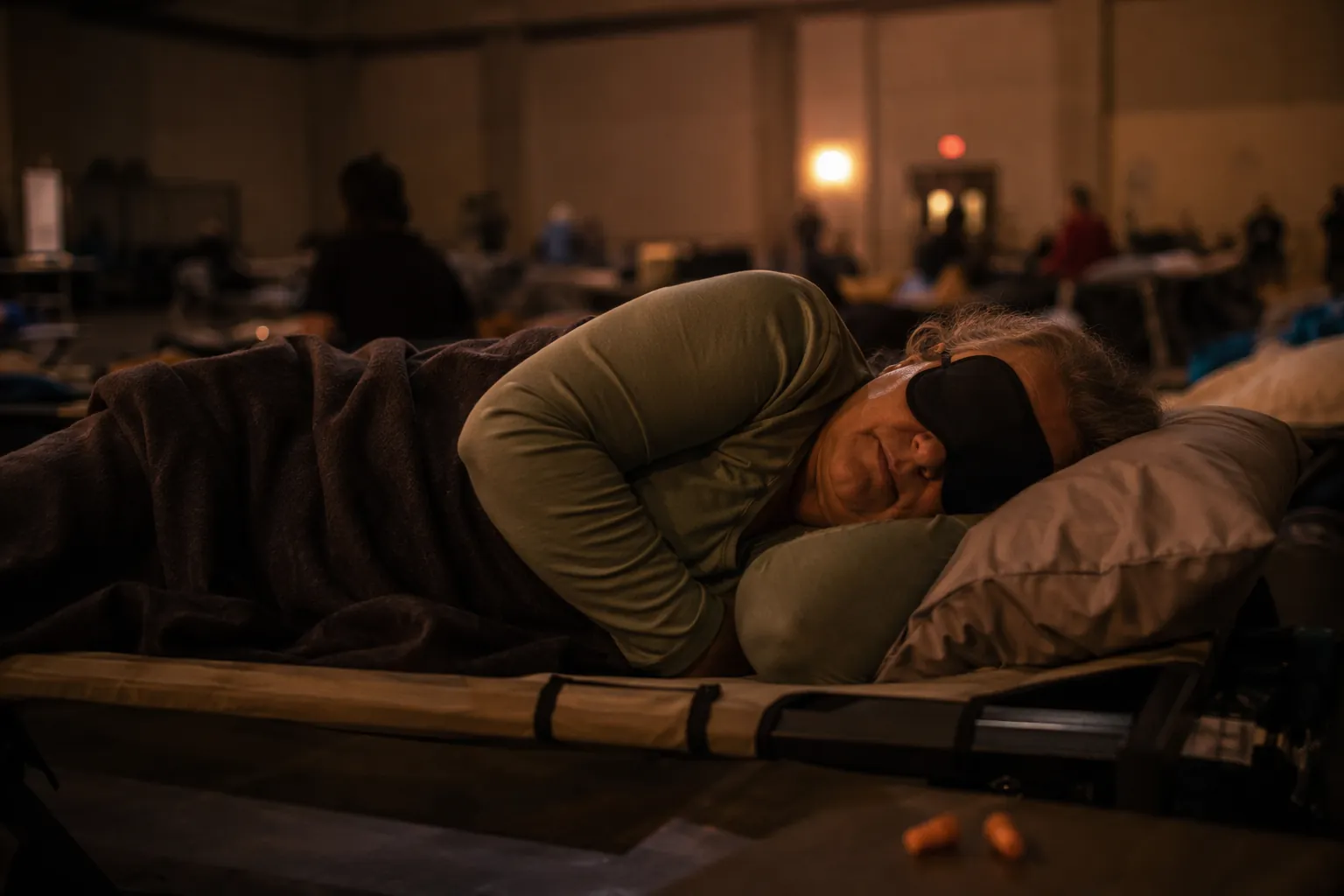
If you are in a shelter
Shelters are often bright, public, and noisy. That is not a personal sleep failure; it is a hard environment. If staff allow it, turn the cot so your face is away from the main walkway. Put bags where they create a small visual boundary without blocking anyone’s path. Ask whether there is a quieter area for families, older adults, people with medical devices, or anyone who has gone multiple nights with almost no sleep.
If you are in a damaged home
Do not make yourself sleep in the old bedroom just because it used to be your bedroom. If the room now makes you listen for creaks, leaks, glass, wind, or roof sounds, it may keep your body on guard. A temporary sleep spot that feels more protected can be the better choice while repairs, inspections, and cleanup are still unsettled.
If your phone is your weather monitor
Keep essential alerts on. Charge the phone where you can reach it. If another trusted person can monitor alerts for part of the night, use that help. What you are trying to avoid in the first 72 hours is not necessary information; it is the half-awake loop of radar, damage videos, comments, and new images that keeps the body re-entering the disaster.
Basic disaster self-care guidance also emphasizes immediate needs such as rest, connection, and pacing yourself after the event. That can sound obvious until you are the person who has spent all day calling insurance, checking on neighbors, and moving debris. Sleep may need to be protected as a recovery task, not something that happens after every other task is finished. [2]
First 1–2 weeks: calm the body that keeps waiting for the next siren
After a tornado, the body may treat ordinary nighttime sounds as warnings. Wind against a window, a truck outside, a generator starting, rain on a roof, or an emergency vehicle nearby can pull you awake before you have formed a thought. That is hyperarousal: the alarm system is doing its job too broadly and too late into the night.
You cannot argue a threatened body into sleep by telling it to relax. You have to give it repeated physical evidence that this moment is different from the tornado. Grounding, slow breathing, muscle relaxation, and steady human contact work best when they are treated as signals to the body, not as tests of willpower.
Use 5-4-3-2-1 grounding when sounds trigger alarm
When you wake suddenly or feel yourself replaying the tornado, name the present room through your senses. Keep it plain and concrete:
- 5 things you can see: ceiling tile, chair, blanket, shoes, exit sign
- 4 things you can feel: cot fabric, sock seam, floor under your feet, your hand on your chest
- 3 things you can hear: a fan, someone shifting, distant traffic
- 2 things you can smell: soap, coffee, rain, dust, laundry
- 1 thing you can taste or one sentence you can say: “I am here now.”
The point is not to make the memory disappear. The point is to pull attention back to the current shelter, living room, car, or hallway long enough for the alarm response to drop a notch.
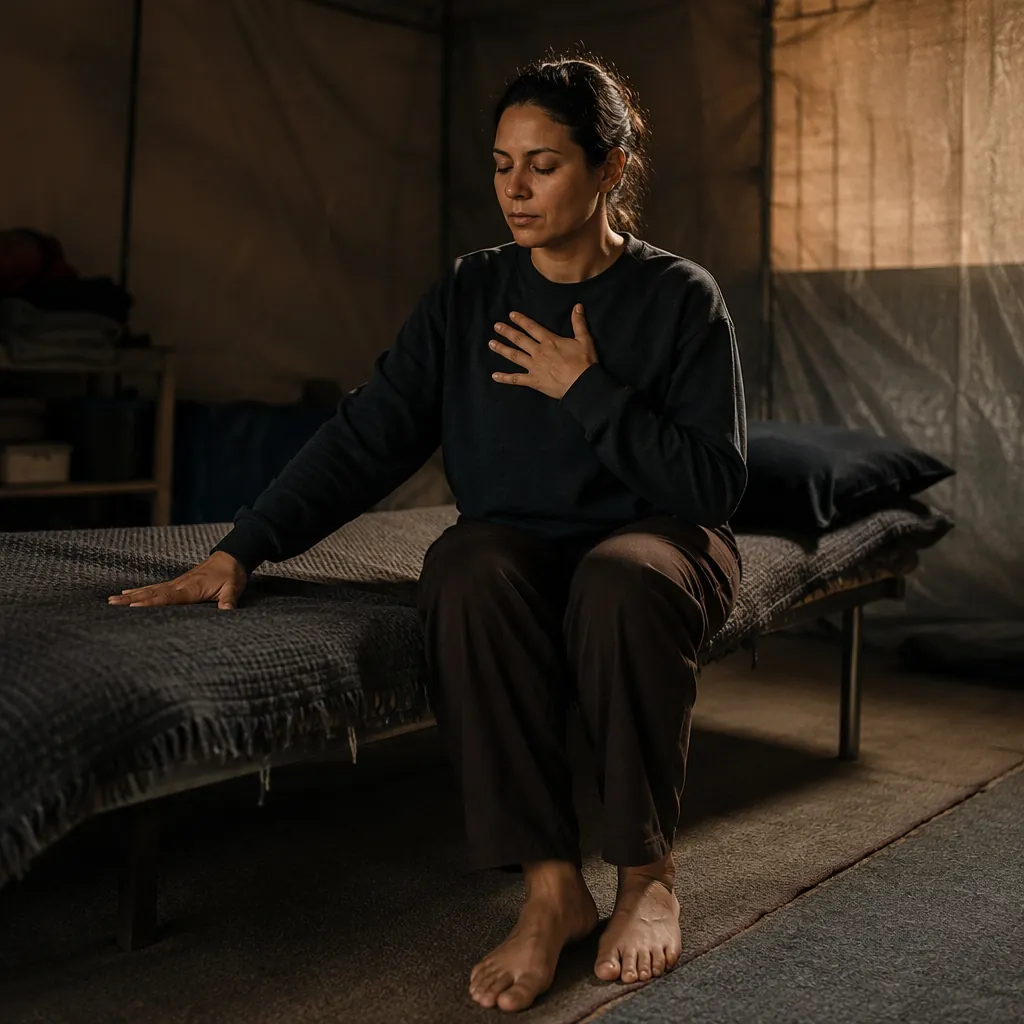
Try slow breathing, but keep it modest
Use a breathing rhythm that does not feel like effort. One simple version is to inhale gently, then exhale a little longer than you inhaled. Do that for a few minutes, not for an hour. If counting makes you more tense, stop counting and put one hand on the belly or ribs instead. The useful part is the slower exhale and the repeated message that you are not currently running, bracing, or taking cover.
Use progressive muscle relaxation when your body will not unclench
Start with areas that are easy to notice: feet, calves, hands, shoulders, jaw. Tense one area gently for a few seconds, then release it. Move through only a few body parts if you are exhausted. After disaster, many people lie down with the muscles still acting as if they need to move fast. Brief tension-and-release gives the body a clearer contrast between readiness and rest.
Let another person help your sleep feel safer
A trusted person nearby can be a sleep intervention. That may mean sleeping in the same room as family, asking a neighbor to text after the weather check, taking turns monitoring alerts, or telling shelter staff that you are struggling to sleep and need a calmer spot if one exists.
This is not just emotional comfort. In a study of 1,358 Korean disaster victims, social support significantly predicted better post-disaster sleep quality; the disasters studied included typhoons, heavy rains, fires, and earthquakes, not tornadoes specifically, so the finding should be read as broader disaster evidence rather than tornado-specific proof. [3]
How common is insomnia after a tornado?
Common enough that it should not surprise you, and serious enough that it should not be brushed off. In a 2022 study of 468 rural Chinese survivors of a 2021 tornado, 65.6% of those diagnosed with PTSD reported trouble falling or staying asleep. The same study’s PTSD prevalence estimates may not transfer neatly to U.S. tornado survivors, but the sleep symptom finding fits the broader pattern that trauma and insomnia often travel together. [4]
Another tornado-related study, a cross-sectional sample of 183 tornado-affected construction workers, found that 41.6% met insomnia criteria. That is a worker-specific sample, not a measure for every survivor, but it is a useful warning against treating post-tornado sleeplessness as rare or minor. [5]
These numbers are not there to label you. They are there to make the experience less lonely. A body that has just lived through danger may keep protecting you after the danger has passed. The problem is that you still need rest to make calls, clean up, drive safely, care for children or older relatives, and face the next day.
Week 2 onward: rebuild only the sleep cues you can actually keep
Once the first shock has shifted into temporary living, cleanup, paperwork, or repairs, sleep often needs a different kind of help. The room may still be wrong. The bedtime may still be irregular. That is why the anchor should be small enough to survive real conditions.
- Choose a consistent wake time before you choose a perfect bedtime. Wake time is often the one schedule cue you can control even when the evening is taken over by phone calls, insurance forms, supply runs, or staying with family.
- Create a short “sleep is next” ritual that works anywhere: wash face, take medication if prescribed, plug in phone, set alerts, put shoes and keys in the same place, cover eyes, start the same calm audio. It can take five minutes.
- Separate essential alerts from disaster scrolling. Keep weather and emergency notifications on, but set a last intentional update check before trying to sleep. Disaster-related news and social media consumption has been linked with worse PTSD, depression, and anxiety symptoms in disaster mental-health reporting citing recent research. [6]
- If you nap, make it recovery sleep rather than escape into an all-day schedule. A short nap may help after a sleepless night; repeated long daytime sleep can make the next night harder once immediate crisis conditions start easing.
The phone rule deserves some care. People who have just survived a tornado are not being unreasonable when they want updates. The problem is the endless feed right before sleep: fresh images, new warnings from outside your area, arguments in comments, and repeated video of destruction. Your body may read all of it as evidence that the emergency is still happening.
When post-tornado insomnia needs more help
Get extra help sooner if you feel unable to function, cannot sleep for multiple nights, are having panic symptoms that feel unmanageable, are using alcohol or other substances to force sleep, or feel at risk of hurting yourself or someone else. Mississippi State Extension’s tornado stress guidance notes that people should seek professional help if stress reactions do not improve after a couple of weeks or interfere with daily life. [7]
For insomnia that persists beyond the acute disaster phase, cognitive behavioral therapy for insomnia, or CBT-I, is the evidence-based pathway to ask about. The VA National Center for PTSD reports that about 7 out of 10 people who complete CBT-I have durable sleep improvement six months later. [8]
If local appointments are hard to get because clinics are disrupted, transportation is limited, or you are displaced, digital CBT-I may be worth asking about. A randomized trial reported at World Sleep 2019 found that online CBT-I improved PTSD, insomnia, and depression symptoms in evacuees from the Fort McMurray wildfire; that is not a tornado study, but it is relevant to disaster displacement and access problems. [9]
If distress feels immediate or unsafe, contact the Disaster Distress Helpline at 1-800-985-5990. [10] After a tornado, sleep relief is not about recreating a perfect bedroom. It is about removing the barriers that are keeping you awake tonight, giving a threatened body repeated proof that this moment is safer, and rebuilding enough cues that sleep has somewhere to land.
References
- How to Manage Your Sleep During and After a Disaster, ASAA/Sleephealth.org
- Self-Care After Disaster Events, VA
- Sleep Problems among Disaster Victims, PMC, 2021
- Prevalence and correlates of PTSD in tornado-affected rural residents, PMC, 2022
- Tornado-affected construction workers insomnia, ResearchGate, 2023
- Taking Care of Your Mental Health After a Natural Disaster, Healthline
- Coping with Stress after a Tornado, Mississippi State Extension
- Sleep Problems and PTSD, VA National Center for PTSD
- Online Cognitive Behavioral Therapy Improves Sleep, PTSD in Evacuees of Natural Disasters, Neurology Advisor
- Disaster Distress Helpline, Disaster Distress Helpline
Read the full guide: Why Power Restoration Disrupts Sleep More Than the Outage