
How a Subpotent Levothyroxine Dose Causes Fatigue and Poor Sleep
Yes. A subpotent levothyroxine dose—or a dose that becomes effectively too low because it is not being absorbed well—can plausibly cause both daytime fatigue and poor sleep. The important next question is whether your pattern looks like under-replacement, or whether another sleep problem is overlapping with your thyroid treatment.
That can sound like a single neat explanation. In real life, it usually needs a short clinical check: TSH, dosing consistency, absorption timing, and the actual sleep pattern. A person who sleeps nine hours and wakes up heavy, cold, and unrested is not describing the same thing as someone who wakes at 3 a.m. with heat, anxiety, and then chills.

What a too-low levothyroxine exposure can feel like
Levothyroxine replaces thyroid hormone. When the exposure is too low for your body—because the tablet is understrength, the prescribed dose is too low, doses are missed, or absorption is reduced—the result can look less like ordinary tiredness and more like an energy system that will not restart.
That matters because thyroid hormone helps regulate cellular energy production. Under-replacement can slow mitochondrial energy metabolism, so the body has less usable energy even after a full night in bed. The person may respond by sleeping longer, napping more, cancelling exercise, or going to bed earlier, yet still wake up unrefreshed.
Prospective data support the basic fatigue link, while also showing why it should not be oversimplified. In a 2023 prospective study of 92 patients, levothyroxine treatment reduced fatigue frequency from 45.7% to 26.1% after 6 months, but more than a quarter of patients still had clinically significant fatigue. Pretreatment TSH correlated with fatigue severity, while diabetes and pretreatment fatigue severity were the strongest risk factors for persistent fatigue, not TSH alone [1].
Sleep is part of the same picture. A systematic review in Frontiers in Endocrinology reported that hypothyroidism, including subclinical hypothyroidism, is associated with longer sleep latency, shorter sleep duration, and lower sleep satisfaction; the same review notes clinical overlap with insomnia, restless legs syndrome, and obstructive sleep apnea [2]. A more recent systematic review also aligns low thyroid hormone states with circadian rhythm disruption [3].
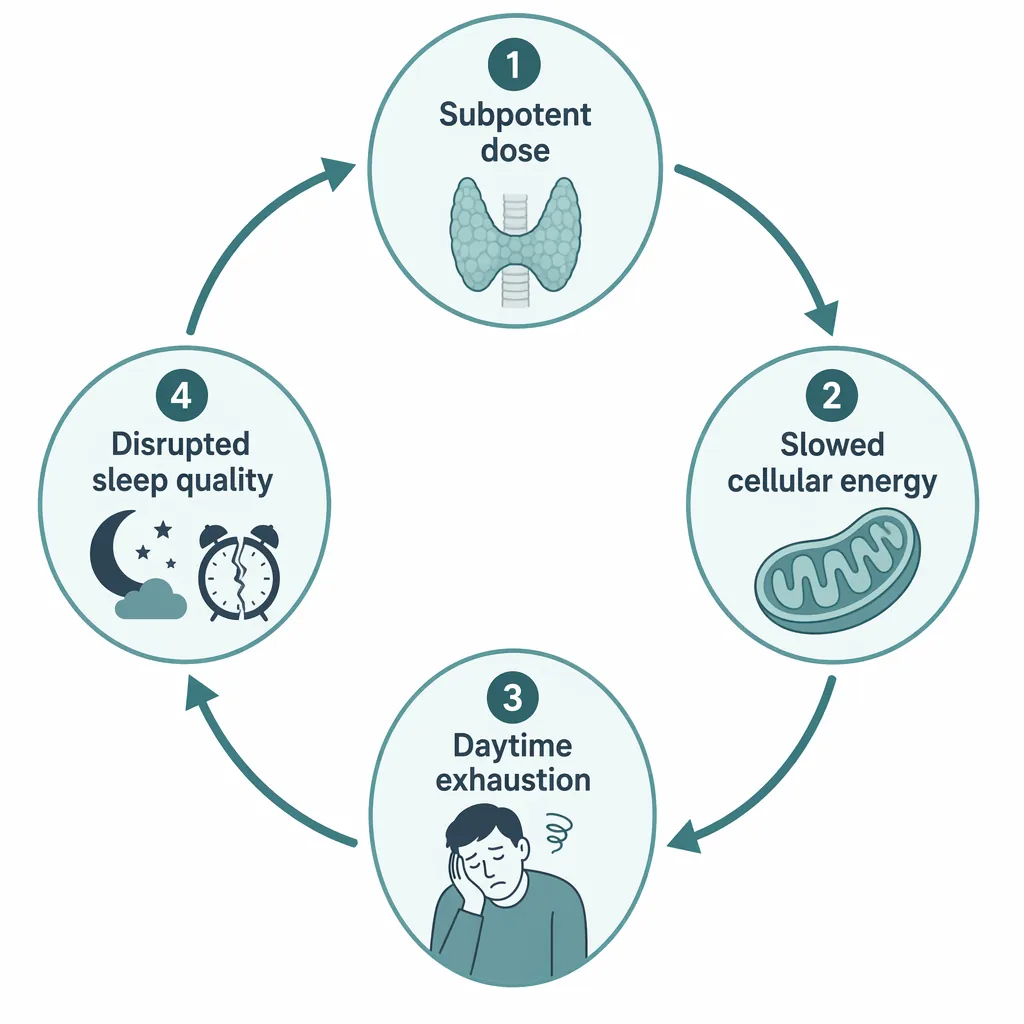
No study in the research base neatly isolates “subpotent tablet or too-low exposure → sleep disruption” as its own standalone question. The practical case is assembled from connected evidence: thyroid status correlates with fatigue, hypothyroidism is associated with poorer sleep measures, and levothyroxine exposure can be reduced by dose strength, timing, and absorption. That is enough to investigate, but not enough to assume every bad night is a thyroid-dose problem.
The quickest triage path
| If this is your main pattern | It may point toward | What to check next |
|---|---|---|
| Sleeping longer than usual, waking unrefreshed, persistent cold, heavy daytime fatigue | Possible under-replacement or reduced levothyroxine absorption | TSH and free thyroid labs as your clinician recommends; dose timing; missed doses; coffee, calcium, iron, or other absorption issues |
| Loud snoring, witnessed pauses, morning headaches, dry mouth, sleepiness despite adequate thyroid treatment | Possible obstructive sleep apnea, with or without thyroid contribution | Sleep-apnea screening or sleep study discussion |
| Urge to move the legs at rest, worse in the evening, sleep delayed by leg discomfort | Possible restless legs syndrome or RLS-like symptoms overlapping with thyroid disease | Iron status and sleep evaluation; thyroid treatment adequacy |
| Waking in the middle of the night with heat, sweating, racing feelings, then chills | Perimenopausal sleep disruption may fit better than hypothyroid sleepiness | Cycle history, vasomotor symptoms, thyroid labs if symptoms overlap |
| Persistent fatigue despite improved TSH, especially with thirst, urination changes, blood-sugar concerns, or known diabetes | A non-thyroid fatigue driver may be contributing | Diabetes or metabolic follow-up with a clinician |
The first row is the one most consistent with a subpotent or effectively too-low levothyroxine exposure. The remaining rows are there because thyroid symptoms and sleep disorders often sit on top of each other. Treating one does not automatically rule out the other.
Why “I take it every day” still may not mean “I absorb the same dose”
Levothyroxine is unusually sensitive to consistency. Two people can take the same labeled dose and absorb different amounts, and one person can change their effective dose by changing breakfast, supplements, or timing.
Clinical thyroid guidance notes that levothyroxine absorption can vary by 20–30% between individuals. Coffee can reduce absorption, and calcium carbonate can reduce absorption by nearly a third [4]. That does not make coffee or calcium “bad”; it means they need to be separated from levothyroxine in the way your clinician or pharmacist recommends.
- Taking levothyroxine with coffee instead of water
- Taking calcium carbonate, iron, or multivitamins too close to the dose
- Switching brands or formulations without follow-up labs
- Missing doses and then trying to “catch up” without medical guidance
- Changing the dosing time after years of a stable routine
A real subpotency event can also lower exposure. The 2025 Accord/Intas levothyroxine subpotency recall is one visible example, but it should not become the whole explanation for persistent fatigue. If that recall is relevant to your prescription history or life stage, see How the Levothyroxine Recall Disrupts Sleep Differently by Life Stage. For most people, the immediate question is still simpler: what was your recent TSH, and has anything changed in the way the medication reaches your bloodstream?
The thyroid-fatigue sleep pattern is usually not subtle
Under-replacement often produces an excessive-sleep-need pattern. The person may need 8–10 hours and still feel as if they are moving through wet cement. They may be cold in a central, relentless way—cold from the inside rather than briefly chilled after sweating. Concentration is slower. Mornings are punishing. Rest helps a little but does not restore.
Poor sleep can then become a consequence of the fatigue itself. Exhaustion can push someone to nap late, spend more time awake in bed, reduce daytime light and movement, and feel wired with worry at night because the day’s basic tasks were not finished. In that loop, bedtime advice may help at the edges, but it will feel inadequate if the upstream hormone exposure is too low.
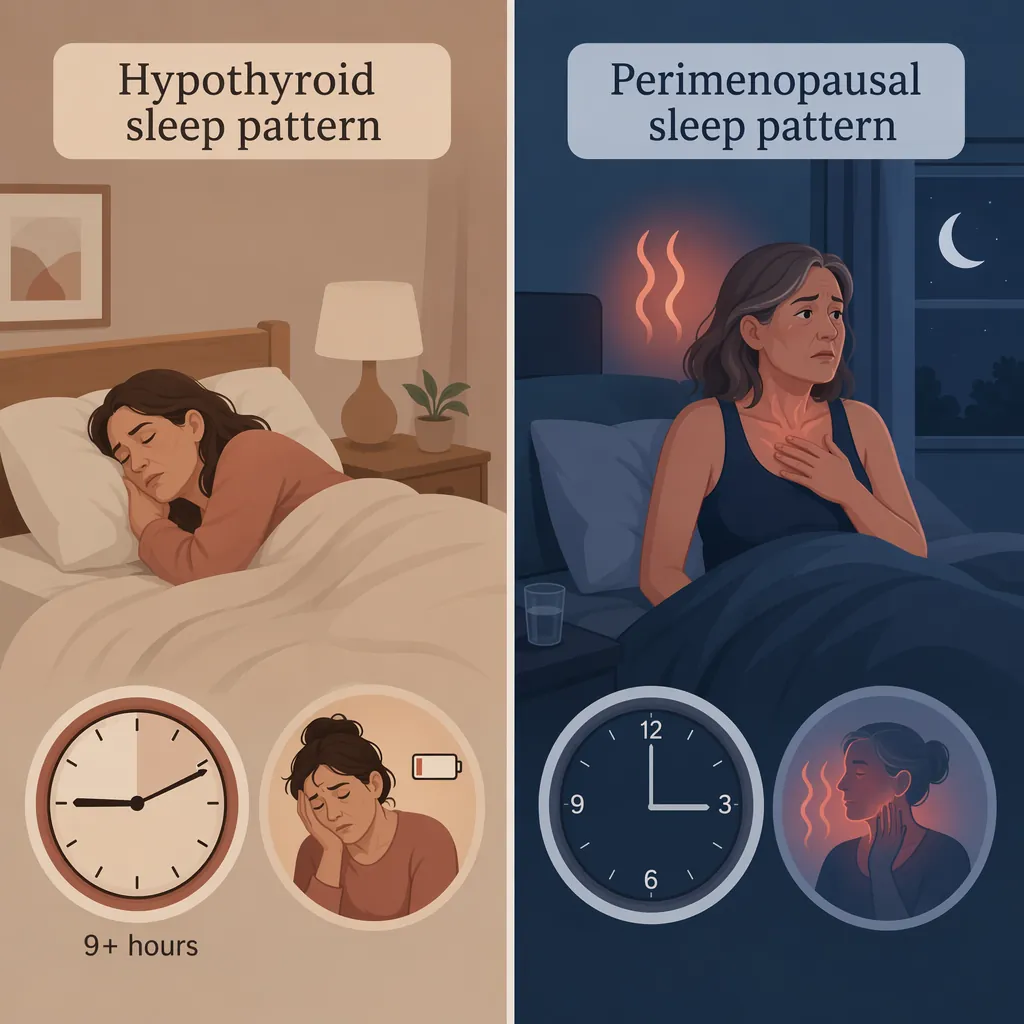
This is different from the pattern often used clinically to distinguish perimenopause from hypothyroidism. CeMCOR’s expert guidance describes hypothyroid sleep disruption as excessive need without refreshment, with central coldness, while perimenopausal sleep disruption more often involves midsleep waking, hot flushes, and chills afterward [5]. That distinction is expert clinical pattern recognition, not randomized-trial evidence, but it is useful when a woman in her 40s or 50s is being told every symptom must be “just hormones.” Sometimes it is thyroid. Sometimes it is perimenopause. Sometimes it is both.
When the pattern points away from levothyroxine alone
A normalizing TSH with persistent sleepiness does not mean the fatigue is imaginary. It means the search has to widen. The Ruíz-Pacheco study is a useful warning here: diabetes had a relative risk of 5.7 for persistent fatigue, and pretreatment fatigue severity also mattered [1]. A thyroid dose can be part of the story without being the only story.
Obstructive sleep apnea
Obstructive sleep apnea can look like thyroid fatigue because it produces unrefreshing sleep and daytime sleepiness. It can also overlap with thyroid disease. In one study, 11.1% of patients with obstructive sleep apnea had newly diagnosed subclinical hypothyroidism, compared with 4% of those without obstructive sleep apnea [6].
Snoring, witnessed breathing pauses, waking gasping, morning headaches, or high daytime sleepiness despite adequate thyroid replacement should move sleep apnea higher on the list. Raising levothyroxine on your own would not treat airway obstruction.
Restless legs symptoms
Restless legs syndrome can delay sleep onset, fragment sleep, and make someone feel as if they never reached deep rest. Thyroid disease can overlap with RLS-like symptoms. In a 2004 study, RLS-like symptoms affected 8.2% of patients with confirmed thyroid disorders versus 0.9% of controls, and 33% of affected patients had resolution of RLS with adequate thyroid treatment [7].
The clue is not just fatigue. It is the uncomfortable urge to move the legs when resting, often worse in the evening. If that is present, thyroid labs matter, but so do RLS evaluation and common contributors such as iron status.
Insomnia and conditioned wakefulness
Insomnia can begin for one reason and continue for another. A too-low levothyroxine exposure may start the cycle by making days unmanageable and sleep less satisfying. Over time, the bed can become a place of effort, clock-watching, and frustration. In that case, correcting thyroid exposure may reduce the biological load, while insomnia-specific treatment may still be needed if wakefulness has become conditioned.
What to bring to the clinician instead of guessing at the dose
The useful appointment is not “I’m tired, so I need more levothyroxine.” It is more specific: “Here is my sleep pattern, here is how I take the medication, here are the supplements or coffee timing changes, and here is when my symptoms returned.” That gives the clinician something safer to act on.
- Recent TSH and any other thyroid labs your clinician uses for monitoring
- The exact levothyroxine product, dose, and whether the manufacturer changed
- How many minutes pass between the pill and coffee, breakfast, calcium, iron, or other supplements
- Whether the sleep problem is long unrefreshing sleep, trouble falling asleep, 3 a.m. waking, hot flushes, snoring, or restless legs
- Whether fatigue improved after starting treatment and then returned, or never improved
- Any diabetes, perimenopause, pregnancy, postpartum, anemia, depression, medication, or sleep-apnea risk context
Some clinical resources note that certain patients feel best with TSH in the lower-normal range, such as around 1–2 mIU/L, rather than near the upper end of the reference range [8]. That is not a reason to self-adjust. It is a reason to describe persistent symptoms clearly when your labs are technically “normal,” especially if the pattern still looks hypothyroid.
A subpotent levothyroxine dose is correctable. So is reduced absorption. But the safe route is pattern plus labs plus clinician-guided adjustment: check TSH and dosing consistency, look for absorption disruptors, compare the sleep pattern, and screen for overlapping sleep disorders when symptoms do not fit or do not improve. Do not change levothyroxine on your own.
References
- Ruíz-Pacheco et al. 2023 prospective study on fatigue in hypothyroidism, PubMed Central, 2023.
- The Link Between Thyroid Function and Sleep, Frontiers in Endocrinology, 2021.
- Addanki et al. 2024 systematic review on thyroid dysfunction and sleep disorders, PubMed Central, 2024.
- Taking levothyroxine, British Thyroid Foundation.
- Is it perimenopause or hypothyroidism?, Centre for Menstrual Cycle and Ovulation Research.
- Prevalence of thyroid disease in patients with obstructive sleep apnea, PubMed, 2011.
- Thyroid disorders and restless legs syndrome, PubMed, 2004.
- What Is the Target TSH Level in Thyroid Hormone Replacement Therapy?, Ubie Health.
Read the full guide: Recalled Levothyroxine? What to Do and How to Sleep