How Super El Niño Disrupts Sleep in Canada This Fall and Winter
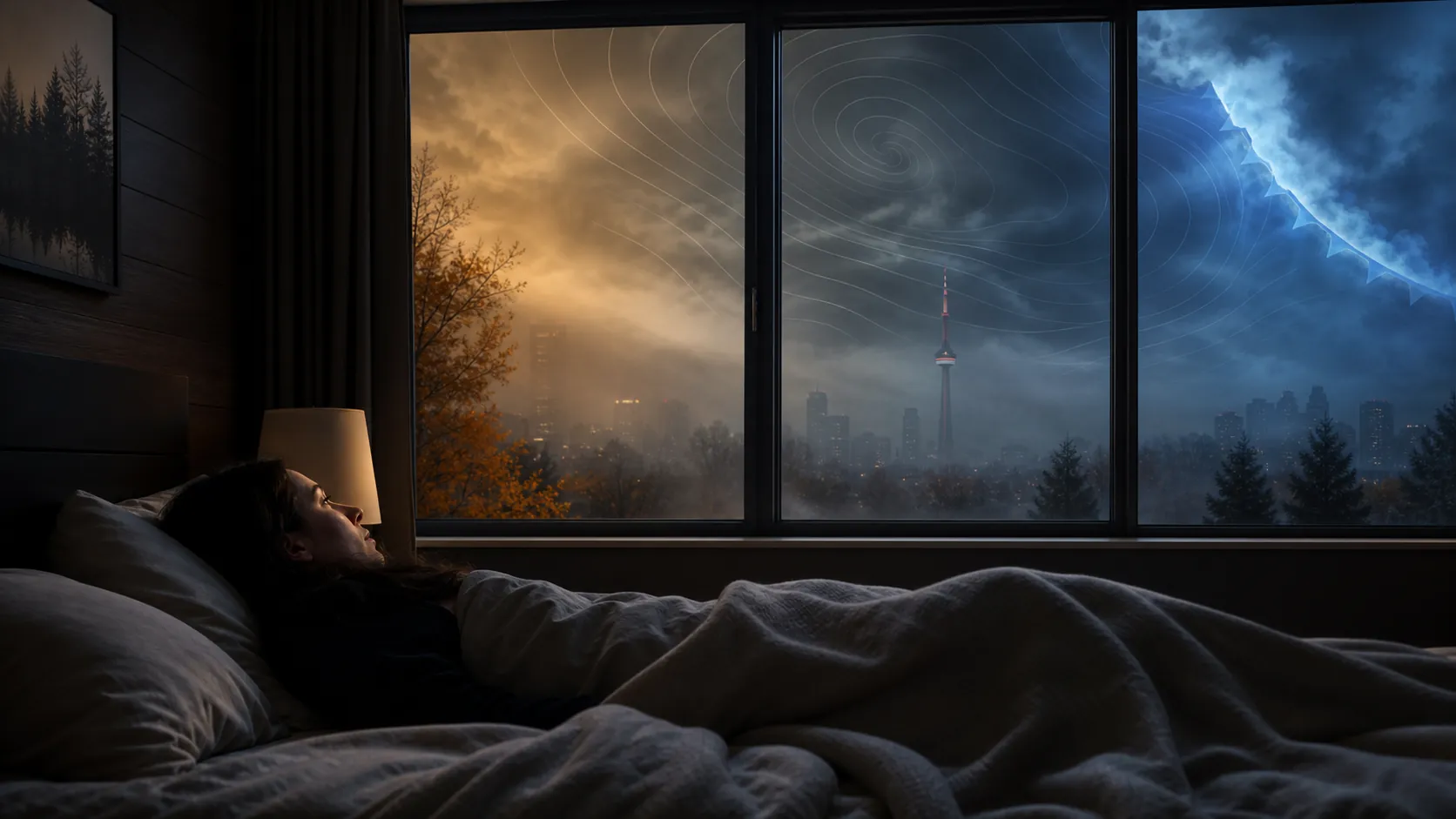
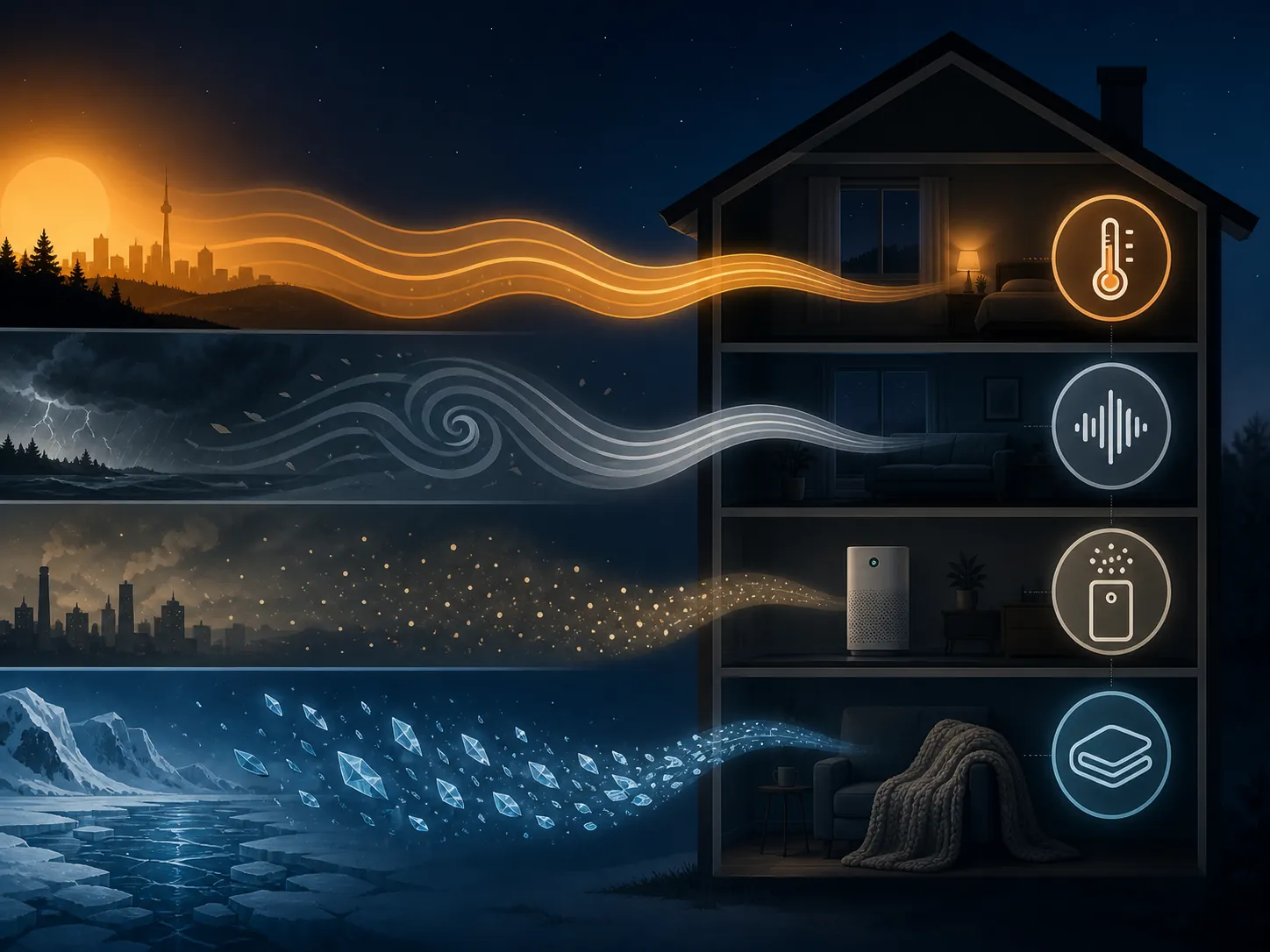
If your sleep is worse this fall or winter and the usual fixes are not working, the useful question is not simply whether El Niño is “causing insomnia.” It is which part of the weather has entered your bedroom. In Canada, a Super El Niño pattern can disturb sleep through several different routes: warmer overnight temperatures, storm systems, air-quality changes, and abrupt cold snaps linked to polar vortex disruption. Each one reaches the sleeping body differently, so each one asks for a different first response.
That distinction matters in fall 2026 and winter 2026–2027 because current long-range model analyses are not describing a subtle background signal. Severe Weather Europe’s July 2026 forecast coverage, based on ECMWF and NMME seasonal guidance, describes a historically strong El Niño signal with sea-surface temperature anomalies exceeding +3°C, along with a forecast high-pressure ridge over Canada and warmer-than-average fall and winter conditions in many areas.[1] A separate July 2026 analysis also flags elevated risk of polar vortex disruption, including possible sudden stratospheric warming influence in January–February 2027.[2]
Those are forecasts, not a guarantee for your block in Mississauga, Montreal, Calgary, or Vancouver. Long-range seasonal models can be wrong on timing, intensity, and regional placement. But they are strong enough to justify preparing the sleep environment before the bad nights become routine, especially across southern Ontario, Quebec, and western Canada, where mild winter anomalies, storms, smoke transport, and cold-air outbreaks can all show up in different combinations.
Start With The Pathway, Not The Label
“El Niño weather” is too broad to troubleshoot. A warmer-than-average night changes heat loss. A storm changes noise, pressure, light, and alertness. Smoke or fine particulate matter changes what the airway and nervous system are dealing with. A cold snap changes peripheral temperature and cardiovascular load, sometimes without waking you fully. The same person can experience two or three of these in one week.
| What you notice at night | Most likely pathway | First thing to check |
|---|---|---|
| You fall asleep later, wake hot, or throw covers off even though it is winter | Warm overnight temperature | Actual bedroom temperature near bedtime and after midnight |
| You wake during wind, rain, ice pellets, or rapid weather changes | Storm noise and pressure-related arousal | Noise entry points, window exposure, and weather-alert habits |
| You feel congested, irritated, heavy-headed, or unusually unrested during hazy periods | Air-quality pathway | Outdoor PM2.5/AQI and indoor filtration |
| You sleep through the cold but wake tense, cold at the edges, or unusually fatigued | Cold-stress pathway | Room cold spots, bedding warmth, and overnight heating stability |
The highest-leverage place to begin is temperature, because sleep is not just a behavior that happens in a room. It is a thermoregulatory event.
Why Mild Nights Can Still Break Sleep
A mild Canadian winter night can look harmless on a forecast app. No heat warning, no storm warning, no dramatic number. But sleep onset depends on the body being able to shed heat. Okamoto-Mizuno and Mizuno’s review in the Journal of Physiological Anthropology describes a core body temperature decline of about 1°C as a prerequisite for sleep onset.[3] The body does this partly by sending heat toward the skin and extremities, allowing core temperature to fall.
A bedroom that stays too warm interferes with that drop. The same review reports that ambient temperatures above 19°C reliably increase wakefulness and suppress slow-wave and REM sleep.[3] That does not mean everyone must sleep at exactly 18°C, or that one warm night damages sleep architecture in a dramatic way. The studies are largely controlled thermal-environment studies, often smaller than real-world population research. But the mechanism is sturdy: when the room reduces the body’s ability to lose heat, sleep onset and sleep maintenance become more fragile.
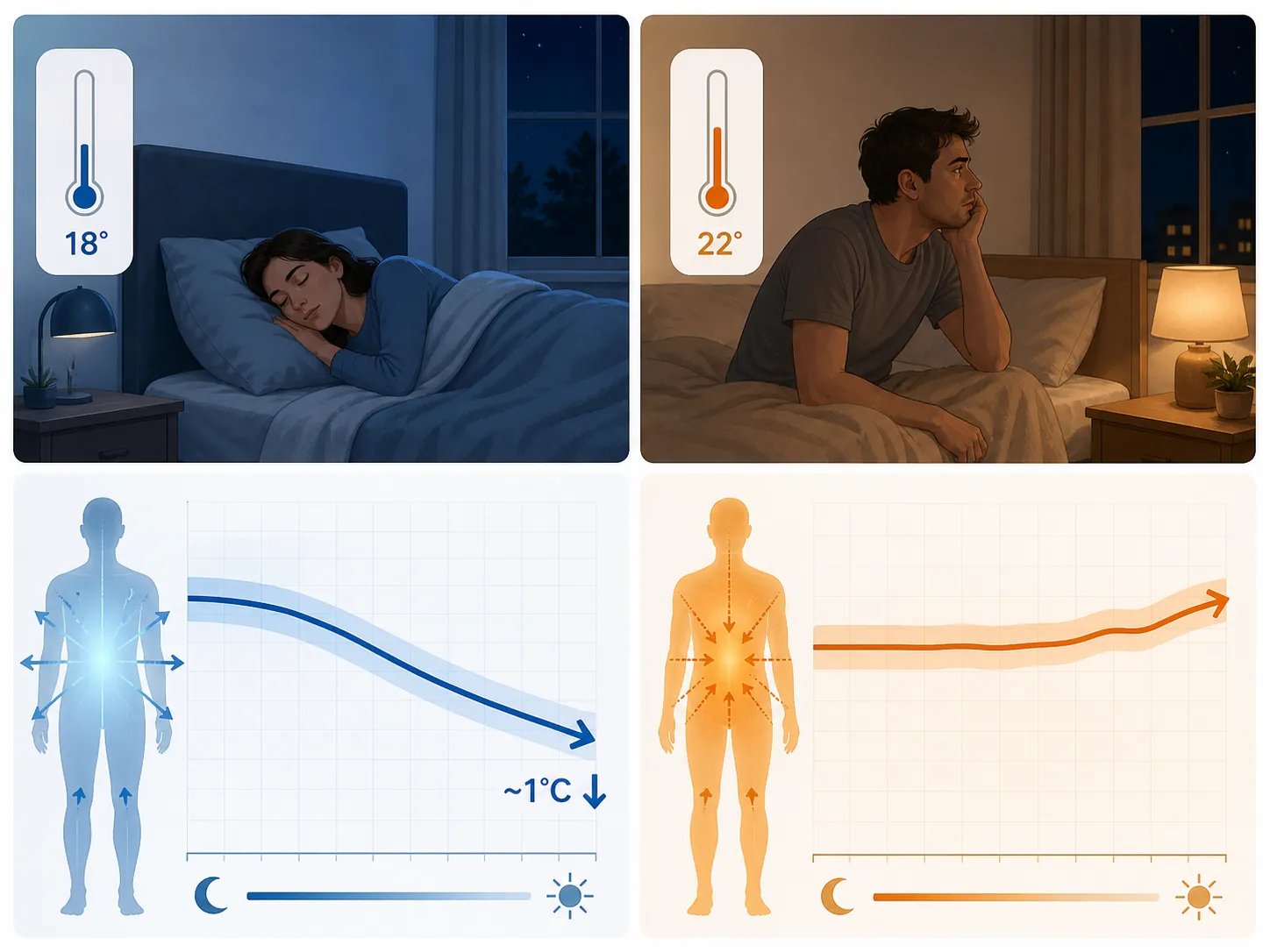
This is where a Super El Niño winter can become personal. A forecast phrase like “warmer than average” may translate indoors as a furnace that cycles less predictably, an apartment riser that stays warm, a condo bedroom that holds heat after sunset, or a household that keeps winter bedding on the bed while the overnight low behaves more like late fall. The weather outside does not need to feel extreme for the room to miss the thermal conditions your body expects.
Seasonal sleep data support the broader idea that weather shifts timing, not only comfort. In Mattingly et al.’s longitudinal study of 216 participants and 51,836 observations, each 1°C temperature-equivalent increase corresponded to bedtimes that were 0.6 minutes later and wake times that were 0.6 minutes later; spring was associated with 12.6 minutes less sleep duration than winter.[4] Those are modest averages, and the study is not a Canada-specific El Niño study. Its value is quieter: it shows that weather and seasonality can move sleep behavior measurably, even outside disaster conditions.
For most homes, the practical test is simple: measure the room, not the thermostat setting in the hallway. Put a small thermometer where your head actually is, then check it at bedtime and if you wake during the night. If the bedroom is sitting above the high teens Celsius while you are using winter bedding, temperature should be the first suspect.
The Temperature Fix Is Usually Physical, Not Motivational
Do not start by blaming caffeine, willpower, or screen discipline if the room is trapping heat. Start with heat pathways. Reduce bedding before lowering the whole-home thermostat. Separate blankets if one partner is cold and the other is overheating. Crack a window only when outdoor air quality, security, and noise make that reasonable. Use a fan to move air across the bed rather than blasting the room cold. If you live in a building with central heat that you cannot control, lighter bedding and breathable sleepwear may do more than another round of generic sleep-hygiene rules.
People vary. Perimenopause, pregnancy, some medications, respiratory disease, older age, ADHD-related arousal, and housing quality can all change how strongly a warm room affects sleep. That does not weaken the temperature pathway; it explains why two people in the same city can have completely different nights.
Storms Wake The Nervous System Before You Have Words For Them
Storm disruption is not the same problem as overheating. A person may sleep in a perfectly cool room and still wake repeatedly because wind hits the window, rain changes intensity, a branch taps the siding, a phone alert lights the room, or the body reacts to a changing pressure and sound environment. Forecast language calls this a storm track. In a bedroom, it is a sequence of small arousals.
The current forecast context makes that worth planning for, but not because every Canadian winter storm can be pinned neatly on El Niño. Seasonal models suggest altered pressure patterns over North America during the developing event, while regional effects will vary.[1] For sleep, the practical issue is whether your home is exposed to repeated nighttime weather intrusions.
- If noise is the trigger, use steady masking sound before the storm starts, not after you are already awake.
- If alerts are the trigger, keep emergency alerts on but remove nonessential weather notifications from the bedroom.
- If light wakes you, block intermittent flashes from phones, hallways, streetlights, and vehicle reflections on wet roads.
- If wind exposure is the trigger, move the bed away from the noisiest window wall when possible, even temporarily during active systems.
Storm planning is not about pretending weather can be made quiet. It is about reducing the number of times the sleeping brain has to decide whether a sound matters.
Air Quality Is The Pathway People Miss Until Morning
Air-quality sleep disruption is easy to misread because the night itself may not feel dramatic. You may not wake to a bang or feel obviously hot. Instead, you wake unrefreshed, congested, headachy, or aware that your breathing was not easy. During El Niño phases, shifts in precipitation, temperature, fire weather, and atmospheric transport can affect fine particulate exposure, though the local pathway differs by region and event.
The strongest population-level sleep evidence in the brief is not Canadian, and that caveat matters. Majeed and Zuberi’s 2025 BMC Public Health study, associated with the University of Toronto, analyzed 3,100 U.S. counties from 2017 to 2024. It found that extreme PM2.5 exposure, defined as at least 11 µg/m³, during El Niño years was associated with a 9.5% increased risk of insufficient sleep, with an adjusted risk ratio of 1.095, 95% confidence interval 1.067–1.123, and P<0.001.[5]
That is not Canadian proof. It uses U.S. county data, and county-level associations do not tell you what happened inside any one bedroom. Still, it gives weight to something many Canadian sleepers already learned during smoky summers: PM2.5 is not just an outdoor visibility issue. Fine particles can become a sleep issue when they enter the breathing environment and add airway irritation or inflammatory stress during the night.
The first countermeasure is not a bedtime ritual; it is exposure control. Check outdoor PM2.5 or AQI before deciding to open windows for cooling. If the air is poor, keep windows closed, run filtration if available, and prioritize the room where sleep happens. A portable HEPA purifier sized for the bedroom is more relevant here than lowering the thermostat by another degree. If you use a forced-air system, a properly fitted higher-efficiency filter can help, provided the system can handle it.
This pathway is especially important for people with asthma, COPD, allergies, cardiovascular disease, pregnancy-related breathing changes, or older age. It is also where renters and people in older housing may have fewer easy controls, because leaky windows and shared ventilation can decide how much outdoor air becomes bedroom air.
Cold Snaps Are Not The Opposite Of The Problem
It sounds contradictory to talk about warmer-than-average El Niño conditions and polar vortex cold snaps in the same sleep article. In practice, both can be true across a season. A winter can average mild and still deliver sharp cold outbreaks, especially if the polar vortex is disrupted and Arctic air spills south for a period. July 2026 forecast analysis flagged elevated risk of sudden stratospheric warming influence in January–February 2027, which can increase the chance of polar vortex disruption patterns affecting parts of North America.[2]
Cold exposure during sleep is less intuitive because bedding can preserve sleep stages even when the room is very cold. Okamoto-Mizuno and Mizuno report that cold exposure down to a 3°C bedroom did not significantly disrupt sleep stages when bedding was adequate, but it did significantly alter cardiac autonomic activity, including the LF/HF ratio during NREM sleep, without the sleeper necessarily noticing.[3] In plain terms: you may think you slept through the cold, while the body still treated the night as a physiological stressor.
That is why the cold-snap response should focus on stable warmth around the body, not just the air temperature number. Seal obvious drafts near the bed. Warm the bed before sleep if needed, then avoid overheating it. Keep hands, feet, and the neck comfortable. Make sure older adults, people with cardiovascular disease, and anyone sleeping in poorly insulated rooms are not relying on “I didn’t wake up” as proof that the cold did not matter.
Match The First Fix To The Night You Are Actually Having
A single sleep-hygiene checklist treats bad sleep as if it has one cause. Weather-driven sleep disruption does not behave that neatly. Use the pattern of the night to choose the first adjustment.
| Dominant pattern | What to do first | What not to overfocus on first |
|---|---|---|
| Hot waking, restless covers, later sleep onset | Measure bedroom temperature and reduce heat load at the bed | Adding more relaxation exercises while the room stays warm |
| Repeated waking during wind, rain, ice, or alerts | Control sound, light, and notification exposure before bed | Changing bedding as the main fix |
| Congestion, irritation, hazy days, unrefreshing sleep | Check PM2.5/AQI and improve bedroom filtration | Opening the window for cool air without checking air quality |
| Cold edges, drafty room, fatigue after a cold night | Stabilize warmth around the sleeper and reduce drafts | Assuming no awakening means no physiological strain |
If more than one pathway is active, choose the one with the clearest physical signal. On a mild, smoky night, filtration may matter more than cooling. During a clean but unusually warm spell, temperature may dominate. During a freezing wind event, draft control and noise reduction may both matter. The point is not to find a perfect explanation; it is to stop applying the same remedy to different problems.
For Canadians heading into fall 2026 and winter 2026–2027, the useful preparation is specific: know the temperature of the bedroom, know when outdoor air should not be invited in, know which storm noises wake you, and know whether a cold room is quietly stressing the body even when sleep seems continuous. Super El Niño does not have to become a bedtime drama to affect sleep. It only has to change the room enough that the body’s usual overnight work becomes harder.
References
- Fall 2026 forecast: Super El Niño creates unusual winter-like weather pattern over the United States, Canada and Europe, Severe Weather Europe, July 2026
- Early forecast data: El Niño polar vortex disruption over the United States, Canada and Europe in winter 2026/2027, Severe Weather Europe, July 2026
- Effects of thermal environment on sleep and circadian rhythm, Journal of Physiological Anthropology, 2012
- The effects of seasons and weather on sleep patterns measured through longitudinal multimodal sensing, npj Digital Medicine, 2021
- Association between El Niño-Southern Oscillation, ambient fine particulate matter and insufficient sleep in the United States, BMC Public Health, 2025
Read the full guide: How to sleep better during a Super El Niño winter