
How to sleep better during a Super El Niño winter
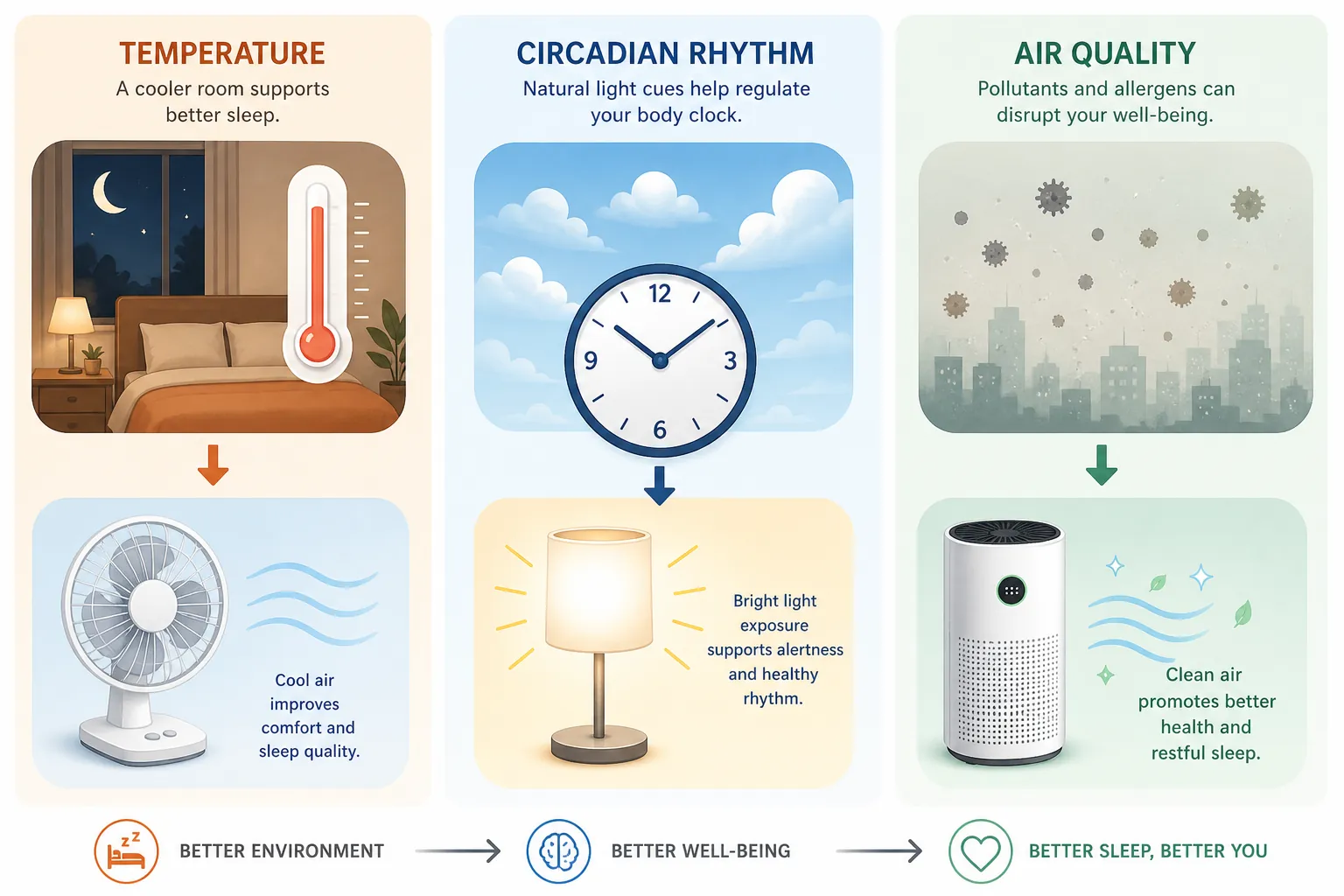
To sleep better during a Super El Niño winter, start by treating some “winter” nights as mild heat events: cool the bedroom actively, get bright light soon after waking even when the sky is gray, and run HEPA filtration when pollution or storm patterns make indoor air feel heavy. That is the practical answer. The reason is that this kind of winter can work against the usual cold-weather sleep script.
For the 2026/2027 season, the relevant forecast signal is not just “El Niño exists.” The useful part for sleep planning is the expected combination of above-normal temperatures in the northern United States and a more active southern storm track, with one forecast discussion describing a 97% confidence that the Super El Niño pattern persists through winter.[1] Historical strong El Niño winters also support the broad setup of a warm ridge toward Canada with a more active southern storm track.[2] That does not prove any one person will sleep badly. It does explain why a bedroom can feel wrong for the season.
Why normal winter sleep advice can backfire
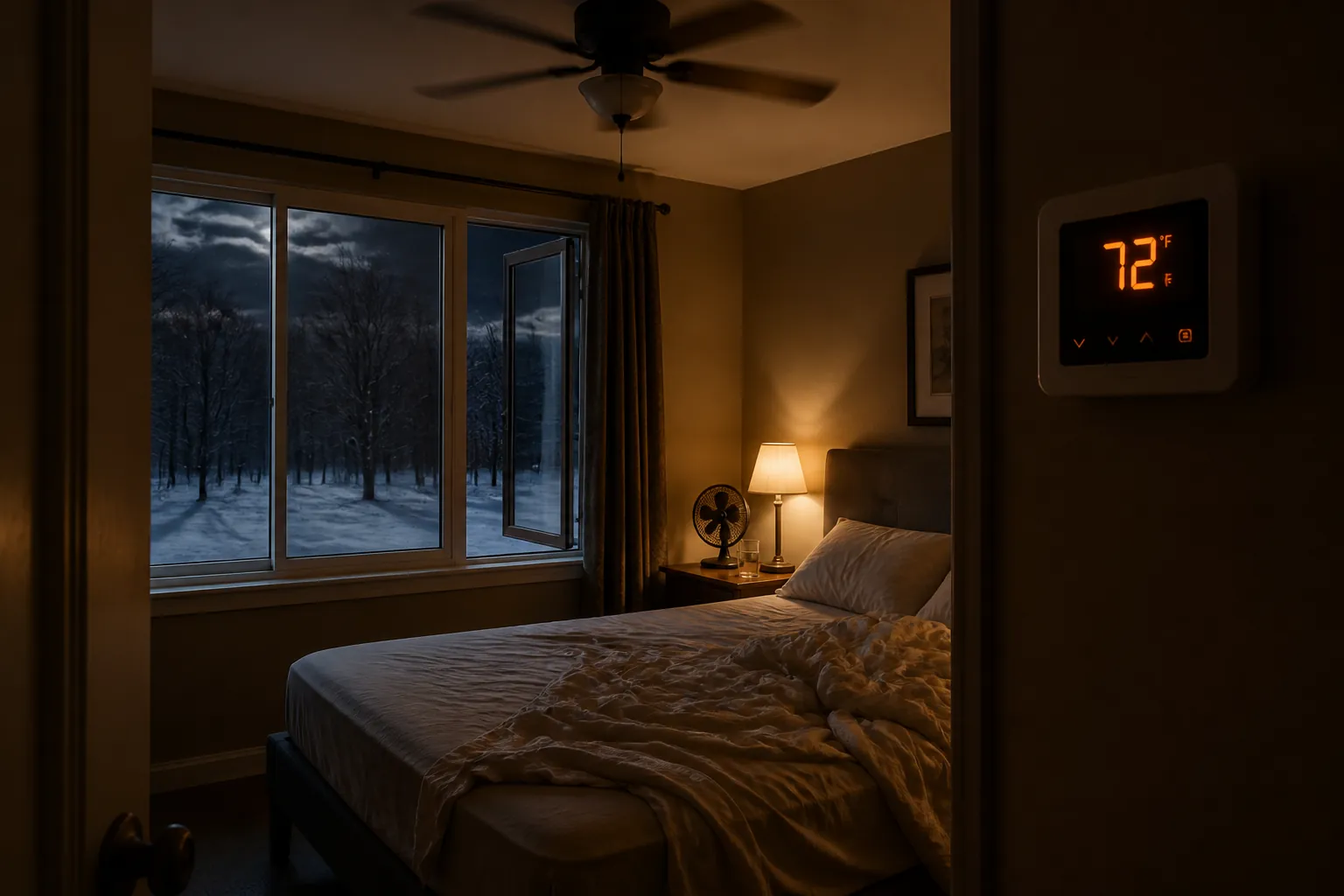
A lot of winter sleep advice assumes the bedroom is cold, the air is dry, and the main task is to preserve warmth. That advice is not useless. It is just calibrated to a different night. If the thermostat is still reading like late fall, extra blankets and a sealed room can trap the very heat your body is trying to shed.
The American Academy of Sleep Medicine’s winter guidance still gets the target right: the bedroom should be “quiet, dark, and a little bit cool — it should remind you of a cave.”[3] During a warm El Niño winter, the problem is that the cave may not happen on its own. Waiting for the room to cool naturally can leave you lying in a bedroom that looks seasonal but behaves thermally like a shoulder-season heat spell.
| If this is the problem | The winter habit that may fail | The better countermeasure |
|---|---|---|
| Warmer-than-normal nights | Adding bedding or closing the room tightly | Actively cool the sleep space before and during the first part of the night |
| Cloudy, stormy mornings | Sleeping in because the day looks dim | Get timed bright light soon after waking |
| Poor air quality or heavy indoor air | Ignoring filtration because it is not wildfire season | Use HEPA filtration and track local air quality |
Cool the bedroom like it is warmer than the calendar says
Sleep onset is not only a matter of feeling relaxed. Your body normally drops core temperature as it moves toward sleep. A warm room makes that heat release harder, especially if bedding, pajamas, and closed windows keep warmth close to the skin. On a Super El Niño winter night, the mistake is often small and ordinary: leaving the winter duvet on the bed, assuming the room will cool after sunset, and noticing too late that the first half of the night has become restless.
The population-level signal is large enough to take seriously. In a 2025 study of 211,159 urban residents in Korea, every 1°C rise above a region’s climate normal was associated with a 16% increase in the odds of poor sleep quality.[4] That does not mean the exact same percentage applies to every US bedroom. It does mean “above normal” is not just a weather phrase. It can be the difference between a room that supports sleep and a room that keeps nudging the body awake.
The physiology backs up the lived experience. A review of thermal environment and sleep found that heat exposure during sleep increases wakefulness and decreases slow wave sleep and REM sleep; it also notes that these effects did not habituate after 5 consecutive nights.[5] That is the part people often need permission to hear. If several warm winter nights have gone badly, the answer is not necessarily to toughen up until your body adjusts. Your bedroom conditions may be asking your sleep system to do something it is not built to do well.
A practical cooling protocol for warm winter nights
- Check the bedroom temperature before bed, not just the outdoor temperature. The room can hold daytime warmth even when the window view looks wintry.
- Strip the bed down earlier in the evening. Swap the heavy winter duvet for layers you can remove without fully waking.
- Use a fan for air movement if the room feels stagnant. Airflow helps sweat evaporate and can make a marginal room feel more sleepable.
- Pre-cool the room before bedtime when possible. Waiting until you are already overheated in bed usually means the first sleep cycle pays the price.
- Keep warmth targeted instead of global. If your feet get cold but your torso runs hot, use socks or a light throw at the foot of the bed rather than heating the whole room.
If you do not have air conditioning, the goal is still to move heat away from the body and out of the sleep space. For immediate tactics, use How to Sleep Cool Without Air Conditioning Tonight as the more detailed cooling guide. If your body already runs hot, How to Sleep During a Heat Wave When Your Body Already Runs Hot is the better next stop than generic winter advice.
Use morning light more deliberately on stormy days
Warm nights are the obvious problem. Dim mornings are the quieter one. El Niño storm tracks can mean more cloud cover and more gray starts, and cloudy winter light can leave the body with a weaker morning signal. The countermeasure is not to surrender the morning because it looks unpromising. It is to make light exposure more intentional.
Morning light helps anchor circadian timing. When it is delayed or too weak, the body can drift toward later sleepiness at night and later alertness in the morning. That matters during a warm winter because temperature and light can push in the wrong direction at the same time: the bedroom is not cooling you down at night, and the day is not strongly waking you up in the morning.
- Get outside soon after waking when weather allows, even if the sky is overcast. Outdoor light usually beats indoor light on cloudy days.
- Open curtains early and work near a window if going outside is unrealistic.
- Keep wake time steady after a bad warm night. Sleeping far later can make the next night harder.
- Use bright indoor light in the morning if storms, safety, or mobility make outdoor light impractical.
- Dim lights in the last hour before bed so the evening signal does not compete with the morning one.
This is the winter habit that feels most counterintuitive. A gray morning tempts people to move slowly, stay inside, and postpone the day. That may feel protective after a poor night, but it can blur the timing signal your body needs most. On stormy mornings, light becomes a scheduled exposure rather than a pleasant bonus.
Treat PM2.5 as sleep-relevant, not just lung-relevant
Air quality is the easiest pathway to miss because many people file it under wildfire season, commuting, or asthma. During a stormy El Niño winter, the practical question is simpler: does the air in and around your bedroom make breathing feel heavier, more irritated, or more congested at night? If so, it belongs in the sleep plan.
The strongest evidence here should be read carefully. A 2025 study covering 3,100 US counties and 2017–2024 data found that, during El Niño phases, extreme PM2.5 air pollution was associated with about a 9.5% increased risk of insufficient sleep in US adults. The same paper reported US insufficient sleep prevalence at 34.3%, with a 4.5% rise from 2017 to 2024.[6] That is not a precise winter-night estimate, and the study uses annual averages rather than a clean seasonal test. Still, it is enough to make filtration a reasonable sleep intervention when PM2.5 is elevated.
The bedroom version is straightforward: track local air quality when storms, inversions, smoke transport, or traffic pollution are in the forecast; close windows when outdoor PM2.5 is high; and run a true HEPA purifier in the sleeping area. If you use a fan for cooling, do not aim to exchange indoor air with polluted outdoor air. Move indoor air across the body while filtering the room as well as you can.
The 24-hour version
A Super El Niño sleep plan works best when it follows the day instead of living only at bedtime. The night problem often starts in the morning and the evening problem often starts with the afternoon room temperature.
| Time | What to do | Why it matters |
|---|---|---|
| Morning | Get bright light soon after waking; keep wake time consistent. | Cloudy winter mornings can weaken the circadian start signal. |
| Afternoon | Check the bedroom before it is time to sleep; reduce heat buildup early. | A room that stayed warm all day may not cool fast enough by bedtime. |
| Evening | Use lighter bedding, airflow, and pre-cooling instead of adding winter layers automatically. | The body needs to shed heat to fall and stay asleep. |
| Pollution or storm periods | Use HEPA filtration and be cautious with open windows when PM2.5 is elevated. | Air-quality stress can compound sleep disruption. |
Perimenopausal readers, older adults, pregnant readers, and people who already sleep hot may need more specific adjustments, but the El Niño-specific evidence does not support pretending there is a separate proven protocol for every group. For perimenopause-specific guidance, start with How to Manage Perimenopause Insomnia During an El Niño Winter. For broader heat-sensitive life-stage guidance, use Heatwave Sleep Tips for Pregnancy, Menopause, and Older Adults.
What the evidence can and cannot say
There is no single study that tests “sleep during a Super El Niño winter” as one complete exposure. The useful sleep advice comes from stitching together better-established pieces: forecast patterns, heat-and-sleep physiology, temperature deviation studies, circadian light timing, and PM2.5 sleep research. That makes the protocol practical, not perfectly proven.
So keep the claim narrow. If winter nights are warmer than normal, treat the bedroom like a mild heat event. If mornings are cloudier than usual, treat light as something to schedule. If PM2.5 rises, treat filtration as part of the sleep environment. Those steps will not guarantee a good night during a Super El Niño winter, but they match the mechanisms most likely to make the usual winter routine fail.
References
- Fall 2026 Forecast: Super El Niño Sets Up a Winter-Like Weather Pattern That Strengthens Into January, Severe Weather Europe
- El Nino Impacts along with other Climate Factors That May Influence our Winter Weather, National Weather Service Paducah
- Tips for sleeping well this winter, American Academy of Sleep Medicine
- Association between temperature rise from climate normal and sleep quality, Nature Scientific Reports, 2025
- Effects of thermal environment on sleep and circadian rhythm, PMC, 2012
- Effects of extreme air pollution and El Niño Southern Oscillation on insufficient sleep, PMC, 2025