
It is only a tornado watch. That is the maddening part. No siren, no confirmed tornado, no instruction to shelter right now — just the message that conditions are favorable for tornadoes somewhere in the watch area. A warning is different: it means a tornado has been sighted or indicated by radar, and protective action is needed. The National Weather Service also notes that many people in tornado-prone regions may experience several watches in a year but far fewer warnings, with local offices reporting different annual alert burdens by region.[1]
So why does a watch at bedtime feel so much louder than its wording? Because sleep does not begin by argument. You can tell yourself that most people in a watch area never see a tornado and still feel your heart rate climb, your ears tune toward the wind, and your thumb drift back to the radar. The body is not waiting for certainty. It is responding to uncertainty.
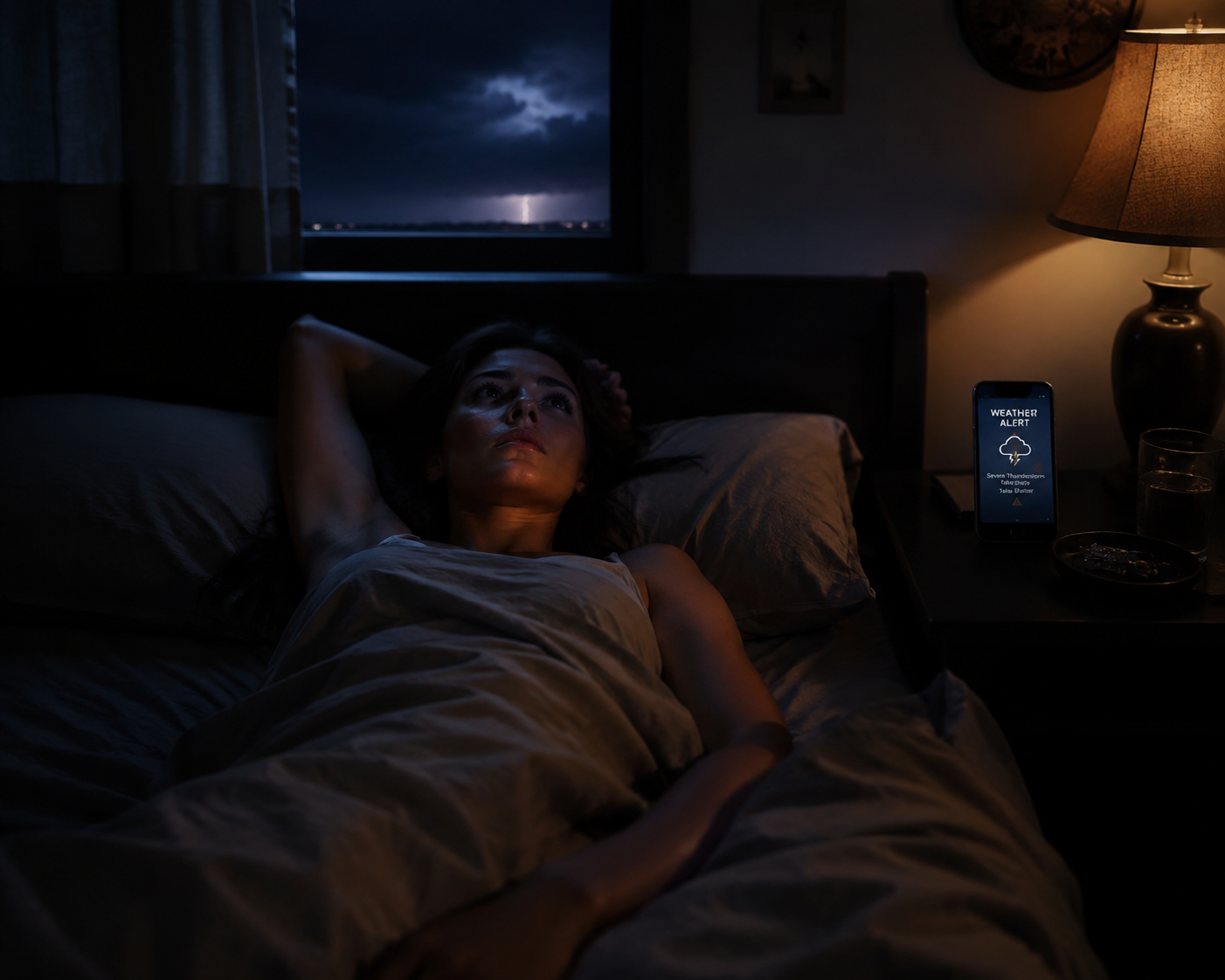
A tornado watch gives the brain an unfinished threat
The most useful answer is not that you are overreacting. It is that a watch gives the brain exactly the kind of cue it is built to prioritize: possible danger, unclear timing, incomplete information, and high consequence if ignored.
In an April 2026 UAB Medicine explanation of storm anxiety, psychiatrist Dr. Merida Grant describes how a tornado watch can activate the salience network, insula, amygdala, and frontal cortex — systems involved in detecting what matters, sensing the body’s internal state, evaluating threat, and deciding what to do next.[2] That source is not a tornado-watch sleep trial, and it should not be stretched into one. It is a clinical application of established anxiety biology to a very recognizable nightstand problem.
The salience network helps decide what deserves attention. On an ordinary night, the hum of the refrigerator, a car passing outside, or a faint gust against the siding can stay in the background. Under a tornado watch, those same inputs get promoted. The phone alert, the phrase “conditions are favorable,” the heavy air before a storm, the memory of last season’s warning — all of it becomes harder to dismiss because the brain has tagged the situation as worth monitoring.
The insula adds another layer. It tracks internal body signals: tightness in the chest, a shift in breathing, a stomach drop, a pulse that feels too present. Once the watch has made threat more salient, normal body sensations can become part of the evidence file. You notice your heart beating, then the noticing itself becomes proof that something is wrong. That is one reason storm anxiety can feel so physical even when nothing has happened outside yet.
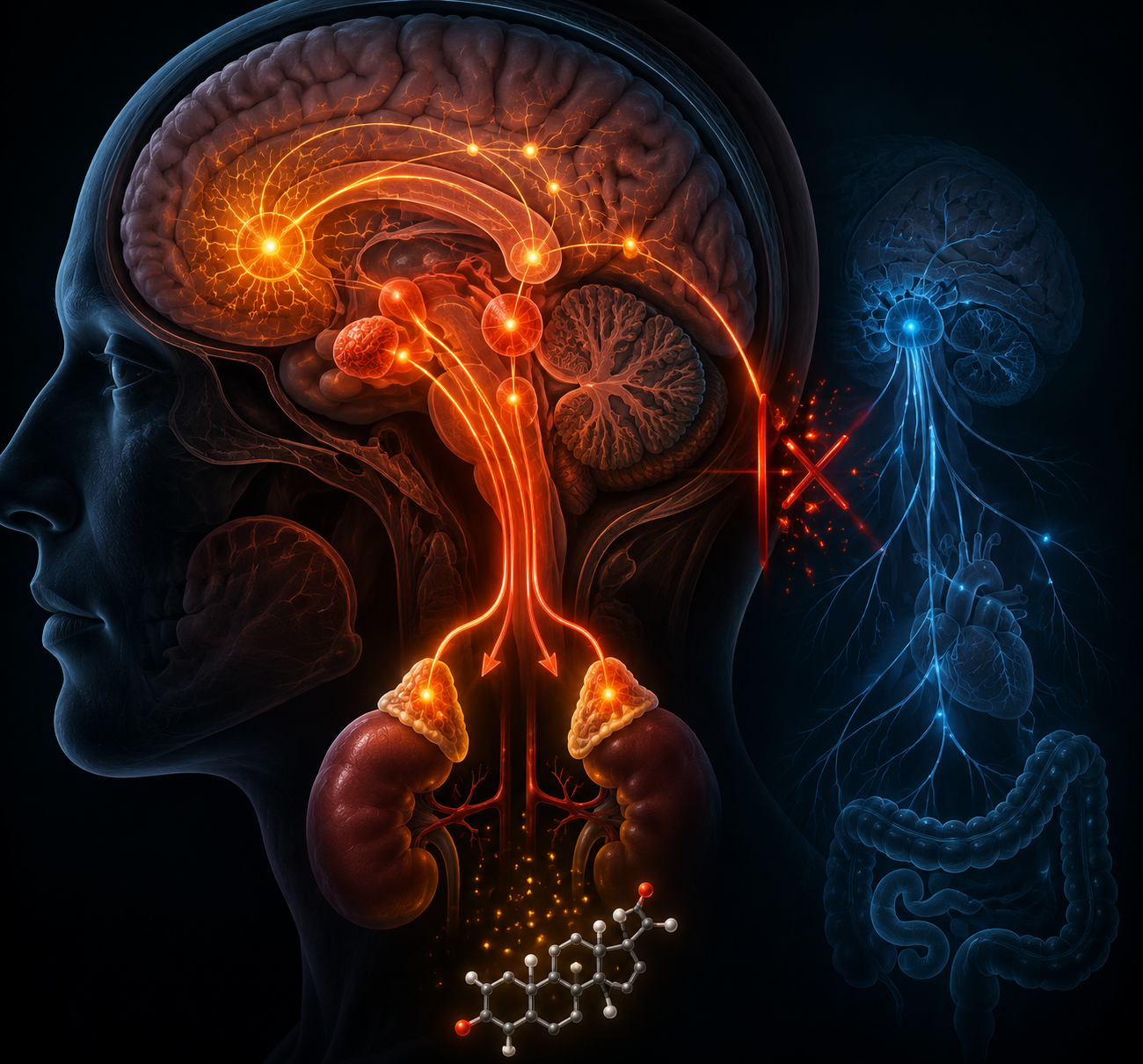
Then the amygdala does what it is supposed to do: it treats possible threat as important before the slower, more deliberative parts of the brain have finished their review. That does not mean the amygdala is irrational in the childish sense. It means it is fast, biased toward survival, and not especially interested in the statistical comfort that any one house is unlikely to be hit on any one night.
The frontal cortex can still reason. It can remember that a watch is not a warning, compare radar loops, read the forecast discussion, and decide whether shoes should go by the door. But when the threat system is activated, reasoning may become repetitive instead of settling. One more radar refresh promises certainty and delivers a slightly updated version of uncertainty. The loop feels productive because checking reduces anxiety for a moment. Then the watch remains in effect, and the body asks again.
Why that alert state blocks sleep
Sleep onset requires a physiological downshift. The parasympathetic nervous system needs room to slow breathing, lower alertness, and let attention loosen. A tornado watch pushes in the other direction. UAB’s storm-anxiety explanation describes cortisol release and sympathetic nervous system activation as part of the threat-response cascade.[2]
Cortisol is often flattened into “the stress hormone,” but the important point at 1 a.m. is what it does to timing. It helps the body mobilize. Mobilization is useful if you need to wake children, get to an interior room, or put on shoes before broken glass becomes a concern. It is not compatible with drifting off as if the night is settled.
Sympathetic arousal has the same problem. It can make the body feel ready: lighter sleep pressure, shallower breathing, a need to listen, a sense that lying still is irresponsible. The person in bed may call this “I can’t relax,” but the body may be running a monitoring program: stay awake enough to catch the next cue.
That is why ordinary sleep hygiene advice can feel insulting during severe weather. A dark room, a cooler temperature, and fewer screens are fine conditions for sleep. They do not answer the question the nervous system is asking: who is watching the threat while I am unconscious?
There is also a carryover effect. UAB notes that untreated storm anxiety can feed a cycle in which poor sleep worsens anxiety sensitivity, making the next severe-weather episode harder to tolerate.[2] Sleep Foundation’s broader review of anxiety and sleep describes the same two-way relationship: anxiety can interfere with sleep, and poor sleep can worsen anxiety.[3] After a few storm seasons, the alert itself can begin to cue the memory of previous sleepless nights.
Your caution is not the problem; the size of the monitoring job is
It would be easier to write this if tornado watches were always meaningless. They are not. Nighttime tornado risk deserves respect because people are asleep, visibility is poor, and warnings can be missed if the only alert source is a silenced phone across the room.
Tornadoes are less common at night than during the day, but one study of U.S. tornadoes from 1950 to 2005 found that nocturnal tornadoes made up 27.3% of tornadoes and 39.3% of tornado deaths.[4] A later study covering 1880 to 2020 reported that the proportion of nocturnal tornado fatalities increased by 20% across that longer historical period.[5] Those are not reasons to panic through every watch. They are reasons to build a system that can wake you when the situation changes.
That distinction matters. Normal vigilance says, “I need reliable alerts, a shelter plan, and a way to act quickly if a warning is issued.” Hypervigilance says, “I need to personally monitor every radar scan until the watch expires.” The first is preparation. The second asks the sleeping brain to be a 24-hour emergency desk.
The prevalence numbers also argue for less shame. Medical-practice sources summarizing a Bulletin of the American Meteorological Society study report that about 1 in 8 people experience clinically significant weather-related anxiety that can disrupt daily functioning and sleep.[6][7] Because that figure is being used here through secondary medical sources rather than independent review of the original journal article, it should be read carefully. Still, the basic message is useful: if weather alerts make sleep difficult, you are not some rare defective sleeper.
Replace radar checking with alert redundancy
The nervous system usually does not stand down because someone says, “You’re probably fine.” It stands down when the monitoring job has been assigned somewhere trustworthy. For overnight tornado watches, that means layered alerts.
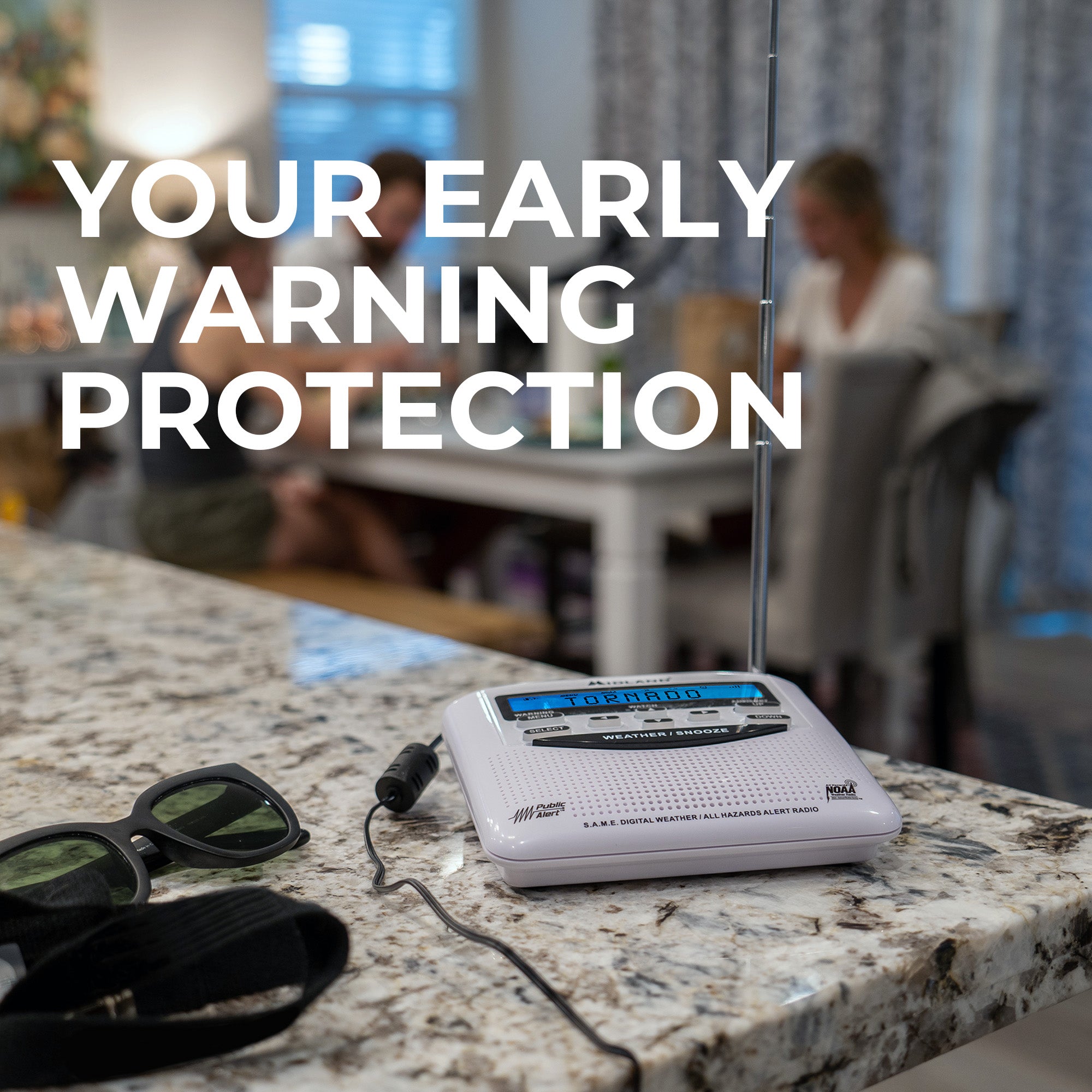
A reasonable overnight setup is not glamorous: a NOAA Weather Radio with alerts enabled, phone emergency alerts on and loud enough to wake you, and a backup plan if power or cell service fails. The point is not to collect gadgets. The point is to stop making your half-asleep attention the only warning system in the house.
This is where the watch-versus-warning distinction becomes practical instead of academic. A watch calls for readiness. A warning calls for action. If you blur the two, every watch becomes an emergency. If you separate them too casually, you may miss the point of the watch. A short rule keeps the middle ground intact.
| Alert or condition | What it means at night | What to do before trying to sleep |
|---|---|---|
| Tornado watch | Conditions are favorable; no confirmed tornado for your location | Turn on layered alerts, charge the phone, choose the shelter space, put shoes and essentials nearby |
| Tornado warning | A tornado is indicated by radar or sighted for the warned area | Go to the shelter location immediately and follow local emergency guidance |
| Watch expires or storms clear your area | The overnight monitoring burden drops | Turn off extra information sources and return to the normal sleep routine |
Warning performance is not perfect, and no alert system should be treated as magic. But the National Weather Service Norman office reports that 97% of strong-to-violent tornadoes, rated EF3 to EF5, are preceded by a warning, with an average lead time of 16 minutes.[8] That is exactly the kind of fact that should change the bedtime strategy: not into denial, and not into all-night scanning, but into reliable wake-up coverage.
Regional burden matters, too. The National Weather Service notes that some tornado-prone areas may average 8 to 10 tornado watches per year, while other offices report lower local averages such as 1 to 3 watches per year.[1] A person in central Oklahoma and a person in eastern Tennessee may both have legitimate storm anxiety, but their annual number of alert nights may not be the same. The plan should match the local pattern without treating every watch as if it has the same probability for every home.
Make the plan specific enough that your brain can stop negotiating
The worst time to decide what counts as “enough checking” is while you are already anxious. A pre-decided plan removes the debate. It does not remove uncertainty from the weather. It removes uncertainty from your role.
- Name the shelter spot before bed: basement, storm shelter, or a small interior room on the lowest floor away from windows.
- Put shoes, glasses, medication, wallet, keys, and a flashlight where you can reach them quickly.
- Choose two or more alert sources, including one that can wake you if your phone is silenced or loses service.
- Decide when you are done checking: for example, after reading the latest local forecast and confirming alerts are working.
- Write the rule in plain language: “Watch means setup and sleep; warning means shelter.”
That last sentence may look almost too simple, but it is useful because anxious brains bargain. They ask whether one more model run, one more storm-chaser post, or one more velocity scan would finally make the night knowable. A rule gives the frontal cortex something concrete to enforce when the salience network keeps flagging the watch as unfinished business.
If you need a more detailed safety protocol, use a dedicated tornado-season checklist before bedtime. The point here is narrower: get the safety system in place before trying to calm down. Skipping that order is why so much bedtime advice fails during severe weather.
Then reduce the threat input
Once alerts are layered and the shelter plan is ready, the next intervention is not a motivational speech. It is less input. Radar loops, live chats, social feeds, and television coverage all keep feeding the salience network new cues. Some of those cues are useful before the plan is set. After that, they often become fuel.
A cleaner cutoff might be: check the official local forecast, confirm the watch timing, confirm alerts, then stop watching continuous coverage unless a warning is issued for your area. If storms are approaching your county and you need to stay awake for a short window, say that plainly. But if your only job is to be reachable by alerts, let the alert system do its job.
Body-based calming works better here than trying to think the watch away. Slow exhaling, unclenching the jaw, relaxing the shoulders, or doing a brief scan from feet to forehead gives the insula different evidence to read. The message is not “there is no weather.” The message is “the plan is complete, and the body can leave emergency posture unless an alert changes the situation.”
If you get out of bed to prepare, return only when the preparation is done. Half-prepared is a bad sleep state: the shoes are still in the closet, the phone is at 12%, and the brain knows it. Finished is different. Finished gives the nervous system a boundary.
When storm anxiety needs more than a bedtime plan
Normal vigilance during a tornado watch is not pathology. If you live in a tornado-prone region, taking watches seriously is part of living there. The concern is proportion: whether the response repeatedly expands beyond the threat and begins to damage sleep, work, relationships, or daytime functioning.
Some people are not only reacting to a forecast. They may be reacting to a previous tornado, a childhood storm memory, the sound of sirens, or a broader phobia of tornadoes and severe storms. Cleveland Clinic describes lilapsophobia as an intense fear of tornadoes or hurricanes and notes that phobias can lead people to avoid situations or experience significant distress.[9] That is a different doorway than an ordinary bad night under a watch.
If storm anxiety repeatedly steals sleep even when you have a solid alert system, or if the fear carries into clear-weather days, clinical support is reasonable. Cognitive behavioral therapy for insomnia can help when the bed itself has become linked with threat-monitoring, and therapy for anxiety or trauma can address the fear system more directly. A one-night breathing routine should not be asked to do the work of treatment.
A tornado watch is not nothing. It is also not an all-night emergency by itself. The workable middle is to respect the watch enough to prepare, trust redundant alerts enough to stop personally patrolling the sky, and give the body a real chance to move back toward sleep.
References
- Understand Tornado Alerts, National Weather Service.
- Understanding and Managing Storm Anxiety During Tornado Season, UAB Medicine, April 2026.
- Anxiety and Sleep, Sleep Foundation.
- Nocturnal Tornadoes in the United States, Weather and Forecasting, 2008.
- A Climatology of Nocturnal Tornadoes in the United States from 1880 to 2020, Weather, Climate, and Society, 2022.
- Finding Calm in the Storm: How to Cope with Weather-Related Anxiety, Nashville Psych.
- Storm anxiety: How to manage tornado season stress, CoxHealth.
- Storm Anxiety, National Weather Service Norman.
- Lilapsophobia, Cleveland Clinic.
Comments
Join the discussion with an anonymous comment.