
Why screens before bed disrupt kids' sleep more than adults'
The short answer: screens before bed are harder on many children’s sleep because the same evening light can suppress their melatonin much more strongly than it suppresses an adult’s. In one study often cited in pediatric sleep discussions, light before bed suppressed melatonin by 88% in children with a mean age of 9.2, compared with 46% in adults under identical conditions.[1] In a separate preschool study, even dim light in the hour before bedtime suppressed melatonin by an average of 78%, and melatonin had not bounced back within 50 minutes after the light ended.[2]
That is why the usual phrase “limit screen time before bed” can sound too small for the problem. For a young child, bedtime light is not just a habit issue or a willpower test. It is an environmental input to a body that may still be very ready to respond to light as a signal that night has not fully started.
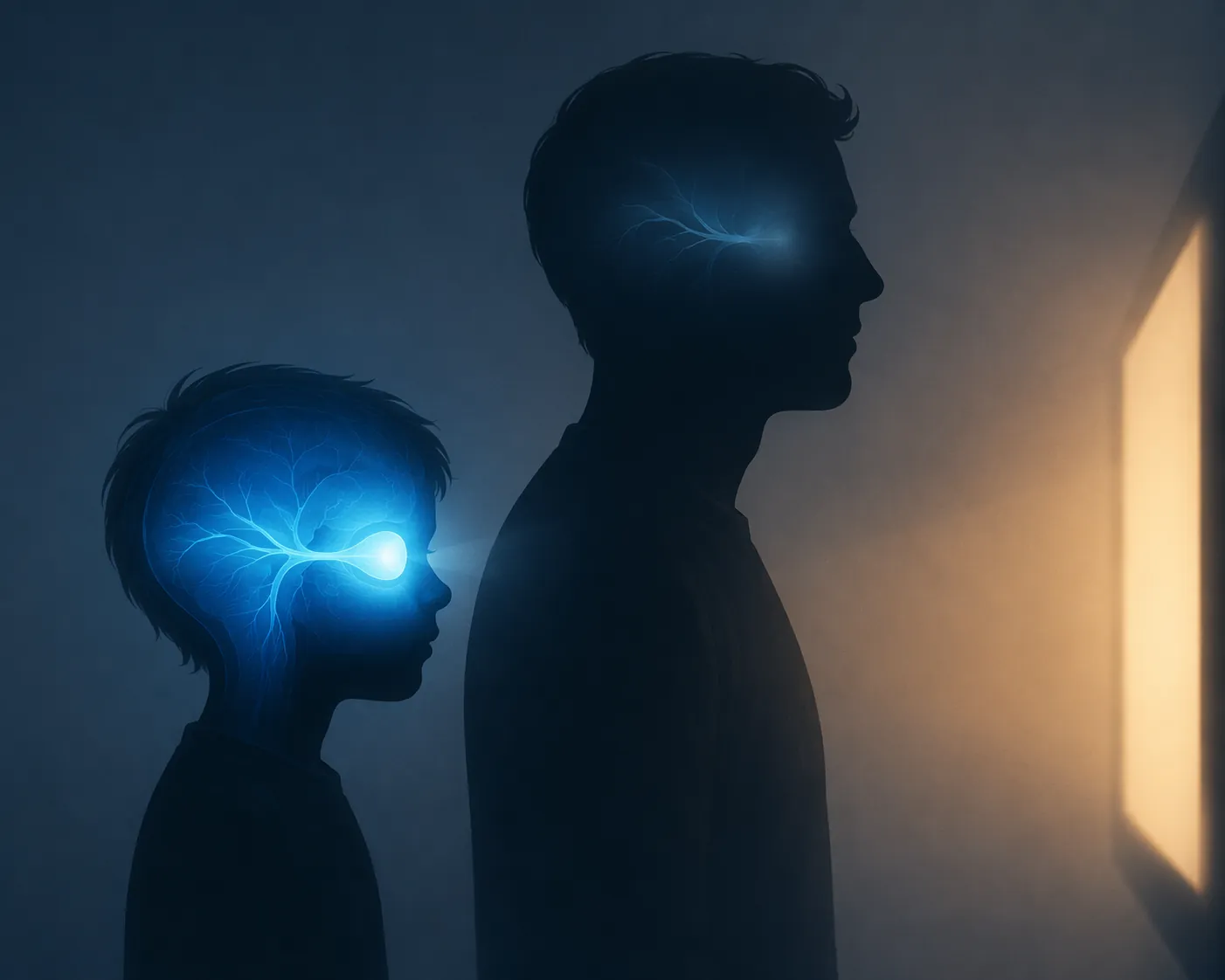
Why does the same screen light affect kids more?
Children’s eyes are not just smaller adult eyes. CU Boulder describes a structural reason younger children may be more light-sensitive at night: larger pupils and clearer lenses can allow more short-wavelength, blue-enriched light to reach the retina. The same CU Boulder summary notes that children’s eyes transmit roughly 1.2 times more blue light than adult eyes.[2]
The retina is part of the body’s clock-setting system. Evening light tells the brain, in effect, that it is not fully dark yet. Melatonin, the hormone that normally rises in the evening and helps signal biological night, can be pushed down. A child who seems wired after a tablet or a bright room may not be “fighting sleep” in the way adults often assume. Their body may have received a stronger wake-up signal than the adult sitting beside them.
The Hartstein preschool data are especially sobering because the exposure was not limited to glaring devices. In 36 children ages 3 to 5, light exposure one hour before bedtime suppressed melatonin by 70% to 99%. Even very dim light, measured at 5 to 40 lux and described as dimmer than typical room light, produced large suppression.[2] The sample is small, so it should not be stretched into a rule for every child in every home. But it does make one thing harder to dismiss: for preschoolers, the last hour before bed can be biologically sensitive even when the room does not look bright to an adult.
Screens disturb sleep in more than one way
A lot of family arguments collapse everything into one question: “How many minutes?” Minutes matter, but they are not the whole story. Gomes and Goldman describe three routes by which screens can disrupt children’s sleep: screen time can replace sleep time, light can suppress melatonin, and content can increase cognitive or emotional arousal.[3]
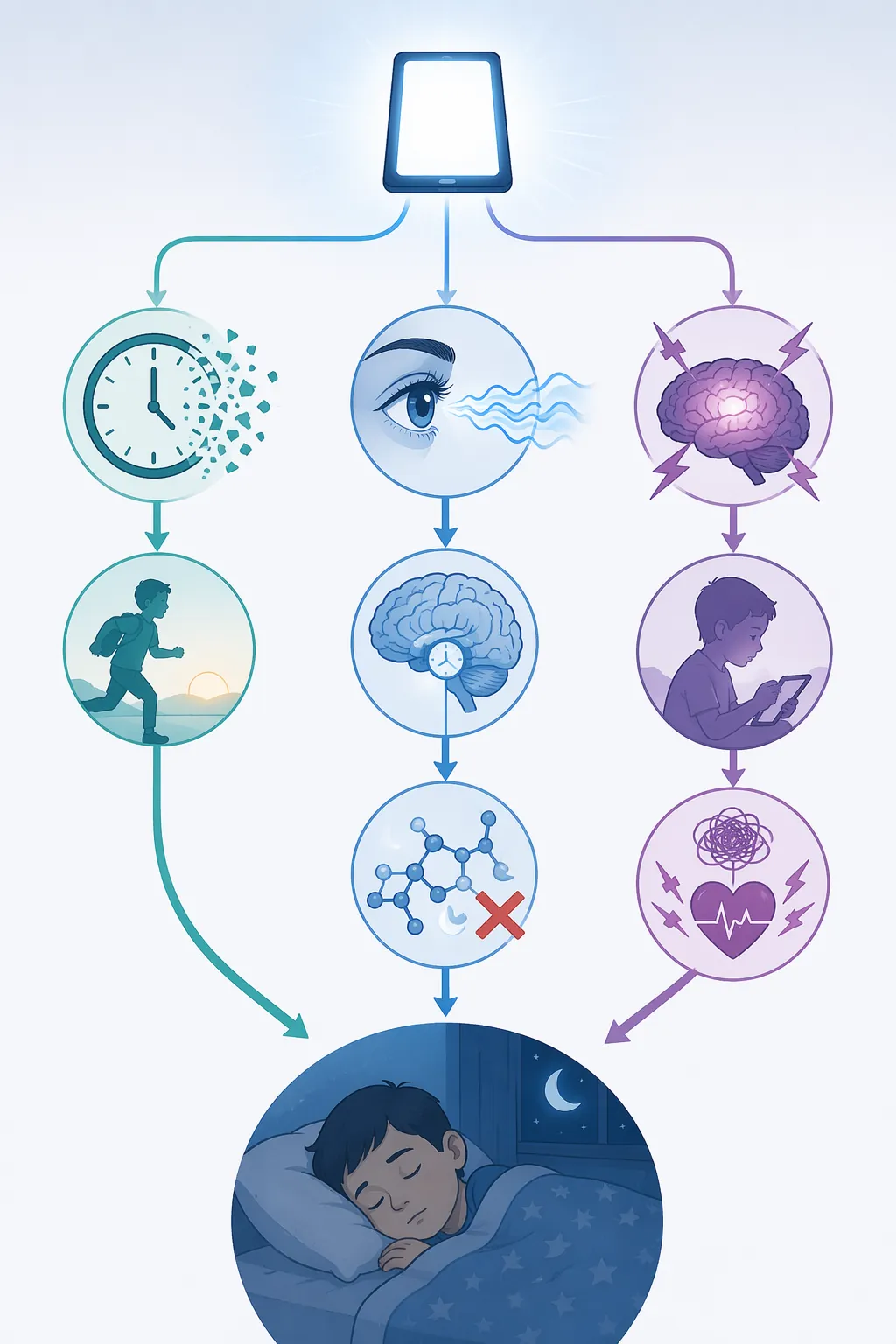
| Route | What happens | What parents may notice |
|---|---|---|
| Time displacement | The device simply uses up the time that would have gone to getting ready, settling down, or sleeping. | Bedtime slides later even when the child seems calm. |
| Light exposure | Evening light reaches the retina and can suppress melatonin, delaying the body’s night signal. | The child looks awake after the screen is off, even if the content was quiet. |
| Arousal | Games, videos, messages, or emotionally charged content keep the brain engaged. | The child wants one more episode, replays a scene, argues, worries, or keeps talking. |
Separating these routes matters because the fix is not always the same. A child watching a calm show too late may mainly have a timing problem. A child using a bright tablet in a dark bedroom may have a light problem. A child playing an exciting game may have an arousal problem even if the screen is dimmed. Many evenings include all three, but parents can make better decisions when they know which one they are trying to reduce.
So is blue light the whole problem?
No. Blue-enriched light is important because it is especially relevant to circadian signaling, and children’s eyes may let more of it through. But the bedtime problem is broader than a blue-light setting. A dimmer screen is usually better than a bright one, yet it does not give back the time spent watching. A warmer screen may reduce one kind of light exposure, but it does not make a suspenseful video emotionally neutral. A blue-light filter can help with one route while leaving the other two routes untouched.
This is also why child-safe smartphone settings should not mean only installing a timer. A timer can stop the session, which is useful. It cannot, by itself, dim the whole household, move the exciting content earlier, or keep the device out of the bedroom after lights-out.
What changes when you treat the last hour as biologically sensitive?
The mood of the rule changes. Instead of “because I said no more screens,” the family is working around a body clock that is unusually responsive to evening light. That does not remove every protest, but it makes the boundary less arbitrary.
- Move the most stimulating screen use earlier, before the bedtime routine is trying to begin.
- Dim household lights as bedtime approaches, not only the device screen.
- Keep phones, tablets, and handheld games out of the bedroom when the child is supposed to sleep.
- Use screen limits as an environmental sleep support, not as a judgment about the child’s character.
- If a screen must be used close to bedtime, choose lower brightness, calmer content, and a clear endpoint.
For younger children, the biggest practical shift is often the room, not the lecture. A bright kitchen, a glowing tablet, and a parent saying “settle down” can send competing messages. The adult is asking for sleep; the environment is still giving wake-up cues.
Does this apply to teenagers too?
The light pathway still matters for adolescents, but the bedtime picture becomes more complicated. Teens also tend to experience later circadian timing, so their bodies may naturally drift toward later sleep and wake times. That does not make late-night phone use harmless; it means a teenager’s sleep problem may not be solved by copying a preschooler’s routine with stricter enforcement.
For children in the preschool and early school-age years, the biological case for protecting the evening from bright light is more direct. The melatonin findings from preschoolers and school-age children point in the same direction, even though the studies differ in age group and design.[1][2]
Can screens ever fit into a healthy bedtime routine?
Some families may have routines where a brief, calm, predictable screen activity does not obviously disrupt sleep. That possibility should not be turned into a blanket permission slip or a blanket condemnation. The narrower biological point still stands: for young children, evening light exposure can suppress melatonin strongly, and the body may not recover immediately after the light stops.
A reasonable parent does not need to prove that every screen is toxic before changing the bedtime environment. The evidence is enough to treat the hour before bed with more care: less bright light, fewer devices in bedrooms, less activating content, and fewer routines that depend on asking a biologically alert child to suddenly behave sleepy.
The answer parents can use tonight
Screens before bed disrupt kids’ sleep more than adults’ because children appear to be more sensitive to evening light at the level of the eye and circadian system. Under identical light exposure, school-age children in one study had roughly twice the melatonin suppression of adults.[1] In preschoolers, even dim light close to bedtime produced large melatonin suppression in a small but careful study.[2]
That makes bedtime screen limits more than a preference for calmer evenings. They are a way of reducing a real sleep input: light at the wrong biological time. The most defensible rule is not “no screens because screens are bad.” It is “we make the last part of the evening darker, calmer, and less device-driven because your body clock is still learning that night has started.”
References
- How Blue Light Affects Kids’ Sleep, Sleep Foundation.
- Even minor exposure to light before bedtime may disrupt preschoolers’ sleep, CU Boulder Today, January 25, 2022.
- Screen time and sleep in children, Canadian Family Physician, 2024.
Read the full guide: How to Use an Old Phone as a Bedside Sleep Tracker