
If your zodiac sleep description sounds uncomfortably accurate, it may mean something useful — just probably not what the horoscope headline implies. Zodiac signs do not have good evidence behind them as direct predictors of sleep habits. What they can do, at their best, is give you a familiar shorthand for a pattern you already recognize: the racing mind, the schedule that keeps slipping, the need for an exact routine, the emotionally charged dreams.
That distinction matters. A mattress-retailer zodiac sleep report, for example, can tell us what kinds of sleep stories are circulating around Aries, Gemini, Virgo, Pisces, and the rest of the zodiac; it cannot prove that people born under those signs sleep that way. The Bensons for Beds Zodiac Sleep Report was a commissioned consumer-facing report featuring astrologer Joanne Jones, so it belongs in the “cultural context” pile, not the “measured sleep science” pile.[1]
The more practical question is not “Does my sign control my sleep?” It is “Which sleep problem did this description help me name?” Once you answer that, you can stop trying to optimize your bedtime by birth chart and start matching the problem to an intervention that has a better reason to work.
Where The Zodiac Frame Overlaps With Sleep Science
The strongest bridge here is not astrology. It is personality research. A 2024 systematic review of Big Five personality traits and sleep included a total sample of 58,182 people and found that some traits have more consistent links with sleep than others.[2]
Neuroticism had the clearest relationship with poorer sleep, with reported effect sizes in the 0.18 to 0.40 range across outcomes in the review.[2] That does not mean “emotional people sleep badly” as a rule. It means that tendencies such as worry, stress reactivity, and difficulty disengaging are plausible routes into insomnia symptoms, lower sleep quality, and nighttime distress.
Conscientiousness showed a different pattern, including links with morningness in the 0.16 to 0.35 range.[2] That fits the everyday observation that some people sleep best when their schedule, environment, and pre-bed sequence are predictable. It also explains why sleep tracking and “perfect routine” advice can become counterproductive for certain sleepers: the same trait that supports consistency can slide into monitoring, correcting, and grading the night.
Extraversion was more mixed in the review, which is a useful caution.[2] Sociability, stimulation-seeking, and high evening energy may affect bedtime behavior, but they do not point to one simple sleep outcome. A person who stays out late because life is interesting and a person who lies awake because their brain is replaying every conversation are not having the same sleep problem.
The honesty checkpoint is important: a large study discussed in Psychology Today reported no correlation between actual zodiac signs and Big Five traits in a sample of 173,709 people.[3] So the useful move is not “Fire signs are extraverted” or “Water signs are neurotic.” It is more modest: if a zodiac-flavored description helps you notice a real trait-like sleep pattern, use the pattern — not the sign — to choose the fix.
A Better Way To Read Zodiac Sleep Advice
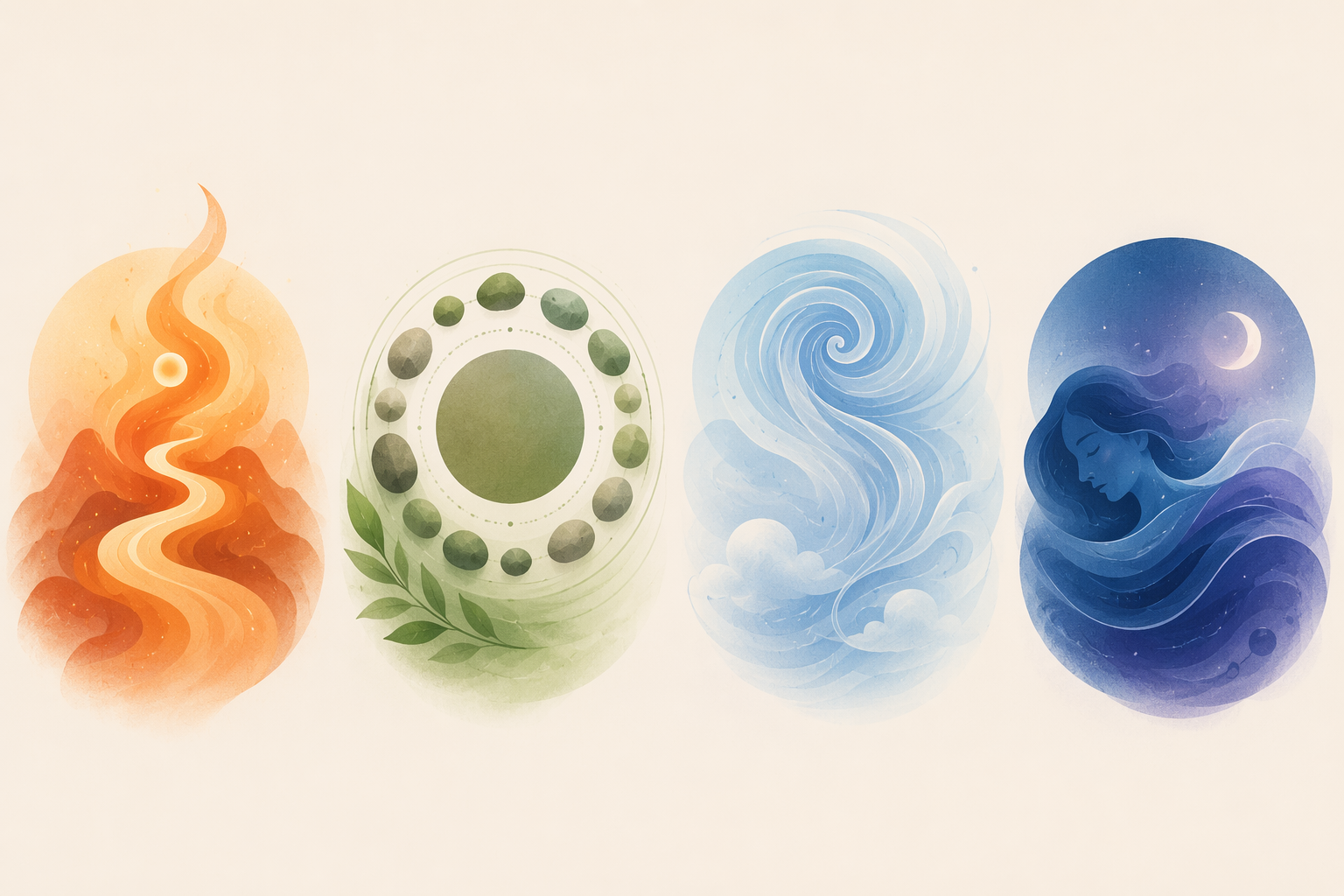
Instead of asking whether all Aries sleepers, all Virgos, or all Pisces dreamers behave alike, sort the advice by the sleep problem it is pointing toward. The element groups are useful only as a loose filing system.
| Element group | Signs included | Common sleep pattern | Better next step |
|---|---|---|---|
| Fire | Aries, Leo, Sagittarius | High evening drive, inconsistent schedule, difficulty winding down | Build a repeatable wind-down that starts before you feel sleepy |
| Earth | Taurus, Virgo, Capricorn | Routine dependence, disrupted sleep after changes, sleep-metric perfectionism | Use a “good enough” sleep framework and keep the environment stable |
| Air | Gemini, Libra, Aquarius | Racing thoughts, bedtime rumination, phone-fueled alertness | Move thinking out of bed with worry journaling, cognitive shuffling, and a digital sunset |
| Water | Cancer, Scorpio, Pisces | Emotional arousal, vivid dreams, sensitivity to the sleep setting | Downshift the nervous system and put boundaries around dream analysis |
Fire Signs: When The Problem Is Stopping
The Fire-sign sleep stereotype — Aries, Leo, Sagittarius — is usually some version of “too energized to stop.” In real life, that can look like answering one more message, starting a late workout, getting caught in a project, or treating bedtime as the point where the day’s ambitions are supposed to magically power down.
The fix is not an elaborate ritual. It is a boringly reliable off-ramp. Pick a wind-down start time that is earlier than your ideal bedtime, then make the first action physical and obvious: dim lights, plug the phone in outside arm’s reach, change clothes, wash face, make tomorrow’s first task visible. The purpose is to reduce the number of decisions between “I should go to bed” and actually getting into bed.
For restless sleepers, consistency matters more than aesthetic perfection. A pre-sleep sequence works best when it is repeatable on a normal night, not only on the rare night when you have candles, a clean room, and no pending responsibilities.
- Set a “last call” for stimulating tasks, not just a target bedtime.
- Move tomorrow-planning earlier so bed does not become a strategy meeting.
- Use the same first wind-down action every night so the routine has a clear entry point.
- If you are wide awake in bed, leave the bed for something quiet and low-light, then return when sleepy.
Earth Signs: When Good Sleep Becomes A Performance Project
Taurus, Virgo, and Capricorn sleep advice often leans into routine, comfort, and control. That can be genuinely helpful. A stable room, a familiar bedtime sequence, and a predictable wake time remove friction from sleep.
The problem starts when sleep becomes another place to achieve. If a tracker score, exact bedtime, or ideal sleep duration decides whether the night “counts,” the routine can turn into surveillance. That is especially relevant because conscientiousness is one of the Big Five traits with documented links to sleep timing patterns, including morningness.[2]
The useful frame for this group is “good enough sleep.” That does not mean ignoring sleep. It means setting a floor that protects the night without requiring a perfect score.
- Keep the wake time steadier than the bedtime; bedtime can flex when life does.
- Judge the routine by whether it helps you feel safer and sleepier, not by whether every step happened.
- Check sleep data less often if the numbers make you anxious before the day begins.
- Optimize the bedroom for repeatability: temperature, light, sound, and bedding you do not have to rethink every night.
A practical test: if your sleep tool makes you calmer, keep it. If it makes you negotiate with the night like a manager reviewing a quarterly report, it may be time to use fewer metrics.
Air Signs: When The Mind Keeps Opening New Tabs
Gemini, Libra, and Aquarius are often described in zodiac sleep content as mentally active, social, curious, and hard to switch off. This is where the astrology language can feel especially precise, because many people do not experience insomnia as “not relaxing enough.” They experience it as a mind that will not stop producing tabs.
The sleep-science version is cognitive arousal: planning, replaying, problem-solving, rehearsing conversations, reading one more thing, or using the phone to quiet the mind and accidentally feeding it. Personality research does not need to prove that Air signs exist for this pattern to be real. Rumination and worry are recognizable pathways into poor sleep, and neuroticism’s relationship with poorer sleep in the Big Five review is one reason that emotionally charged thinking deserves more attention than generic “just relax” advice.[2]
A better bedtime plan gives the mind somewhere to put its unfinished material before the pillow gets involved.
Try A Short Worry Journal
Do this away from bed. Write the concern, the next possible action, and when you will look at it again. The point is not to solve your life at night. It is to show the brain that the issue has been captured and scheduled.
Use Cognitive Shuffling When Thinking Turns Sticky
Cognitive shuffling is a simple mental technique: choose a neutral word, then imagine unrelated objects or scenes that begin with each letter. The images should be ordinary and low-stakes. You are not trying to create a story; you are interrupting the mind’s habit of building one.
Set A Digital Sunset With A Specific Replacement
“Stop scrolling” is weak advice unless something else is ready to take its place. Put the phone somewhere inconvenient, then replace it with a low-input option: a familiar book, an audio track you have already heard, stretching, or a paper list for tomorrow. The replacement should reduce novelty. Novelty is the trap.
Water Signs: When Sleep Carries The Emotional Weather
Cancer, Scorpio, and Pisces sleep descriptions often emphasize sensitivity, vivid dreams, emotional processing, and porous boundaries between the day and the night. Again, the sign is not the evidence. The recognizable problem is emotional arousal.
This is the element group where the Big Five evidence is most useful as a guardrail. Neuroticism’s association with poorer sleep outcomes does not make intense feeling a flaw; it suggests that stress reactivity and difficulty disengaging can follow a person into bed.[2] If your sleep gets worse after conflict, grief, uncertainty, or overstimulation, the intervention needs to address the nervous system, not just the pillow.
Start with a downshift that is bodily rather than analytical. Slow breathing, progressive muscle relaxation, a warm shower, gentle stretching, or a quiet sensory cue can help mark the transition out of the day. The aim is not to erase emotion before sleep. It is to stop asking the bed to be the first place your body finally gets permission to feel it.
Dream journals need a boundary for this group. If writing dreams down helps you feel less haunted by them, keep it brief and do it after waking. If it turns into interpretation spirals, delay it until later in the morning or skip it on emotionally loaded days. A dream record should lower the charge; it should not become a second night shift.
- Use relaxation before dream analysis.
- Keep emotionally intense conversations out of the final stretch of the night when possible.
- Make the room feel steady: low light, familiar sound, comfortable temperature, and fewer sensory surprises.
- If dreams are distressing, recurring, or trauma-related, treat that as a clinical signal rather than a personality quirk.
What Your Sign Can And Cannot Tell You
There is no need to throw away the little moment of recognition that made you click on zodiac signs and sleep habits in the first place. Recognition can be useful. It can tell you, “Yes, this is the kind of tired I am.”
The mistake is turning recognition into prediction. Your sign does not determine your sleep duration, sleep quality, bedtime, dreams, or insomnia risk. The current evidence supports a narrower and more helpful conclusion: some of the sleep struggles commonly assigned to zodiac elements resemble personality-linked sleep patterns, and those patterns point toward different interventions.
If the Fire description fits, work on the off-ramp. If Earth fits, protect routine without worshiping the score. If Air fits, move thinking out of bed. If Water fits, calm the nervous system before you interpret the night. The stars do not have to be causal for the pattern to become useful.
References
- The Bensons for Beds Zodiac Sleep Report, ResponseSource.
- Big Five personality-sleep systematic review, PubMed Central, 2024.
- Lu et al. 2020 173,709-person study, Psychology Today, 2020.
Comments
Join the discussion with an anonymous comment.