Mechanism explainer
Chronotype Guide: Are You a Morning Person or Evening Person?
Chronotype — your body's natural preference for sleep and wake timing — is a biologically real, genetically influenced trait distributed along a continuous spectrum, not a binary identity. This guide explains what drives your chronotype, how to assess it with validated tools, how it shifts across your lifetime, and what it means for building sleep habits that work with your biology rather than against it.
The Question Itself Is Misleading
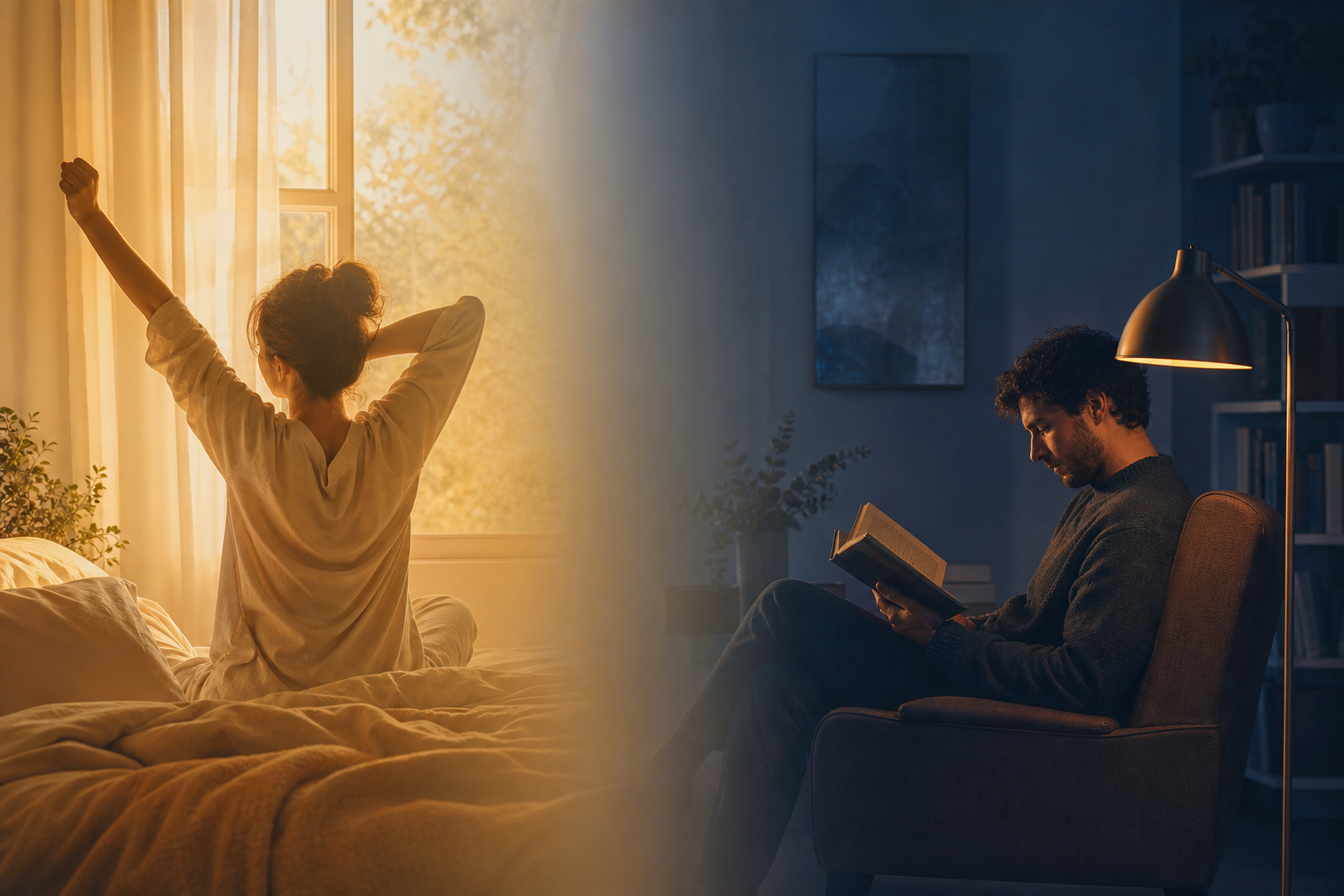
"Are you a morning person or an evening person?" The phrasing implies a clean division — two camps, one identity. The biology does not work that way. Chronotype falls along a continuous spectrum, and roughly half of all adults land somewhere in the middle. Surveys of tens of thousands of people consistently show that only about 10–25% of the population sits at either extreme. Most people are intermediate types who lean one way or the other but do not fit neatly into "lark" or "owl."
The framing matters because it shapes how people interpret their own sleep struggles. Someone who cannot fall asleep before midnight might conclude they lack discipline. Someone who wakes naturally at 5 am might assume they have better character. Neither conclusion is accurate. What differs between these people is the timing of a biological oscillator — not their work ethic or virtue.
You may have encountered the lion/wolf/bear/dolphin typology popularized in recent years. It is culturally widespread, and the four-animal framework is easy to remember. It is also not validated against objective biological markers such as dim-light melatonin onset. This article grounds its framework in the two instruments that are: the Morningness-Eveningness Questionnaire (MEQ) and the Munich ChronoType Questionnaire (MCTQ), both of which correlate meaningfully with measurable circadian physiology.
What Chronotype Actually Is — and How It Differs from Circadian Rhythm
Every human has a circadian rhythm — a roughly 24-hour internal oscillator that regulates sleep, wakefulness, body temperature, hormone secretion, digestion, and dozens of other physiological processes. This oscillator is universal. What varies between individuals is not whether they have one, but where it is set in time.
Chronotype is the individual expression of how your circadian clock is timed relative to the social clock — the shared external world of work schedules, school start times, and daylight hours. Two people can have equally robust, well-functioning circadian rhythms. One person's rhythm peaks and troughs two hours earlier than the other's. That difference in phase position is chronotype.
The consequences extend well beyond when you prefer to fall asleep. Chronotype governs the timing of:
- Core body temperature rhythm — the daily rise and fall that signals wakefulness and sleep readiness
- Melatonin secretion onset — the hormonal signal that initiates sleep pressure
- Cortisol awakening response — the morning hormone surge that promotes alertness
- Cognitive peak windows — when working memory, attention, and processing speed are at their highest
- Appetite and digestive timing — when hunger signals are strongest
- Athletic performance peaks — when muscle strength and cardiovascular output are optimal
This is why chronotype is not simply a "sleep preference." It is the phase signature of your entire biological day.
What Determines Your Chronotype
Three factors drive chronotype, in rough order of strength: genetics, age, and light environment. Sex plays a secondary modulating role.
Genetics
The most powerful evidence comes from a 2019 genome-wide association study involving 697,828 participants, which identified 351 genetic loci associated with being a morning person. Many of the strongest associations fall in known circadian clock genes: PER1, PER2, PER3, CRY1, FBXL3, and ARNTL. The study estimated SNP heritability of chronotype at approximately 13–14%. The 5% of individuals carrying the most morningness-associated alleles had sleep timing shifted roughly 25 minutes earlier than the 5% carrying the fewest.
Twin studies suggest the true heritability figure is higher — the GWAS estimate captures only common variants and likely underestimates the total genetic contribution. The practical implication is that genetics anchors your chronotype without fully fixing it. It sets the range within which environmental and behavioral factors operate.
Age
Chronotype shifts substantially across the lifespan in a predictable arc — early morningness in infancy, progressive shift toward eveningness through childhood and adolescence, then a gradual return toward earlier timing through adulthood. This arc is covered in detail in a later section.
Light Environment
Light is the primary external input to the circadian clock — the dominant zeitgeber (time-giver). Morning bright-light exposure advances the clock; evening light delays it. This makes light the most actionable chronotype-alignment lever available to adults. Unlike genetics or age, light timing is something you can influence deliberately — within limits.
Sex
Before approximately age 50, men on average show slightly later chronotypes than women of the same age. This gap narrows and largely disappears in older adulthood. The mechanism likely involves sex hormone interactions with circadian clock gene expression, though the effect size is modest compared to age and genetics.
How to Assess Your Chronotype Reliably
Two validated research instruments exist for assessing chronotype. They approach the question from different angles and have complementary strengths.
| Instrument | What it measures | Output | Score interpretation | Best used for |
|---|---|---|---|---|
| MEQ (Morningness-Eveningness Questionnaire) | Preferences across 19 scenarios — when you would choose to wake, exercise, take a demanding test, etc. | Single score from 16 to 86 | ≤41 = evening type; 42–58 = intermediate; ≥59 = morning type | Population research; personal self-assessment; freely available for non-profit use |
| MCTQ (Munich ChronoType Questionnaire) | Actual sleep and wake times on free days vs. work/school days | MSFsc — mid-sleep on free days corrected for sleep debt; also calculates social jetlag | Earlier MSFsc = more morning-leaning; later MSFsc = more evening-leaning | Clinical research; situations where actual sleep behavior is more informative than preferences |
A controlled study comparing both instruments to DLMO in 60 participants found that MEQ scores and MCTQ-derived MSFsc each correlated significantly with DLMO (r = −0.70 and r = 0.68, respectively). Together with age, they explained approximately 60% of the variance in DLMO timing.
A practical self-observation approach: track your natural sleep and wake times on multiple consecutive free days — days with no alarm, no obligations, no alcohol or unusual stress. Your average mid-sleep time on those days (halfway between when you fell asleep and when you woke) is a reasonable proxy for your endogenous circadian timing. This is the core logic behind the MCTQ.
Animal-type quizzes (lion, wolf, bear, dolphin) are memorable and widely shared. They are not validated against biomarkers such as DLMO or core body temperature rhythms. They may correlate loosely with MEQ scores, but they should not be used to time clinical interventions or to make confident claims about your biological circadian phase.
The Biological Fingerprints of Morning and Evening Types
Morning and evening types differ in measurable physiological ways — not in motivation, character, or work ethic. Understanding these differences helps explain why generic sleep advice often fails people whose biology does not match the assumed schedule.
| Biological marker | Morning type | Evening type |
|---|---|---|
| Dim-light melatonin onset (DLMO) | Earlier — melatonin rises sooner in the evening | Later — melatonin rise is delayed relative to clock time |
| Core body temperature minimum | Earlier — approximately 4 am | Later — approximately 6 am |
| Cortisol awakening response | Peaks earlier after waking | Peaks later after waking |
| Cognitive peak window | Morning hours | Late afternoon to evening |
| Athletic performance peak | Earlier in the day | Later in the day — higher VO2 max and strength output in evening |
| Natural sleep midpoint (free days) | Earlier | Later |
A detail worth noting: morning types do not simply wake up earlier. They wake at a later circadian phase despite waking at an earlier clock hour — meaning their biology has already progressed further through the sleep-wake cycle by the time they open their eyes. Evening types who wake at the same clock hour are waking at an earlier circadian phase, which is why they feel groggy and cognitively impaired in early morning: their biology is still in what amounts to the middle of their night.
Intermediate types share features of both, weighted toward their dominant lean. The spectrum is continuous, and most people experience moderate rather than extreme versions of these physiological differences.
How Chronotype Shifts Across Your Lifetime
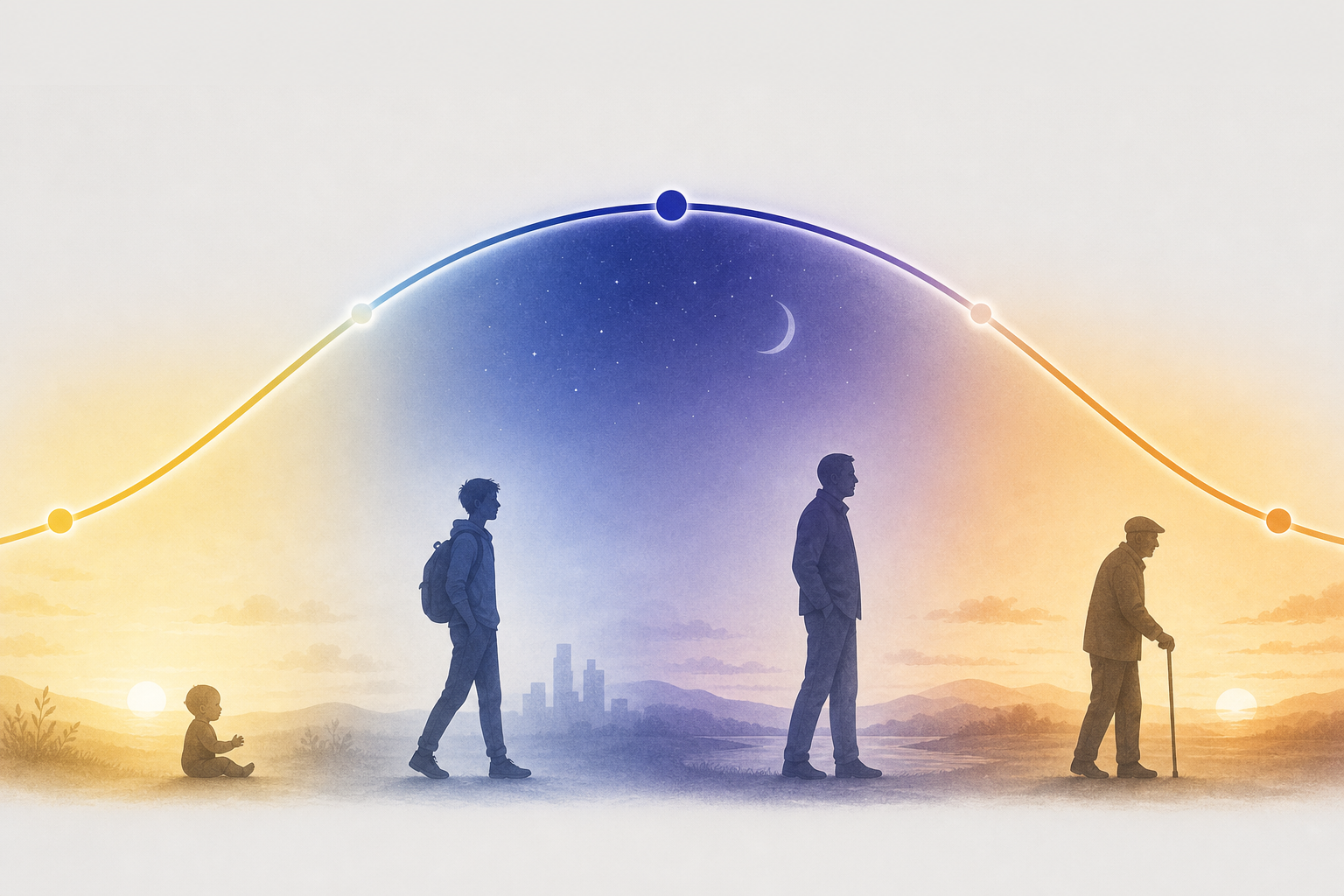
Chronotype is not static across a lifetime. It follows a well-documented developmental arc that is now supported by both large-scale survey data and objective actigraphy measurements.
A cross-sectional study of 26,214 participants across ages 0 to 30 mapped this arc in detail. At ages 0–1, approximately 70% of infants are morning types and only about 1% are evening types. The shift toward eveningness begins in early childhood, accelerates sharply during puberty, and reaches its peak in mid-to-late adolescence. The turning point toward morningness occurs at approximately 15.7 years in girls and 17.2 years in boys.
By age 16, only about 5% of adolescents are morning types — compared to 70% at age 0–1 — while approximately 19% are evening types. This is not a behavioral choice or a failure of sleep discipline. It is a developmentally normal biological shift, likely driven by puberty-related changes in circadian clock gene expression and melatonin timing.
Objective confirmation comes from an accelerated longitudinal study using wrist actigraphy in 329 adolescents aged 14 to 22. Chronotype shifted toward eveningness by approximately one hour and 54 minutes between ages 14 and 19, then began shifting back toward morningness — confirming the developmental arc with objective sleep-timing data rather than self-report alone.
Through young adulthood and into middle age, chronotype gradually advances toward earlier timing. This process accelerates in older adults, who often become strongly morning-preferring. The person who could not sleep before 1 am at age 19 may find themselves naturally awake by 6 am at age 65 — and both experiences reflect the same underlying biology, operating at different life stages.
Social Jetlag: When Your Biology and Your Schedule Disagree
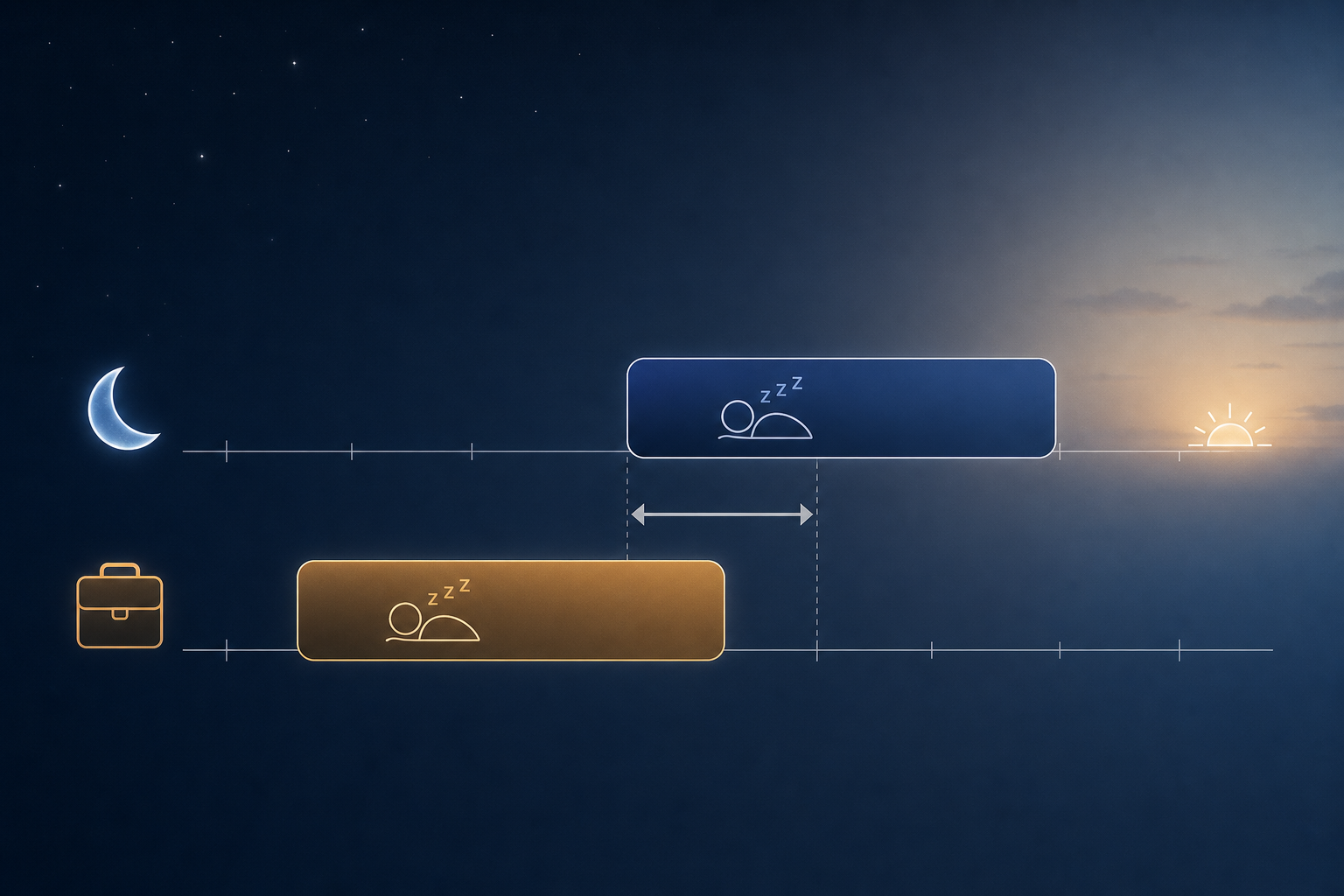
Social jetlag is defined as the difference in sleep midpoint between free days (when you sleep on your own schedule) and work or school days (when an external schedule dictates your wake time). It is calculated from MCTQ data and expressed in hours.
For a strong evening type forced to wake at 7 am for work, the social jetlag can easily reach one to two hours daily — the biological equivalent of traveling one to two time zones west every Sunday night and returning every Friday. Unlike travel-related jetlag, this mismatch never fully resolves during the workweek. It accumulates.
A natural experiment during pandemic-related social restrictions showed that social jetlag decreased by approximately 30 minutes when people gained more control over their schedules — underscoring that the mismatch is structural and schedule-driven, not dispositional.
What Social Jetlag Is Associated With
Research consistently links social jetlag to adverse health outcomes. In people with obesity-related chronic conditions, social jetlag exceeding one hour has been associated with higher odds of overweight status and elevated fasting glucose. Evening types and those with larger social jetlag also show greater intake of energy and saturated fat at dinner, which may contribute to cardiometabolic risk over time. Mental health burden — including depressive symptoms, anxiety, and emotional dysregulation — is also associated with greater eveningness and social jetlag.
A 2025 cross-sectional study of 428 adults found that eveningness was associated — in decreasing order of strength — with emotion dysregulation, ADHD symptoms, depression, autism traits, emotional instability, generalized anxiety, social anxiety, and impulsivity. The authors explicitly caution that the cross-sectional design prevents causal conclusions: depression itself may predict future evening preference, meaning the relationship runs in both directions. Maintain appropriate caution when interpreting these associations — "associated with" is not the same as "causes."
Sleep Hygiene Tailored to Your Chronotype
The general foundation of good sleep hygiene — consistent sleep timing, a settled wind-down period, a cool and dark sleep environment, stimulus control — applies to everyone regardless of chronotype. The evidence-based sleep hygiene fundamentals guide covers that foundation in full. What follows focuses strictly on what changes by type: when to seek light, when to avoid it, how to time caffeine, how to approach exercise, and how to anchor your schedule.
| Practice | Evening type | Morning type | Both types |
|---|---|---|---|
| Morning light exposure | 10–30 minutes of bright light within 30 minutes of waking — advances the clock over days to weeks | Less urgent; natural morning light is already well-timed | Consistent morning light exposure supports circadian stability |
| Evening light management | Light curfew 2 hours before target bedtime; dim indoor lighting; blue-light filtering after dark | Evening light exposure can help delay premature drowsiness if needed | Avoid bright overhead light in the 1–2 hours before bed |
| Caffeine cutoff | Move cutoff earlier relative to natural sleep onset — not by clock time, but relative to your biological bedtime | Avoid overly early cutoffs that eliminate afternoon function; caffeine is well-timed in the morning | Caffeine half-life is approximately 5–7 hours; the cutoff should account for your actual bedtime, not a universal 2 pm rule |
| Exercise timing | Avoid high-intensity exercise within 2–4 hours of target bedtime — it raises cortisol and adrenaline and can worsen evening alertness | Morning high-intensity exercise is generally well-tolerated; monitor recovery if waking very early | Moderate exercise earlier in the day supports sleep quality for both types |
| Wake-time anchoring | Anchor wake time consistently, including weekends — this is the single most powerful behavioral lever for stabilizing circadian timing | Same principle applies; avoid sleeping significantly later on weekends | Consistency of wake time matters more than bedtime consistency for circadian stability |
For Evening Types: The Light Strategy
Morning bright-light exposure is the most evidence-supported behavioral tool for advancing an evening chronotype. The mechanism is direct: light hitting the retina in the morning suppresses residual melatonin and sends a strong phase-advancing signal to the suprachiasmatic nucleus — the circadian pacemaker. Consistent exposure over days to weeks can shift sleep timing earlier by one to two hours.
The practical target is 10 to 30 minutes of bright light within 30 minutes of waking. Outdoor natural light is most effective; indoor lighting is generally insufficient unless a dedicated bright-light device is used. Timing matters more than intensity — light exposure in the first hour after waking has the strongest phase-advancing effect.
In the evening, the goal is the reverse: reduce light input so that melatonin onset is not further delayed. Dimming overhead lights, switching to warmer-toned lamps, and reducing screen brightness two hours before your target bedtime all reduce the phase-delaying stimulus that keeps the evening-type clock running late.
For Morning Types: Avoiding Premature Drowsiness
Morning types face a different problem: their clock advances naturally, sometimes to the point where they become sleepy in the early evening and wake before they want to in the early morning. Evening light exposure — spending time outdoors in late afternoon or using brighter indoor lighting in the evening — can modestly delay the clock and extend the evening alertness window.
Morning types should also be cautious about caffeine cutoffs that are too early. Eliminating caffeine by noon to protect sleep may leave afternoon hours cognitively impaired without meaningfully improving sleep for someone whose natural bedtime is 9 or 10 pm. The cutoff should be calibrated to the actual bedtime, not a generic early-afternoon rule.
The Wake-Time Anchor
For both types, the single most powerful behavioral lever is a consistent anchor wake time — waking at the same time every day, including weekends. Bedtime is harder to control directly; it is downstream of sleep pressure and circadian phase. Wake time is something you can control, and consistency of wake time is what stabilizes the circadian anchor point over time.
Sleeping significantly later on weekends — common in evening types catching up on sleep debt — resets the clock toward a later phase, making Monday morning harder and perpetuating the social jetlag cycle. The goal is not to eliminate all flexibility, but to keep the weekend wake time within about 30 to 60 minutes of the weekday wake time.
When Chronotype Becomes a Clinical Issue
A strong evening preference is not a disorder. Most evening types can function adequately — if uncomfortably — within standard social schedules, and many find that chronotype-aligned behavioral adjustments meaningfully reduce their sleep difficulties. But there is a distinct clinical condition that goes further: Delayed Sleep-Wake Phase Disorder (DSWPD, also called DSPD).
DSWPD is characterized by a sleep-wake cycle that is chronically delayed by two or more hours relative to conventional timing, is resistant to voluntary adjustment, and causes significant functional impairment in daily life — not just inconvenience, but inability to meet social, occupational, or educational obligations without severe consequences. The person with DSWPD does not simply prefer late nights. They are physiologically incapable of initiating sleep at a conventional time, and forced early waking leaves them severely impaired.
If your MEQ score is at the extreme evening end and your sleep timing is genuinely intractable — you cannot fall asleep before 2 or 3 am regardless of behavioral effort, and early wake times leave you severely impaired for hours — clinical evaluation is warranted. DSWPD is a recognized circadian rhythm disorder, not a character flaw.
Evidence-based treatment for DSWPD includes timed bright-light therapy and low-dose melatonin administered at the correct circadian phase — not simply at bedtime. The timing of both interventions depends on individual DLMO, which requires clinical assessment. Recall the four-hour DLMO range at any single MEQ score: self-treating with light or melatonin based on questionnaire score alone risks mistiming the intervention, which can worsen circadian misalignment rather than correct it.
Supports these guides
Spot an error or have clinical feedback?
Because this article covers clinical, medication, or safety information, we use a moderated correction channel instead of open public comments. Let us know if something about “Chronotype Guide: Are You a Morning Person or Evening Person?” needs a closer look.
Send feedback on this article