
Mechanism explainer
How heat domes block the cooling your sleep needs
Heat domes trap high temperatures through the night, preventing the core body temperature drop required for sleep onset and maintenance. This explainer details how deep sleep (N3) takes the biggest hit, drawing on data from over 23 million sleep records and global studies.
A heat dome does not just make the afternoon hotter. Its sleep damage begins after sunset, when the bedroom should finally start giving heat back to the night. Under a strong high-pressure system, warm air is capped over a region like a lid, and the usual evening radiational cooling is blunted or delayed. That missing nighttime release is why a heat dome can feel different from an ordinary hot day: the day ends, but the body never receives the cooler environment it depends on to move into sleep. UC Davis describes this atmospheric setup as a high-pressure system that traps heat and suppresses normal relief, including the cooling that would otherwise arrive overnight.[1]

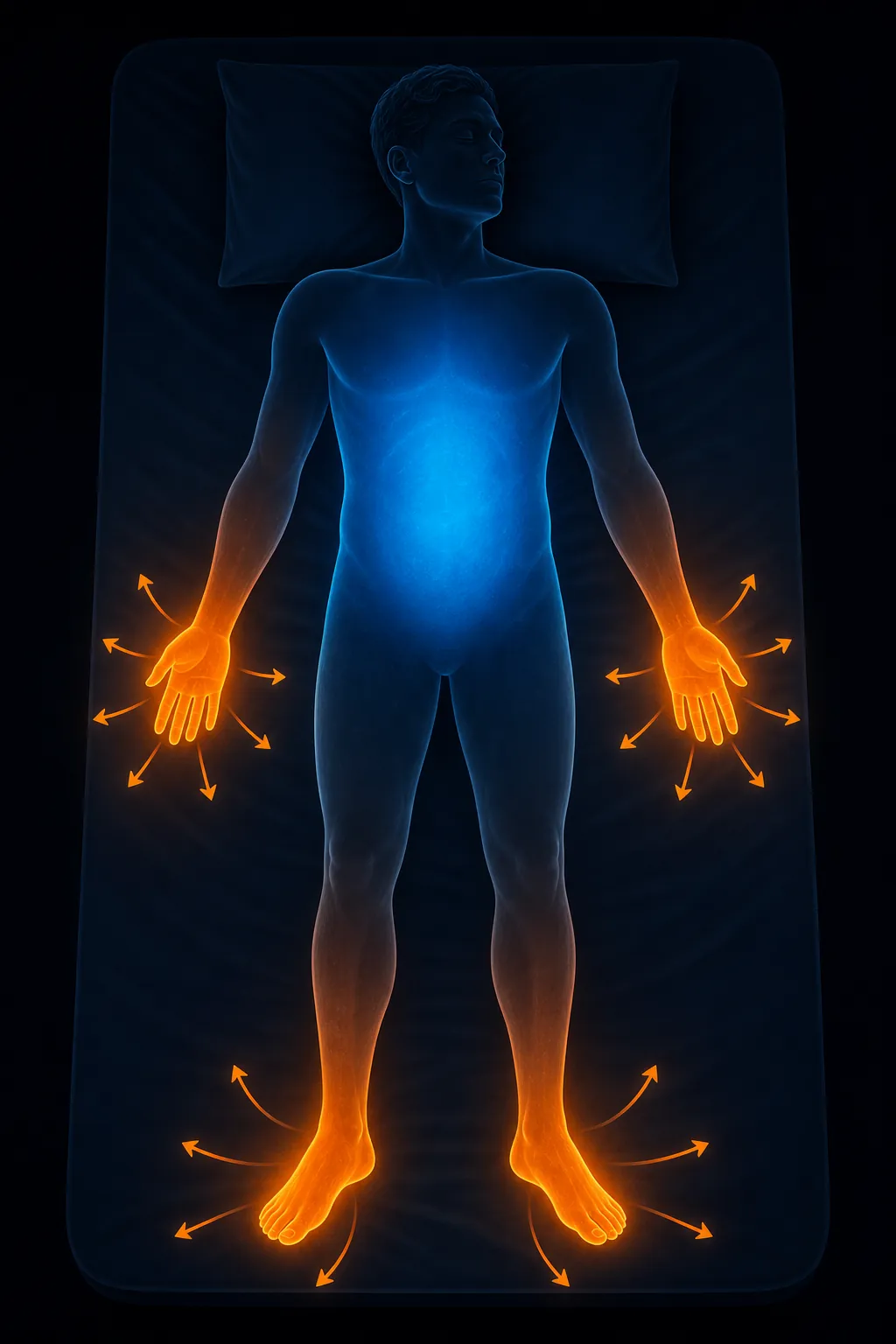
That is the short answer to how heat domes affect sleep: they keep the surrounding air too warm for the body’s normal sleep-onset cooling to proceed. Sleep is not simply the brain deciding to switch off. It is a thermoregulatory transition. Core body temperature needs to fall by about 0.5–1°C around sleep onset, and that fall depends partly on heat moving out through the skin, especially through the hands and feet.[2][3]
When the room stays hot, the bottleneck is physical. Blood vessels near the skin widen, the hands and feet try to act like radiators, and the body attempts to dump heat into the surrounding air. If the air is still too warm, the gradient is too weak. The body can be tired, the room can be dark, and the clock can say bedtime, but the cooling signal that helps open the night is muted.
The night fails before sleep begins
The useful threshold is not the day’s headline temperature. It is whether the sleeping environment falls far enough below roughly 24–25°C to let heat leave the body. Publicly available expert comments in Le Monde describe the sleep problem in these terms: the body needs a core temperature decline, and ambient heat above that approximate range makes it harder to dissipate heat at night.[3]
This is why a bedroom that “only” feels stale can still be physiologically hostile. A person lying awake at 2 a.m. may not be experiencing dramatic heat illness. They may simply be stuck at the entrance to sleep because their core temperature has not fallen enough. The hands and feet may feel warm because they are being recruited to release heat, not because the process is succeeding.
Humidity makes the same temperature more punishing. Sweating helps only when sweat can evaporate. In humid air, evaporation slows, so the body loses one of its remaining routes for heat removal. Experimental and review work on thermal environments and sleep has found that humid heat can worsen sleep disruption beyond what dry temperature alone would suggest.[4]
The result is not always one clean symptom. Some people take longer to fall asleep. Some wake repeatedly. Some sleep for what looks like a tolerable number of hours but wake up unrefreshed because the night contained less of the deepest sleep. Heat is not only stealing time; it is changing the shape of the night.
Deep sleep appears especially vulnerable
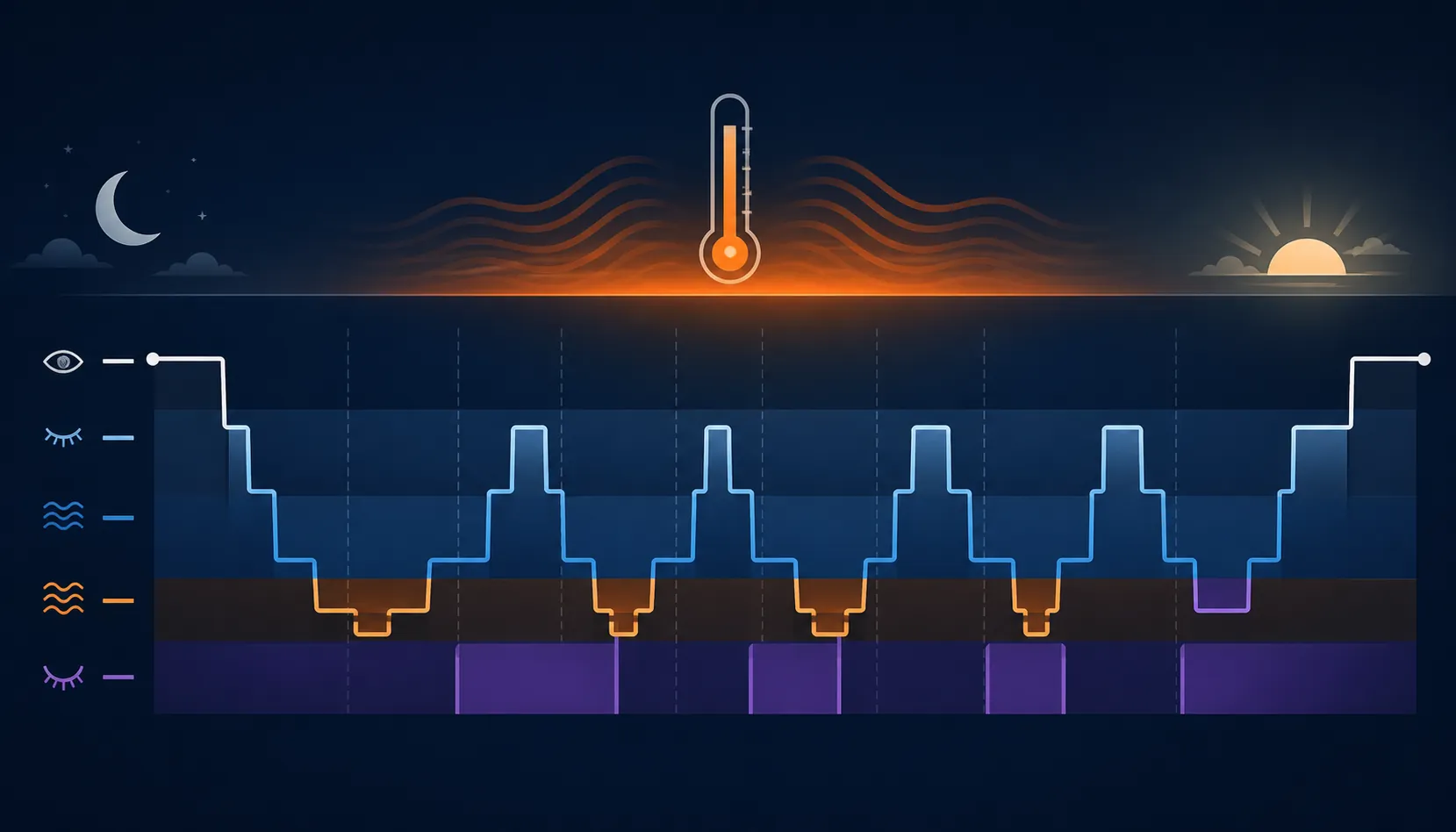
The clearest large-scale stage evidence comes from Li et al. 2025 in Nature Communications, which analyzed more than 23 million sleep records from wearable devices. For each 10°C rise in daily mean temperature, the odds of sleep insufficiency rose 20.1%. More specifically, deep sleep, or N3, showed the largest proportional stage decline: a 2.82% drop in duration per 10°C rise.[5]
That N3 result matters because deep sleep is not just another slice of a sleep chart. It is the stage most associated with high sleep pressure being discharged early in the night, with the brain entering large slow-wave activity rather than hovering near lighter sleep. If heat delays sleep onset and keeps the body struggling to cool, the early-night window in which N3 is normally most prominent becomes easier to compress.
The wearable evidence should be read carefully. Li et al. studied Chinese participants using Huawei devices, so the dataset is not a direct map of every climate, housing type, culture, or population. Wearables also do not replace laboratory polysomnography. Still, repeated records from millions of nights can reveal heat-linked patterns that small laboratory studies cannot capture. The reasonable interpretation is convergence, not overclaim: this dataset shows a large real-world association, and its direction fits what controlled thermal physiology would predict.[5]
| Finding | What it measures | Best use in this question |
|---|---|---|
| 20.1% higher odds of sleep insufficiency per 10°C rise | Likelihood of insufficient sleep in a large wearable dataset | Shows that hotter days are linked with poorer sleep at scale |
| 2.82% lower N3 duration per 10°C rise | Proportional reduction in deep sleep duration | Identifies the sleep stage that appears most sensitive |
| About 14 minutes less sleep on nights above 30°C | Average sleep-duration loss across a global sample | Gives readers a practical sense of the size of the effect |
The loss is not only visible in one dataset
Minor et al. 2022 looked at sleep and temperature across 47,000 adults in 68 countries. One useful scale-setting finding is that on nights above 86°F, or 30°C, people slept about 14 minutes less on average.[6] Fourteen minutes may sound modest if imagined as a single night. During a heat dome, the problem is repetition: the room fails to recover, sleep debt accumulates, and the person begins the next evening already less resilient.
The global result also helps keep the wearable findings in proportion. Li et al. offers unusually detailed repeated-measure evidence, including sleep stages; Minor et al. supports the broader point that warmer nights reduce sleep across many settings. Controlled thermal studies then explain why the association makes biological sense rather than appearing as a mere seasonal correlation.[2][5][6]
A heat dome is especially unfriendly to sleep because it tends to repeat the same insult. An older controlled study by Libert et al. reported no automatic adaptation after 5 consecutive hot nights.[7] That finding is uncomfortable because it pushes against a common hope: that the body will simply “get used to it” by the third or fourth night. Some people may adjust behaviorally by changing bedding, timing showers, or moving rooms, but the physiological burden of hot nights does not disappear just because the exposure continues.
Why the same forecast does not mean the same night
Outdoor temperature is only a rough proxy for the temperature the sleeper actually experiences. A top-floor apartment, a poorly ventilated bedroom, a west-facing room that stored afternoon sun, or a home without reliable air conditioning can stay warm long after the official weather station cools. During a heat dome, this gap matters because the central problem is not just peak heat. It is whether the sleeping space ever falls into a range where the body can shed heat efficiently.
Individual susceptibility also varies. Older adults often have reduced thermoregulatory capacity. Perimenopausal women may already be dealing with temperature dysregulation and night sweats. People with sleep apnea can be especially vulnerable when heat fragments sleep or worsens nighttime breathing comfort. Body size, sex, medications, bedding, and baseline sleep health can all change how a given room temperature is felt and tolerated. Those modifiers do not replace the main mechanism; they decide who reaches the limit sooner.
Access to cooling is another reason population averages can understate the experience of people in the hottest bedrooms. A study average mixes sleepers with air conditioning, sleepers with partial cooling, and sleepers with little relief. The 14-minute average loss above 30°C is therefore not a personal ceiling. Someone whose bedroom remains hot and humid for much of the night can fare worse than the mean, while someone in a cooled room may be partly protected.[6]
What the body is trying to do at 2 a.m.
During a normal evening, the body begins shifting heat outward. Peripheral blood vessels widen, heat leaves through the skin, and core temperature falls. That cooling is not decorative; it is part of the entry into sleep. In a heat dome, the body can still try to run the program, but the surrounding air is a poor heat sink. Warm hands and feet, sticky sheets, and repeated position changes are signs of a thermoregulatory task that has become inefficient.
This is also why advice that treats hot-night sleep as a matter of willpower misses the point. The person lying awake may have a quiet room, a regular bedtime, and genuine sleep pressure. If core temperature is not falling, sleep onset can stall. If the night remains hot, lighter sleep and awakenings become more likely. If the early part of sleep is disrupted, N3 may be the stage that pays the largest proportional price.[5]
Cooling strategies can help when they actually lower the sleeping environment or improve heat loss from the body. But the main explanation is not a missing trick. Heat domes damage sleep because they remove the overnight cooling window the body depends on. The atmosphere holds heat in place; the bedroom fails to release it; the skin cannot shed enough warmth; core temperature does not drop as it should; and deep N3 sleep appears especially sensitive to that blocked descent.
References
- Guide to heat domes and how to prepare for them, UC Davis.
- The Temperature Dependence of Sleep, Frontiers in Neuroscience, 2019.
- Why heatwaves disrupt our sleep – and how we can protect it, Le Monde, July 2026.
- Effects of thermal environment on sleep and circadian rhythm, PMC, 2012.
- Climate warming may undermine sleep duration and quality in repeated-measure study of 23 million records, Nature Communications, 2025.
- Temperature-sleep findings across 68 countries, One Earth, 2022.
- Heat-related sleep disruption and lack of adaptation after 5 consecutive hot nights, Sleep, 1988.
Supports these guides
Spot an error or have clinical feedback?
Because this article covers clinical, medication, or safety information, we use a moderated correction channel instead of open public comments. Let us know if something about “How heat domes block the cooling your sleep needs” needs a closer look.
Send feedback on this article