
Mechanism explainer
More Than Half of Veterans With Head Trauma Have Sleep Problems
Over half of veterans with traumatic brain injury experience persistent sleep disorders, yet most go undiagnosed. This article explains the scale of the problem, why sleep disruption is a core TBI consequence, and why it demands attention for recovery.
One of the most uncomfortable findings about sleep problems after head trauma in veterans is not simply that sleep disorders are common. It is that they can be common in structured assessment and almost invisible in the medical record. In a VA Research report on post-9/11 veterans with traumatic brain injury, about 77.7% met criteria for insomnia disorder in a research assessment, while only about 3% had insomnia documented in their medical records.[1]
That gap is too large to dismiss as paperwork. It means many veterans may be living for years with fragmented sleep, long wake periods, early-morning awakenings, nightmares, daytime exhaustion, or irregular sleep timing while the official problem list records something else: PTSD, depression, pain, aging, stress, or no sleep diagnosis at all. Those conditions matter. They also should not be allowed to absorb the sleep disorder until it disappears.
The scale makes the underdiagnosis more consequential. RAND reported in 2025 that more than 500,000 U.S. service members had sustained at least one traumatic brain injury since 2000.[2] In a Neurology cohort of 197,418 veterans, those with TBI were 41% more likely to develop a diagnosed sleep disorder than veterans without TBI; 23.4% of veterans with TBI developed a diagnosed sleep disorder compared with 15.8% of those without TBI.[3]
Those are diagnosed disorders, not the full burden of symptoms. That distinction matters. A diagnosis rate can show what reaches the chart. A structured assessment can show what a veteran is actually reporting when someone asks carefully enough.
Insomnia Is the Main Signal, Not a Side Note
Sleep problems after head trauma are not one disorder. Veterans with TBI may experience insomnia, sleep apnea, hypersomnia, circadian rhythm disruption, and nightmares. Still, the strongest veteran-specific signal in the available material is insomnia.
The Colvonen findings are especially hard to ignore because they do not describe vague dissatisfaction with sleep. They describe a large post-9/11 veteran sample in which approximately 77.7% of veterans with TBI met criteria for insomnia disorder, while chart documentation captured only a small fraction of that burden.[1] That is the difference between a symptom mentioned in passing and a treatable disorder recognized as part of the recovery picture.
Insomnia after TBI can look ordinary from the outside: trouble falling asleep, waking repeatedly, waking too early, or lying awake despite exhaustion. The clinical mistake is to treat ordinary-looking sleep loss as clinically minor. In someone recovering from head trauma, repeated sleep disruption can aggravate the very symptoms that already make daily life harder: attention lapses, irritability, slowed thinking, pain sensitivity, low mood, and difficulty tolerating stress.
This is also where PTSD complicates the picture without erasing it. Many veterans have both TBI and PTSD, and both can disturb sleep. The National Center for PTSD notes that sleep problems are common in veterans with PTSD, including insomnia and nightmares.[4] For a clinician, that overlap should sharpen the sleep history, not end it. “PTSD-related” is not the same as “nothing to assess.”
The Range Is Wider Than Insomnia
Insomnia deserves the most space because the veteran-specific data make it dominant. But a veteran with head trauma may be dealing with more than sleeplessness.
- Sleep apnea: In the Neurology veteran cohort, post-TBI incidence of sleep apnea was reported at 11.4%.[3]
- Hypersomnia: The same cohort reported hypersomnia incidence after TBI at 2.1%.[3]
- Nightmares: These often overlap with PTSD, but they still belong in a sleep assessment rather than being treated only as a trauma symptom.[4]
- Circadian rhythm disruption: Some veterans describe sleep that shifts later, fragments unpredictably, or no longer follows a stable day-night pattern.
The American Academy of Sleep Medicine’s public sleep education materials also identify veterans as being at risk for sleep apnea, insomnia, and nightmares.[5] That does not mean every veteran with poor sleep has TBI-related sleep disease. It does mean that when head trauma is in the history, sleep symptoms deserve direct questions rather than a quick referral to “sleep hygiene.”
Why Sleep Disruption Belongs Inside TBI Recovery
Sleep is not downtime for the injured brain. During sleep, the brain supports memory processing, emotional regulation, metabolic clearance, immune signaling, and neuroplastic changes that matter for recovery. When sleep breaks down after TBI, it can become part of the injury burden rather than a separate complaint waiting politely outside the exam room.
Poor sleep can worsen cognition in ways that look, to the veteran, like “my brain is not coming back.” Attention becomes less reliable. Working memory feels thinner. Word-finding and planning can take more effort. None of that proves sleep is the only cause, especially after head trauma. But untreated insomnia, apnea, nightmares, or irregular sleep can add a second load to a nervous system already trying to compensate.
The same is true emotionally. Sleep loss makes threat detection more reactive and frustration harder to regulate. For veterans with PTSD symptoms, nightmares, hyperarousal, and insomnia can reinforce one another. For veterans with pain, poor sleep can lower tolerance the next day, while pain then makes the next night harder. This is not a neat line of cause and effect. It is a loop.
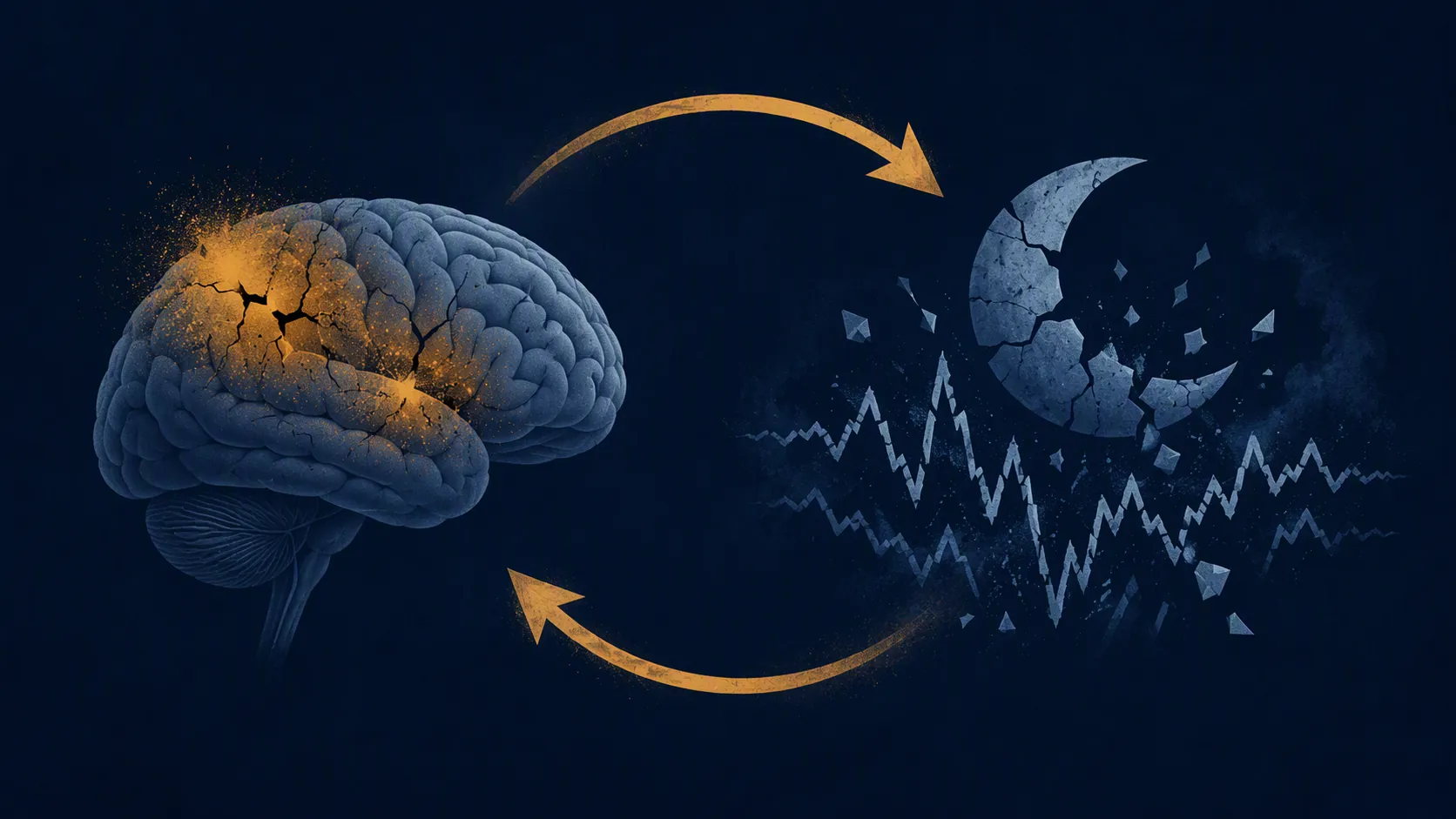
Mechanistically, researchers have proposed several pathways that may connect brain injury and sleep disruption, including changes in arousal systems, circadian signaling, melatonin rhythms, and glymphatic clearance. Those mechanisms are biologically plausible, but they should not be oversold as simple explanations for every veteran’s symptoms. For a closer look at those pathways, see Four brain mechanisms behind sleep disruption after brain injury.
The practical point is simpler than the biology: if sleep is helping regulate inflammation, clearance, learning, emotion, pain, and daytime alertness, then persistent sleep disruption can interfere with rehabilitation. Treating sleep as a footnote risks making every other TBI symptom harder to improve.
Why the Chart May Miss It
The 3% documentation figure should make readers uneasy, but it should not be flattened into a story of careless clinicians.[1] A medical record is shaped by appointment length, urgent complaints, screening habits, diagnostic priorities, coding practices, and what the patient has learned is worth bringing up. Sleep can lose in that competition.
Veterans may not report sleep symptoms because they have normalized them, because they assume poor sleep is part of deployment stress, because they are focused on pain or headaches, or because previous conversations made sleep feel like a lifestyle issue rather than a medical one. Clinicians may hear insomnia and immediately think PTSD, depression, medications, pain, or substance use. Those associations can be clinically reasonable. They become a problem when they stop further assessment.
A better sleep history after head trauma is not complicated, but it is specific. It asks about sleep onset, awakenings, early waking, nightmares, snoring, witnessed pauses in breathing, restless sleep, daytime sleepiness, irregular timing, naps that do not refresh, medications, alcohol, pain, headaches, and the timeline: what changed after the injury, what changed after deployment, and what has persisted.
PTSD Overlap Should Increase Screening, Not End the Conversation
The TBI-PTSD overlap is one of the reasons sleep problems in veterans can be so difficult to classify cleanly. Nightmares may be trauma-related. Insomnia may be maintained by hyperarousal. Pain may keep the body alert. Depression may shift sleep timing or increase time in bed. Sleep apnea may fragment sleep without the veteran remembering awakenings.
Trying to force one cause too early can be misleading. A veteran does not need a perfectly isolated mechanism before sleep deserves care. If a veteran has TBI, PTSD symptoms, pain, and insomnia, the clinical conclusion should not be that the sleep complaint is too tangled to name. It should be that the sleep complaint is important enough to evaluate directly.
This also matters for family members. A spouse or partner may notice the pattern before the veteran does: repeated awakenings, choking or gasping, dream enactment, irritability after short sleep, or exhaustion that does not match time in bed. Those observations can be clinically useful, especially when the veteran’s own sleep perception is blurred by fragmented nights.
Waiting It Out Is a Poor Assumption
Some sleep disruption soon after injury may improve. The problem is assuming that time alone will resolve it, especially when insomnia, nightmares, apnea symptoms, or daytime sleepiness continue beyond the acute recovery period. Persistent sleep problems after head trauma are not proof of permanent damage, but they are a reason to screen, diagnose when appropriate, and treat.
That treatment path depends on the disorder. Insomnia may call for evidence-based behavioral treatment rather than only medication or generic sleep tips. Suspected sleep apnea needs sleep testing and appropriate airway treatment. Nightmares may need trauma-informed care and targeted nightmare treatment. Circadian disruption may require careful scheduling of light, activity, and sleep timing. For readers looking specifically at behavioral sleep treatment after trauma, Evidence-Based Sleep Treatments After Earthquake Trauma covers CBT-I and imagery rehearsal therapy in a trauma-sleep context.
A treatment plan for a veteran with head trauma should also account for pain, mood, PTSD symptoms, medications, substance use, headaches, and safety risks. That is not because sleep is secondary. It is because sleep is connected to all of them.
What Deserves to Happen in the Visit
For veterans with a history of head trauma, sleep should be part of the recovery review, not an optional complaint saved for the end of the appointment. The minimum standard is direct screening: insomnia symptoms, breathing-related sleep symptoms, nightmares, daytime sleepiness, circadian disruption, and the way sleep affects cognition, pain, mood, and function the next day.
The next step is not to diagnose from a questionnaire alone. It is to decide what needs further evaluation: a full insomnia assessment, a sleep apnea workup, PTSD-focused care, medication review, pain management, behavioral sleep treatment, or coordination between primary care, sleep medicine, mental health, rehabilitation, and neurology.
The strongest conclusion the evidence supports is also the most clinically practical one: for veterans with head trauma, sleep problems are common, persistent enough to take seriously, and recovery-relevant enough to deserve direct screening and care, especially when PTSD, pain, depression, or cognitive symptoms are also present.
References
- Insomnia disorder common in post-9/11 Veterans with traumatic brain injury, VA Research, October 2020.
- Traumatic Brain Injury and Long-Term Care: A Scoping Review, RAND Corporation, 2025.
- Traumatic Brain Injury and Incidence Risk of Sleep Disorders in Nearly 200,000 US Veterans, Neurology, 2021.
- Sleep Problems in Veterans with PTSD, National Center for PTSD, U.S. Department of Veterans Affairs.
- Veterans are at risk for sleep apnea, insomnia and nightmares, AASM Sleep Education.
Supports these guides
Spot an error or have clinical feedback?
Because this article covers clinical, medication, or safety information, we use a moderated correction channel instead of open public comments. Let us know if something about “More Than Half of Veterans With Head Trauma Have Sleep Problems” needs a closer look.
Send feedback on this article