
Mechanism explainer
Best Sleep Trackers for People Who Actually Can't Sleep: Which Devices Help (and Which Harm) When You Have Insomnia
For adults with insomnia, the wrong sleep tracker can worsen sleep through orthosomnia and data anxiety. This guide compares scoring-based vs. passive devices, reveals how accuracy drops for low-sleep-efficiency individuals, and offers practical recommendations for using trackers constructively without harming your rest.
The Paradox of Sleep Tracking for People Who Can't Sleep
If you have insomnia, the promise of a sleep tracker is seductive: finally, a way to see what is actually happening at night. You strap on a ring or a watch hoping for clarity — a number that explains why you feel exhausted, a score that tells you if you are improving. But for a significant subset of users, the data does not bring relief. It brings a new kind of pressure.
This is the central paradox of consumer sleep tracking for people who genuinely struggle to sleep: the very tool designed to help you understand your rest can, when chosen or used poorly, make your sleep worse. The clinical literature now has a name for this phenomenon — orthosomnia — and the research on tracker accuracy reveals a troubling pattern: the worse your sleep is, the less reliable the data becomes.
This guide is device-agnostic. It covers Oura, Whoop, Apple Watch, Fitbit, Google Nest Hub, and several ring-type trackers, comparing them specifically through the lens of insomnia and orthosomnia risk. If you are looking for a Garmin-specific analysis, we have covered that separately in our Garmin Sleep Tracking and Insomnia article. Here, we are asking a broader question: which devices help, which harm, and how do you use a tracker without feeding the anxiety that keeps you awake?
What Is Orthosomnia and Why Should Insomniacs Care?
The term orthosomnia was introduced in a 2017 paper in the Journal of Clinical Sleep Medicine (JCSM). The authors described a pattern they observed in clinical practice: patients who, in their words, developed "a perfectionistic quest for the ideal sleep" driven by consumer sleep technology. These individuals became so focused on optimizing their sleep scores, sleep stages, and nightly metrics that the tracking itself became a source of anxiety and a contributor to poor sleep.
For someone without sleep difficulties, a low sleep score might be a curiosity. For someone with insomnia, it can be a confirmation of failure. You already know you slept poorly — you were there. But seeing a device quantify that failure with a red number, a downward arrow, or a notification that your "readiness score" is low can amplify the catastrophic thinking that fuels insomnia: I am broken. I will never recover. Tonight will be worse.
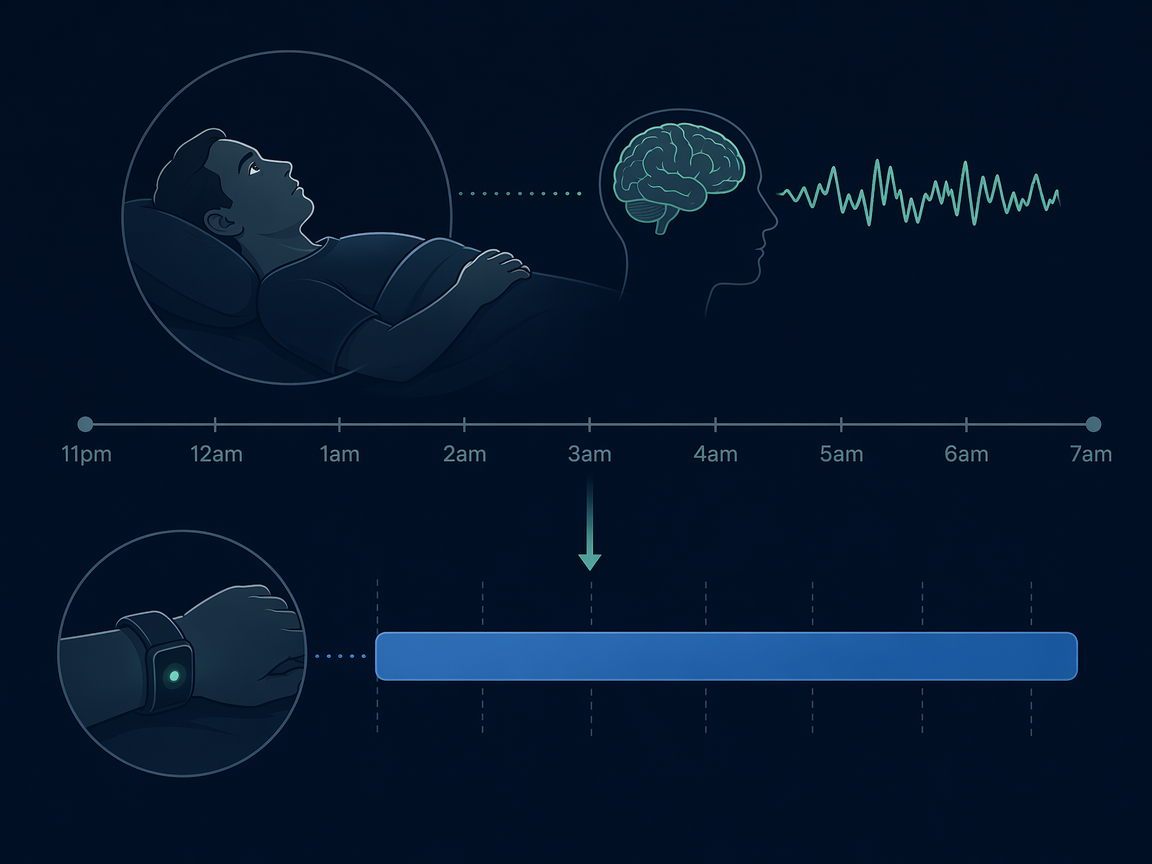
This is not a fringe problem. The 2023 multicenter validation study by Lee et al., which enrolled 75 participants across two sleep centers in Korea and collected nearly 3,900 hours of data, found that consumer sleep trackers systematically misclassify quiet wake as light sleep. For an insomniac who spends hours lying still in bed trying to fall asleep, this means the tracker is likely telling you that you slept more than you did — and then giving you a score that does not match your experience. The mismatch between subjective experience and objective data can be deeply disorienting and can drive further obsessive checking.
Scoring vs. Passive Display: Which Device Philosophy Triggers Sleep Anxiety?
Not all sleep trackers are created equal when it comes to their potential to trigger orthosomnia. The most important differentiator is not accuracy or battery life — it is design philosophy. Devices fall into two broad camps: scoring-based systems that assign a daily grade to your sleep, and passive-display systems that present raw data without judgment.
| Design Philosophy | Examples | How It Presents Data | Orthosomnia Risk |
|---|---|---|---|
| Scoring-based | Oura Ring, Whoop, Fitbit | Daily sleep score (0–100), readiness score, recovery score; push notifications for low scores | High — creates a good night / bad night binary that invites perfectionism |
| Passive display | Apple Watch (Vitals app), Google Nest Hub 2 | Trend lines, raw metrics, no summary score; data is visible but not pushed | Lower — supports curiosity without judgment; user must actively seek data |
| Hybrid | Garmin, Samsung Galaxy Watch | Sleep score available but can be deprioritized in the interface; notifications are configurable | Moderate — depends on user's notification settings and how prominently the score is displayed |
Supports these guides
Spot an error or have clinical feedback?
Because this article covers clinical, medication, or safety information, we use a moderated correction channel instead of open public comments. Let us know if something about “Best Sleep Trackers for People Who Actually Can't Sleep: Which Devices Help (and Which Harm) When You Have Insomnia” needs a closer look.
Send feedback on this article