
Mechanism explainer
Garmin Sleep Tracking and Insomnia: When the Data Helps and When It Makes Things Worse
For adults managing chronic insomnia or sleep anxiety, checking Garmin sleep data every morning carries a clinically recognized risk of deepening the problem—yet certain Garmin metrics, used selectively, can still support recovery. This article maps exactly when to engage with Garmin sleep data and when to step away from it entirely.

The Appeal and the Trap: Why Insomnia Sufferers Reach for Sleep Data
When sleep is broken and unpredictable, the Garmin app offers something that feels genuinely useful: a record of what actually happened. You wake at 3 a.m. unsure whether you slept at all, and the watch says you got four hours and twenty minutes of light sleep with a brief stretch of deep. That number feels like solid ground. It replaces the anxious uncertainty of subjective memory with something that looks objective.
This is the appeal. The trap is that the same impulse driving you to check the app—the need to monitor, to verify, to know exactly how bad it was—is one of the core behaviors that behavioral sleep medicine works to eliminate. Cognitive behavioral therapy for insomnia (CBT-I) explicitly discourages clock-watching, sleep-monitoring, and the nightly accounting of hours because these behaviors reinforce the hyperarousal that keeps poor sleepers awake. Checking your Garmin sleep score every morning is, functionally, a digital version of staring at the clock at 2 a.m.
There is a second problem layered beneath the behavioral one: the nights that matter most to you—the fragmented, restless nights when you desperately want to know what went wrong—are precisely the nights when Garmin's accuracy is worst. The data you are most likely to act on is the data you should trust least.
This article does not attempt to replicate the full technical breakdown of Garmin's sensor methodology and PSG validation studies—that ground is covered in the general Garmin sleep tracking accuracy review. What this article maps instead is the specific question insomnia sufferers need answered: when does checking your Garmin sleep data help your recovery, and when does it actively make things worse?
Why Garmin's Accuracy Is Worst on the Nights That Matter Most to You
Garmin's Advanced Sleep Monitoring algorithm uses photoplethysmography (PPG) for heart rate and HRV, combined with accelerometer data for movement. It does not measure brain activity. Sleep stages identified by a wristwatch are inferences drawn from physiological proxies, not direct measurements of neural state—a distinction Garmin's own technology documentation acknowledges by describing these signals as providing "valuable clues" for recognizing stages rather than confirming them.
For healthy sleepers with consolidated, architecturally normal sleep, those proxies work reasonably well at the population level. For people with insomnia, the picture is considerably worse—and the degradation is not random.
The Proportional Bias Problem
A 2021 independent study by the Naval Health Research Center (Chinoy et al., published in Sleep) tested seven consumer sleep-tracking devices against polysomnography in 34 healthy adults across three consecutive lab nights, including one experimentally disrupted sleep night. The two Garmin devices tested—the Fenix 5S and Vivosmart 3—had the lowest specificity for wake detection of all seven devices: 0.18 and 0.19, respectively. In practical terms, Garmin correctly identified only about 18–19% of actual wake epochs. Both devices significantly underestimated wake after sleep onset, missing an average of nearly 50 minutes of true waking time per night.
The finding with the most direct relevance to insomnia sufferers is what the researchers called proportional bias: device accuracy worsened proportionally on nights with poorer or more disrupted sleep. The more fragmented the night, the larger the gap between what the device reported and what PSG recorded. This pattern appeared across most devices in the study, but was particularly pronounced in the Garmin models.
What Garmin's Own Data Shows for Sleep Disorder Users
Garmin's internal validation study (conducted at the University of Kansas Medical Center in 2019, n=55) found that its Advanced Sleep Monitoring algorithm achieved an overall accuracy of 69.7% against a Sleep Profiler ambulatory EEG reference device. Fourteen of the 55 participants self-reported a sleep disorder or took medications affecting sleep architecture. The single worst-performing participant—who self-reported having a sleep disorder—achieved only 49.9% accuracy, with a Cohen's kappa of 0.18, indicating agreement with the reference device barely above chance.
One important caveat: this study used Sleep Profiler as its reference device rather than full polysomnography. Sleep Profiler itself has approximately 83% accuracy versus PSG, which means the 69.7% and 49.9% figures are relative to a non-gold-standard reference. The true gap between Garmin's output and what a clinical sleep lab would record is likely larger than these numbers suggest.
| Data source | Key finding for disrupted/insomnia sleep | Caveat |
|---|---|---|
| Chinoy et al. 2021 (Naval Health Research Center, PSG-validated) | Garmin specificity for wake: 0.18–0.19; ~50 min of waking time missed per night; accuracy worsened proportionally on disrupted nights | Tested older Garmin models; current hardware not independently validated |
| Garmin internal KUMC study, 2019 | Overall accuracy 69.7%; worst-case participant (self-reported sleep disorder): 49.9% accuracy, kappa 0.18 | Reference device was Sleep Profiler (~83% vs. PSG), not full PSG |
| Schyvens et al. 2024 systematic review (JMIR) | Garmin Vivosmart 4: 30% specificity for wake, 34% sensitivity for REM, kappa 0.20 for multistate sleep categorization | Systematic review of 8 studies; findings vary across study conditions |
The practical implication is direct: on a night when your sleep was badly disrupted—exactly the night you most want to understand what happened—Garmin's stage breakdown is least likely to reflect reality. Acting on that data, whether by adjusting behavior, extending time in bed, or spiraling into anxiety about what the numbers mean, is acting on noise.
Orthosomnia: When Tracking Sleep Becomes Part of the Problem
In 2017, researchers at Northwestern University published a case series in the Journal of Clinical Sleep Medicine documenting a pattern they had started to see in their clinical practice: patients whose sleep worsened specifically because of how they were using consumer sleep trackers. They named the phenomenon orthosomnia—a perfectionistic preoccupation with achieving ideal sleep data.
The three cases documented by Baron et al. involved patients using Fitbit and other non-Garmin wearables—the concept applies to consumer sleep trackers generally, not to Garmin specifically. What the cases showed was a consistent clinical pattern: patients' wearable data reinforced anxiety about sleep quality, led all three to spend more time in bed in an attempt to increase the sleep duration the device reported, and made engagement with CBT-I protocols substantially harder. Extending time in bed is one of the behaviors CBT-I most directly works against, because it reduces sleep efficiency and deepens the insomnia cycle.
The authors also noted something that underscores the accuracy problem described above: patients' belief in the tracker data was resistant to change even when objective polysomnography showed the device's readings were inaccurate. The data felt authoritative. The PSG results did not dislodge that feeling.
The Nightly Sleep Score as Digital Clock-Watching
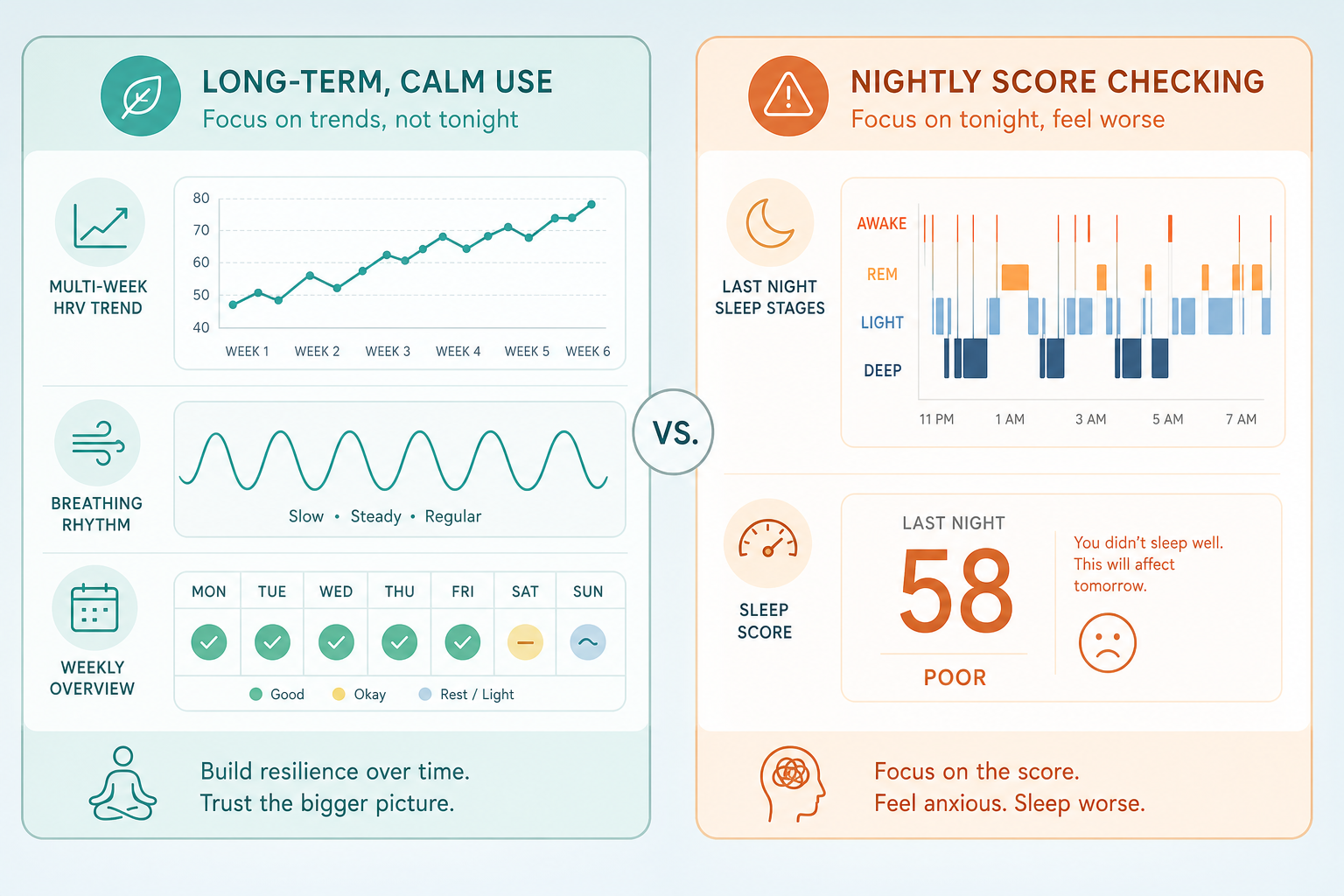
CBT-I targets a specific set of behaviors that perpetuate insomnia—clock-watching is among the most consistently addressed. Looking at the clock at 2 a.m. reinforces cognitive monitoring of sleep, increases arousal, and makes returning to sleep harder. Checking a Garmin sleep score at 7 a.m. operates through a similar mechanism: it is a daily audit of sleep performance that keeps attention focused on sleep as a problem to be solved rather than a process to be trusted.
For readers who want a deeper understanding of how sleep anxiety and cognitive hyperarousal interact to sustain insomnia, that mechanism is covered in detail in the sleep anxiety and insomnia article. The relevant point here is narrower: wearable monitoring is one of the specific behaviors through which hyperarousal is maintained, and Garmin's nightly score provides a daily trigger for exactly that loop.
"Orthosomnia is an unhealthy or excessive concern with achieving the perfect sleep. One of the signs or symptoms of orthosomnia is developing sleep problems because of the feedback you receive from personal fitness trackers. Sometimes, this kind of feedback can cause sleep loss or make sleep problems worse."
Dr. Sabra Abbott, a neurologist and sleep medicine specialist at Northwestern Medicine and co-author of the original orthosomnia paper, made this observation in a 2025 Northwestern Medicine article. She also noted that orthosomnia can lead to insomnia when people start spending more time in bed to improve their sleep score—because the brain begins to associate the bed with wakefulness and stress. Her practical advice: stop tracking data and start paying attention to how you feel.
When Garmin Sleep Data Can Still Help: The Narrow Safe Zone
The argument against nightly score-checking is not an argument against all engagement with Garmin sleep data. There is a meaningful difference between using a wearable to audit each night's performance and using it to observe longer-term physiological patterns. The former reinforces the monitoring loop; the latter can provide genuinely useful signal with lower orthosomnia risk.
Three specific Garmin metrics occupy this narrower, safer zone for insomnia sufferers:
- HRV Status (multi-week trend view). Garmin's HRV Status feature tracks your heart rate variability over rolling weeks and flags whether you are within your baseline range, below it, or recovering. A single night's HRV reading is highly variable and easily distorted by alcohol, illness, stress, or poor sleep itself. But a multi-week downward trend in HRV Status—particularly one that persists across two to three weeks—can indicate that cumulative sleep debt or chronic stress is affecting autonomic recovery. This is the kind of signal worth noting without acting on in the moment. It does not tell you what happened last night; it tells you something about your physiological trajectory over recent weeks.
- Body Battery 7–14 day patterns. Body Battery is Garmin's composite energy reserve metric, calculated from HRV, stress, activity, and sleep. A single day's Body Battery reading is not meaningful for insomnia sufferers—it will predictably be low after a bad night. But a 7–14 day pattern showing whether the score is trending upward, flat, or downward can serve as an indirect proxy for whether cumulative recovery is occurring. Again, this is trend data, not nightly audit data. The distinction matters.
- Breathing disturbances flag. Garmin's breathing disturbances metric detects irregular breathing patterns during sleep and flags nights with elevated disturbance counts. This metric is explicitly non-medically certified—Garmin's own documentation describes it this way, and it is not a substitute for a clinical sleep study. However, if the metric consistently flags elevated breathing disturbances across multiple nights, that pattern is worth bringing to a physician or sleep specialist as a reason to consider evaluation for sleep-disordered breathing. It is a prompt for a clinical conversation, not a self-diagnosis tool.
The common thread across all three metrics is that they are meaningful at the multi-week scale and unreliable at the single-night scale. Long-term trend data smooths individual-night noise—including the noise introduced by Garmin's proportional bias on disrupted nights—into patterns that carry more signal than any single reading. This is the use mode that carries lower orthosomnia risk because it does not invite the nightly performance-review loop.
When to Limit or Stop Engaging with Garmin Sleep Data
There are specific conditions under which insomnia sufferers should reduce or pause all engagement with Garmin sleep data—not just nightly scores, but the app overall. These are not general cautions; they are situations where the evidence suggests continued monitoring is likely to slow or reverse recovery.
- During active CBT-I treatment phases. CBT-I's behavioral components—particularly sleep restriction and stimulus control—require tolerating short-term sleep pressure and resisting the urge to compensate for poor nights by extending time in bed. Checking a Garmin sleep score after a restricted night creates a direct conflict: the score will be low, the temptation to extend time in bed will be high, and acting on that temptation undermines the protocol. The CBT-I versus medication treatment comparison covers why behavioral compliance is central to CBT-I outcomes.
- During periods of elevated sleep anxiety or hyperarousal. If you are in a period where sleep-related worry is prominent—lying awake anticipating poor sleep, catastrophizing about daytime consequences, or feeling significant distress about sleep—adding a daily data review is adding fuel to the anxiety loop. This is the population most at risk for orthosomnia, and the one for which Dr. Abbott's advice to stop tracking is most directly applicable.
- When nightly score-checking has become a ritual. If checking the Garmin app is the first thing you do when you wake up, or if you find yourself checking it before you have even assessed how you feel, the behavior has become automatic and monitoring-driven. This is the pattern the Baron et al. case studies described—and it is a signal that the tracker is no longer providing information, it is generating anxiety.
- When the data is being used to justify extending time in bed. If a low sleep score or a poor deep-sleep reading is prompting you to go to bed earlier, stay in bed later, or nap to compensate, the tracker is actively worsening your sleep efficiency. All three patients in the Baron et al. case series did exactly this—and it is one of the clearest mechanisms by which wearable use deepens insomnia. For more on why this pattern stalls recovery, the sleep restriction therapy troubleshooting guide covers the sleep efficiency dynamics in detail.
A Practical Protocol: How to Use Garmin Sleep Data Safely During Insomnia Recovery
The following framework is not a prescription—it is a structured set of defaults that reduce orthosomnia risk while preserving the genuine signal value Garmin data can provide for insomnia sufferers. Individual circumstances vary, and anyone in active CBT-I treatment should discuss wearable use with their clinician.
| Garmin metric | Recommended use during insomnia recovery | Frequency | What to avoid |
|---|---|---|---|
| HRV Status (trend view) | Check for multi-week directional pattern—sustained downward trend over 2–3 weeks may indicate cumulative recovery deficit | Weekly, not daily | Do not interpret single-night HRV readings; do not use as a nightly performance measure |
| Body Battery (7–14 day pattern) | Observe whether the overall trend is recovering, flat, or declining across 1–2 weeks | Weekly review only | Do not check daily; do not use single-day readings to assess last night's sleep |
| Breathing disturbances | Note if the metric flags elevated disturbances across multiple consecutive nights; bring to a physician if persistent | Passive monitoring; review weekly | Do not use to self-diagnose or rule out sleep apnea; do not act on single-night flags |
| Nightly sleep score (0–100) | Avoid during active insomnia phases and CBT-I treatment | Pause or stop during acute phases | Do not use to evaluate individual nights; do not use to justify time-in-bed adjustments |
| Sleep stage breakdown (light, deep, REM) | Avoid during active insomnia phases | Pause or stop during acute phases | Do not use to assess stage quality on disrupted nights; accuracy is lowest when you most want it |
The Behavioral Experiment: Testing Whether Monitoring Helps or Harms You
One approach suggested in the orthosomnia literature—and consistent with CBT-I's emphasis on behavioral experimentation over assumption—is a structured self-test. The logic: rather than assuming the Garmin app is either helping or harming your sleep, run a controlled comparison.
- For one to two weeks, check the Garmin app as you normally would each morning. Each day, rate your subjective sleep quality (1–10) and your daytime functioning (energy, concentration, mood, on a simple 1–10 scale). Record these in a separate note, not in the Garmin app.
- For the following one to two weeks, stop opening the Garmin app entirely. Keep wearing the watch if you use it for other purposes, but do not check sleep data. Each morning, rate the same subjective measures—sleep quality and daytime functioning—using the same scale.
- At the end of the second period, compare the two sets of ratings. If subjective sleep quality and daytime functioning were similar or better in the no-tracking period, that is your empirical answer: the monitoring was not helping, and may have been adding anxiety. If the ratings were meaningfully better during the tracking period, that is also useful information.
This experiment works because it grounds the decision in your own data rather than a general recommendation. Some people with insomnia find that long-term trend monitoring genuinely reduces anxiety by providing evidence that recovery is occurring. Others find that any engagement with sleep data increases preoccupation. The experiment makes that distinction concrete.
The broader principle is worth stating plainly: Garmin sleep data is a tool, and tools are only useful when they serve the task at hand. For insomnia sufferers, the task is reducing hyperarousal, building sleep confidence, and allowing the sleep system to consolidate. Data that supports that task—long-term HRV trends, breathing disturbance flags for medical follow-up—has a place. Data that undermines it—nightly scores checked as the first act of each morning—does not, regardless of how reassuring the number looks on a good night.
Supports these guides
Spot an error or have clinical feedback?
Because this article covers clinical, medication, or safety information, we use a moderated correction channel instead of open public comments. Let us know if something about “Garmin Sleep Tracking and Insomnia: When the Data Helps and When It Makes Things Worse” needs a closer look.
Send feedback on this article