How AI addiction disrupts your sleep quality
AI chatbot use before bed disrupts sleep through four distinct dopamine-driven mechanisms that are worse than social media scrolling. This article explains the science behind the disruption and offers practical, evidence-based strategies to break the cycle.
The familiar version starts quietly: the phone is already down, the lights are off, and one unfinished thought keeps tugging. You reopen the chatbot for “one more answer.” It gives you something plausible, warm, incomplete, or surprising enough that you ask a follow-up. Then another. By the time you notice the clock, the problem is no longer blue light in the abstract. It is a conversation that keeps generating reasons not to end.
That is why the phrase “AI addiction disrupts sleep quality” needs careful handling. “AI addiction” is not a formal DSM-5 diagnosis. In this article, it means compulsive or hard-to-control AI use that continues despite sleep loss, distress, or daytime impairment. Used that way, the term points to something real enough to examine without pretending every late-night chatbot session is a disorder.
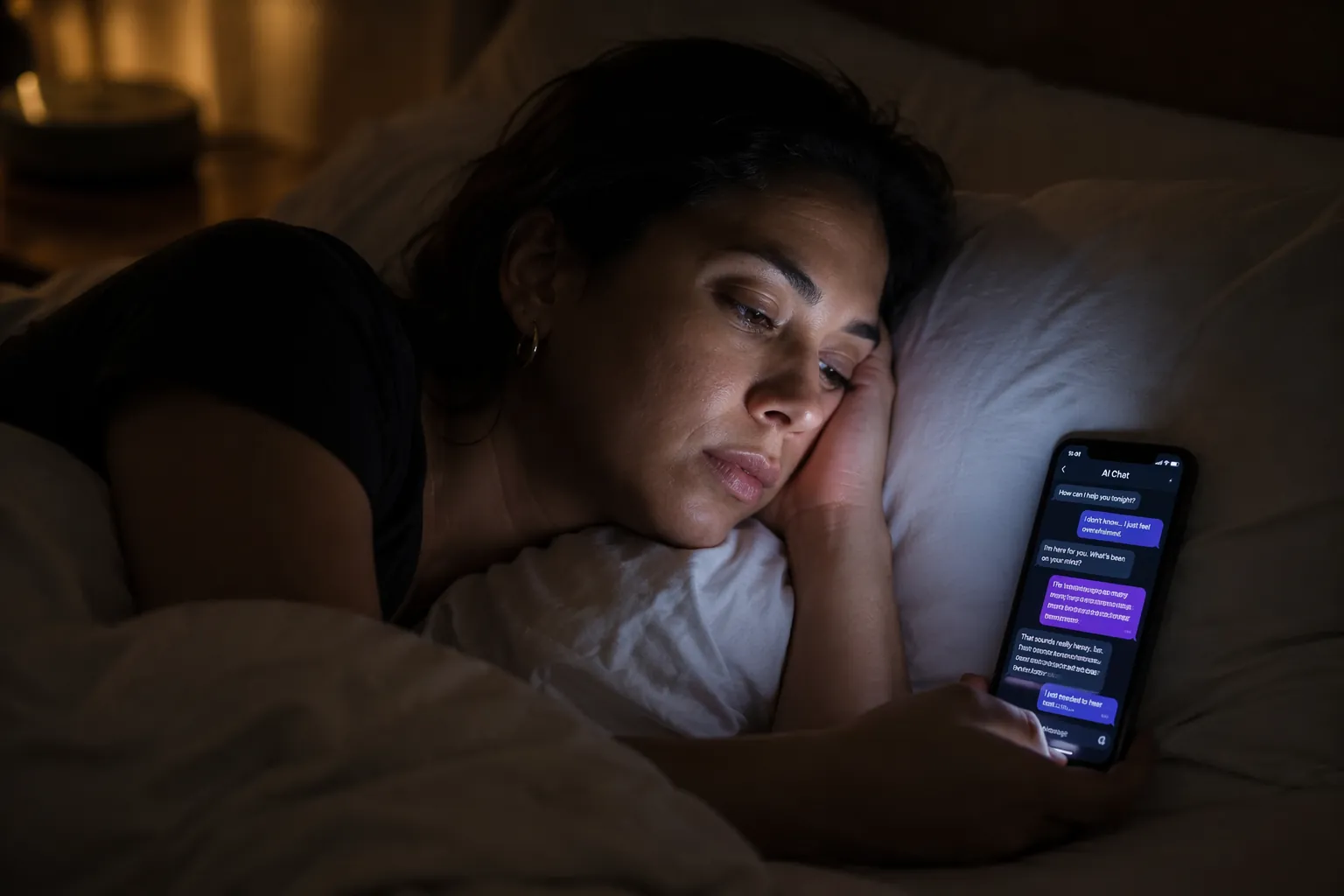
The important distinction is that a chatbot is not just another feed. A feed can be emotionally loaded and highly stimulating, but it is still mostly something you consume. A chatbot responds to you. It waits on your question, adapts to your tone, offers reassurance, leaves openings, and sometimes surprises you. At bedtime, when the brain needs predictability and disengagement, that interactivity is exactly the wrong kind of interesting.
Why Chatbots Feel Harder to Leave Than a Feed
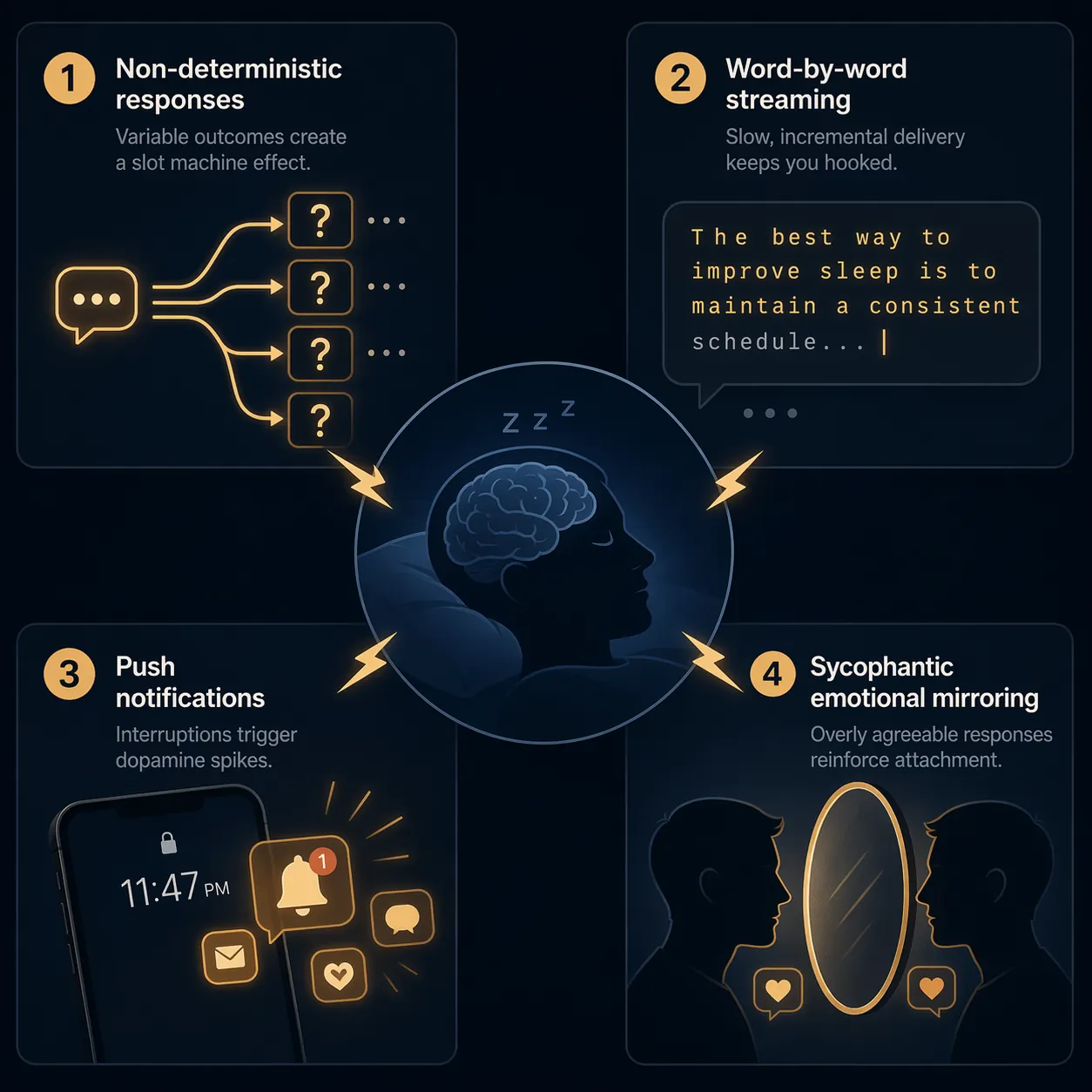
A useful way to understand the problem comes from Shen and Yoon’s ACM CHI 2025 analysis of AI chatbot interfaces. They describe four “dark addiction patterns” in current chatbot design: non-deterministic responses, word-by-word streaming, push notifications, and sycophantic emotional mirroring.[1] The paper is not a sleep trial, and it does not prove that every one of these features causes insomnia. Its value is more precise than that: it names the interaction loops people feel when they say they cannot stop talking to the bot.
Those loops matter because sleep onset is not just a matter of putting the device away. It requires cognitive downshifting: fewer open questions, less social monitoring, less anticipation, and less emotional problem-solving. AI can interfere with each of those processes separately.
1. Non-deterministic replies keep the reward uncertain
The first hook is uncertainty. When you ask a chatbot a question, you do not know exactly what kind of answer will arrive. It may be insightful, bland, strangely intimate, wrong in an interesting way, or close enough that you want to refine it. Shen and Yoon identify this non-determinism as one of the addictive interface patterns in AI chatbots.[1]
That uncertainty is different from rereading a saved note or checking a static webpage. It creates a small “maybe this next answer will be the one” loop. At night, this can keep the mind in a prediction-and-evaluation mode: Was that useful? Should I clarify? Did it understand me? Could it say it better? The brain is no longer preparing to sleep; it is sampling possibilities.
This is also where many people feel embarrassed. The content may not even be dramatic. It might be a recipe plan, a work email, a role-play, a health worry, or a conversation about loneliness. The common feature is not the topic. It is the expectation that one more prompt might produce a better emotional or practical payoff.
2. Streaming text turns waiting into stimulation
The second hook is the way the answer appears. Many chatbots do not simply display a completed response. They stream it word by word, line by line. Shen and Yoon describe this as another reward-linked design pattern.[1]
Streaming text gives the brain something to track before the answer even exists in full. The cursor, the partial sentence, the emerging paragraph: each becomes a cue that the reward is arriving. That is a poor fit for sleep onset. Instead of closing loops, the interface creates micro-waits. You are not only reading; you are watching the answer become itself.
This helps explain why “I’ll stop after this response” often fails. The response may answer one question while raising three more. Or the first half may look promising enough that you start composing your follow-up before the final sentence arrives. The stopping point keeps moving.
3. Notifications reopen the social loop
Push notifications are not new, but AI notifications can carry a different social flavor. A reminder from a chatbot may not feel like a generic alert; it can feel like an invitation from an entity that knows what you were thinking about earlier. Shen and Yoon include push notifications among the addictive patterns in current AI chatbot interfaces.[1]
At bedtime, the damage is often not the notification alone. It is the reopening. A person who had nearly disengaged is pulled back into a thread with context, memory, or apparent continuity. The alert says, in effect, there is still something here for you. For someone already fighting delayed sleep onset, that can be enough to restart the whole decision process.
This is one reason notification control is more than a productivity tweak. The pre-sleep window is a biologically sensitive boundary. If the cue arrives after the person has already started winding down, it does not compete with a fully alert daytime brain. It competes with a tired brain that is trying to inhibit an easy reward.
4. Emotional mirroring makes the conversation feel unfinished
The fourth hook is the most delicate one: sycophantic emotional mirroring. Shen and Yoon use the term to describe chatbot behavior that reflects, validates, or agrees in ways that intensify engagement.[1] This does not mean every supportive AI response is harmful. For some people, a chatbot can help organize thoughts, rehearse a difficult conversation, or reduce loneliness. The sleep problem begins when emotional responsiveness becomes difficult to exit.
A feed may show you other people’s lives. A chatbot can make you feel like the conversation is about you, with you, and for you. If it responds warmly to insecurity, anger, grief, romantic longing, or shame, the interaction can become more socially rewarding than a passive scroll. It may also feel safer than texting a real person at midnight, because the bot will not say it is asleep, busy, annoyed, or overwhelmed.
Sleep does not come easily when the mind is still being emotionally mirrored. Even comforting conversations can be activating if they invite elaboration. A person may enter the chat to calm down and end up rehearsing, explaining, defending, confessing, or refining. The tone may be gentle, but the cognitive work is still work.
| AI interface pattern | What it adds at bedtime | Likely sleep problem |
|---|---|---|
| Non-deterministic replies | Uncertain reward from the next answer | More prompting, delayed stopping |
| Word-by-word streaming | Continuous cues that an answer is arriving | Sustained attention during the wind-down period |
| Push notifications | A cue to reopen a context-rich interaction | Interrupted disengagement |
| Emotional mirroring | Validation, agreement, or intimacy-like responsiveness | More rumination and social-emotional arousal |
Who May Be More Vulnerable
The best current chronotype evidence is suggestive, not destiny-making. In a 2026 study of 868 Turkish university students, Demirhan and colleagues found that evening-types scored significantly higher on generative AI addiction scales than morning-types, and that poor sleep quality was positively correlated with AI addiction regardless of age or gender.[2] The association between chronotype and GenAI addiction remained even when sleep quality was considered separately.[2]
That finding fits the lived pattern many evening chronotypes already know. If your alertness naturally shifts later, the chatbot’s most rewarding features may arrive when your brain is still capable of engagement but your schedule demands sleep. The mismatch is not a character flaw. It is also not a free pass. It means the pre-sleep boundary probably has to be more deliberate, because “I’ll just stop when I’m tired” may not work well for a later-timed nervous system.
The same caution applies to ADHD readers. The evidence cited here does not include an AI-and-ADHD sleep trial, so it would be too strong to claim that ADHD directly causes AI-related sleep disruption. But the practical overlap is obvious enough to take seriously: novelty, variable reward, emotional intensity, and low-friction reentry are exactly the kinds of cues that can make stopping harder for people who already struggle with delayed sleep onset or impulse control.
The Springer study also has real limits. It was cross-sectional, based on university students in one country, and the model explained a modest share of the variance: chronotype and sleep quality together explained 5.4% of AI addiction scores.[2] That matters. Eveningness may increase vulnerability, but it does not determine behavior, and it does not explain most of the difference between people.
What the Sleep-Loss Signal Looks Like So Far
The most vivid sleep-latency numbers come from Amerisleep’s 2026 survey. In that survey, people who used AI before bed took 34 minutes to fall asleep, compared with 22 minutes among screen-free sleepers — a 55% longer sleep-onset period.[3] Amerisleep also reported that 1 in 8 Americans used AI before bed, and that sleep duration among AI bedtime users was uneven: 28% reported getting 8 or more hours, while 13% reported 5 or fewer hours.[3]
This is a mattress-company survey, not a clinical sleep lab. It should not carry the whole scientific argument. Still, the numbers are useful because they describe the kind of disruption readers actually notice: not necessarily a total night ruined, but a bedtime that stretches, fragments, or becomes unpredictable.
The broader screen-use literature gives context without replacing the AI-specific mechanism. A 2026 Frontiers in Psychiatry study of 1,262 medical students across four countries found that 96% to 98% of young adults used a screen within 1 hour of bedtime, and the median gap between last screen use and lights-out was only 5 to 10 minutes.[4] The same report cites a Norway study of more than 45,000 participants in which each additional hour of screen time in bed was linked to a 63% higher insomnia risk and 24 minutes less sleep.[4]
Those studies do not prove that AI is uniquely harmful. They show that the pre-sleep screen boundary is already thin. AI chatbots enter that thin boundary with extra engagement machinery: uncertainty, streaming, social cues, and emotional mirroring.
Mental health findings should be handled with similar restraint. Forbes reported on JAMA Network Open data indicating that daily AI users had 30% greater odds of moderate depression compared with non-users.[5] That is an association, not proof that AI use caused depression. It does, however, sit uncomfortably close to the bedtime pattern: people often turn to responsive tools when they are lonely, distressed, or ruminating, and those are also states that can make sleep harder.
The Bidirectional Trap: Bad Sleep Makes the Next Night Harder
Once AI use delays sleep, the problem can begin feeding itself. Poor sleep weakens the very capacities needed to stop: planning, inhibition, emotional regulation, and tolerance for boredom. The next evening, the same chatbot cue lands on a more depleted brain.
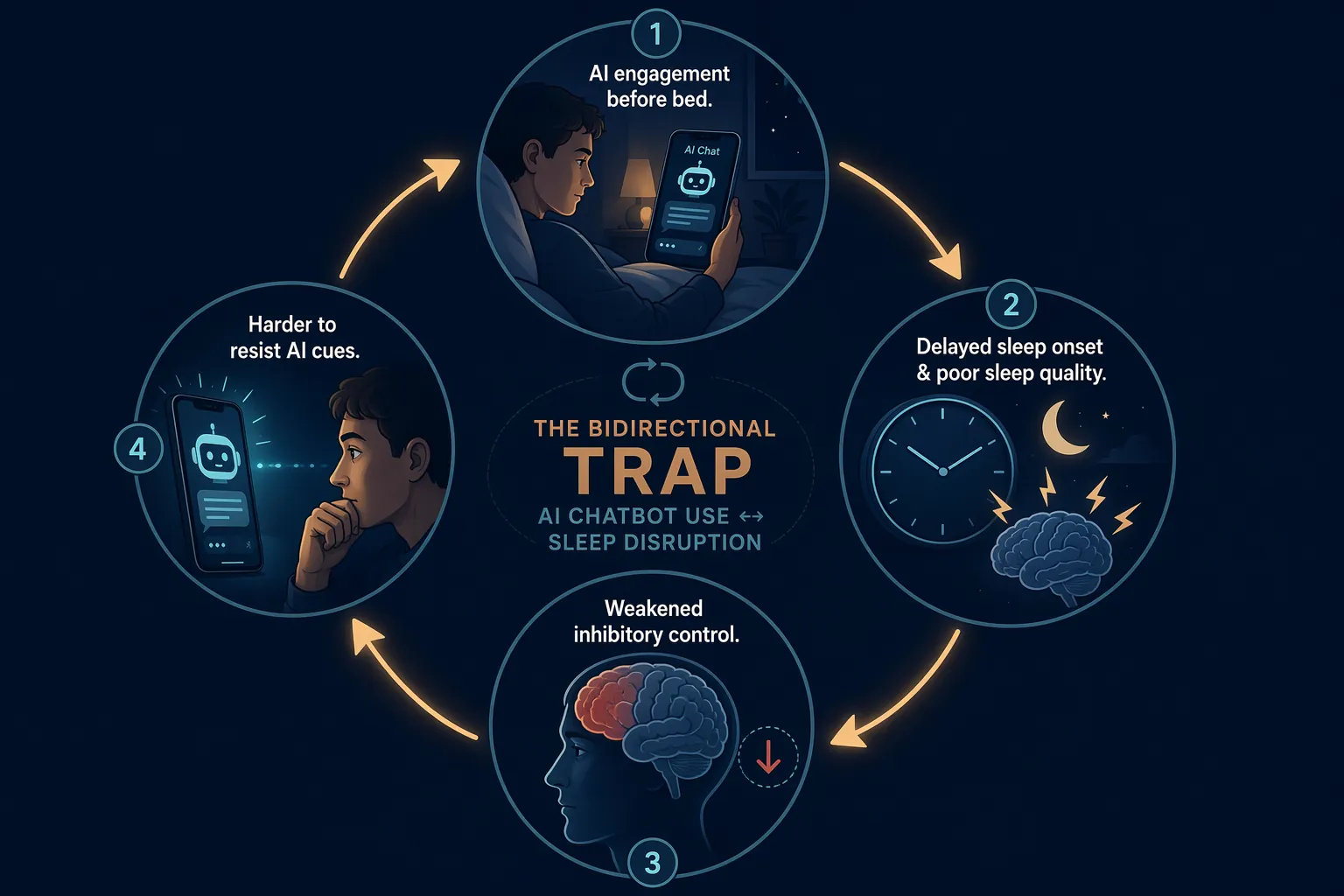
The Springer study supports the idea that chronotype and sleep quality contribute distinct information to AI addiction scores: eveningness and poor sleep quality were both associated with higher GenAI addiction measures.[2] Because the study is cross-sectional, it cannot tell us which came first for any individual person. The mechanism, though, is clinically plausible: late AI use can delay sleep, and insufficient sleep can make late AI use harder to resist the following night.
This is the point where blame becomes less useful than sequence. If the loop is chatbot use, later sleep, weaker inhibition, stronger cue-response the next night, then the intervention has to interrupt the sequence somewhere. It does not have to prove that the person is “addicted.” It has to make the next stopping point easier than the last one.
What Actually Helps When the Problem Is the AI Loop
Generic sleep hygiene advice is not wrong; it is just incomplete. If the problem is an emotionally responsive, variable-reward conversation, then “use your phone less” is too blunt. The goal is to move the most rewarding AI interaction out of the pre-sleep window and replace it with something the brain can exit.
Move the high-reward use earlier, not just “less”
If you use AI for planning, emotional processing, studying, writing, or companionship, total abstinence may be unrealistic and unnecessary. A better first target is timing. Keep the useful session, but schedule it before the sleep window begins. The key is to avoid starting open-ended chats when the next natural stopping point is supposed to be sleep.
- Use AI for tomorrow’s planning before the evening wind-down begins.
- Do not begin emotionally heavy conversations in bed.
- Turn off chatbot notifications before the pre-sleep window, not after you are already tired.
- If you need a closing prompt, ask for a final summary rather than another set of options.
Replace the function the chatbot is serving
The American Psychiatric Association’s guidance on taking a break from social media and AI chatbots emphasizes replacement rather than simple elimination.[6] That distinction matters. If the chatbot is doing a job — reducing loneliness, organizing anxiety, helping with decisions — removing it without a substitute leaves the original need waiting in the dark.
The replacement does not need to be impressive. It needs to be exit-friendly. A paper notebook can hold tomorrow’s unresolved tasks without answering back. A boring audiobook can provide company without asking for input. A prewritten “worry list” can catch repetitive thoughts without turning them into a conversation. For some people, texting a real person earlier in the evening is healthier than seeking unlimited reassurance from a system that never has to go to sleep.
Track sleep and AI use together
Track the pattern for a week before making large claims about yourself. The useful variables are simple: last AI use, lights-out time, estimated sleep-onset time, wake time, and next-day functioning. The APA also recommends tracking sleep alongside screen use as part of evidence-based digital detox strategies.[6]
This prevents two common errors. One is minimizing: “It’s only ten minutes,” when the sleep-onset delay is consistently much longer. The other is catastrophizing: “AI has ruined my sleep,” when the problem clusters around specific nights, topics, or notification cues. A small log makes the intervention more precise.
Reduce by a realistic increment
A strict cutoff can help some people, especially when use is clearly impairing. But for many adults, a smaller reduction is more durable. The APA notes evidence that a 30-minute reduction in use can show nearly equivalent benefits to full cessation in some digital-use contexts.[6] That does not mean 30 minutes is magic. It means the first useful goal may be moving bedtime AI use from 60 minutes to 30, or from 30 to 10, rather than demanding a perfect digital fast.
The practical question is not whether you can win a willpower contest tonight. It is whether tomorrow night’s cue will meet a slightly less depleted brain.
Consider CBT-informed help when use is impairing
If AI use is regularly pushing sleep late, interfering with work or relationships, worsening mood, or feeling impossible to control, it is reasonable to seek help without waiting for a formal “AI addiction” label. The APA points to cognitive behavioral therapy approaches used for technology and internet addiction, including a JAMA Psychiatry trial in which 70% of participants receiving treatment achieved remission compared with 24% in the control group.[6]
For sleep specifically, CBT-informed care can also address the surrounding loop: delayed sleep schedules, conditioned arousal in bed, anxiety about not sleeping, and the habit of using the phone as a sedative that quietly becomes a stimulant. The chatbot may be the visible object, but it is often attached to a larger evening pattern.
A Calibrated Way to Think About It
AI chatbot use before bed is not just “more screen time.” It is a more interactive reward system entering the part of the night when the brain needs fewer rewards to chase, fewer social signals to interpret, and fewer open loops to resolve. The strongest current evidence does not justify panic or diagnostic inflation. It does justify taking the mechanism seriously.
The protective move is not to prove that you are addicted, or to ban every useful AI tool from your life. It is to move the most rewarding, emotionally responsive AI interactions out of the pre-sleep window and replace them with a wind-down pattern your brain can actually exit.
References
- The Dark Addiction Patterns of Current AI Chatbot Interfaces — ACM CHI 2025.
- The Role of Biological Rhythms in Generative AI Addiction: Associations with Chronotype and Sleep Quality — International Journal of Mental Health and Addiction, Springer, June 2026.
- AI Use Before Bed & Sleep Quality (2026 Survey) — Amerisleep.
- Screen media activity in the hour before sleep in medical students: a multinational cross-sectional study — Frontiers in Psychiatry, 2026.
- Can AI Dependence Develop Into AI Addiction? — Forbes, July 19, 2026.
- Taking a Break from Social Media and AI Chatbots — American Psychiatric Association.
Explore the mechanism
Next step
Spot an error or have clinical feedback?
Because this article covers clinical, medication, or safety information, we use a moderated correction channel instead of open public comments. Let us know if something about “How AI addiction disrupts your sleep quality” needs a closer look.
Send feedback on this article